Cardano Founder Warns KelpDAO Hack Exposes Ethereum’s Weakest Link

bitcoinist发布于2026-04-22更新于2026-04-22

文章摘要

Cardano founder Charles Hoskinson argues that the $292 million KelpDAO exploit reveals a critical systemic flaw in Ethereum's DeFi ecosystem, rather than just a simple bridge failure. He emphasizes that the core issue was not a smart contract vulnerability, but a failure in cross-chain message verification. Specifically, a single-verifier setup allowed a forged message to be accepted, leading to the theft of 116,500 rsETH. Hoskinson warns that the attack’s true danger emerged when the stolen assets were used as collateral in lending markets, creating widespread bad debt contagion and triggering a liquidity crisis that caused up to $13 billion in withdrawals across multiple protocols. He calls for a broader industry discussion on bridge security and verifier design to prevent similar systemic risks.

Cardano founder Charles Hoskinson used his latest livestream to argue that the roughly $292 million KelpDAO exploit was not just another bridge failure, but a broader warning about how Ethereum’s restaking, cross-chain messaging, and lending stack can turn a single compromise into system-wide contagion.

In Hoskinson’s telling, the April 18 attack exposed what he sees as the most fragile part of modern DeFi: not necessarily application-level smart contracts, but the verification layers and interdependencies that sit between protocols. He said the exploit, which involved about 116,500 rsETH drained from KelpDAO’s Ethereum escrow, should force a wider industry conversation about bridge trust assumptions, verifier design, and the speed at which bad collateral can spread through lending markets.

Cardano Founder Warns Of Dangerous Flaw At The Heart Of Ethereum DeFi

Rather than deliver a standard postmortem, Hoskinson said he took internal incident-report material and used AI to turn it into a website that walked viewers through the mechanics of the exploit. That structure framed his larger point: the failure, as he described it, did not begin with broken contract math inside KelpDAO itself, nor with an obvious accounting flaw at LayerZero. Instead, he said it centered on a forged cross-chain message that was accepted as legitimate and allowed funds to be released on Ethereum.

“So, this was not a smart contract issue with Kelp and this was not a smart contract issue with LayerZero, but this was a cross-chain message forgery,” Hoskinson said. “So this was something new and different.”

The Cardano founder repeatedly returned to one design choice in particular: the reported use of a one-of-one verifier configuration. In his explanation, best practice would be a multi-verifier model such as three-of-five, but KelpDAO’s setup relied on a single active DVN. That, he argued, created an unacceptable single point of failure in a system already layered with staking wrappers, restaking protocols, bridges, and lending venues.

“The failure was in the verification logic, not the application logic,” he said. “Kelp did everything right from their contracts. They’re audited. They’re working well. The application’s working well. It’s the bridge configuration.”
Hoskinson also emphasized that the industry still lacks a settled account of exactly where responsibility lies.

According to his summary, three separate root-cause analyses emerged after the exploit: one from LayerZero, one from KelpDAO, and one tied to LlamaRisk and Aave governance discussions but none fully agree. That leaves open whether the break occurred in the messaging layer, verifier setup, KelpDAO’s acceptance logic, or in the seams between them.

What made the event especially significant, in his view, was not only the theft itself but what happened next. Instead of dumping the stolen rsETH on decentralized exchanges, the attacker allegedly used it as collateral in lending markets to borrow more liquid assets. That turned an exploit into a balance-sheet problem for other protocols, leaving what Hoskinson described as poisoned collateral behind.

He called that dynamic the real novelty of the incident. “It wasn’t just a bridge hack. It spread to lending which then created bad debt contagion inside these lending protocols. It created a bank run and we saw $13 billion of TVL pulled in a very short period of time for a $290 million hack.”

The Cardano founder said the broader DeFi liquidity shock reached far beyond KelpDAO itself. Citing public reporting referenced in his walkthrough, he pointed to at least nine directly affected protocols and said Aave alone saw between $6.6 billion and $8.45 billion in losses, while rsETH traded in a volatile range between about $1,600 and $2,500 during the 24 hours following the attack.

He also raised the possibility of Lazarus involvement, though he acknowledged attribution remains unconfirmed. “There’s a lot of evidence here that there’s Lazarus connections,” he said, before adding that no independent forensics firms had definitively proven it.

At press time, Cardano (ADA) traded at $0.2504.
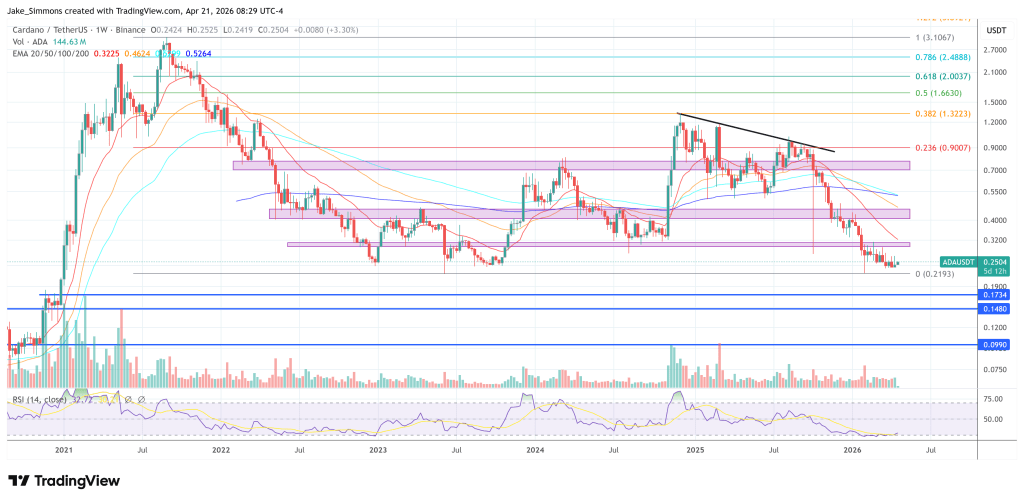
Cardano hovers below key resistance, 1-monthly chart | Source: ADAUSDT on TradingView.com

相关问答

QWhat did Charles Hoskinson argue was the broader warning exposed by the KelpDAO exploit?

AHe argued that the exploit was a broader warning about how Ethereum's restaking, cross-chain messaging, and lending stack can turn a single compromise into system-wide contagion.

QAccording to Hoskinson, what was the specific technical failure that led to the KelpDAO exploit?

AThe failure was a cross-chain message forgery that was accepted as legitimate, not a smart contract issue with KelpDAO or LayerZero.

QWhat dangerous design choice did Hoskinson specifically criticize in the system's setup?

AHe criticized the use of a one-of-one verifier configuration, arguing that a multi-verifier model (like three-of-five) is a best practice to avoid a single point of failure.

QHow did the attacker allegedly use the stolen rsETH to create a wider contagion in the DeFi ecosystem?

AInstead of dumping it, the attacker used the stolen rsETH as collateral in lending markets to borrow more liquid assets, which turned the exploit into a balance-sheet problem and created bad debt contagion for other protocols.

QWhat was the estimated total value locked (TVL) that was pulled from protocols following the hack, according to Hoskinson's account?

AApproximately $13 billion of TVL was pulled in a very short period of time following the $290 million hack.

你可能也喜欢

解读Agent商业、支付与基础设施的真相

作者基于一年来为Agent经济构建基础设施的经验,指出当前Agent商业尚未形成真实、规模化的市场需求,初创公司面临结构性挑战。 文章分析了四个关键场景: 1. **Agent对商户**:目前电商体验中,聊天界面在视觉比价购物上逊于传统界面,商户接入多出于防御性“优化”心态。对话式商业在如外卖等高頻、低决策场景有潜力,但受限于平台开放性和成本。 2. **Agent对API**:开发者现有支付方式(如预付)已能处理低频、小额的API调用成本问题。真正的机会在于服务长尾、小众的供应商市场,但规模有限。 3. **Agent对Agent**:这是长期的愿景,涉及机器间的自动交易与结算,需求真实但当前市场几乎为零,需要专用的基础设施。 4. **Agent对金融**:这是唯一存在现成需求和付费客户的领域。将AI嵌入金融工作流是自然演进,但竞争激烈,老牌机构优势明显。 文章认为,行业巨头因资金充足和战略防御而持续投入,但对初创公司而言,真正的机会并非单纯构建支付层。支付只是更宏大问题——**Agent与人类的协同工作、验证与结算**——的一部分。未来,解决协同问题的公司将主导市场,而非支付服务商。作者团队已转向一个存在真实需求、快速增长且未被充分服务的领域。

marsbit16分钟前

解读Agent商业、支付与基础设施的真相

marsbit16分钟前

Kalshi、MTS 与 a16z 的野望

本文探讨了预测市场在2025年成为投资、加密和媒体领域共同关注焦点的现象,并着重分析了其精神内核的演变及其与风投机构a16z所倡导的“新媒体”愿景的契合。 文章首先回顾了预测市场的思想渊源:从哈耶克关于市场作为分散知识协调机制的观点,到罗宾·汉森设计对数市场评分规则(LMSR)以激励信息真实披露,乃至衍生出的“未来统治”(Futarchy)治理乌托邦构想。 然而,作者指出,a16z在2024-2025年投资估值飙升的预测市场平台Kalshi,为此领域注入了新的精神内涵——“在场感”。在人们与现实世界日益疏离的后现代语境下,预测市场提供了一种通过真金白银下注来介入和“预测”未来的方式,使用户从被动观察者转变为主动的“超级观察者”,从而对抗不确定性与无力感。当足够多人使用并依赖这种媒介时,市场本身将对事件的真实性与重要性获得解释权,这正是a16z构建新媒体帝国的关键拼图。 最后,文章以媒体公司MTS为例,说明a16z的“新媒体”是一种全频段、高烈度的信息工程,旨在“接管时间线”。而Kalshi的核心价值在于,它通过真实的交易数据构建了一种强大的“现实扭曲力场”,其显示的市场概率能深刻影响公众认知与判断,这种赋予私营公司的社会影响力是其获得高估值的根本原因。

链捕手16分钟前

Kalshi、MTS 与 a16z 的野望

链捕手16分钟前

交易

现货
合约

热门文章

如何购买S

欢迎来到HTX.com!我们已经让购买Sonic(S)变得简单而便捷。跟随我们的逐步指南,放心开始您的加密货币之旅。第一步:创建您的HTX账户使用您的电子邮件、手机号码注册一个免费账户在HTX上。体验无忧的注册过程并解锁所有平台功能。立即注册第二步:前往买币页面,选择您的支付方式信用卡/借记卡购买:使用您的Visa或Mastercard即时购买Sonic(S)。余额购买:使用您HTX账户余额中的资金进行无缝交易。第三方购买:探索诸如Google Pay或Apple Pay等流行支付方法以增加便利性。C2C购买:在HTX平台上直接与其他用户交易。HTX场外交易台(OTC)购买:为大量交易者提供个性化服务和竞争性汇率。第三步:存储您的Sonic(S)购买完您的Sonic(S)后,将其存储在您的HTX账户钱包中。您也可以通过区块链转账将其发送到其他地方或者用于交易其他加密货币。第四步:交易Sonic(S)在HTX的现货市场轻松交易Sonic(S)。访问您的账户,选择您的交易对,执行您的交易,并实时监控。HTX为初学者和经验丰富的交易者提供了友好的用户体验。

2.5k人学过发布于 2025.01.15更新于 2026.06.02

如何购买S

相关讨论

欢迎来到HTX社区。在这里,您可以了解最新的平台发展动态并获得专业的市场意见。以下是用户对S(S)币价的意见。

活动图片