Behind the Rejection of the $17M CRV Grant: Founder's Proposal Power Weakened, Convex and Yearn Become Key Players

marsbit发布于2025-12-25更新于2025-12-25

文章摘要

A proposal to grant 17 million CRV tokens (worth approximately $1.7 million) to Swiss Stake AG, a long-time core development team, was rejected in a Curve Finance governance vote. Major veCRV holders, including Convex and Yearn, voted against it, wielding enough voting power to determine the outcome. The rejection reflects two key shifts in DAO governance: First, communities are demanding greater accountability, transparency, and measurable results for treasury grants, moving beyond unconditional funding. Second, large veCRV holders, motivated by self-interest, are resistant to proposals that dilute their token value without clear, foreseeable benefits to them. The incident highlights the evolving power dynamics within Curve's governance. The veToken model, which ties voting rights to long-term locked capital, inherently concentrates power among large, capital-rich entities like Convex and Yearn. As users delegate their tokens to these protocols for yield and liquidity, governance is increasingly shifting from founders and communities to a form of "governance capitalism" dominated by major stakeholders.

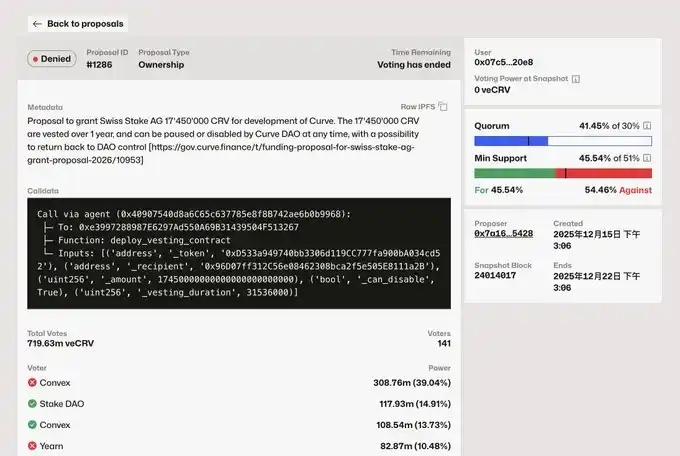
A few days ago, a funding proposal on Curve was rejected, which involved allocating 17M $CRV to the development team (Swiss Stake AG) for development expenses. Both Convex and Yearn voted against it, and their voting power was sufficient to influence the final outcome.

Since the Aave governance issue began to gain attention, governance has started to be scrutinized by the market, and the habit of approving funding requests without question is being broken. This Curve proposal highlights two key points:

1. Some voices in the community are not opposed to funding AG, but they want clarity on how previous funds were used, how future funds will be utilized, whether the approach is sustainable, and whether it has generated returns for the project. At the same time, this overly simplistic grant model lacks accountability once funds are disbursed. In the future, the DAO needs to establish a Treasury, ensure transparency in income and expenditures, or add governance constraints.

2. The major veCRV holders do not want to dilute their value. This is a clear conflict of interest. If the projects supported by CRV grants cannot foreseeably benefit veCRV holders, they are unlikely to gain support. Of course, Convex and Yearn also have their own agendas and influence, but that’s a separate issue.

This proposal was initiated by Curve founder Mich. AG is one of the teams that has been maintaining the core codebase since 2020. The roadmap presented by AG for this funding includes advancing llamalend, supporting PT and LP, as well as expanding the on-chain foreign exchange market and crvUSD. These seem like worthwhile initiatives, but whether they justify a 17M $CRV grant is another calculation. Particularly, Curve’s governance differs significantly from Aave’s, with power distributed among several teams with distinct stances.

Comparing ve with conventional governance models:

First, the conclusion: most conventional governance models, by design, have little to no advantage. Of course, if a DAO is mature enough, traditional structures can function well, but unfortunately, no crypto project has reached that level of maturity yet, as even market-consensus leaders like Aave have encountered issues.

If we focus solely on model design, ve has some advanced aspects. Firstly, it generates cash flow and is backed by liquidity control rights. When there is external demand for liquidity, this power is subject to bribes. So even if you don’t want to lock your tokens long-term, you can delegate them to proxy projects like Convex/Yearn to earn yields.

Thus, ve is a model where voting rights are tied to cash flow. Its future evolution will likely follow the path of “governance capitalism.” Vetoken binds voting rights with “long-term locking,” essentially筛选 those with large capital, ability to bear liquidity loss, and capacity for long-term博弈. Over time, this means governance will shift from ordinary users to “capital groups.”

At the same time, due to the presence of proxy layers like Convex/Yearn, many ordinary users, even loyal ones, who want to retain liquidity and flexibility while earning yields, will gradually choose to delegate their governance to these projects.

This vote also offers some insight: in the future, Mich may not be the key player in Curve’s governance; instead, power lies with these major token holders. When Aave faced governance issues, some proposed the idea of “delegated governance/elite governance,” which is quite similar to Curve’s current structure. As for whether this is good or bad, only time will tell.
热门币种推荐

相关问答

QWhy was the proposal to grant 17M $CRV to the development team Swiss Stake AG rejected by the Curve community?

AThe proposal was rejected primarily because major veCRV holders, such as Convex and Yearn, voted against it. They were concerned about the dilution of their token value and the lack of transparency and accountability regarding the use of funds. The community also demanded clearer details on past fund usage, future plans, and measurable benefits to the project before approving such a grant.

QWhat are the key concerns raised by the Curve community regarding grant proposals like this one?

AThe community emphasized the need for transparency in treasury management, including clear reporting on how funds are used and how they generate value for the project. They also called for sustainable and constrained grant models rather than unconditional funding, ensuring that grants align with the long-term interests of veCRV holders and the ecosystem.

QHow does Curve's ve token model differ from traditional governance models in crypto?

ACurve's ve (vote-escrowed) model binds voting rights to long-term token lockups, creating a system where governance power is coupled with financial incentives like yield and bribes. This contrasts with traditional governance models, which often lack built-in economic alignment. The ve model tends to concentrate governance influence among large, long-term capital providers rather than ordinary users.

QWhat role do Convex and Yearn play in Curve's governance structure?

AConvex and Yearn act as major vote aggregators in Curve's governance by accumulating veCRV tokens from users who delegate to them. They wield significant voting power, often enough to sway governance outcomes, as seen in the rejection of the 17M $CRV grant proposal. Their influence highlights the shift toward 'governance capitalism,' where large capital entities dominate decision-making.

QWhat does the rejection of this proposal indicate about the future of Curve's governance?

AThe rejection signals that Curve's governance is increasingly dominated by large veCRV holders and proxy platforms like Convex and Yearn, rather than individual founders or small stakeholders. This reflects a broader trend toward capital-driven governance, where decisions are made based on economic incentives and long-term value preservation for major stakeholders.

你可能也喜欢

华尔街点评美联储 6 月会议纪要:核心看通胀,短期无加息紧迫性

美联储6月会议纪要显示,全体与会者支持维持当前利率不变。尽管市场最初担忧纪要偏鹰,但华尔街三大机构(高盛、摩根士丹利、花旗)普遍解读为边际偏鸽,认为短期内没有加息的紧迫性。 纪要的核心信号是:政策走向完全取决于未来通胀数据。高盛指出,若通胀能很快回落,几乎所有官员支持维持或降息;若通胀因AI需求、地缘冲突等因素持续高企,则可能需要一定程度政策收紧。摩根士丹利强调,纪要中“少数”官员认为有加息理由,但并非倾向于立即行动,目前仍满意于按兵不动。 官员们暂不急于加息的原因在于:通胀预期仍与2%目标路径相符,且劳动力市场目前不被视为通胀主要来源。花旗认为,近期就业数据疲软进一步削弱了通胀担忧。摩根士丹利指出,若未来几个月通胀数据显示压力消退,美联储将继续保持耐心;若通胀顽固,可能仅加息50-75个基点进行“政策校准”,而非开启全面加息周期。 机构预测方面,摩根士丹利预计今年利率不变,2027年或之后降息两次;高盛基准情景为2026年全年按兵不动;花旗则相对鸽派,预计今年10月、12月及2027年1月各降息25个基点。总体而言,美联储政策仍坚持数据驱动,未出现制度性转变。

marsbit25分钟前

华尔街点评美联储 6 月会议纪要:核心看通胀,短期无加息紧迫性

marsbit25分钟前

交易

现货

热门文章

如何购买S

欢迎来到HTX.com!我们已经让购买Sonic(S)变得简单而便捷。跟随我们的逐步指南,放心开始您的加密货币之旅。第一步:创建您的HTX账户使用您的电子邮件、手机号码注册一个免费账户在HTX上。体验无忧的注册过程并解锁所有平台功能。立即注册第二步:前往买币页面,选择您的支付方式信用卡/借记卡购买:使用您的Visa或Mastercard即时购买Sonic(S)。余额购买:使用您HTX账户余额中的资金进行无缝交易。第三方购买:探索诸如Google Pay或Apple Pay等流行支付方法以增加便利性。C2C购买:在HTX平台上直接与其他用户交易。HTX场外交易台(OTC)购买:为大量交易者提供个性化服务和竞争性汇率。第三步:存储您的Sonic(S)购买完您的Sonic(S)后,将其存储在您的HTX账户钱包中。您也可以通过区块链转账将其发送到其他地方或者用于交易其他加密货币。第四步:交易Sonic(S)在HTX的现货市场轻松交易Sonic(S)。访问您的账户,选择您的交易对,执行您的交易,并实时监控。HTX为初学者和经验丰富的交易者提供了友好的用户体验。

2.8k人学过发布于 2025.01.15更新于 2026.06.02

如何购买S

相关讨论

欢迎来到HTX社区。在这里,您可以了解最新的平台发展动态并获得专业的市场意见。以下是用户对S(S)币价的意见。

活动图片