Abstract
This week, we focus on the following events: 1) Reddit Launches Polygon-Based 'Collectible Avatar' Marketplace; 2) TON Foundation Sets Up US$90M Ecosystem Fund; 3) US Restricts Officials Holding Crypto From Policy Making; ______________________________________________________________________________
Project Analysis: On June 30, the Decentral Bank announced USN v2.0 which is an update version of USN v1.0. The Decentral Bank aims to create a stablecoin that is “truly stable, which can withstand a bear and thrive in a bull.” The following report will analyze what changes have been made for USN v2.0.
1. Industry overview
I. Overall market trend
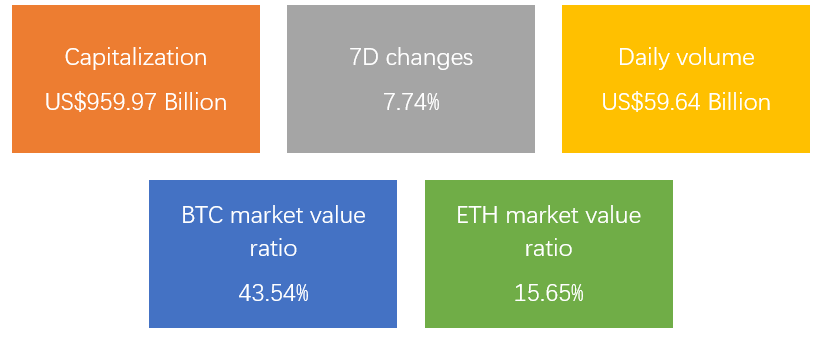
Figure 1. Overall market data
Source: CoinMarketCap
Prices of cryptocurrencies have been trending upwards in the past week, continuing the trend from the week before that. Bitcoin is officially price at over US$22,000 this week, and currently at $22,095, which indicates a sign of recovery. Ethereum also had a good week, going higher from US$1,052 all the way to US$1,256. Some meme coins are experiencing a large-scale drop while major market indicators are showing upward trends.
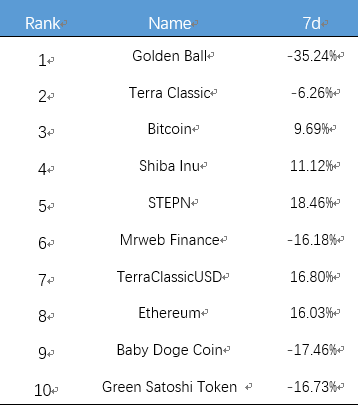
Table 1. Last week's hot currencies
Source: CoinMarketCap
Crypto prices have correlated increasingly to equity markets, which also rose on Thursday, with the tech-focused Nasdaq jumping more than 2% and the S&P 500 and Dow Jones Industrial Average each climbing by more than a percentage point, according to Coindesk. It is not clear whether this is a sign of complete recovery or a short-term surge, as the market consensus considers the current situation a bear market. The crypto market still faces pressure from supervision, ongoing inflation, and interest rate rise. Russia and Britain still have ambiguous attitude toward crypto assets, and unstable war and financial situations have resulted in a crypto market crisis and opportunity at the same time, because digital assets can either be seen as safe-haven assets or trigger greater supervision pressure.
II.NFT
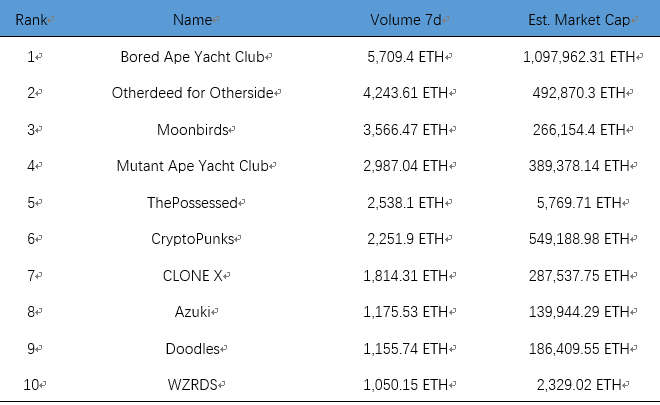
Table 2. NFT Collections Listed By Sales Volume (7d)
Source: CoinMarketCap
The NFT market last week experienced a major decrease in market cap, while sales volume and total sales remained unchanged. Amongst the top collections, the different NFT projects have experienced little change as most of the volume and average prices changed less than 0.1% compared to last week. While the top 10 collections (according to weekly volume) changed, collection prices remained steady. The top collections like BAYC, ENS, and Otherdeed have a slowly rising market cap, while volumes fluctuated greatly.
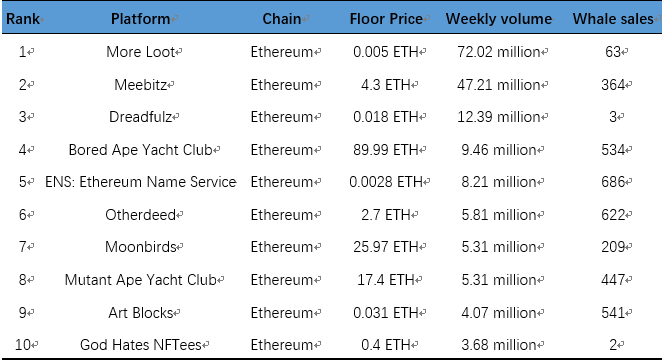
Table 3. Top trending collections on NFTGO (by weekly volume)
Source: NFTGO
III.DeFi
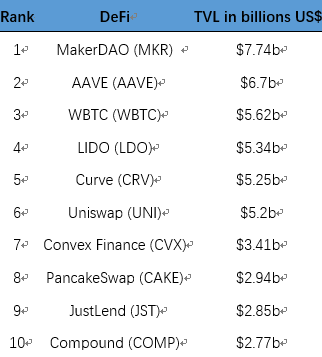
Table 4. DeFi market TVL ranking
Source: DefiLlama
IV.Layer 2
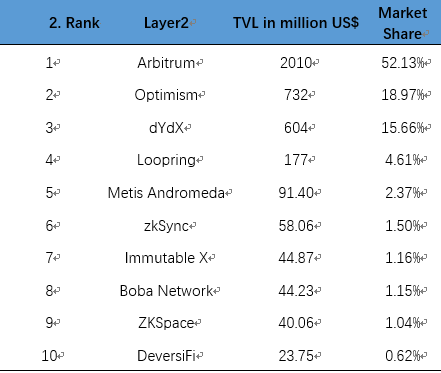
Table 5. Layer2 protocols ranking and market share
Source: l2beat
2. Market news (Sources: Coindesk, Odaily, Jinse Finance, CoinGape, Coingeek, PR Newswire)
I. Industry news
Reddit Launches Polygon-Based 'Collectible Avatar' Marketplace
Social network Reddit's Polygon-based collectible avatar marketplace – allowing users to purchase blockchain-based profile pictures for a fixed rate – is open for business, the company said Thursday.
“Collectible avatars are backed by blockchain technology, giving purchasers rights (a license) to use the art – on and off Reddit,” the company said. The avatars can be stored and managed on Reddit’s own blockchain wallet, Vault, which is currently used to earn blockchain-based community points which can be spent on in-app features such as badges.
Celsius Sends US$500M of Bitcoin Derivative to Crypto Exchange After Debt Payoff
Beleaguered crypto lender Celsius deposited US$500 million in wrapped bitcoin (WBTC), a bitcoin derivative product of the Ethereum blockchain, to crypto exchange FTX just hours after Celsius repaid its debt to the decentralized lending protocol Maker and reclaimed US$450 million of collateral in WBTC. Blockchain transaction data shared by blockchain data firm Nansen shows that a wallet linked to Celsius sent 24,463 WBTC to FTX in various steps.
Shiba Inu Plans to Launch Stablecoin, Reward Token, Collectible Card Game
A lead developer behind popular meme cryptocurrency SHIB on Wednesday teased plans to expand the Shiba Inu ecosystem with a decentralized stablecoin, a reward token called TREAT as well as a collectible card game for its metaverse. In a Medium blog post, pseudonymous developer Shytoshi Kusama said that "independent developers" are crafting a decentralized stablecoin called SHI, which "seems to avoid the issues found in other moonshots" – a likely reference to the billion-dollar Terra/Luna implosion. The team expects to share more information when SHI gets closer to its final form, and plans to launch later in 2022, the blog post said.
II. Investment and Financing
TON Foundation Sets Up US$90M Ecosystem Fund
The stewards of the TON Foundation have set up a new US$90 million ecosystem fund, continuing its recent attempts to get the Telegram-founded blockchain project back into gear. TON is a proof-of-stake blockchain originally created by Telegram in 2017, but was shut down by the messaging app in August 2020 following legal action from the U.S. Securities and Exchange Commission (SEC) alleging that it had run an unregistered securities sale.
Animoca Brands Leads US$32M Funding Round for Planetarium Labs
Planetarium Labs, which is building a community-driven Web3 game network, has raised US$32 million in a Series A funding round led by Animoca Brands. The investment will be used to help Planetarium Labs build out its network with tools for gaming and player governance, according to co-founder and CEO Kijun Seo and CoinDesk. Other investors in the round included Samsung Next and Planetarium partners Krust Universe, the investment arm of South Korean tech giant Kakao, and WeMade, the publisher of play-to-earn game Mir4.
New Crypto Pptions and Futures Exchange 'Thalex' closes Series A Funding Round
Thalex, a trading platform offering stablecoin-settled crypto options and futures, announced it has closed its Series A funding round of EUR 7.5 million. Among the participants are Bitfinex, Bitstamp, Flow Traders, IMC, QCP and Wintermute. These strategic investors will support the company's ambition to enable on-exchange trading of crypto derivatives at scale by removing friction, ensuring platform reliability; and partnering with liquidity providers and major exchanges.
III. Supervision
US Restricts Officials Holding Crypto From Policy Making
US Government’s Ethics Chief mentioned that officials holding digital assets will be restricted from guiding President Joe Biden over crypto related policies. As per the release from their office, any US govt employee holding any amount of crypto or stablecoins as a personal investment is barred from participating in any matter related to such policies. It added that the employee may know that any particular matter could have a predictable or direct effect on the worth of their holdings.
US Treasury Develops 'Framework' for International Crypto Regulation
The U.S. Treasury Department published a fact sheet Thursday outlining how it could work with foreign regulators to address the cryptocurrency sector.The fact sheet, which is the first report published by the department as a result of U.S. President Joe Biden's executive order on crypto, said the framework "is intended to ensure that ... America's core democratic values are respected," pointing to consumer, investor and business protection, the safety of the global financial system and interoperability.
Central African Republic launches official digital currency ‘Sango Coin’
The Central African Republic’s (CAR) adoption of digital assets and blockchain technology continues to gain new grounds. The country has introduced a national digital currency called “Sango Coin” that will complement its digital currency hub project—Project Sango. CAR President Faustin-Archange Touadéra announced Sango Coin during the Sango Genesis Event, a virtual event launching Project Sango. According to Touadéra, Sango Coin will be the next-generation currency for the country and will be a gateway to the country’s natural resources.
3. Trending project analysis – USN v2.0
On June 30, Decentral Bank, a decentralized autonomous organization (DAO), announced USN version 2 (v2.0) update of their current system. Its goal is to create a stablecoin that is “truly stable, which can withstand a bear and thrive in a bull.”
I. USN v1.0
Previously, the main stabilization mechanism of USN v1.0 exploited an arbitrage smart contract that allowed for the exchange of NEAR and USN so that in any circumstance, 1 USN can be traded for US$1 of NEAR, and US$1 of NEAR could be traded for 1 USN.
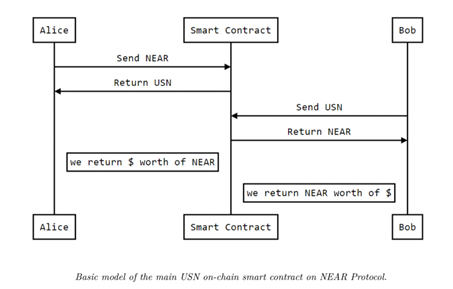
Figure 1 : Basic model of the main USN on-chain smart contract on NEAR Protocol
Source: USN v1.0 white paper
The Decentral Bank created USN and maintains stability based on two principles: initial double-collateralization and automatic rebalancing of the Reserve Fund.
Initial double-collateralization
The Reserve Fund of USN stablecoin was the core of this project. The Decentral Bank believes an overcollaterallized stablecoin is the best kind of stablecoin to maintain its stability, as USN can be bought back from the reserve in extreme cases. Specifically, they started the Reserve Fund with US$1 billion worth of USDT. The initial double collateralization of USN in the Reserve Fund – with both the NEAR and other stablecoin amounts each equal to the total amount of initially issued USN – guarantees “ultimate liquidity” of USN by means of the Reserve Fund, both initially and further down the line. Since Decentral Bank has constructed a model where the issuer will always be able to buy back the entire issuance of USN even during extreme scenarios of “panic sale” or “death spiral,” it ensures that the ratio between backed assets and issued USN is at least 100%.
Automatic rebalancing of the Reserve Fund
Treasury Management processes were automated using smart contracts deployed on the NEAR Protocol. The Decentral Bank implemented automatic rebalancing of the Reserve Fund as a part of the Treasury Management activity. For example, given the decentralized nature and frequency of transactions in cryptocurrency markets, Decentral Bank performed very frequent, dynamically configurable, nearly real-time small-volume transactions to avoid any severe imbalances in the Reserve Fund. Figure 2 below shows how it works in real-life.
Figure 2 : Examples about automatic rebalancing of the Reserve Fund
Source: USN v1.0 white paper
This system helped the Decentral Bank maintain its peg and collaterlization during the May 21 crash.
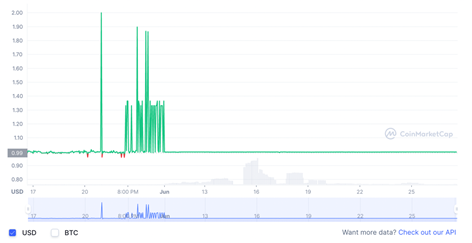
Figure 3 : Market price of USN to USD
Source: CoinMarketCap
However, due to recent events, such as the death spiral of UST, the pain level is extremely high. In the previous report published by Huobi Research, the pain level is calculated according to the formula below:
Pain Level = ($Top_marketcap — $price * circ_supply)* btc_amount_in_loss/ circ_supply * (address balance>0.1 BTC / address balance>0.01 BTC) * (1/Entity-Adjusted Dormancy Flow)
The result shows that the pain crypto market players are currently experiencing has only occurred 3 times across the entire lifetime of the crypto market.
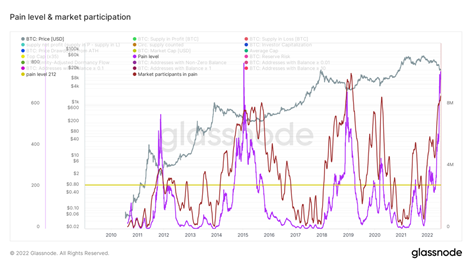
Figure 4 : Pain level indicator
Source: Data built by Huobi Research
The Decentral Bank team conducted more sophisticated and aggressive simulations, and it found that "given the uncertainty around how long this bear market will last and the selling pressure induced by tightening macro conditions, v1.0 could, potentially, pose a risk that $USN could become undercollateralized from sustained volatility of the NEAR price." In order to eliminate the risk, the Decentral Bank redesigned USN to adapt the current market condition.
II. USN v2.0
USN v2.0 will be going through two phases and be a more flexible model that can adapt to any market condition. It starts with a 1:1 backing of primarily stable assets with a sustainable, native yield from NEAR staking rewards; and then reintroduces non-stablecoin assets as collateral in the future.
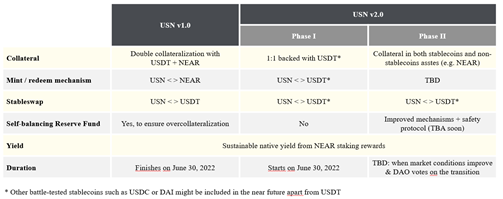
Figure 5 : Comparison between USN v1.0 and USN v2.0
Source: The Decentral Bank’s Twitter
Phase I
Unlike USN v1.0 overcollateralized with USDT and NEAR, USN v2.0 will be 1:1 backed with USDT. Users can mint and redeem USN only with USDT. Starting from June 30, users can find that on the contract level, as well as the Decentral Bank swap page, Ref Finance, and Sender wallet, the on-chain arbitrage mechanism becomes USDT and USN from NEAR and USN.
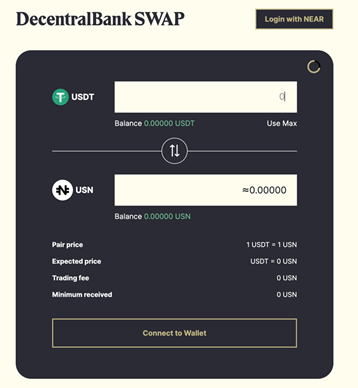
Figure 6 : DecentralBank SWAP USDT and USN
Source: Decentral-bank.finance
Meanwhile, the NEAR in the Reserve Fund from USN v1.0 and other grants may be staked to generate a native USN yield. Beginning with Phase I, US$1 million USN per month may be distributed through Ref Finance during July 2022 and August 2022. The risk of undercollateralization posed by NEAR's volatility during bear markets has been radically reduced.
Phase II
As market conditions recover, the Decentral Bank may vote to transition to Phase II, where non-stablecoin assets will be reintroduced to mint and redeem USN . Starting with NEAR, USN v2.0 will generate greater yield in the bull market condition, as more NEAR is used to mint USN. Furthermore, the Decentral Bank said it might use a basket of market-leading stablecoins as its underlying collateral, including USDT, USDC and DAI. The full structure of Phase II will be detailed in the USN whitepaper about v2.0.
4. Calendar of future popular asset events
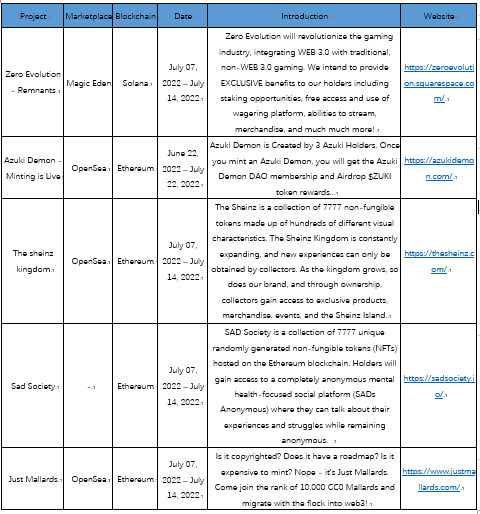
I. NTF mint Calendar
II. Token Airdrops