Ripple Pays Hackers To Attack The XRP Ledger’s New DeFi Lending Protocol

bitcoinist发布于2025-10-14更新于2025-10-14

文章摘要

RippleX has put a sharp point on its “institutional DeFi” roadmap by inviting the security community to actively break the...

Trusted Editorial content, reviewed by leading industry experts and seasoned editors. Ad Disclosure

RippleX has put a sharp point on its “institutional DeFi” roadmap by inviting the security community to actively break the XRP Ledger’s forthcoming lending stack—before it ships. In a coordinated program with Immunefi, the company unveiled a $200,000 “Attackathon” aimed at hardening the proposed XRPL Lending Protocol, a ledger-native system for fixed-term, uncollateralized credit governed by the emerging XLS-66 standard.

“We are collaborating with @immunefi to prepare a $200K Attackathon to test and strengthen the proposed XRP Ledger Lending Protocol,” RippleX wrote on X on October 13, adding that the competition focuses on “more than 35K lines of C++ code” and is paired with an educational track to onboard researchers to XRPL specifics.

Immunefi posted via X: “We’ve partnered with RippleX to launch a $200,000 Attackathon helping secure the proposed XRPL Lending Protocol. This is a time-boxed, adversarial competition to identify vulnerabilities before the protocol reaches production.”

Ripple Invites Hackers to Test the XRP Ledger

The Attackathon is preceded by an “XRPL Attackathon Academy” that Immunefi says provides ledger-specific walkthroughs, Devnet guides, test environments and a C++ curriculum, plus direct access to Ripple engineers during the education window.

The program’s core pool totals $200,000, with flat distribution rules and performance bonuses. The most consequential result is binary: if even one valid critical vulnerability is found, the full pool unlocks; if not, a $30,000 fallback is split among researchers who nonetheless submit valid insights.

Immunefi’s public brief also names the primary, in-scope components targeted by researchers, including XLS-66 (Lending Protocol), XLS-65 (Single-Asset Vaults), XLS-33 (Multi-Purpose Tokens), XLS-70 (Credentials), XLS-77 (Deepfreeze), and XLS-80 (Permissioned Domains)—a window into how Ripple envisions lending, liquidity, identity/permissions, and asset controls interlocking at the base layer.

Immunefi’s launch blog lists the education period as October 13–27 and the Attackathon as October 27–November 29, 2025. The Academy page further specifies rewards paid in RLUSD, Ripple’s dollar-pegged stablecoin, and confirms that Immunefi will triage reports and require KYC.

Ripple has been telegraphing this architecture throughout September, positioning XLS-65 and XLS-66 as the nucleus of an institutional credit market built into the ledger, rather than stitched on via external smart contracts. The company’s own technical brief describes pooled lending, on-chain enforcement and underwritten, off-chain credit evaluation, while adjacent standards—Permissioned Domains, Deepfreeze and Credentials—are designed to map compliance, recoverability and identity controls to ledger-native primitives.

The security-first rollout reflects a broader industry shift toward pre-production “offense testing” on non-EVM codebases and at-protocol designs, where conventional smart-contract bug classes don’t always apply. Immunefi’s brief makes clear what matters most for the XRPL stack: anything that compromises fund security or vault solvency, misrepresents interest accrual or debt, subverts clawback/freeze semantics, manipulates administrative records, or bypasses permissioned access controls.

Those priorities map directly to the design’s claim to avoid wrapped assets and third-party contracts, meaning the bounty effectively challenges researchers to find ledger-level logic flaws rather than Solidity-style pitfalls. “This program is a time-boxed, adversarial competition, where security researchers dive into the code to ensure the protocol has the strongest possible security posture, surfacing vulnerabilities before they reach production,” Immunefi wrote.

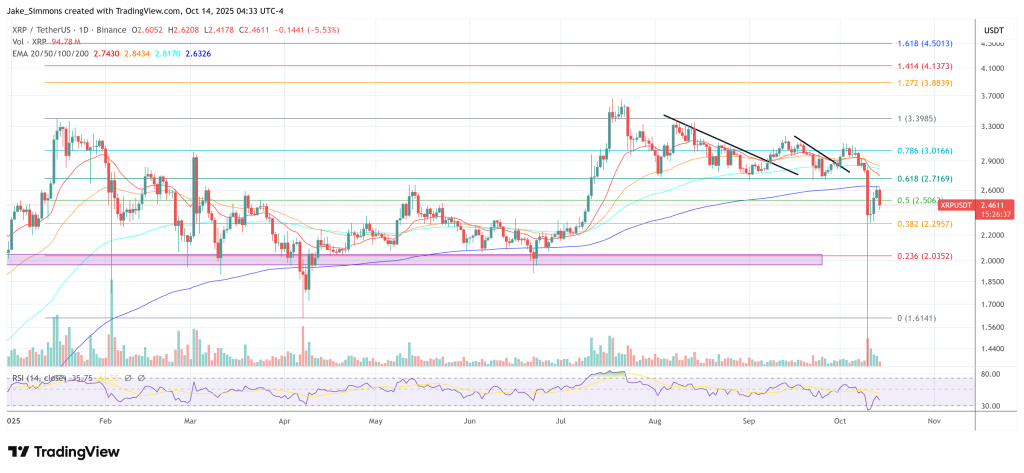
At press time, XRP traded at $2.46.
XRP price
XRP faces the EMA200, 1-day chart | Source: XRPUSDT on TradingView.com
Featured image created with DALL.E, chart from TradingView.com
Editorial Process for bitcoinist is centered on delivering thoroughly researched, accurate, and unbiased content. We uphold strict sourcing standards, and each page undergoes diligent review by our team of top technology experts and seasoned editors. This process ensures the integrity, relevance, and value of our content for our readers.

Jake Simmons has been a Bitcoin enthusiast since 2016. Ever since he heard about Bitcoin, he has been studying the topic every day and trying to share his knowledge with others. His goal is to contribute to Bitcoin's financial revolution, which will replace the fiat money system. Besides BTC and crypto, Jake studied Business Informatics at a university. After graduation in 2017, he has been working in the blockchain and crypto sector. You can follow Jake on Twitter at @realJakeSimmons.

你可能也喜欢

Sharplink CEO:现在清仓ETH,就像互联网泡沫时卖掉亚马逊

本文是对Sharplink CEO Joseph Chalom文章《Ethereum Going Back on Offense》的编译与摘要。针对近期以太坊社区因Bankless联创清仓ETH引发的悲观情绪,Chalom以资深金融从业者(前贝莱德高管)和大型ETH持仓公司CEO的身份,试图提振市场信心,并提出不同视角。 Chalom的核心观点如下: 1. **以太坊基本面坚实**:他认为当前市场争议是噪音,以太坊在信任、安全和流动性上已遥遥领先,处理着全球主要稳定币结算和大部分代币化资产,这是以太坊基金会(EF)长期专注核心协议开发(如The Merge、EIP-1559等重大升级)的结果。 2. **去中心化是优势,非缺陷**:EF专注协议安全与去中心化,这正是机构信任的基础。以太坊的可信中立性是其成为未来金融结算层的核心,不应被视作弱点。 3. **将ETH类比互联网泡沫时的亚马逊**:他认为当前市场低估了ETH,就像当年市场只关注亚马逊亏损而忽视其重塑零售和云计算的愿景。以太坊的目标市场是全球金融体系,其价值将随网络处理稳定币、RWA、DeFi等交易量的爆发性增长而提升。 4. **建议逆向投资**:他指出市场极度恐惧时(恐惧与贪婪指数为证),正是纪律资本布局优质资产的良机,应学习巴菲特和贝莱德在危机中逆势投资的智慧。 5. **呼吁生态积极发声**:Chalom承认以太坊在市场推广层面存在领导力问题,并呼吁Sharplink等生态利益相关者更积极地构建叙事、推动机构采用。他透露Sharplink已质押数十亿美元ETH,并投资DeFi协议及成立相关基金。 文末,Chalom总结道:以太坊的未来正在此刻发生,EF正回归其核心职责(专注于CROPS框架,即审查阻力、开放性、隐私和安全),而生态需共同推动机构采用的超级周期。

marsbit1小时前

Sharplink CEO:现在清仓ETH,就像互联网泡沫时卖掉亚马逊

marsbit1小时前

交易

现货
合约

热门文章

什么是 XRP 2.0

XRP 2.0:加密货币领域的新前沿 XRP 2.0 简介 在不断演变的加密货币领域,各种新项目不断涌现,争夺关注和采用。其中一个颇具前景的倡议是 XRP 2.0,这是一个旨在利用先进区块链技术和强大加密方法的新型加密货币项目。尽管其名称与 Ripple 的 XRP 存在一定的相似性,但必须指出的是,XRP 2.0 独立运营,专注于提升交易安全性、隐私和可扩展性。随着数字金融领域越来越多地采用去中心化解决方案,XRP 2.0 旨在为 web3 和加密项目的整体扩展做出重要贡献。 XRP 2.0 是什么? 从根本上说,XRP 2.0 是一个旨在创建安全、去中心化数字货币生态系统的加密货币项目。其基础技术将复杂的区块链原理与前沿的加密技术相结合。XRP 2.0 的总体目标是建立一个可靠、高效的平台,以实现快速的交易执行,同时优先考虑用户的隐私保护。 该项目被宣传为克服现有加密货币面临的许多局限的解决方案,提出了一个可以处理更高交易量且速度和隐私得到改善的系统。这种多功能性使 XRP 2.0 在充满各种数字货币的市场中成为一个重要竞争者。 XRP 2.0 的创造者是谁? XRP 2.0 的创建者被标记为“Wilbur”。然而,关于 Wilbur 或其相关实体的详细信息仍然难以捉摸。许多加密货币创造者的匿名性在行业中并不少见,通常旨在保持一定程度的隐私和安全。 XRP 2.0 的投资者是谁? 目前,有关支持 XRP 2.0 的投资基础或组织的具体信息尚未公开。在加密货币领域,知名投资者的支持可以显著影响项目的可信度和成功,但关于 XRP 2.0 财务支持者的透明度尚未建立。 XRP 2.0 如何运作? XRP 2.0 的一个亮点是采用了区块链技术与先进加密算法的结合,以确保安全和去中心化的交易。其创新结构包括旨在促进用户参与和拓宽功能的独特特性,超越了传统加密货币交易。 在这些特性中,XRP 2.0 集成了 AI 驱动的能力,如文本转图像和文本转语音功能。这些添加旨在增强用户的交互体验,促进在各个行业中更广泛的应用。通过将技术进步与以用户为中心的设计相结合,XRP 2.0 旨在吸引寻求将加密货币解决方案融入其运营框架的多样化个体和企业的注意。 XRP 2.0 时间线 要理解 XRP 2.0,就需要审视定义其迄今为止旅程的里程碑: 2023年7月23日:XRP 2.0 作为一个新型加密货币项目被推出,旨在革新区块链领域的安全和去中心化交易能力。 2023年9月8日:另一个项目 XRP20 启动,这标志着在以太坊区块链上出现一个与 XRP 2.0 无关的 ERC-20 代币。 2023年11月13日:XRP 分类账经历重大更新,发布了 rippled 服务器软件版本 2.0.0。值得注意的是,此发展与 XRP 2.0 加密货币项目无关。 XRP 2.0 的关键点 要提炼出 XRP 2.0 的本质,有几个关键因素浮现: 独特特性:诸如 AI 驱动的文本转图像和文本转语音的功能进一步丰富了 XRP 2.0 的潜在应用。 区块链技术:该框架利用先进的区块链机制和加密协议,确保交易的安全和去中心化环境。 可扩展性和隐私:XRP 2.0 优先考虑交易过程中的增强隐私保护以及满足日益增长的用户基础所需的可扩展性。 与 Ripple 无关:重要的是,尽管名称相似,XRP 2.0 与 Ripple 的 XRP 并无任何忠诚或合作关系,区分了其在加密货币生态系统中的运营框架和目标。 结论 XRP 2.0 代表了在加密货币领域的一项雄心勃勃的探索,旨在在数字交易中提供安全、隐私和效率的结合。通过集成复杂技术和用户友好的功能,该项目希望拓宽加密货币在当今数字经济中所能实现的可能性。 尽管其创造者的匿名性和缺乏公开投资者的信息可能引起一些人的疑问,但 XRP 2.0 对先进功能和去中心化的关注增强了它在日益拥挤的加密市场中的吸引力。随着加密货币领域的持续演变,XRP 2.0 可能会成为安全和可扩展区块链解决方案扩展的关键参与者。

163人学过发布于 2024.04.01更新于 2024.12.03

什么是 XRP 2.0

相关讨论

欢迎来到HTX社区。在这里,您可以了解最新的平台发展动态并获得专业的市场意见。以下是用户对XRP(XRP)币价的意见。

活动图片