A Bitcoin Lightning payment request has been relayed through a geostationary satellite and then paid, in what appears to be the first public demonstration of a Lightning invoice transmitted “through actual space.”
Bitcoin Lightning Blasts Into Space
The experiment, carried out by the X user “Printer” (@Printer_Gobrrr), uplinked a Lightning invoice as an image to the QO-100 (Es’hail-2) amateur radio transponder and downlinked it back to Earth, where it was decoded and settled over the Lightning Network. “Achievement unlocked: Received and paid the first lighting [sic] invoice which was sent through actual space,” the user wrote on Sept. 9, 2025.
Achievement unlocked: Received and paid the first lighting invoice which was sent through actual space. pic.twitter.com/9zq5SYnAWK
— Printer ⚡ (@Printer_Gobrrr) September 9, 2025
Unlike earlier satellite-based Bitcoin milestones that focused on on-chain transactions or blockchain distribution, the novelty here is Lightning-specific: the payment request itself—encoded as a BOLT11 invoice and rendered as a QR image—was delivered via satellite rather than the terrestrial internet.
According to technical descriptions, the process began with a wallet generating a Lightning invoice. That invoice was converted to an image and injected into an AMSAT-DL Multimedia HS Modem, which digitally modulated and uplinked the file to QO-100’s wideband amateur transponder.
The satellite rebroadcast the data back to Earth; the downlink was decoded, the QR scanned, and the Lightning payment executed normally. In other words, the settlement path remained Lightning’s standard network, but the “last-mile” delivery of the invoice was fully off-grid.
QO-100 (Es’hail-2) is a geostationary satellite positioned over 25.5°E with amateur S-band uplink and 10 GHz downlink transponders that cover a footprint spanning Europe, Africa, the Middle East and parts of Asia—making it a favorite platform for amateur radio digital experiments. The use of its wideband digital transponder for file/image transmission is consistent with AMSAT-DL’s guidance for experimental digital modulation on QO-100.
The demonstration underscores a broader theme that’s been developing for years: satellite infrastructure can harden Bitcoin’s communications layer against last-mile failures, censorship, and disaster scenarios.
Blockstream’s Satellite network, for example, continuously broadcasts the Bitcoin blockchain around the world, allowing nodes to stay in sync without a terrestrial connection; developers can also pay Lightning invoices to broadcast arbitrary messages over that network via the Satellite API. Today’s Lightning-over-satellite invoice adds a complementary capability: off-grid dissemination of payment requests, not just blocks or messages.
It also invites careful parsing. While headlines describe a “Lightning payment sent via satellite,” the architecture shown indicates that what traveled through space was the invoice, not the channel-routed payment itself. Once decoded, a wallet still needed normal Lightning connectivity—direct or via a routing node—to settle the invoice before it expired. That distinction matters for reliability claims and for evaluating what parts of the payments stack can operate during internet outages.
Bitcoin’s History In Outer Space
Historically, Bitcoin’s “space” experiments have ranged from block broadcasts to in-orbit signing. In August 2020, SpaceChain executed a multi-signature Bitcoin transaction using hardware aboard the International Space Station, illustrating that private-key operations can be anchored off-planet.
Blockstream’s satellite service, meanwhile, has matured into a 24/7 global broadcast of the Bitcoin blockchain with developer tooling. The Lightning invoice relay through QO-100 slots into that lineage as the first widely publicized Lightning-specific satellite hop.
There are practical constraints. QO-100’s footprint does not cover the Americas, and lawful use of amateur transponders requires adherence to band plans and licensing in each jurisdiction. The hardware profile—parabolic dish, RF front-end, and specialized modem—puts this squarely in the “enthusiast” tier for now.
Lightning-specific considerations persist as well: invoices are time-limited; channel liquidity and route availability still govern payment success; and any truly “air-gapped” settlement would require additional relays or satellite-capable Lightning networking beyond today’s proof-of-concept.
Still, the signal is clear: Bitcoin’s communications resiliency keeps expanding. With satellites broadcasting blocks, APIs that accept Lightning for satellite message uplinks, and now a public demo of a Lightning invoice delivered through space and successfully paid, the system is incrementally decoupling itself from single points of terrestrial failure. Whether for disaster recovery, censorship resistance, or simply engineering curiosity, the frontier of off-grid Bitcoin just pushed a little farther into orbit.
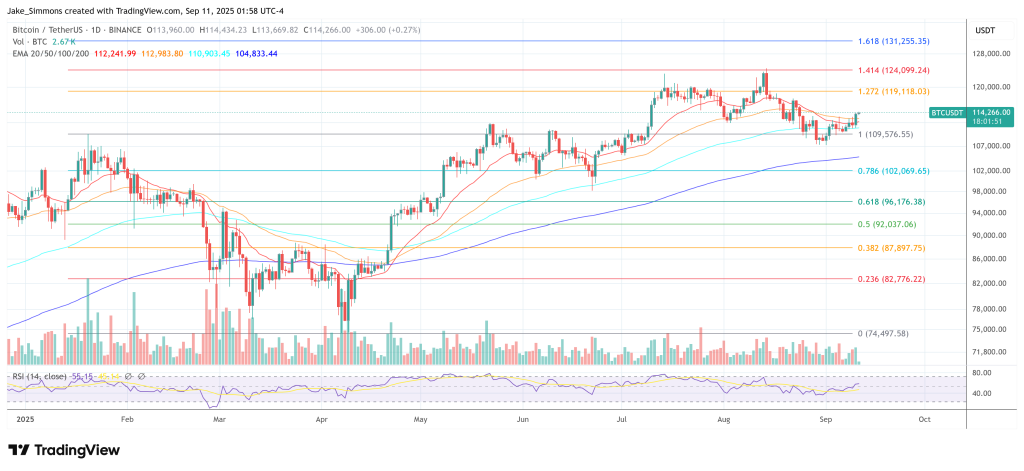
At press time, BTC traded at $114,266.

Related Posts