The US Securities and Exchange Commission on July 29 approved orders permitting in-kind creations and redemptions for Bitcoin and crypto exchange-traded products, reversing the cash-only constraint that governed January’s spot bitcoin launches and this spring’s ether funds. In a formal statement, the agency said bitcoin and ether ETPs “will be permitted to create and redeem shares on an in-kind basis,” aligning them with the mechanics long used by commodity ETPs. “It’s a new day at the SEC,” Chair Paul S. Atkins said, adding that the change should make the products “less costly and more efficient.”
Bloomberg Intelligence senior ETF analyst Eric Balchunas amplified the news on X, posting the Chair’s remarks: “It’s a new day at the SEC … [in-kind] creations and redemptions for a host of crypto asset ETPs.” His post underscored the policy turn: allowing authorized participants (APs) to deliver or receive bitcoin or ether directly, rather than routing cash through the issuer to buy or sell the underlying in the open market.
Why In-Kind Redemptions Are A Big Deal For The Bitcoin ETF Market
Bitwise President Teddy Fusaro followed with a technical explainer on July 30, arguing the shift will remove recurring frictions embedded in the cash-creation model. Under cash creations, an ETF facing inflows must “go out and buy bitcoin from the market,” typically paying at least some spread to the benchmark price.
For illustration, Fusaro posited a two-basis-point premium to the CME CF Bitcoin Reference Rate (New York variant) on a $100 million purchase: “If the ETF pays .02% above the benchmark price (BRRNY) on a $100 million purchase, that’s $20 [thousand].” Those costs, he wrote, do not disappear; they are billed back to the AP, passed on to the market maker, and “ultimately … the end shareholder” pays by way of a slightly higher share price. With in-kind, the AP instead delivers the requisite bitcoin, “without the .02% slippage,” taking that cost “out of the equation.”
The plumbing behind Fusaro’s example is familiar to ETF practitioners but often opaque to end investors. In the primary market, APs assemble creation units and exchange them with the trust for ETF shares; in a cash-only regime, this compels the issuer or its agent to source bitcoin at observable benchmarks plus execution costs. The BRRNY index—calculated from 3 p.m. to 4 p.m. New York time from trades on vetted constituent exchanges—anchors that pricing window in the U.S. trading day, but real-world fills still incur spreads and market impact.
In-kind substitutes bitcoin for cash in that exchange, enabling APs to contribute or receive the asset directly and net their inventory without forcing the fund to trade. Over time, that tends to tighten secondary-market spreads, reduce tracking noise around the close, and compress the “hidden” costs that wash through to investors during heavy creation or redemption day.
The SEC’s orders were broader than a single operational tweak. Alongside the in-kind relief, the Commission said it approved additional actions that “advance a merit-neutral approach” to crypto ETPs, including exchange applications to list and trade an ETP holding both spot bitcoin and spot ether, options on certain spot bitcoin ETPs, FLEX options on shares of specific BTC-based ETPs, and an increase of listed options position limits up to the generic ceilings—“up to 250,000 contracts”—for some bitcoin ETP options. The agency also issued scheduling orders to solicit comments on delegated approvals to list two large-cap crypto ETPs.
Commissioner Mark T. Uyeda framed the move as a correction of an outlier policy: before July 29, crypto ETPs “could not use in-kind creations and redemptions—in stark contrast to other forms of commodity ETPs—a limitation that resulted in unnecessary costs and burdens.” His statement dovetails with the cost channel Fusaro highlighted, and it helps explain why ETF market-makers and APs have lobbied for parity with gold and other commodity funds since spot crypto products debuted.
From a market-structure perspective, the implications are concrete rather than theoretical. In-kind mechanisms let APs manage bitcoin inventory across prime brokers, OTC desks, and custodians without compelling the fund to tap spot markets at the close. That, in turn, can sharpen the arbitrage that keeps ETF prices close to net asset value, especially during volatile sessions when cash creations may force hurried purchases above benchmarks.
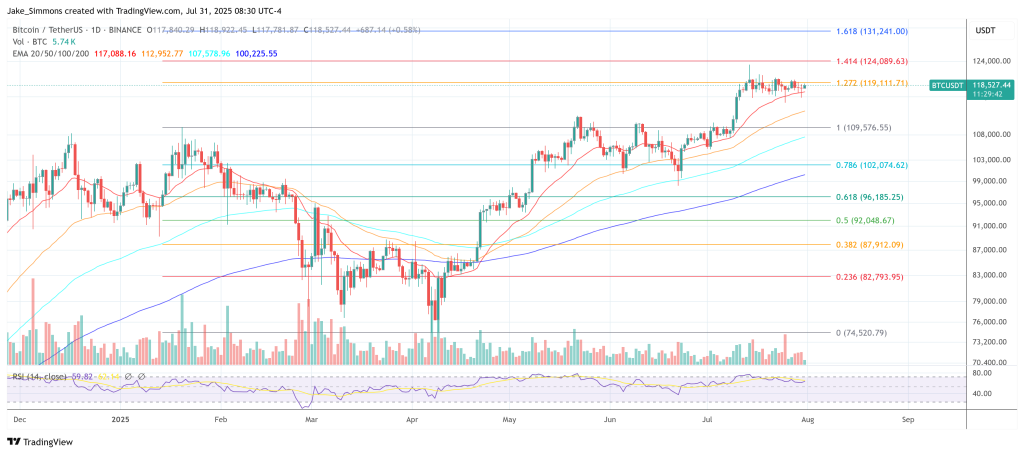
The speed of implementation will vary by issuer; AP agreements, operations, and custody rails must be updated to support in-kind flows. But the policy baseline has shifted. At press time, BTC traded at $118,527.

Related Posts