Ripple CTO Explains Why XRP Ledger Lags Despite 300+ Bank Deals

bitcoinist发布于2025-07-31更新于2025-07-31

文章摘要

Ripple chief technology officer David “JoelKatz” Schwartz moved to explain the gap between Ripple’s oft-touted roster of bank relationships and...

Trusted Editorial content, reviewed by leading industry experts and seasoned editors. Ad Disclosure

Ripple chief technology officer David “JoelKatz” Schwartz moved to explain the gap between Ripple’s oft-touted roster of bank relationships and the still-modest on-chain activity on the XRP Ledger (XRPL), responding at length on July 30 to a widely shared thread of questions from investor and YouTuber Andrei Jikh. In a series of posts on X, Schwartz pointed to compliance realities, institutional behavior, and product roadmap items—most notably a forthcoming “permissioned domains” model—as key reasons that institutional flows remain largely off-chain today.

300+ Bank Deals, Little Volume? Ripple CTO Answers

Jikh’s prompt captured long-standing critiques: after more than a decade and “300+ bank partnerships,” why isn’t the XRPL clearing “billions in daily on-chain volume,” why would payers choose a volatile asset like XRP over stablecoins, and—in a world saturated with fiat-linked tokens—do bridge assets still matter? He also raised questions about tokenization strategy, including why a firm such as BlackRock would select XRPL rather than operate a captive chain, and about geopolitical risk for non-US users.

Schwartz’s central explanation for sluggish on-chain settlement was blunt about the constraints facing regulated entities that cannot unknowingly transact against illicit counterparties on public DEX liquidity: “Even Ripple can’t use the XRPL DEX for payments yet because we can’t be sure a terrorist won’t provide the liquidity for payment. Features like permissioned domains will address this.” The post acknowledged “it has been very slow” to shift institutional flows on chain, even as he argued that institutions are “starting to see the benefits.”

Pressed by another user on whether the same counterparty-risk problem exists on other L1s, Schwartz said that, depending on how features are used, “generally decentralized exchanges on public layer 1’s don’t give you any control or knowledge of who your counterparties are.” The point was procedural rather than moral—“regulations aren’t always totally logical,” he added—underscoring why regulated payment flows have struggled to route through open liquidity.

Schwartz framed “permissioned domains” as a design intended to keep the ledger’s openness while giving compliance-bound participants a venue with rule-enforced counterparties. In follow-ups, he described a structure in which “retail is welcome in the permissioned parts provided they can prove they’re not sanctioned,” and said the “net effect” should be that liquidity in these domains remains comparable to the open side because of market-making between the two.

XRP Vs. Stablecoins

On the stablecoin question, Schwartz rejected the idea that XRP’s volatility automatically disqualifies it for payments. He argued there are use cases where volatility “isn’t a minus, or is even a plus,” and—separately—contended that a functioning bridge requires inventory: “A bridge currency only works if someone is holding it so that you can get it precisely when you need it.” He added that if users don’t know which asset they will need next, they may rationally hold the “dominant bridge” because it’s cheaper to pivot from a liquid hub asset into whatever comes next.

Schwartz also addressed whether bridge assets still matter if stablecoins increasingly cover most trading pairs. He allowed that “if one stablecoin wins,” it could act as the bridge, but said he doesn’t think a single stablecoin can win because each is “only…stable relative to one particular fiat currency” and anchored to jurisdictions. That multi-stablecoin reality, he argued, leaves room for a neutral bridge to connect a “long tail” of tokenized assets.

Asked why a heavyweight like BlackRock wouldn’t simply build its own chain for tokenization—especially as some brokerages do—Schwartz downplayed the importance of chain homogeneity in a world of interoperability and portability. He urged skeptics to “ask the same question about Circle—why don’t they launch USDC only on their own blockchain?” implying the obvious answer: ubiquity and liquidity come from meeting users where they are, across many networks.

On geopolitics, he drew a line between XRPL, which he described as neutral infrastructure, and Ripple’s enterprise products, which are segmented by jurisdiction. “If you’re asking about XRPL, it’s not really US based,” he wrote, adding that the ledger “has never discriminated against any particular participant,” and conceding that, for Ripple’s own products, licensing realities apply and some corridors—“North Korea or Cuba any time soon”—are out of bounds.

Schwartz further argued that XRP’s role within Ripple’s payments stack remains material even if much of it is not visible on public ledgers. “I don’t have the numbers in front of me,” he wrote, “but I’m pretty sure XRP’s use as a bridge in Ripple Payments dwarfs every other asset.” In a related point on XRPL design, he reminded readers that “XRP has a privileged place on the XRP Ledger.”

At press time, XRP traded at $3.13.
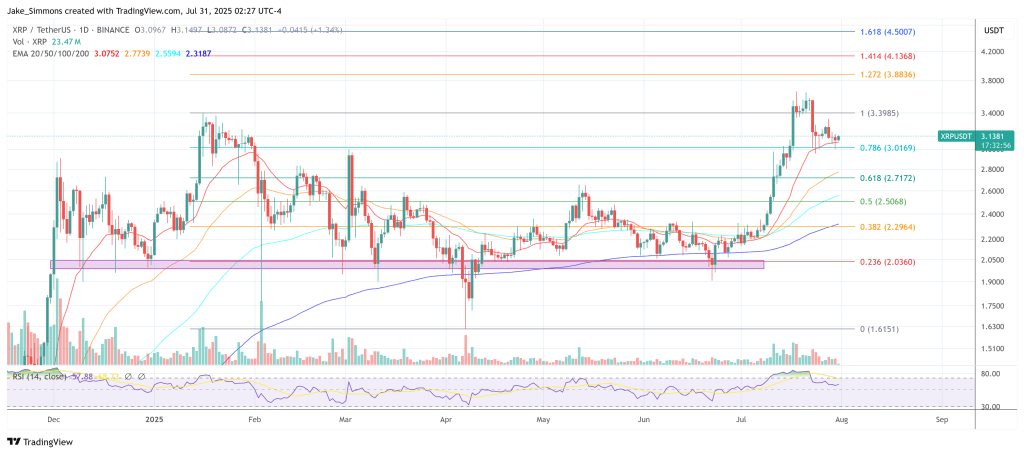
XRP price
XRP bulls defend the 0.786 Fib, 1-day chart | Source: XRPUSDT on TradingView.com
Featured image created with DALL.E, chart from TradingView.com
Editorial Process for bitcoinist is centered on delivering thoroughly researched, accurate, and unbiased content. We uphold strict sourcing standards, and each page undergoes diligent review by our team of top technology experts and seasoned editors. This process ensures the integrity, relevance, and value of our content for our readers.

Jake Simmons has been a Bitcoin enthusiast since 2016. Ever since he heard about Bitcoin, he has been studying the topic every day and trying to share his knowledge with others. His goal is to contribute to Bitcoin's financial revolution, which will replace the fiat money system. Besides BTC and crypto, Jake studied Business Informatics at a university. After graduation in 2017, he has been working in the blockchain and crypto sector. You can follow Jake on Twitter at @realJakeSimmons.

热门币种推荐

你可能也喜欢

摩根大通认为MicroStrategy的比特币销售政策是‘双向风险’——详解!

摩根大通近日指出,迈克尔·赛勒的微策略公司(Strategy)的比特币销售政策带来了“双向风险”。微策略长期通过发债和增发来筹集资金并购买比特币,其巨额持仓(约84.7万枚BTC)此前实质上锁定了市场供应。然而,公司新的资本结构允许其出售部分比特币以支付优先股股息等财务承诺,同时启动了股票回购计划。 尽管公司持有约25.5亿美元现金,足以覆盖约17个月的股息与利息支出,但摩根大通认为,这笔缓冲资金仍不足以保证未来不会出售比特币。该行分析师团队建议,微策略需要通过增发普通股等方式,将现金覆盖率提升至24-36个月,才能让投资者相信其在可预见的未来无需抛售比特币。 核心问题在于,微策略从此前单一的比特币“净买家”转变为可能根据现金需求在买卖之间切换的角色,这为市场带来了不确定性。虽然公司授权的12.5亿美元出售额度仅占其总持仓的一小部分,但其心理影响可能远超实际抛售规模。当前,美国现货比特币ETF面临资金净流出,比特币价格承压。市场希望《清晰法案》的获批能恢复市场信心与比特币价格,从而改善微策略面临的环境。 简而言之,摩根大通建议微策略需进一步增强现金缓冲以消除市场对其抛售比特币的担忧;尽管近期出售规模有限,但政策转变已引发市场不安。

ambcrypto14分钟前

摩根大通认为MicroStrategy的比特币销售政策是‘双向风险’——详解!

ambcrypto14分钟前

稳定币是加密世界的“保皇派”:Open USD 让旧货币体系亲自下场

Open USD的推出标志着稳定币竞争进入新阶段,由140多家传统金融、科技和加密机构组成的联盟共同参与,使其从创业公司的产品之争升级为基础设施之争。学者胡翌霖指出,稳定币并非加密革命的温和派,而是旧货币体系内部的“保皇派改革”——它利用区块链提升效率,却依然维护美元和美联储的中心地位。真正的加密革命需挑战更根本的前提:市场是否必须依赖央行作为货币秩序的核心。 Open USD由Visa、万事达、贝莱德、谷歌、Coinbase等巨头联合推出,允许企业零成本铸造赎回,并将储备收益分配给合作伙伴。这直接威胁到USDC等现有稳定币的商业模式。胡翌霖认为,其象征意义在于传统金融体系亲自下场主导稳定币网络,反衬出原生稳定币创业者的尴尬:若其目标仅是提升旧体系效率,那么当旧体系采纳该技术后,其革命性便宣告终结。 胡翌霖将稳定币比作天文学史上的第谷体系:虽吸收新技术,却拒绝“地球动起来”的核心革命。稳定币反对的是低效的支付网络与金融中介,而非美元本位本身。它更像是美元霸权的“区块链升级包”,可能强化而非削弱美元体系。如果链上金融全面以美元稳定币计价,繁荣的链上活动反而可能巩固链下传统金融资产的价值,使加密本币(如ETH)沦为单纯的“燃料”,难以获得货币性溢价。 因此,胡翌霖强调,追求文明级变革的加密项目(如比特币)不应将叙事降格为手续费经济,而必须坚持“去中心化”的核心,无论是通过币本位、抗审查还是开放治理。真正的“哥白尼时刻”在于让人们相信:市场交易与货币价值可以自发形成,无需一个固定的央行作为中心。稳定币可作为过渡工具,但若加密世界最终仍围绕美元旋转,则革命尚未成功。

链捕手3小时前

稳定币是加密世界的“保皇派”:Open USD 让旧货币体系亲自下场

链捕手3小时前

交易

现货

热门文章

什么是 $BANK

银行人工智能:银行业未来的革命性一步 介绍 在科技迅速发展的时代,银行人工智能站在人工智能(AI)和银行服务的交汇点。这个创新项目旨在重新定义金融格局,通过人工智能的力量提升运营效率、安全措施和客户体验。在我们开始探讨银行人工智能的过程中,我们将深入了解该项目的内容、运营动态、历史背景和重要里程碑。 什么是银行人工智能? 从本质上讲,银行人工智能代表了一项变革性倡议,旨在将人工智能融入各种银行运营中。该项目利用人工智能的能力自动化流程、改善风险管理协议并通过个性化服务增强客户互动。 银行人工智能的主要目标包括: 银行功能自动化:通过利用人工智能技术,银行人工智能旨在自动化日常任务,减轻人力资源的负担并提升效率。 增强风险管理:该项目利用人工智能算法预测和识别风险,从而加强对欺诈和其他威胁的安全措施。 个性化银行服务:银行人工智能专注于通过分析客户数据和行为提供量身定制的金融产品和服务。 改善客户体验:实施人工智能驱动的解决方案,如聊天机器人和虚拟助手,旨在为用户提供更人性化的互动,彻底改变客户与银行的互动方式。 凭借这些目标,银行人工智能将自己定位为一个重要参与者,使银行服务更加高效、安全和以用户为中心。 银行人工智能的创造者是谁? 关于银行人工智能创造者的详细信息仍然未知。因此,在现有信息中没有确定的个人或组织。有关项目创立的匿名性引发了各种问题,但并不削弱其雄心勃勃的愿景和目标。 银行人工智能的投资者是谁? 与项目的创造者类似,银行人工智能的投资者或支持组织的具体信息尚未披露。没有这些信息,很难概述可能推动该项目前进的资金支持和机构保障。尽管如此,拥有坚实的投资基础对于在如此创新的领域维持发展至关重要。 银行人工智能如何运作? 银行人工智能在多个创新领域运作,专注于使其与传统银行框架区分开来的独特因素。以下是关键运营特点: 自动化:通过应用机器学习算法,银行人工智能自动化银行内的各种手动流程。这降低了运营成本,使人类员工能够将精力转向更具战略性的活动。 先进的风险管理:将人工智能整合到风险管理实践中,使银行具备准确预测潜在威胁如欺诈的工具,从而确保客户信息和资产的安全。 量身定制的财务建议:通过持续学习客户互动,人工智能系统对用户需求形成细致了解,使其能够在财务决策上提供量身定制的建议。 增强客户互动:利用由人工智能驱动的聊天机器人和虚拟助手,银行人工智能使客户体验更加生动,让用户能够快速解决问题,从而减少等待时间,提高满意度。 这些运营特点共同将银行人工智能定位为银行业的先锋,为服务交付和运营卓越建立新的基准。 银行人工智能的时间线 了解银行人工智能的轨迹需要查看其历史背景。以下是突显重要里程碑和发展的时间线: 2010年代初:人工智能与银行服务的整合构思开始受到关注,银行机构认识到潜在的好处。 2018年:当银行开始使用聊天机器人等人工智能工具进行基本客户服务和风险管理系统以提高安全性时,人工智能技术的实施显著增加。 2023年:人工智能的复杂性继续提高,生成式人工智能被引入用于更复杂的任务,如文档处理和实时投资分析。今年标志着人工智能技术为银行提供的能力的重大飞跃。 2024年至今:截至今年,银行人工智能处于上升轨迹,持续的研究和开发正在进一步提升银行运营的能力。对人工智能应用的持续探索暗示着即将出现的激动人心的发展。 关于银行人工智能的关键点 人工智能在银行业的整合:银行人工智能专注于采用人工智能来简化银行流程并改善用户体验。 自动化和风险管理重点:该项目在这些领域有很强的强调,旨在减轻日常任务的负担,同时通过预测分析增强安全框架。 个性化银行解决方案:通过利用客户数据,银行人工智能能够提供符合个人用户需求的量身定制的银行服务。 对发展的承诺:银行人工智能承诺持续进行研究和开发,确保其适应性和持续的相关性,随着技术的不断发展而演变。 结论 总之,银行人工智能体现了银行业向前迈出的重要一步,通过运用人工智能来重塑操作范式、增强安全性并促进客户满意度。尽管关于创造者和投资者的信息缺如,银行人工智能清晰的目标和功能机制为其持续演变提供了坚实的基础。随着人工智能技术的不断进步并与银行业结合,银行人工智能在未来的金融服务中将对我们理解和互动银行的方式产生重大影响。

194人学过发布于 2024.04.06更新于 2024.12.03

什么是 $BANK

如何购买BANK

欢迎来到HTX.com!我们已经让购买Lorenzo Protocol(BANK)变得简单而便捷。跟随我们的逐步指南,放心开始您的加密货币之旅。第一步:创建您的HTX账户使用您的电子邮件、手机号码注册一个免费账户在HTX上。体验无忧的注册过程并解锁所有平台功能。立即注册第二步:前往买币页面,选择您的支付方式信用卡/借记卡购买:使用您的Visa或Mastercard即时购买Lorenzo Protocol(BANK)。余额购买:使用您HTX账户余额中的资金进行无缝交易。第三方购买:探索诸如Google Pay或Apple Pay等流行支付方法以增加便利性。C2C购买:在HTX平台上直接与其他用户交易。HTX场外交易台(OTC)购买:为大量交易者提供个性化服务和竞争性汇率。第三步:存储您的Lorenzo Protocol(BANK)购买完您的Lorenzo Protocol(BANK)后,将其存储在您的HTX账户钱包中。您也可以通过区块链转账将其发送到其他地方或者用于交易其他加密货币。第四步:交易Lorenzo Protocol(BANK)在HTX的现货市场轻松交易Lorenzo Protocol(BANK)。访问您的账户,选择您的交易对,执行您的交易,并实时监控。HTX为初学者和经验丰富的交易者提供了友好的用户体验。

1.4k人学过发布于 2025.05.09更新于 2026.06.02

如何购买BANK

相关讨论

欢迎来到HTX社区。在这里,您可以了解最新的平台发展动态并获得专业的市场意见。以下是用户对BANK(BANK)币价的意见。

活动图片