Jack Dorsey’s payments company Block has laid out a policy agenda that it argues could unlock Bitcoin’s evolution from reserve asset to routine means of payment in the United States. “A path towards Bitcoin as everyday money,” Dorsey posted on X today, amplifying a detailed blog post and earlier thread by Thomas Templeton, the company’s lead for Bitcoin hardware and mining initiatives.
Templeton wrote that Block is “building toward a world where Bitcoin is everyday money — not just a store of value,” stressing that congressional action is now the decisive variable. “To realize this vision, we need Congress to modernize the regulatory frameworks to support this,” he told his followers, linking to the firm’s memorandum Policies to Unlock Bitcoin as Everyday Money.
3 Changes To Make Bitcoin Money
In that document, Block revisits the founding premise of Bitcoin as set out by Satoshi Nakamoto in 2008: “A Peer-to-Peer Electronic Cash System.” It argues that the network’s open, permissionless design is “not about speculation—it’s about access,” and positions BTC’s architecture as a model for “resilience and innovation” in national payments infrastructure. Block says it is investing across the stack—mining rigs, self-custody wallets, and Square-branded point-of-sale integrations—to lower barriers for “people and small businesses” who wish to transact natively on Bitcoin.
Yet the company contends that federal law has not kept pace with technical progress. It urges lawmakers to take three steps it sees as prerequisites for mass-market use.
First, Block underscores the urgency of comprehensive market-structure reform now embodied by the Digital Asset Market Clarity (CLARITY) Act. Re-quoting Block’s own brief, the company maintains that Bitcoin’s “decentralized, permissionless, and open-source architecture makes it one of the most transparent and democratically governed forms of money ever created.”
Second, the company seeks statutory protection for “participants that do not custody customer funds—like software developers, node operators, miners, and wallet providers.” This language mirrors the bipartisan Blockchain Regulatory Certainty Act, which would encode the principle that money-transmitter rules apply only to intermediaries with control over customer funds.
Third, Block presses for a de minimis capital-gains exemption on small retail transactions, likening Bitcoin’s tax treatment to that of foreign currency. Under current rules, buying a cup of coffee with appreciated BTC triggers a taxable event, a friction Block believes “disincentivizes everyday use.” The firm notes that Square plans to enable direct BTC payments “later this year” and says a tax safe harbour is “essential to ensuring bitcoin can be more widely adopted as a medium of exchange.”
Throughout the policy paper, Block differentiates Bitcoin from the broader digital-asset sector by emphasizing its fixed supply of 21 million coins, its “fungibility,” and its decade-plus operational history. “Whether it’s sending value across borders, or seamlessly transacting with small businesses, bitcoin has the real-world potential of modernizing payments and addressing everyday financial needs,” the memo states.
While Dorsey’s personal advocacy for Bitcoin is well-known—he once called it “the native currency of the internet”—Block’s new roadmap still represents the company’s most detailed policy blueprint to date. Since its release, the legislative chessboard has shifted: the Digital Asset Market Clarity (CLARITY) Act passed the House on 17 July by 294–134 and now awaits action on the Senate calendar.
By contrast, the narrower Blockchain Regulatory Certainty Act has only been re-introduced and remains bottled up at the House Financial Services Committee, with no Senate companion yet filed. Capitol-hill watchers are therefore focused on whether Senate Banking Chair Tim Scott will grant CLARITY a markup following the committee’s 9 July hearing on digital-asset market structure and on whether tax writers will graft a de minimis capital-gains exemption onto the next must-pass vehicle, now that President Trump has already signed the GENIUS stablecoin law on 21 July.
Absent those reforms, Block warns, the United States risks ceding ground to jurisdictions where Bitcoin payments already operate at retail scale. With Square’s merchant network preparing to accept Bitcoin alongside credit cards and Tap-to-Pay, the company’s message to lawmakers is unambiguous: “It’s time for Congress to pass a comprehensive federal licensing framework and unlock a tax barrier for small-dollar BTC transactions to be a viable medium of exchange.”
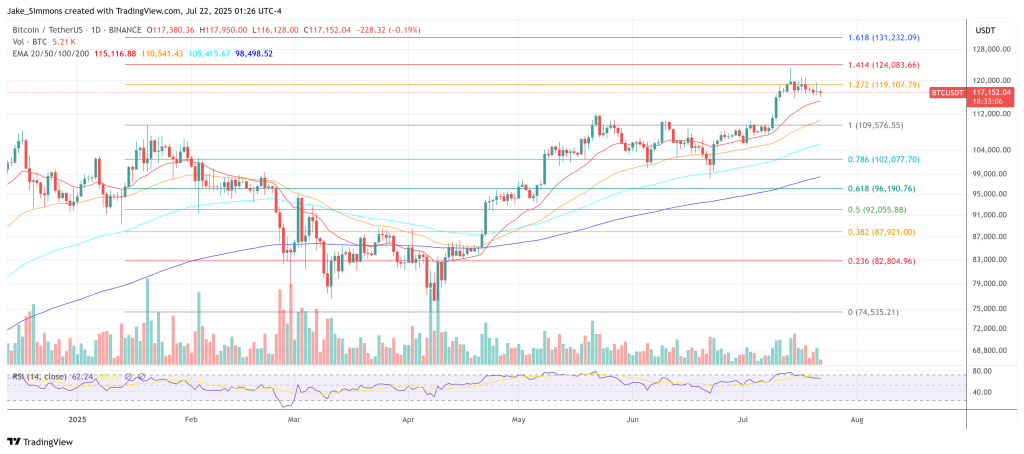
At press time, BTC traded at $117,152.

Related Posts