Michael Saylor’s latest move to finance more Bitcoin purchases has reignited debate over the viability of his high-stakes approach. The company now called Strategy (formerly MicroStrategy) announced it would issue a new perpetual preferred stock, STRF (“Strife”), at a 10% annual dividend. While some see this as an inventive way to accumulate more BTC, others warn the cash dividend obligations could become untenable if Bitcoin prices plummet.
Could Saylor Be The Next Bitcoin Bear Market Catalyst?
On X, Strategy announced the creation of STRF (Strife), which it described as a “new perpetual preferred stock offering, available to institutional investors and select non-institutional investors.” In its statement, the company explained that proceeds would go toward general corporate purposes—including working capital—“and the acquisition of Bitcoin,” although it stressed this remained “subject to market and other conditions.”
According to Strategy, STRF carries cumulative dividends of 10% annually, with the first cash dividend scheduled for June 30, 2025, and then each quarter thereafter. Observers quickly noted how such a high payout could strain the firm’s resources, given that its balance sheet is heavily tilted toward Bitcoin rather than traditional revenue streams.
Among the early critics was WhalePanda (@WhalePanda), co-host of the Magical Crypto Friends YouTube channel with Riccardo Spagni, Samson Mow, and Charlie Lee. He argued the 10% dividend, which could amount to $50 million in annual payouts if Strategy raises $500 million, is too large given the company’s structure:
“I’ve said it before that Saylor is going to bring the next Bitcoin bear market. This seems desperate. 10% dividend on $500 million translates to $50 million annually, payable solely in cash… they don’t have that cash.”
Another vocal critic, Simon Dixon—an ex-investment banker turned Bitcoin investor known for backing platforms like Kraken, Bitfinex, and BitStamp—drew a sharp parallel between Strategy’s bold move and the notorious collapse of Long-Term Capital Management (LTCM) in the late 1990s. Although not equating the two scenarios outright, Dixon argued that offering such a high fixed dividend from “insufficient dollar revenue” resembled a “next-level risk.”
He cautioned: “Strategy’s announcement of a perpetual 10% dividend paid in dollars—despite lacking sufficient dollar revenue & operating with a Bitcoin-based balance sheet—is next-level risk. This is starting to resemble Long-Term Capital Management, which required a bailout. If this ship sinks, nationalization might become a strategic move for the US government. For clarity, this does not change my thesis on Bitcoin.”
Not everyone shares the dire outlook. Some industry figures insist that Saylor’s track record in growing Strategy’s BTC reserves—and the relative simplicity of its balance sheet compared to LTCM—offers a substantial cushion. David Bailey, CEO of BTC Inc, argued that Saylor’s personal commitment to Bitcoin should not be discounted: “Saylor literally has more skin in the game than anyone alive… If you don’t like the stock, don’t buy it, simple.”
He referred to critics as “ungrateful,” underscoring how Saylor’s public advocacy and corporate purchases have brought mainstream attention—and considerable inflows—to Bitcoin. Bitcoin analyst Dylan LeClair also dismissed the LTCM comparison, calling it “literally nothing like LTCM” and implying that Strategy’s BTC-backed balance sheet does not pose the same systemic risk as a heavily leveraged hedge fund dealing in derivatives.
Preston Pysh, co-founder of The Investor’s Podcast Network, offered a more nuanced take. While he expressed reservations about the new issuance—questioning why Strategy didn’t utilize “the previous preferred issuance which has an 8% dividend yield and optionality for payments in common or cash”—he viewed direct parallels to LTCM as “over the top laughable.”
Pysh floated rough numbers suggesting that even if Bitcoin were to tumble 70% from its current levels, Strategy could theoretically maintain dividend and coupon payments for more than a decade. He wrote:
“If the price of Bitcoin went down 70% from here, he still has 12 billion USD worth of Bitcoin on the balance sheet and 115M in annual CASH payments (dividends and coupons combined) that need to be paid. That’s approximately 12 years worth of payment inventory on the balance sheet even with a 70% reduction in BTC’s value. Now this math is extremely rough and I’ve put about 2 minutes worth of effort into debunking this, so take it for what it’s worth, but I think your claim is hyperbolic.”
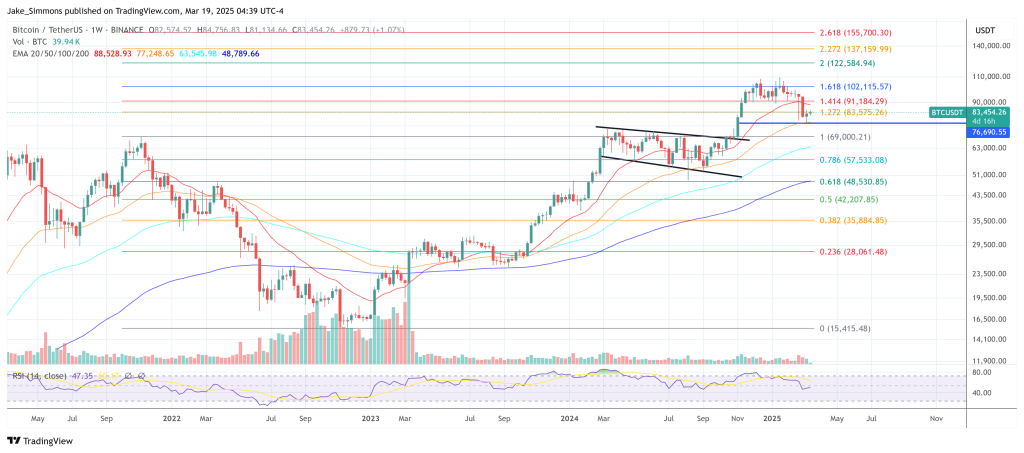
At press time, BTC traded at $83,454.

Related Posts