$272B in Bitcoin ETF Outflows Force Crash Below $100B as $HYPER Pumps

bitcoinist发布于2026-02-04更新于2026-02-04

文章摘要

Massive outflows of $272 billion from Bitcoin ETFs have driven total assets below $100 billion, signaling institutional pullback. However, on-chain data suggests this reflects a rotation rather than capital flight, as smart money moves from passive products into high-yield Layer 2 protocols. Bitcoin Hyper ($HYPER) is highlighted as a key beneficiary, leveraging the Solana Virtual Machine to address Bitcoin's scalability issues with high-speed execution and a decentralized bridge. The project has raised over $31.2 million in its presale, with significant whale accumulation noted, indicating strong interest in programmable Bitcoin infrastructure amid ETF volatility.

Institutional capitulation has hit the market hard. After weeks of chop, spot Bitcoin ETFs recorded a staggering $272 billion in volume-adjusted outflows.

That massive exit dragged total Assets Under Management (AUM) below the critical $100 billion mark, a psychological blow many didn’t see coming.

Is capital actually leaving? Not quite. While retail investors panic-sell on the headlines, on-chain data reveals a different story: rotation. Smart money is moving downstream, dumping passive ‘paper Bitcoin’ products to chase yields in the Layer 2 sector.

The logic is brutal, but it makes sense. Why hold stagnant assets in a bleeding ETF when infrastructure plays are heating up? As legacy pipes clog, liquidity is flooding into protocols solving Bitcoin’s oldest headache: scalability.

That’s where Bitcoin Hyper ($HYPER) steps in, using the Solana Virtual Machine (SVM) to bring high-speed execution to the Bitcoin network.

Buy $HYPER here now.

Solving The Scalability Dilemma With SVM Integration

The current flush exposed (again) the limits of Bitcoin’s base layer. When volatility hits, the network congests. Fees skyrocket. L1 becomes unusable for anything but settlement. Bitcoin Hyper ($HYPER) fixes that friction.

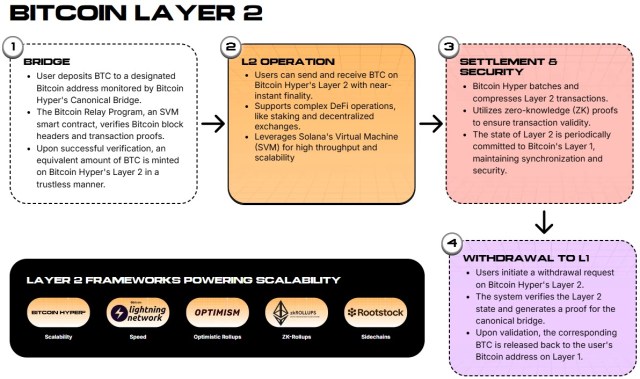
By integrating the Solana Virtual Machine (SVM) as a Layer 2 environment, the protocol delivers sub-second finality while keeping Mainnet security.

It’s not just a speed upgrade; it’s an architectural overhaul. Traditional Bitcoin L2s often struggle with fragmented liquidity or clunky bridging. (Sound familiar?) Bitcoin Hyper’s Decentralized Canonical Bridge creates a seamless pipeline for BTC transfers, letting users deploy capital into DeFi and gaming instantly.
Traders are watching. According to Etherscan records, 3 whale wallets accumulated $1M recently. The largest transaction, $500K, hit the chain on Jan 15, 2026. This accumulation during a drawdown suggests sophisticated actors are positioning for the ‘Programmable Bitcoin’ narrative before the retail herd returns.

For developers, the SVM environment means building with familiar Rust-based SDKs, but with Bitcoin’s security guarantees. It’s the liquidity of the world’s largest asset combined with the speed of the fastest chain.

Check out the Bitcoin Hyper presale.

Smart Money Rotates Into High-Yield Layer 2 Protocols

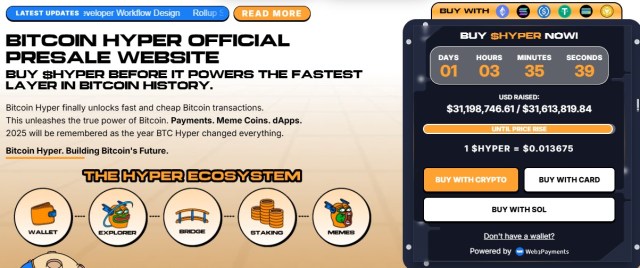
While ETF investors lick their wounds, the Bitcoin Hyper presale is showing strength. According to the official site, the project has raised over $31.2M, with tokens currently priced at $0.0136751.
That divergence highlights a decoupling. Institutional inflows are often lagging indicators, they react to what just happened. Presale participation? That’s usually a leading indicator of where liquidity flows next. The appeal is twofold: potential token appreciation and yield generation.

Unlike holding $BTC in cold storage, Bitcoin Hyper offers immediate staking after the Token Generation Event (TGE). Stakers face a 7-day vesting period, a mechanism designed to stop mercenary dumping and align incentives. Plus, the protocol rewards governance participation, turning holders into active stakeholders rather than passive speculators.

The risk here is obvious: L2s are competitive, and execution is everything. But the sheer volume of capital raised suggests the market is betting big on the SVM-on-Bitcoin thesis. As the dust settles on the ETF crash, projects building essential infrastructure are likely to capture the rebound.

Buy your $HYPER today.

This article is for informational purposes only and does not constitute financial advice. Cryptocurrencies are volatile; presale projects carry high risk. Always perform your own due diligence before investing.


相关问答

QWhat was the total amount of outflows from spot Bitcoin ETFs that caused the AUM to drop below $100 billion?

A$272 billion in volume-adjusted outflows.

QAccording to the article, what is the primary reason 'smart money' is moving away from Bitcoin ETFs?

AThey are rotating capital to chase yields in the Layer 2 sector, dumping passive 'paper Bitcoin' products for higher returns.

QWhat technology does Bitcoin Hyper ($HYPER) use to solve Bitcoin's scalability issues?

AIt uses the Solana Virtual Machine (SVM) as a Layer 2 environment to deliver sub-second finality.

QHow much has the Bitcoin Hyper ($HYPER) presale raised, according to the official site?

AOver $31.2 million.

QWhat is the purpose of the 7-day vesting period for stakers in the Bitcoin Hyper protocol?

AIt is a mechanism designed to stop mercenary dumping and align incentives among stakeholders.

你可能也喜欢

华为云不打Token价格战,周跃峰要给AI云换一个赢的方式

在2026华为云INSPISE创想者大会上,新任CEO周跃峰首次公开阐述华为云AI战略,明确表示不以Token调用量或收入规模为竞争核心,而是聚焦于“每个Token是否真正提升生产力”。 面对当前国内AI云市场普遍以Token价格战和规模增长为焦点的态势,华为云选择了差异化路径:其一,依托昇腾、鲲鹏等全国产化软硬件构建“第二算力平面”,不参与“万国牌”硬件的规模比拼;其二,将政企及国计民生行业作为主战场,通过混合云与机密计算等技术,在保障数据主权的同时输送公有云迭代能力;其三,坚持开源开放策略,并联合20余家头部模型厂商共建生态。 周跃峰提出,AI竞争焦点正从算力、模型转向智能体(Agent)的实际应用。为此,华为云发布“Agentic Infra”新范式及一系列新品,旨在解决企业部署智能体时的工程难题,如AICS灵衢集群降低时延、AMS解决长程记忆、ModelArts Next实现多模型智能调度以降低成本。 更关键的举措是推出智慧医疗、具身智能等“行业AI梦工厂”专区,深入具体场景。例如,智慧医疗专区与瑞金医院共建大模型,旨在向基层医院规模化输出顶级诊疗能力。华为云试图将竞争从“卖Token”转向“卖生产力”,衡量标准变为金融风控效果、医疗诊断可及性等实际价值。 周跃峰承认,这条依赖国产算力、深耕产业的路比追逐MaaS收入更慢、更难,但避开了当前的价格红海,押注于智能体深入产业后底层基础设施的机遇。华为云的目标是证明其国产算力体系能满足中国产业AI未来的真实需求。

marsbit9分钟前

华为云不打Token价格战,周跃峰要给AI云换一个赢的方式

marsbit9分钟前

70%民众反对AI,美国人希望美国输掉人工智能战争

这篇文章主要讲述了美国社会目前普遍存在的反AI情绪。一项民调显示,高达70%的美国人认为AI发展“太快”,需要加强监管。这种情绪已经从线上蔓延到线下,具体表现为: 1. **公开抵制**:谷歌前CEO埃里克·施密特在大学毕业典礼上鼓励学生拥抱AI时,遭到台下学生集体嘘声和社交媒体嘲讽。科技公司的AI广告被涂鸦破坏,硅谷等地爆发了多次反AI游行示威。 2. **阻碍基建**:各地居民强烈反对在当地建设AI数据中心,担心其推高水电费、消耗水资源、造成热污染及破坏环境。多个数据中心项目因居民抗议而推迟或取消,甚至有议员因支持项目而遭罢免或住所被枪击。 3. **走向极端**:出现了向OpenAI CEO奥特曼住宅投掷燃烧弹、枪击支持数据中心项目的议员等暴力事件。 民众反对AI的主要原因包括: * **担忧失业**:普遍认为AI会取代大量工作岗位,让财富更集中于科技巨头,而大众承担失业风险。 * **经济负担**:数据中心巨大的能耗和水耗,导致电网升级和水资源成本被分摊到居民账单上,推高生活成本。 * **环境影响**:数据中心运行加剧碳排放,阻碍碳中和目标,其废热排放也抬升局部气温,引发环保团体反对。 * **社会与政治忧虑**:担心AI存在偏见、制造虚假信息,影响公众舆论和选举公正;同时也忧虑当前AI投资热潮可能是泡沫,一旦破裂会引发经济衰退。 这一问题已演变为复杂的政治难题。特朗普上台后废除了拜登时期加强AI监管的行政令,转而推行以“创新与竞争力”为先的政策,以在AI竞赛中保持领先。但这引发了其支持者阵营(MAGA)内部“硅谷派”与“极右翼”的分歧,后者与民主党在限制AI发展上形成了临时同盟,共同反对数据中心建设。特朗普面临着在支持其的科技金主与反对AI的草根票仓之间做出艰难抉择的困境。

marsbit42分钟前

70%民众反对AI,美国人希望美国输掉人工智能战争

marsbit42分钟前

Agent接管流量分发权,腾讯、字节、阿里在抢什么?

近日,腾讯、阿里、字节三大互联网巨头几乎同时加码AI智能体(Agent)布局,争夺AI时代的入口主导权。核心在于,谁掌握了Agent,谁就掌握了未来的流量分发权。 **阿里**采取“双子星”策略:千问App正演变为超级Agent,深度接入淘宝、支付宝等生态业务,实现从搜索到交易的全流程操作,并已向外部品牌开放接入;夸克则定位为AI旗舰应用,致力于成为“AI超级框”。在B端,阿里推出企业智能体平台“悟空”,探索“一人AI公司”模式。 **字节**凭借“豆包”App已获超3亿月活,并通过“扣子”平台构建开发者生态,支持多智能体协同。其战略是软硬一体,将豆包能力延伸至AI手机、智能眼镜等硬件,旨在让AI入口无处不在。 **腾讯**的杀手锏藏于微信。正在内测的微信AI智能体可通过右滑直接调用数百万小程序完成任务,将微信生态转化为“服务操作系统”。腾讯试图将AI深度融入现有国民应用,而非另造新入口。 三家的竞争折射出商业逻辑的深刻变化:流量分配权正从“用户自主点击”转向“Agent代为决策”。商业模式从争夺用户时长的“注意力经济”,转向以结果和效率为核心的“意图经济”。未来,服务提供者不仅比拼品牌,更需比拼其接入AI生态的能力。 这标志着从PC网页、移动App到AI Agent的又一次入口更迭,新一轮行业洗牌已然开始。

marsbit2小时前

Agent接管流量分发权,腾讯、字节、阿里在抢什么?

marsbit2小时前

交易

现货
合约

热门文章

加密市场宏观研报:《GENIUS Act》法案取得重大进展,BTC突破历史新高,后市全新展望

2025年5月22日,比特币价格正式突破11万美元大关,创下历史新高。在政策面、宏观经济、资金面与投资者结构共同作用下,一场结构性牛市浪潮正在展开。而此轮上涨背后的核心驱动,是美国《GENIUS稳定币法案》的实质性进展以及多项利好的叠加。本文将从政策端突破、宏观环境转向、链上与ETF资金结构、交易行为演化,以及重点受益赛道五大维度,全面解析此轮BTC再创新高的深层逻辑,并前瞻下半年市场的潜在趋势。

1.6k人学过发布于 2025.05.22更新于 2025.05.22

加密市场宏观研报:《GENIUS Act》法案取得重大进展,BTC突破历史新高,后市全新展望

相关讨论

欢迎来到HTX社区。在这里,您可以了解最新的平台发展动态并获得专业的市场意见。以下是用户对BTC(BTC)币价的意见。

活动图片