On August 24, Pavel Durov, co-founder and CEO of Telegram, was arrested in France, sending immediate shockwaves through the crypto market as the value of Toncoin (TON) plunged. The arrest is notably significant given Telegram’s central role in the crypto industry as a primary hub for communications. However, the implications could be even more far-reaching.
Crypto Experts React To Telegram CEO Arrest
The charges against the Telegram CEO Durov are severe and numerous, encompassing a range of illegal activities allegedly facilitated by Telegram’s platform. These include complicity in allowing the platform to be used for illegal transactions, refusal to cooperate with law enforcement by not providing necessary data for lawful intercepts, and involvement in distributing and maintaining illicit content.
The breadth and severity of these charges have led to a swift and vocal response from the crypto and tech communities, concerned about the implications for privacy and regulatory overreach.
Wayne Vaughan, CEO of Tierion, framed the situation as a direct challenge to the crypto ethos, stating, “Telegram’s CEO is being charged for using cryptography without government approval. This should concern everyone in Bitcoin and crypto—no one should need government permission to do math.”
Scott Melker, a well-known crypto analyst, emphasized that Durov’s case might signal a worrying trend where developers are held accountable for the uses of their platforms, suggesting that “Durov is basically being charged for starting an encrypted platform and not policing its usage.”
Remarkably, the US government has taken similar action against the privacy-oriented Bitcoin wallets Samourai and Wasabi this year. The US Department of Justice (DOJ) charged the founders with “conspiracy to commit money laundering and conspiracy to operate an unlicensed money-transmitting business.”
Durov’s arrest has stirred a broader debate about the future of technology and encryption. Andy Yen, founder and CEO of Proton, pointed to the potential chilling effects on tech innovation, particularly in France, labeling the legal actions as “economic suicide” for French tech ambitions. “The unsealed charges against Durov are insane. […] I don’t see how tech founders could possibly travel to France, much less hire in France. This is economic suicide and is rapidly and permanently changing the perception of founders and investors,” Yen remarked via X.
Vitalik Buterin, the founder of Ethereum, while previously critical of Telegram’s approach to encryption, expressed grave concerns about the implications for communications freedom in Europe. Buterin noted that the charges against Durov, focused primarily on the lack of moderation and data provision, represent a significant threat to the foundational principles of software freedom in the region. “This looks very bad and worrying for the future of software and comms freedom in Europe,” Buterin said.
Lyudmyla Kozlovska, President of the Open Dialogue Foundation, warned of the broader stakes involved, particularly the need to defend against regulatory and governmental overreach that targets the crypto and tech sectors. She warned that without robust protections, privacy and encryption might soon be treated as criminal activities under regulatory frameworks similar to those being applied to Durov.
“Every time when I was said ‘bitcoin doesn’t care’ I was telling that we need to protect and PREVENT attacks against developers, investors, end-users and entire ecosystem of Bitcoin, including miners. Case of Durov is a bright example what we can expect if technology is labeled with negative language by regulators in western countries, especially EU,” she stated.
Kashif Raza, the founder of Bitinning, drew parallels between Durov’s arrest and a hypothetical scenario involving Satoshi Nakamoto. “The arrest of Pavel Durov just tells you what they would have done to Satoshi Nakamoto?? They are against everything that promotes FREE SPEECH. Pavel Durov’s arrest is an advertisement for the importance of Bitcoin.”
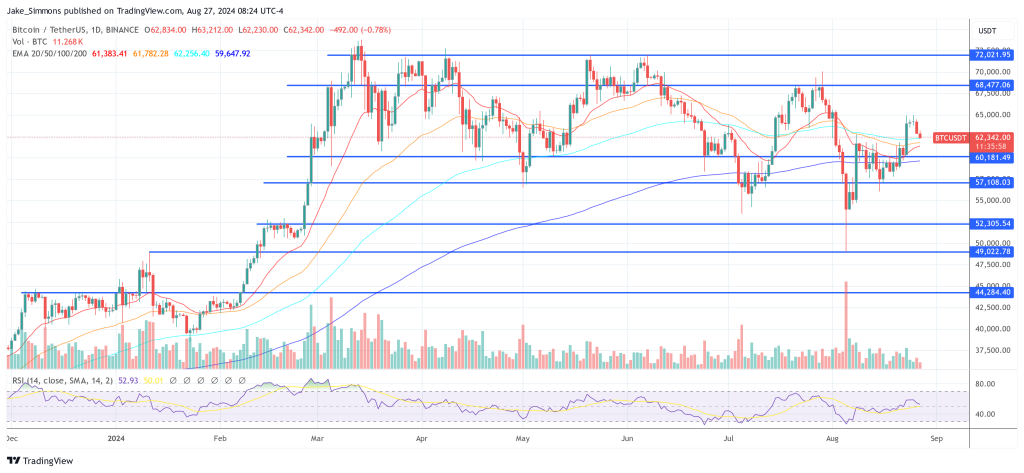
At press time, Bitcoin traded at $62,342.

Related Posts