Authored by Linhan Dong, Bridge Qiao, Researcher at Huobi Research Institute
Abstract
This week, we focus on the following events: 1) Elon Musk strikes deal to buy Twitter for US$44 billion; 2) Yuga Labs' new project Otherside to use Dutch auctions and only support ApeCoin payments; 3) 0x Labs Completes US$70 million Series B Funding, led by Greylock Partners; 4) Project analysis of a budding NFT borrow and lend protocol – BendDAO
______________________________________________________________________________
Focusing on the NFT borrow and lend protocol, BendDAO is performing well with its Total Volume Locked (TVL) reaching US$190 million within 40 days. The new decentralized project lets NFT holders loan ETH for liquidity pools and depositers earn interest by providing ETH liquidity, all through NFT as collateral.
1. Industry overview
I. Overall market trend
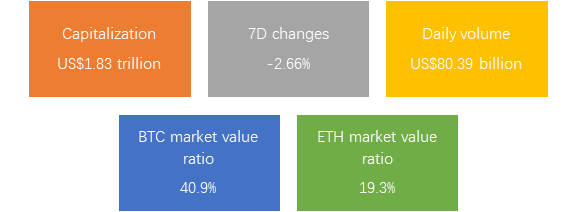
Figure 1. Overall market data
Source: Coinmarketcap
Affected by macro sentiment this week, the three major U.S. stock indexes all fell to a greater extent. On Wednesday (27th), the Nasdaq, which is dominated by technology stocks, fell nearly 4%, hitting a new low for the year, and the Dow fell 2.38% , while the S&P 500 fell 2.81%.
At a time when the traditional financial market is in deep bear territory, the cryptocurrency market has been similarly impacted. Bitcoin prices continue to fall this week and break new lows of 38,000 on Wednesday. The total crypto market capitalization continued to shrink this week. It fell to US$1.83 trillion, down by 2.66% over the last week. Average daily volume was US$80.39 billion. BTC and ETH accounted for 40.9% and 19.3% of the market capitalization, respectively.
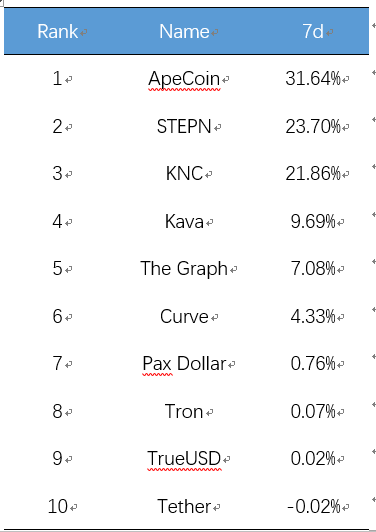
Table 1. Last week's hot currencies
Source: Coinmarketcap
Fewer than 10 of the top 100 cryptocurrencies by market capitalization saw price growth in the bear market last week. The STEPN project, which has gained a lot of attention with Move-to-Earn, is still popular this week. According to data website Dune, the project’s active exceeded 100,000 this week, and as many as 11,833 new users were added on the 27th. The project has been launched on OpenSea on the 28th. Its governance token GMT is up 23.7% this week.
On April 26, Otherside, a new project of Yuga Labs, the parent company of BAYC, announced it would hold Dutch auction that week, and only support ApeCoin payment. As soon as the news came out, Apecoin started to rise, and the current weekly gain has reached 31.64%.
Since integrating with Uniswap v3 and Avalanche, Kyber Network has been in the growth stage, with the KNC price up by 21.86% this week.
On April 23, Kava announced that the Kava 10 mainnet is expected to be released on May 10. The new Kava network is a highly optimized "co-chain" network designed to provide the development architecture of the two largest Web 3 ecosystems in one network. The project’s token price rose 9.69% this week.
II.NFT
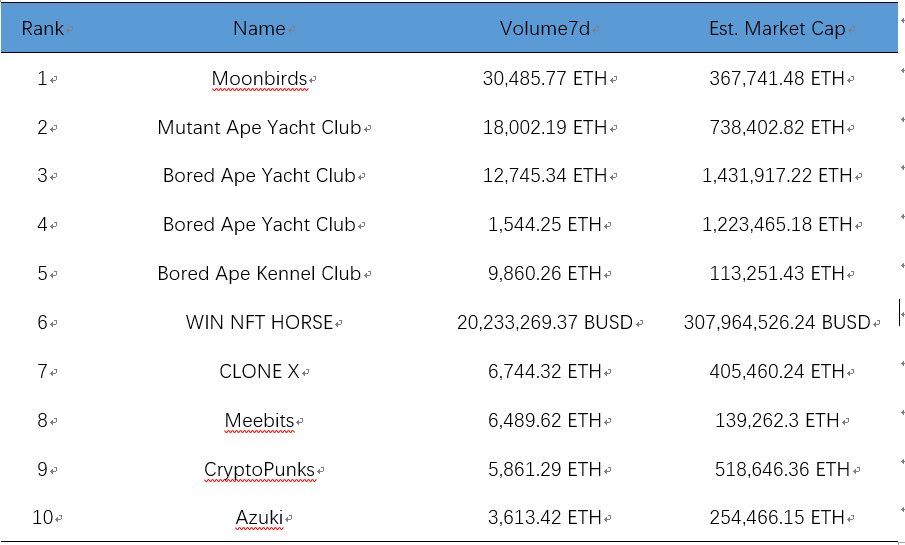
Table 2. NFT Collections Listed By Sales Volume (7d)
Source: Coinmarketcap
The NFT market has generally remained stable this week, with a total market capitalization of US$18.7 billion. This week, Moonbirds continued to lead the NFT market, ranking first in trading volume for several consecutive days, and far surpassing the second place with a weekly trading volume of 30,485.77ETH. Its parent company PROOF also received a US$10 million investment from 776 Management on the 26th.
Thanks to the popularity of the Othersides metaverse project, the NFT projects under Yuga Labs performed well this week, occupying the second to fifth positions on coinmarketcap’s ranking.
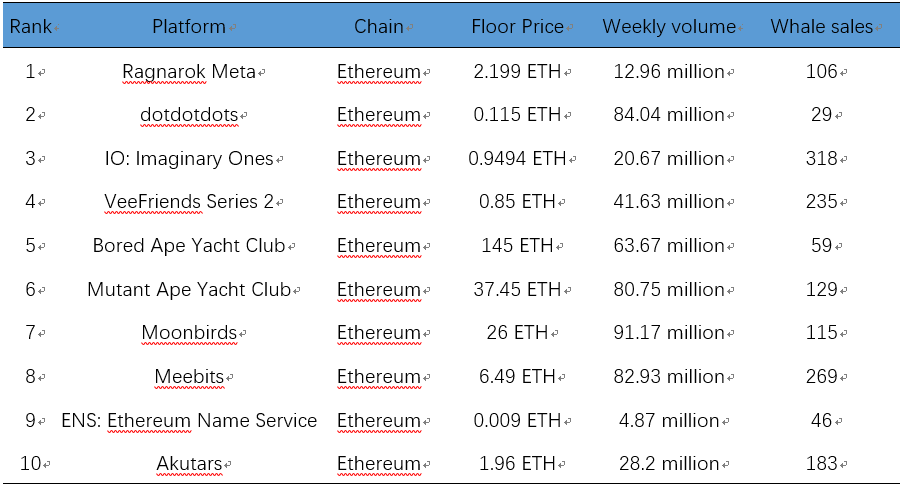
Table 3. Top trending collections on NFTGO(by daily volume)
Source: NFTGO
III.DeFi
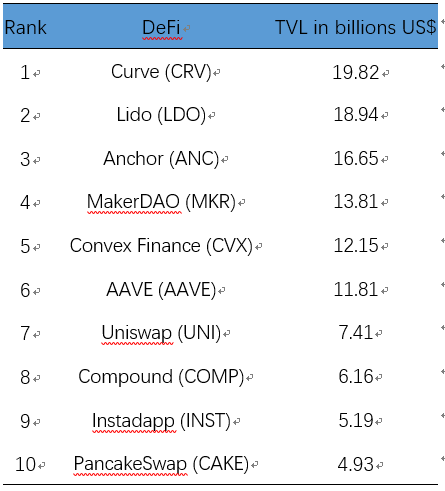
Table 4. DeFi market TVL ranking
IV.Layer2
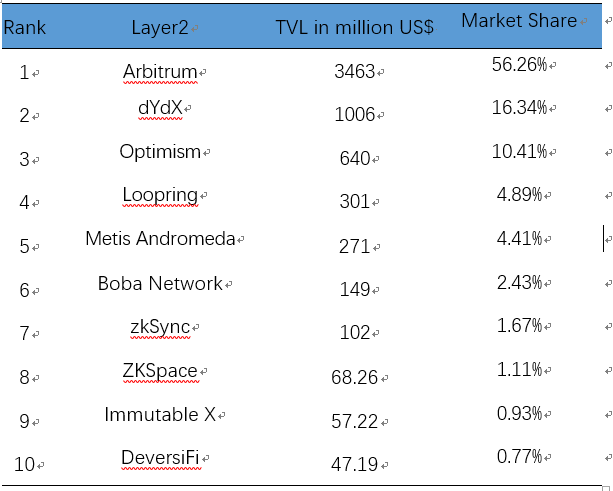
Table 5. Layer2 protocols ranking and market share
2. Market news
I. Industry news
Elon Musk strikes deal to buy Twitter for US$44 billion
On April 25, San Francisco-based Twitter announced that it had reached a definitive agreement with Elon Musk to acquire Twitter at a price of US$54.20 per share, totaling approximately US$44 billion in cash. After the deal, Twitter will become a privately held company.
The deal was unanimously approved by Twitter's board, but still requires shareholder and regulatory approvals.It is expected to close in 2022. Twitter Chairman Bret Taylor wrote, "The board conducted a thoughtful and comprehensive process to evaluate Elon's proposal, with a focus on value, stability and financing." Musk said Twitter was a digital town square where people discuss issues that are critical to the future of humanity, adding: "I want to enhance the Twitter product with a number of new features, such as open source algorithms to increase public trust, and human-machine verification to solve the problem of fraudulent bots."
Musk said these potential new features would give Twitter users the best experience ever, reiterating his comments when he launched his takeover bid that he looks forward to working with the company and users to unlock Twitter’s huge potential. Twitter CEO Parag Agrawal said that with Twitter's mission and ability to impact the entire world, he was proud of his team and “inspired by a job that has never been more important”.
Yuga Labs' new project Otherside to use Dutch auctions and only support ApeCoin payments
On April 26, Yuga Labs' new project Otherside announced on social media that it will use a Dutch auction and only support ApeCoin payments. The opening bids for the Dutch auction will be announced later this week. BAYC and MAYC holders can claim NFTs within 21 days of the auction. KYC certification is not required for application, but required to be minted in the auction. In addition, Otherside stated that ApeCoins obtained in the auction will be locked for one year and can not be used to vote in the ApeCoin DAO.
a16z Announces Formation of Research Unit a16z Crypto Research
a16z has announced the formation of a16z crypto research, a research unit comprising Stanford and Columbia University researchers and computer science professors. They include a16z research director Tim Roughgarden, a Stanford University computer science professor, verifiable delay function developer Dan Boneh, Princeton and other university cryptocurrency course lecturers Joseph Bonneau, Espresso Systems Chief Scientist Benedikt Bünz, Harvard Associate Professor of Business Administration Scott Duke Kominers and Diem Blockchain Research Scientist and Cryptographer Valeria Nikolaenko. The department will work with a16z-invested crypto companies to solve puzzles and develop “production-grade” code to ensure project concepts and implementation are in line with specifications.
Google search data shows retail interest in Bitcoin waning
The price of Bitcoin (BTC) soared to as high as US$69,000 last year and is in the US$40,000-plus range this year, according to Google Trends search data. However, it has failed to attract sustained interest from the retail market. Global searches for Bitcoin have reached mid-2020 levels as of April 22, 2022, with 17 for the week of April 17 to April 23, down from May 2021 (when it was 76) .
The data shows that most searches for Bitcoin come from Nigeria, followed by El Salvador and Austria. The data is relative, meaning Nigerians search for bitcoin more than other keywords, but not necessarily more than the overall search numbers in places like the US.
But despite the apparent waning of interest in Bitcoin, some analysts say the retail crowd is being drawn to new sectors and markets within the crypto space, such as DeFi tokens or blockchains like Solana and Avalanche.
II. Investment and Financing
Moonbirds parent company PROOF raises US$10 million
On April 25, PROOF, the parent company of Moonbirds, announced a US$10 million investment from 776 Management, a venture capital firm under Reddit’s co-founder. True Ventures, PROOF founder Kevin Rose's own venture capital arm, also participated in the round. Kevin Rose is also the co-founder and venture capitalist of Digg. PROOF started last year as a podcast. Launched in December last year, PROOF Collective, a private community of 1,000 people via NFT access passes, allows members to unlock free NFT Drops, as well as access future events and other perks.
Startup Afriex completes US$10 million Series A financing, co-led by Sequoia China and Dragonfly Capital
On April 25, Nigerian fintech startup Afriex raised a US$10 million Series A round at a valuation of US$60 million for its blockchain remittance platform. This round of financing was jointly led by Sequoia Capital (China) and Dragonfly Capital, with participation from Goldentree, Stellar Foundation and Exceptional Capital. Afriex is currently only focusing on its core remittance product, and hopes to launch a stable currency in the future.It has signed a partnership with Visa to provide Afriex users with credit and debit cards later this year.
OpenSea acquires NFT transaction aggregator Gem
On April 25, OpenSea announced the acquisition of Gem, an NFT transaction aggregator.
After the acquisition, Gem will continue to operate as an independent brand, and OpenSea will integrate Gem's functionality into its operations in future.
Currently, GEM directly aggregates NFT pending orders on multiple platforms, including OpenSea, Rarible, LooksRare, X2Y2, NFTX, and NFT20. Its ultimate goal is to integrate all pending orders in the NFT market, and users no longer need to compare prices between platforms.
CertiK announces completion of US$60 million financing with SoftBank Vision Fund II, Tiger Global participates in investments
On April 24, CertiK announced the completion of US$60 million in financing, with the participation of SoftBank Vision Fund II and Tiger Global, marking it SoftBank’s first foray into Web3 security.
CertiK had announced on April 7 that it had recently completed a US$88 million B3 round of financing, bringing its valuation to US$2 billion. The financing was led by Insight Partners, Tiger Global and Advent International, with participation from Goldman Sachs, Sequoia Capital and Lightspeed Venture Partners.
0x Labs completes US$70M Series B funding, led by Greylock Partners
On April 26, 0x Labs, a decentralized trading platform infrastructure provider, announced the completion of a US$70 million Series B financing. This round of financing was led by Greylock Partners, with participation from Pantera Capital, Jump Capital, OpenSea and Jared Leto. 0x Labs co-founder and co-CEO Will Warren said the funds from this round will be used to continue growing 0x Labs, expanding the team and doubling down on the products and services currently offered. It was reported that 0x Labs launched the NFT trading function at the beginning of this year. The Coinbase NFT marketplace is powered by 0x.
Lending protocol Maple Finance partners with Circle and others to issue US$45 million mortgage
Institutional lending protocol Maple Finance has partnered with Circle, Coinshares, and Solana to issue US$45 million in mortgages. It plans to increase the pool to US$300 million through EOY and issue US$1 billion in loans on Solana.
Previously, Maple Finance had announced the launch of the Solana mainnet. The goal of Maple Solana was to integrate the on-chain capital market infrastructure provided by Maple to bring scalability to the Solana network. The project will also address the financial needs of the platform. The expansion of Solana is expected to foster increased activity on the Solana network.
“Over the next three months, we expect to bring more than US$300 million in liquidity to Solana. We will soon welcome another credit expert to the platform and share more about how the liquidity protocol is using Maple infrastructure as Solana's launch platform," said Quinn Barry of Maple Solana.
Contxts.io completes US$12 million in Series A financing, led by Hashed
Contxts.io, the operator of NFTBank, an NFT asset management platform, has completed a 15 billion KRW Series A financing (about US$12 million) led by Hashed, with participation from Sequoia Capital, 1kx, DCG, Alameda Research, Dapper Labs, Bitcraft, Espermion And HPR, etc. There may be additional investments by other institutions.
Hashed made an angel round of investment in Contxts.io in June 2020, and led a seed round investment in Contxts.io in April 2021. Earlier this month, Kakao blockchain subsidiary Ground X also bought a roughly 10% stake in Contxts.io.
III. Supervision
Decentralized exchange dYdX to block Russian IP addresses
Decentralized trading platform dYdX will block the IP addresses of Russian users from April 25. According to the platform's terms of use, people in Iran, Syria, North Korea, Cuba, Myanmar, Donetsk, Luhansk and Kerry Mia are not allowed to use dYdX. While Russia is not specifically mentioned, dYdX said the service restrictions apply to other jurisdictions currently sanctioned by the U.S. government.
South Korea may introduce first-ever regulations for NFTs, which may be recognized as securities
On April 21, it was reported that South Korea may introduce its first-ever rules for NFTs, which may be recognized as securities. Music Cow's main services are divided into "auction" and "market", and the rights to participate in music copyright fees are first disclosed through auctions.
IV. Security
34 million USD worth of ETH in Akutar project permanently locked, a logical problem of contract implementation
11,539.5 ETH (about US$34 million) of NFT project Akutar is permanently locked in the auction contract. Aku uses a form similar to the Dutch price reduction auction. After the auction, the portion that exceeds the minimum price will be refunded to the user based on the closing price. Therefore, the project party has achieved both the refund and total bids aspects..
When withdrawing the ETH in the contract, refundProgress >= totalBids is required, and totalBids records the number of NFTs. The final status of the contract is a refundProgress value of 3669 and a totalBids value is 5495, which makes the project party unable to withdraw the 11539.5 ETH in the contract. It should be pointed out that before executing processRefunds(), users participating in the auction can withdraw the ETH invested by themselves through emergencyWithdraw() three days later, but due to the execution of processRefunds(), the auction status of the user changes from unprocessed to refund, so emergencyWithdraw() can no longer be performed.
Akutar will issue 0.5 ETH refunds to Pass holders, expected next Monday; Akutar will start airdrops and audit contracts to ensure accuracy, expected Sunday.
Hackers attack BAYC Instagram and steal 765.3 ETH and 91 NFTs
Paidun tweeted that the hacker who attacked the BAYC Instagram account in late Aprilstole 765.3 ETH and 91 NFTs, and has now sold 23 NFTs (including 4 BAYC, 6 MAYC and 2 Clonex) and made a profit US$2.4 million. They started moving the stolen ETH to centralized exchanges (CEX).
According to Paidun’s analysis, hackers in this attack released a fraudulent link to a counterfeit BAYC website through a false airdrop, and prompted users to sign a “safeTransferFrom” transaction. This moved their assets into the scammers' wallets.
3. Trending Project Analysis – BendDAO
BendDAO is a decentralized Peer-to-Pool based NFT-backed borrowing and lending protocol where users can participate as depositors or borrowers. Depositors provide ETH liquidity to the lending pool to earn interest, while borrowers are able to borrow ETH through the lending pool using NFTs as collateral. Based on Ethereum, it uses Chainlink (a standard for building oracle services) to decentralized key functions underpinning the Bend protocols, including the instant NFT-backed Loans.
Figure 2. BendDAO
Officially running from 21 March and as of 28 April, it has achieved a total deposit & borrow volume of more than 65,000 ETH, worth around US$190 million. And the number of ETH in custody is now 13, and the total market value is claimed to be approximately 241 ETH. We cannot access the NFT that is currently being held, but have an overview of the NFTs that are being added to the list.
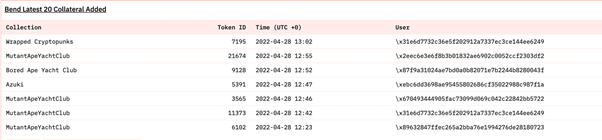
Figure 3. NFT list of Bend
Source: Dune Analytics
1)NFT loans
Why do we need an NFT lending service?
With the vigorous development of the NFT industry, the NFT market has reached a market value of more than US$10 billion in less than 4 years. ‘NFT’ was chosen as Collins Dictionary's word of the year for 2021. While it’s relatively straightforward to obtain the market price for cryptocurrencies like Bitcoin or Ether at any point in time, the vast majority of NFTs are illiquid and low-velocity - meaning they don’t change hands very often, much like physical collectibles and real estate in the “real world”. If liquidity can be improved, it will surely release more vitality and opportunities for the market.
Which NFTs can work?
Not every piece of NFT can be loaned.The project team needs to consider other parameters apart from bidding price to keep the lending pool viable.. Bend is a nice tool for NFT holders who wish to be able to actively participate in the DeFi ecosystem. However, it also exposes the protocol to volatility, The NFT collateral used in the lending pool affects the protocol and solvency at its core, that’s pretty much why currently only six NFT projects have permission to be in Bend’s lending pool.
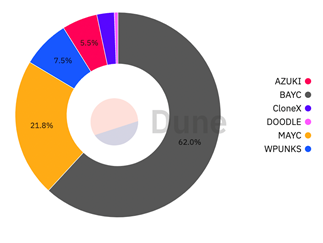
Figure 4. Bend collateral value
Source: Dune Analytics
Are there different collateral ratios among NFTs?
Short answer: yes. Because NFT markets are very volatile, different NFTs hold inconsistent valuations. Therefore, every project has its calculated standard of collateral ratio (a 60% to 70% range). And these follow a set of financial rules such as liquidation threshold (90%) and liquidation bonus(5%) according to their market performance and NFT projects’ valuations. The redemption duration and auction duration are equal (48 hours).
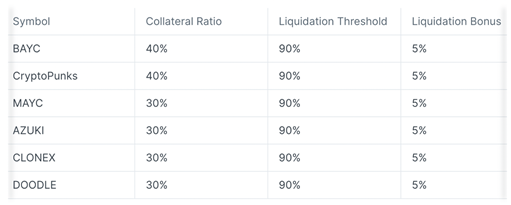
Figure 5. Collateral Ratio Standards
Source: BendDAO
Security
For crypto industry investors, security always comes first.
Bend claims that their boundNFT protocol the NFT in custody can never be stolen because the digital asset is designed to be untransferable. NFTs will be converted into representing ERC-721 boundNFTs through instant NFT loans. boundNFTs are untransferable and avoid the risk of theft. According to their official description, Bend has been running safely for 40 days, with an open audit report signed by CertiK.
2)How does it work on each side?
For NFT holders:
• NFT will be bundled into one separate token (boundNFT) through BendDAO Protocol
• boundNFT will function as a single unit of collateral
• borrow ETH through the lending pool instantly
For depositors/ lenders:
• Deposit/withdraw ETH to the reserve pools
• Earn yields by providing liquidity
From the depositors’ point of view, it’s akin to Yield Farming, a popular trend during the summer of 2020.
3)boundNFT protocol
NFT valuation has been a tricky and significant problem to solve liquidity-wise. .
Currently, Bend considers five different parameters in reference to the NFT Performance Map designed by nonfungible.com, and lists five key metrics. Trade Volume (Number of sales)
• Asset value (Average asset sales value)
• Interactions (Number of dApp transactions, including bids and other interactions)
• Community (Number of unique wallets interacting at the dApp level)
• Retention (Percentage of how many days a wallet is active during the time period, for example a retention rate of 14.3% indicates that users are only active one day a week).
Utilities of boundNFT
It is interesting to note the proclamation that the original NFT and boundNFT will function as a single unit, which essentially means borrowers will be eligible for the same related NFT airdrops as holders. Here are the four primary utilities of the boundNFT produced by the Bend protocol.
• As debt NFTs when minted and burned on borrow and repayment;
• To protect NFT owners from hacking by non-transferable and non-approvable;
• Same metadata as PFP for Twitter Blue;
• Get access to any of the airdrops, claimable & mintable assets by the project;
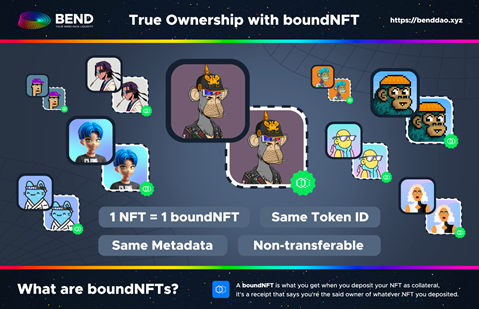
Figure 6. illustration of boundNFT
Source: BendDAO
4)Review
It was earlier posed that NFTs are enslaved by illiquidity and low velocitydespite being worth billions. , However, NFTs by nature are unique and in short supply, in addition to having particular cultures and communities intertwined within., Considering these aspects, BendDAO as an NFT lending protocol is definitely a viable approach. Although it still has a long way to go, considering the NFT financing industry is still a young one, it’s anyone’s guess which NFT oracle or protocol will win the race. But further considerations need to be taken into account.. For example, the lending duration is now set at only 48 hours, which considerably limits the NFT’s liquidation prospects NFT. Given the demands for safety, efficiency and flexibility, we may see more space for development such as NFT options trading only if major aspects such as the liquidation period are improved on. This is a problem for real-world mass adoption of NFTs as a trading asset. . It is hard to define liquidity for NFTs since different assets have differing t liquidity depending on an individual user’s needs. Some people might wish to swap it for another NFT, some might want to stake it in a liquidity pool (DeFi), and some might like to exchange it for cash. Nevertheless, NFT uptake is on the rise and will continue to boost the crypto world, especially when its decentralized financial potential is activated.
4. Calendar of future popular asset events
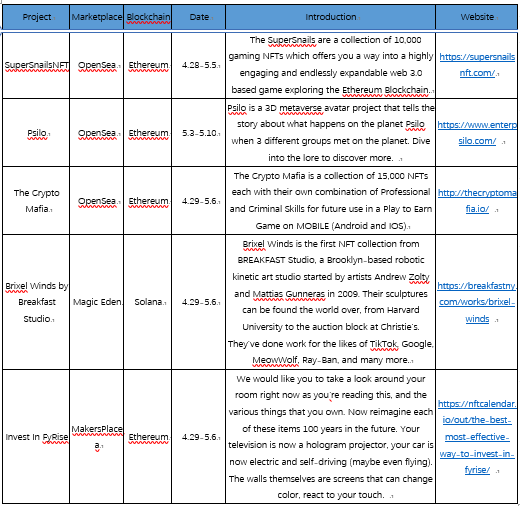
I. NTF mint Calendar
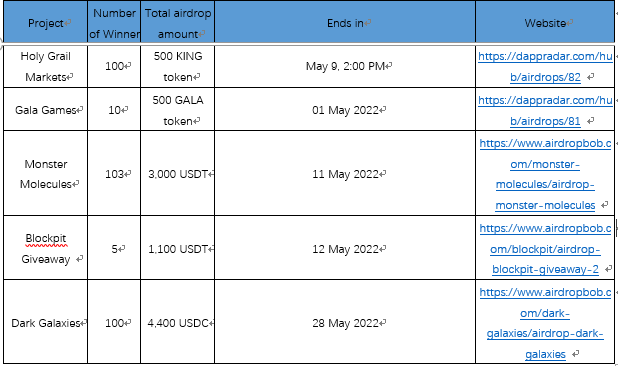
II. Token Airdrops
About Huobi Research Institute
Huobi Blockchain Application Research Institute (referred to as "Huobi Research Institute") was established in April 2016. Since March 2018, it has been committed to comprehensively expanding the research and exploration of various fields of blockchain. As the research object, the research goal is to accelerate the research and development of blockchain technology, promote the application of blockchain industry, and promote the ecological optimization of the blockchain industry. The main research content includes industry trends, technology paths, application innovations in the blockchain field, Model exploration, etc. Based on the principles of public welfare, rigor and innovation, Huobi Research Institute will carry out extensive and in-depth cooperation with governments, enterprises, universities and other institutions through various forms to build a research platform covering the complete industrial chain of the blockchain. Industry professionals provide a solid theoretical basis and trend judgments to promote the healthy and sustainable development of the entire blockchain industry.
Official website:
https://research.huobi.com/
Consulting email:
research@huobi.com
Twitter: @Huobi_Research
https://twitter.com/Huobi_Research
Medium: Huobi Research
https://medium.com/huobi-research
Disclaimer
1. The author of this report and his organization do not have any relationship that affects the objectivity, independence, and fairness of the report with other third parties involved in this report.
2. The information and data cited in this report are from compliance channels. The sources of the information and data are considered reliable by the author, and necessary verifications have been made for their authenticity, accuracy and completeness, but the author makes no guarantee for their authenticity, accuracy or completeness.
3. The content of the report is for reference only, and the facts and opinions in the report do not constitute business, investment and other related recommendations. The author does not assume any responsibility for the losses caused by the use of the contents of this report, unless clearly stipulated by laws and regulations. Readers should not only make business and investment decisions based on this report, nor should they lose their ability to make independent judgments based on this report.
4. The information, opinions and inferences contained in this report only reflect the judgments of the researchers on the date of finalizing this report. In the future, based on industry changes and data and information updates, there is the possibility of updates of opinions and judgments.
5. The copyright of this report is only owned by Huobi Blockchain Research Institute. If you need to quote the content of this report, please indicate the source. If you need a large amount of reference, please inform in advance (see "About Huobi Blockchain Research Institute" for contact information), and use it within the allowed scope. Under no circumstances shall this report be quoted, deleted or modified contrary to the original intent.