Author: San\Laoda | Deep Tide TechFlow
Search for "USDT" on Xianyu, and the page is blank. But change the keyword to "Sell USD Coin", and a hidden digital black market instantly unfolds.
Sellers use various homophones, code words, and images to evade platform supervision. "Those who know, know" is the passphrase here. Some hide contact information in the corners of images, while others directly post screenshots of exchange logos to prove they are "insiders".
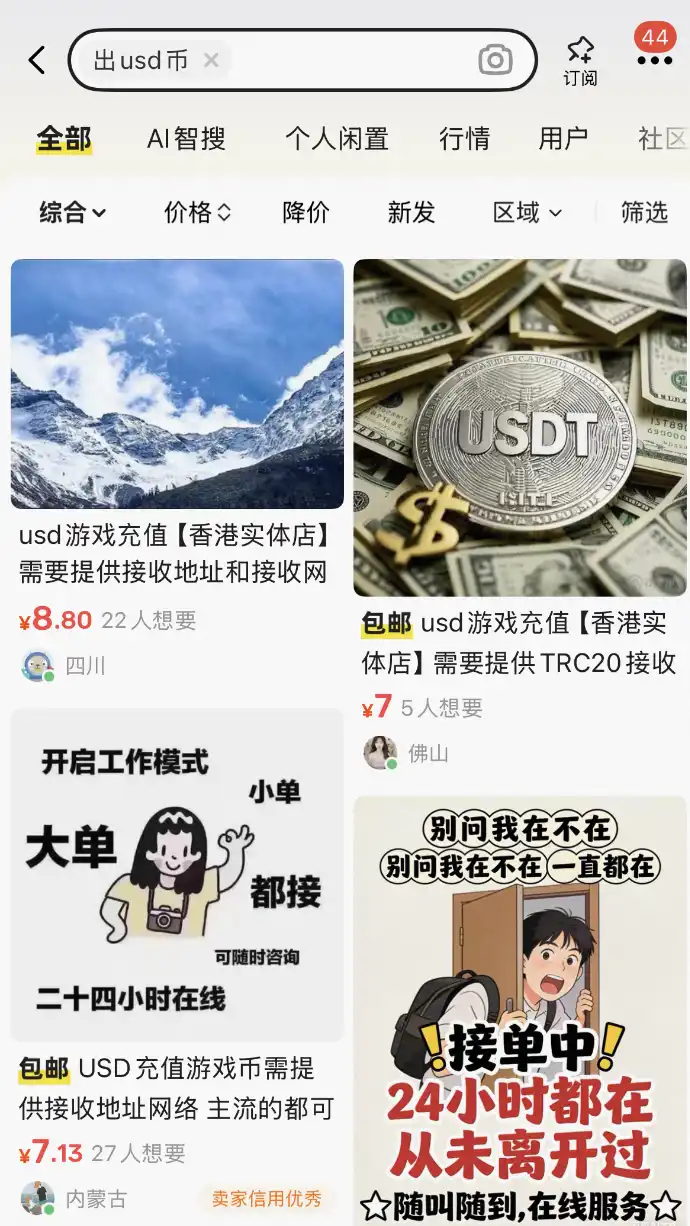
Crypto assets, highly sensitive and strictly restricted in public discourse, haven't truly disappeared. Instead, they've been disguised and folded into a more下沉 (down-market) platform.
"Buy/Sell USDT", "Step-by-step guide to downloading exchange apps", "Overseas ID for exchange KYC", "Binance alpha tutorial"... Here, you can almost buy a one-stop service for crypto guidance.
The digital black market extends far beyond crypto-related content: discounted air tickets, hotel bookings, reservations at热门 (hot) restaurants, concert内场 (inner field/vip) tickets, Soldier AI verification...
On social media, there's a saying:
"You can buy almost anything on Xianyu."
This is not an exaggeration.
The Hidden Crypto Business
In October 2025, the official X account of the Palau Republic's digital residency program rarely issued an announcement in Chinese.
"Recently, it has been discovered that individuals are publicly displaying forged Palau ID documents on social media and using them to bypass KYC verification processes on various platforms. This behavior constitutes serious identity fraud." RNS.ID officially announced that it would implement secondary reviews for all Palau ID users with Chinese pinyin names. Users failing verification would be marked as fraud objects and synchronized to global fraud databases.
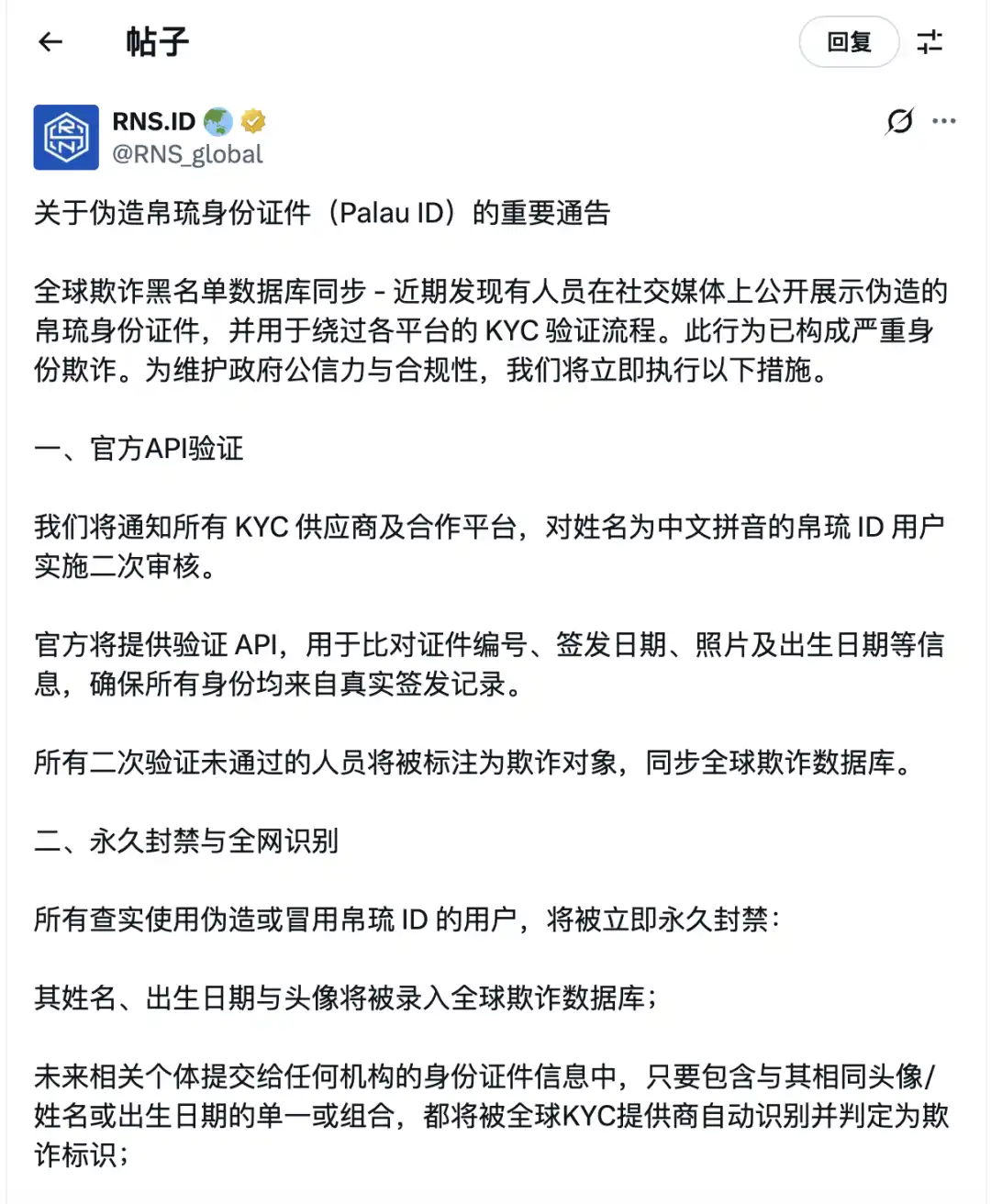
Why would this Pacific island nation's government specifically release a Chinese announcement? The answer lies in Xianyu's search results.
Entering keywords like "overseas identity" or "Palau ID" reveals an underground network for trading fake documents. Prices range from tens to hundreds of RMB, promising "100% pass rate for major exchange verification".
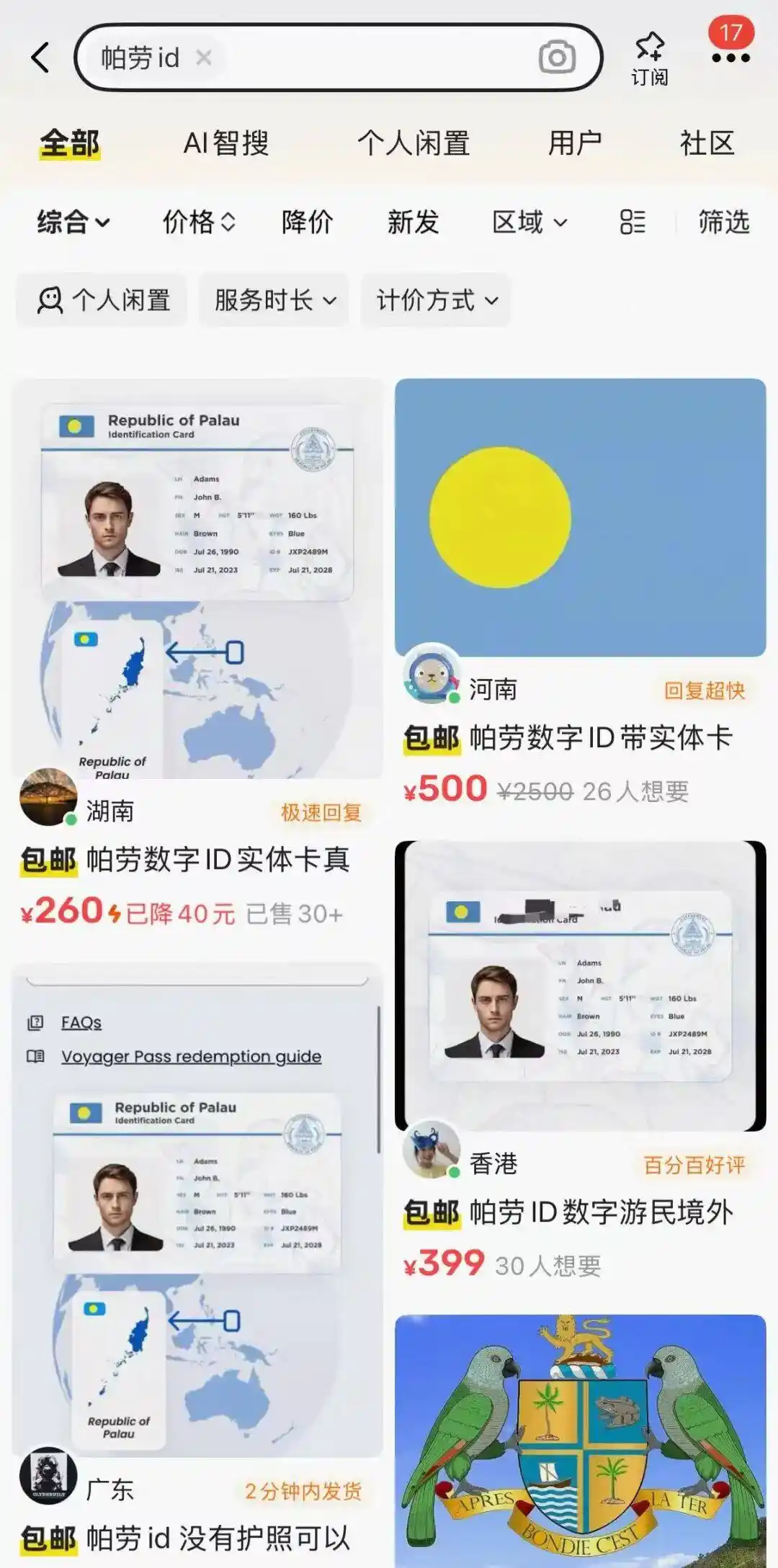
Besides Palau, documents from Dominica, Nigeria, the Philippines, and other countries are also hot commodities. The quality of these fake documents is constantly improving, with sellers offering customization services, using the buyer's real photos to ensure they pass facial recognition.
Beyond selling fake KYC documents, the Xianyu crypto black market has more zero-cost virtual services.
On Xianyu, an account named "Shenzhen Xiaoxia" once sold a 30-minute guidance service for downloading and installing Binance and OKX for 10 RMB. (Note: Currently delisted)
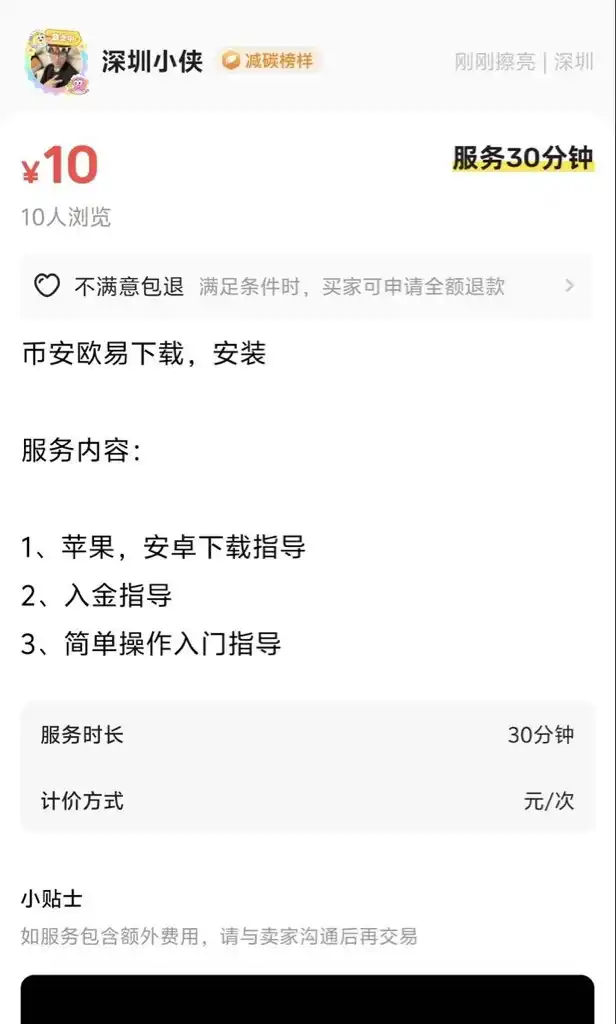
"Xiaoxia" is not a nobody; in the crypto world, this is a thunderous name, a top-tier KOL.
Not long ago, news of him buying Shenzhen's top luxury mansion, CITIC Xinyue Bay, while 60 million RMB in debt, was widely circulated in the industry.

Why would a crypto billionaire personally do "customer service" business for 10 RMB per order on Xianyu?
The 10 RMB tuition fee is just bait; the real income comes from referral commissions. Every user who registers through his link can bring him a share of the transaction fees in the future. An active user might generate hundreds or even thousands of RMB in revenue per month.
This 10 RMB business is an extremely low-cost fishing rod. The other end of the rod connects to a vast, sustainably monetizable pool of traffic.
If "Xiaoxia's" business is an open scheme, more sellers are doing a purer form of "chipping away at the wall" of information asymmetry.
A product priced at 88 RMB, "Binance Alpha Beginner Tutorial", offers one-on-one online lessons, promising "hand-holding guidance, worry-free and effort-saving". The so-called "Alpha" usually refers to activities launched by platforms like Binance that allow users to earn potential airdrop rewards by completing tasks.
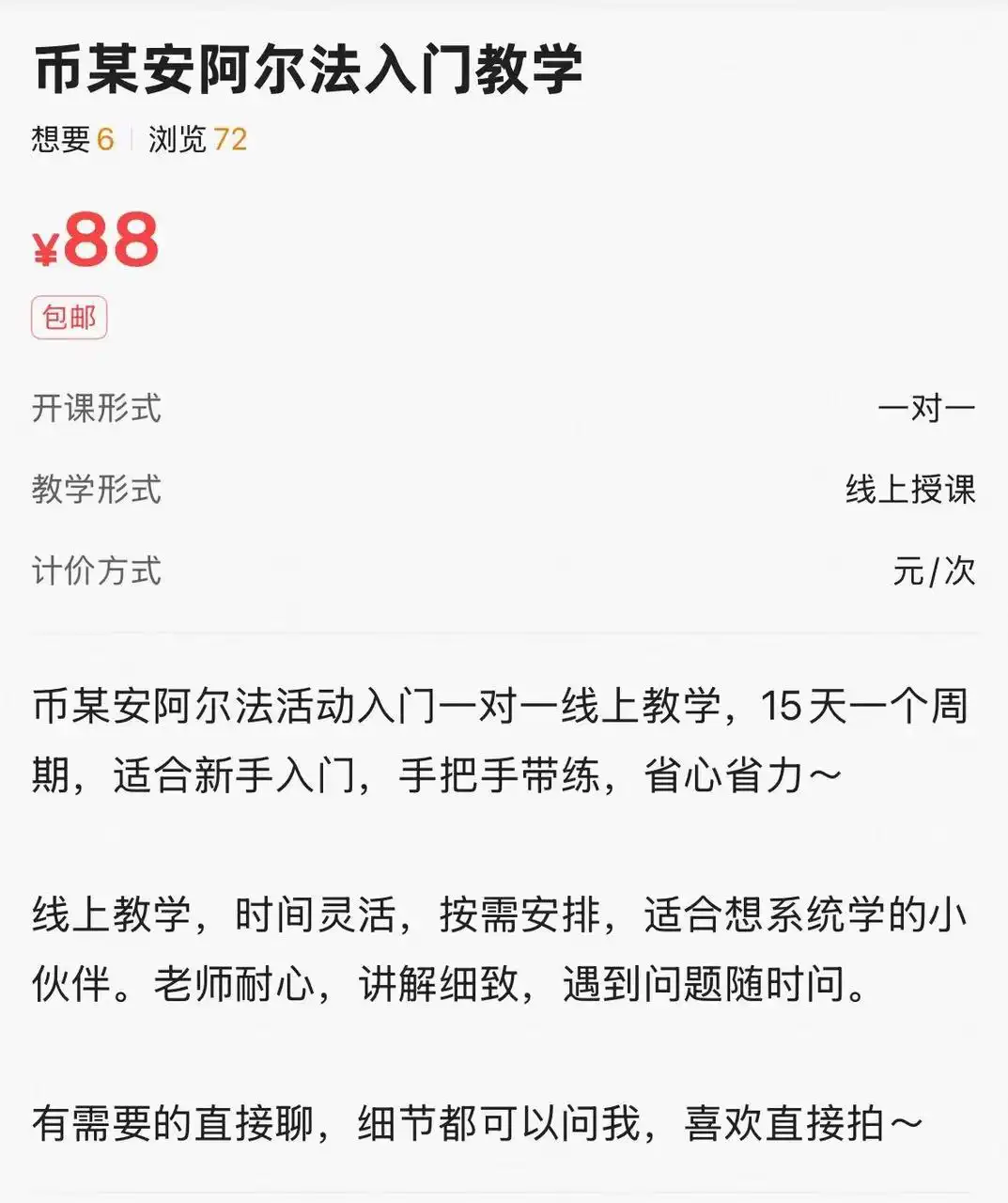
The methods for participating in these activities are already open secrets on platforms like X and YouTube, where countless bloggers share detailed guides for free. But for most domestic users, the wall built by language, internet environment, and information channels is very real.
One buyer commented, "The seller is very helpful, much more convenient than figuring it out myself."
AI "Arsenal"
If crypto trading is just a small "darkroom" opened up in this folded space of Xianyu, then the trade surrounding AI is a truly massive,全民参与的 (nationwide participating) "digital arsenal".
When names like ChatGPT and Claude exploded globally, an invisible wall also rose. Complex registration processes, network environment issues, and the barrier of credit card payments kept the vast majority of curious Chinese users out. They could see the绚烂烟火 (brilliant fireworks) of the new world but couldn't find the entrance.
Xianyu unexpectedly became the folk path绕过高墙 (bypassing the high wall).
The "arms dealers" here offer全套服务 (full-service packages) from入门到精通 (beginner to master).
The most basic commodity is "accounts" – a ready-made GPT or Claude account, priced from tens to over a hundred RMB, often with follow-up monthly top-up services.
Which overseas AI applications and large models are hottest in the market? Just look at Xianyu.
In 2025, when the AI app Manus (now acquired by Meta for $2 billion) burst onto the scene, beta access codes were extremely scarce. On Xianyu, the price of beta codes soared from a few hundred RMB initially to thousands, even tens of thousands overnight. At its peak, someone even listed an astronomical price of "one hundred thousand RMB", which contributed to Manus's massive出圈 (breakout into mainstream awareness).
Currently, the hottest AI products on Xianyu are Gemini and ChatGPT.
The $20 monthly subscription fee for the Plus version is enough to dampen the enthusiasm of many ordinary people.
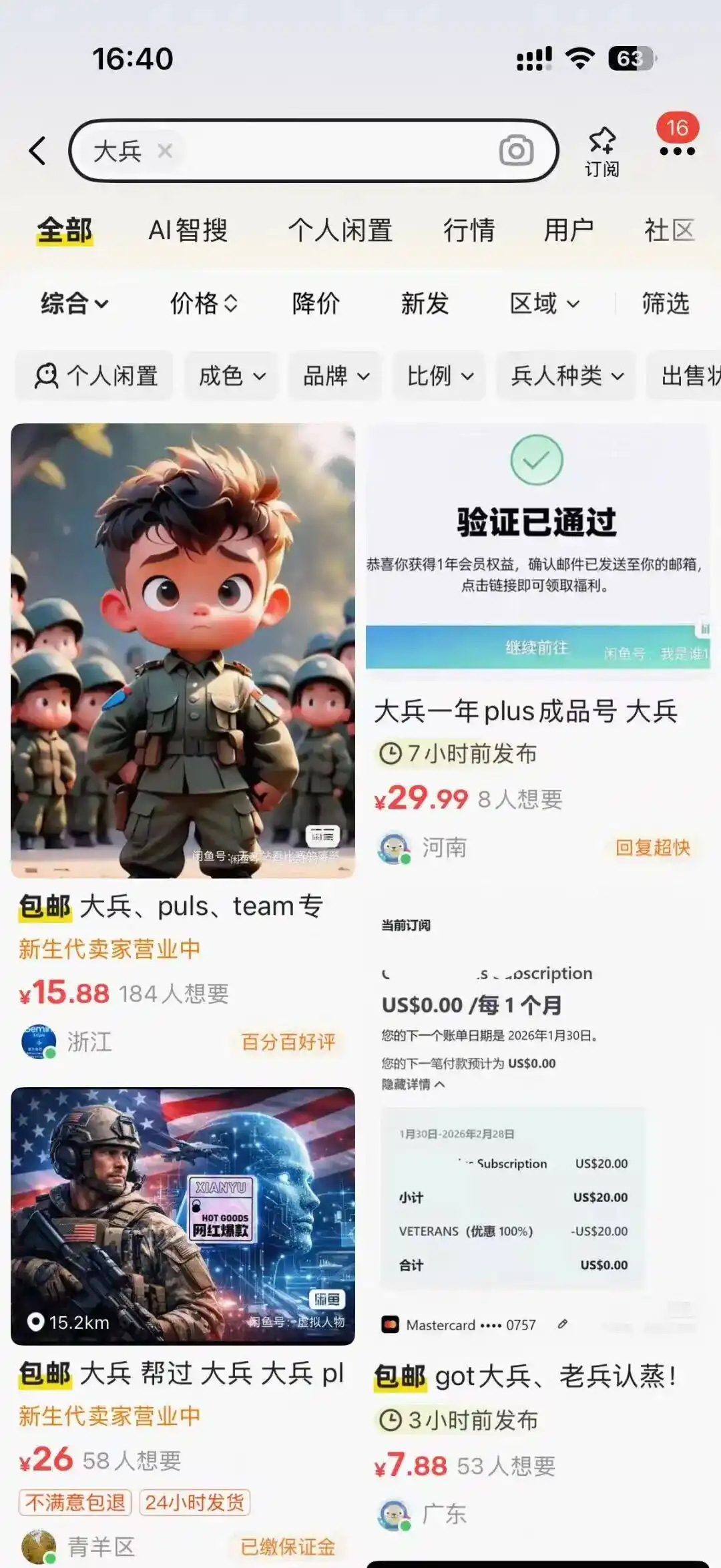
However, Google offers a one-year free福利 (benefit) for students, and OpenAI launched a福利活动 (benefit campaign) for US military veterans and active-duty personnel, offering a free year of ChatGPT Plus. This small act of policy goodwill was developed by a group of敏锐的卖家 (keen sellers) on Xianyu into a规模化 (scaled) business.
Search for "大兵" (soldier) on Xianyu, and a peculiar cyber spectacle unfolds. Product covers feature various cartoon soldiers or tough guy images, with product names full of默契的黑话 (tacit understanding slang): "Soldier help get verified!", "Soldier one-year plus ready-made account", priced from a few RMB to几十块 (dozens of RMB).
One Xianyu user mentioned on social media: "Xianyu is currently the largest AI training base in the Chinese-speaking world. Without Xianyu, most Chinese people simply couldn't use top-tier international AI models."
This statement is full of contradictions, yet incredibly realistic.
Xianyu, a platform originally meant for trading second-hand goods, thus inadvertently assumed the role of "enlightener" and "popularizer" for top-tier international AI models in China.
Buying Everything
Whether it's crypto trading or AI services, this is still just the tip of the iceberg of Xianyu's digital black market.
"Humanity's development of Xianyu is less than one percent," someone commented, calling Xianyu the Chinese version of the dark web.
The "dark" of Xianyu doesn't solely refer to blackness, but more to the absurdity. A large number of捞偏门 (unconventional/edge) and "underground industries" rarely seen in daily life have taken root and sprouted on the platform.
Some products are so abstract, even匪夷所思 (unimaginable), that they become a source of amusement on social media.
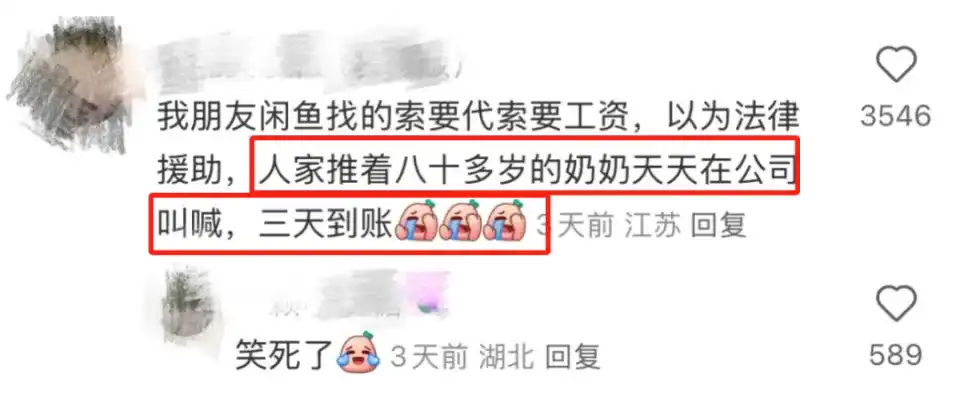
What should a worker do if maliciously owed wages?
Someone went on Xianyu and found low-cost legal aid. Unexpectedly, the merchant directly sent out an over-80-year-old grandma to fight, employing tactics like crying, making a scene, and threatening suicide. The wages arrived in three days.
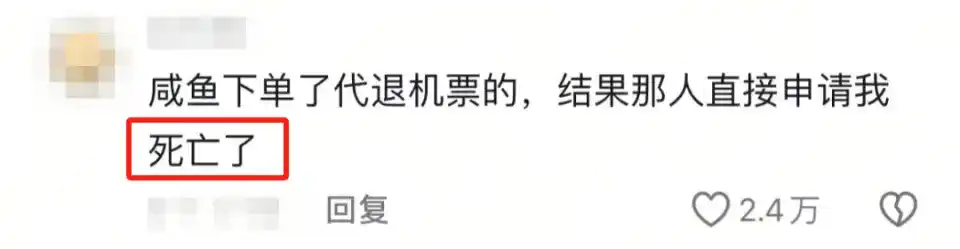
Someone wanted to refund an airline ticket and sought help on Xianyu, directly receiving a "death certificate".
On Xianyu, we see not just needs and transactions, but perhaps the most authentic field research of the Chinese internet.
In this field grows the most vigorous "wild wisdom".
It doesn't follow the elegant rules of the commercial world,信奉 (believing in) only the highest principle of "solving problems". When正规渠道 (official channels) cannot meet demand, or the cost is too high,民间创造力 (folk creativity) gushes out in a raw, even darkly humorous way.
Xianyu's digital black market presents a真实切片 (real slice) of contemporary Chinese society. Here, there is no glossy brand packaging, but there are the most authentic slices of human nature: speculation, cutting corners, laziness, despair, and the instinct to survive in the cracks of the rules.
However, when the path to solving problems slides into deeper gray areas, the subject of the transaction reaches its endpoint: the person themself.
If hiring an old lady is renting "someone else's performance", then the most dangerous business on Xianyu is renting out "your own identity".
"Selling新人 (newbie), exchange", "Stably recycling exchange accounts, KYC passed, long-term cooperation", "Long-term buying新人扫码注册 (newbie scan code registrations)"... These notices赤裸地 (nakedly) package and sell a person's KYC identity in the digital world. The seller's rhetoric is highly seductive, with some包装 (packaging) this behavior as being a "digital landlord", misleading users into thinking they are merely activating "idle assets" to easily achieve "lying down and earning".
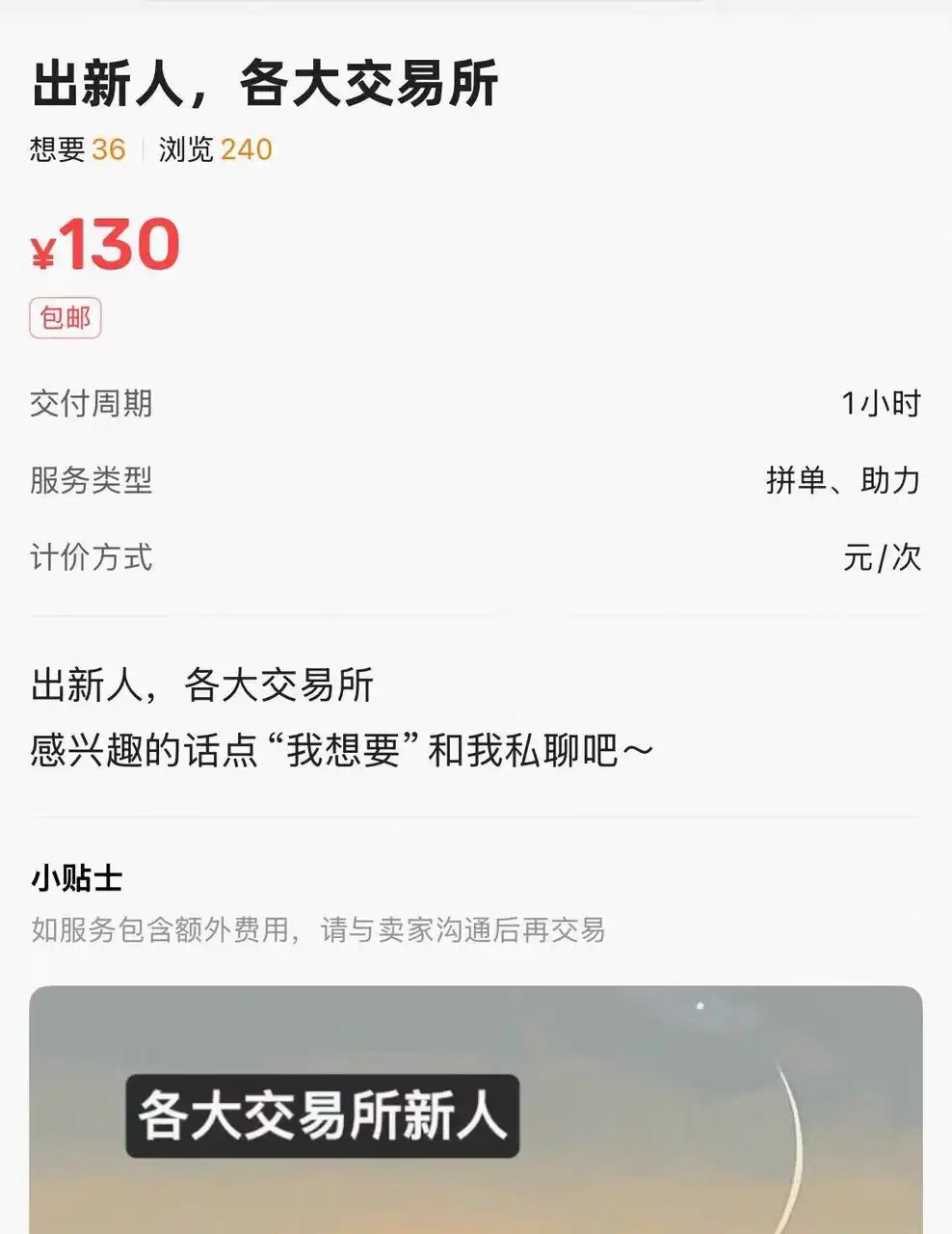
However, an account rented or sold by a novice could become a tool for telecom fraud or money laundering gangs.
From buying a tutorial, to buying an account; from hiring someone to solve your troubles, to renting yourself out to trouble itself. This bizarre chain of transactions ultimately forms a terrifying closed loop.
We start by using money to buy convenience, and end up walking all the way to exchanging ourselves for money.
This fantastical digital soil is both the "folk infrastructure" for ordinary people to bypass barriers and obtain resources, and a dark forest潜伏着 (lurking with) countless traps. It proves in the most extreme way that any suppressed demand will not disappear, but will only emerge in corners untouched by rules, in more primitive and dangerous ways.
Here, convenience and cost are tagged with the same price. You think you're just taking a shortcut, only to find that the end of the shortcut might also be a cliff.
Original article link