Written by: Jesus Rodriguez, Co-founder of Sentora
Compiled by: Luffy, Foresight News
Discussions of the RWA industry often start with a simple vision: take a treasury bill, fund share, stock, invoice, megawatt-hour, or an hour of GPU computing, and mint a token representing it.
Does it work? Yes, it does. Is it transformative? Not yet.
It's like proclaiming that global trade problems are solved by putting a barcode on a shipping container. The barcode makes the container identifiable and machine-readable, but it doesn't magically create ports, cranes, customs, insurance, financing, shipping lanes, or buyers in distant lands.
A token is simply an addressable rights certificate, while DeFi is a market operating system. The truly worthwhile question to explore is not how many types of assets can be tokenized, but how many assets can, under stress, undergo valuation, financing, hedging, trading for liquidity, and loss disposal, without requiring a physical meeting for coordination every time a transaction occurs.
Tokenization achieves the representation of rights; DeFi delivers the actual utility.
Tokenization is Just the Barcode, Not the Supply Chain
A similar scene has already played out in financial market history. The scale of mortgage lending was not achieved simply by turning paper certificates into electronic records. True scale emerged when an entire operational system was built around such assets: credit underwriting, loan servicing, securitization, credit ratings, warehouse financing, repos, hedging, clearing and settlement, and loss allocation rules.
RWA needs to undergo the exact same evolution.
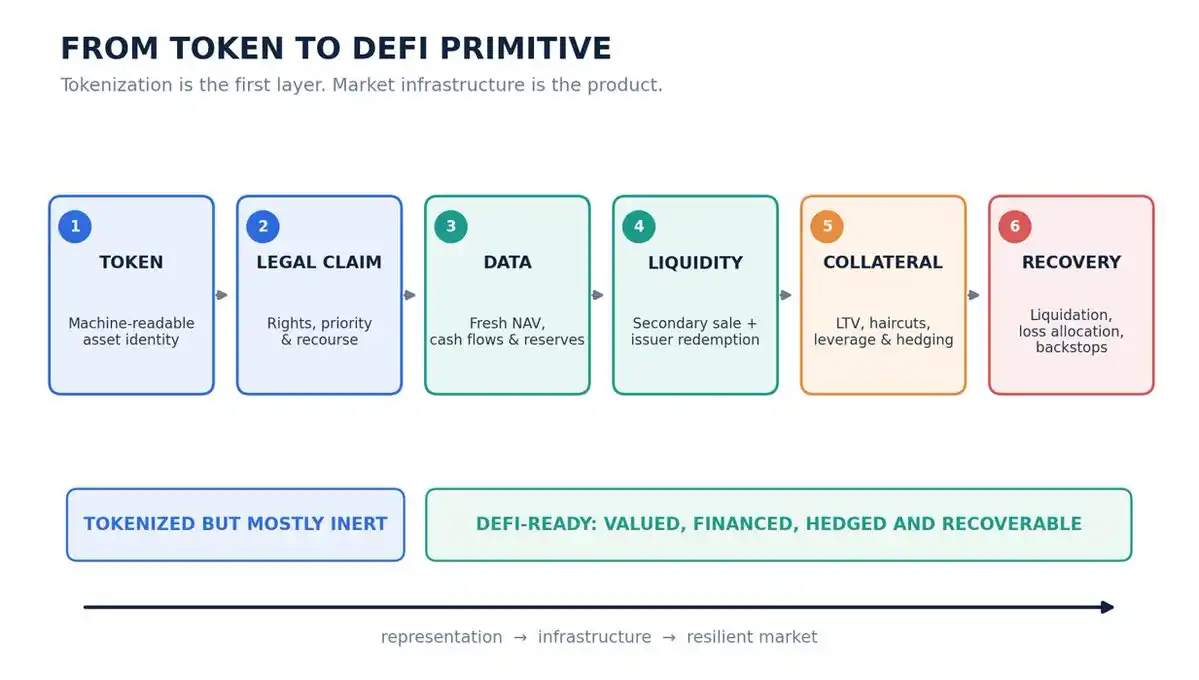
An asset truly compatible with DeFi requires six layers: legally enforceable rights, reliable data sources, clear transfer and redemption rules, executable secondary market liquidity, realistic collateral parameters, and credible liquidation and loss disposal pathways.
Most tokenization projects, however, often stop at the first five layers.
A simple test can gauge an asset's maturity by answering three questions:
- What is this asset worth right now?
- Can the protocol exit and liquidate its position at this moment?
- If both of the above judgments are wrong, who bears the loss?
When a smart contract can deterministically answer these three questions, RWA can truly be considered a foundational financial component. Until then, it is often merely a layer of digital packaging.
The Four Time Clocks of RWA
The deepest technical contradiction is that RWA operates simultaneously on multiple, different time clocks.
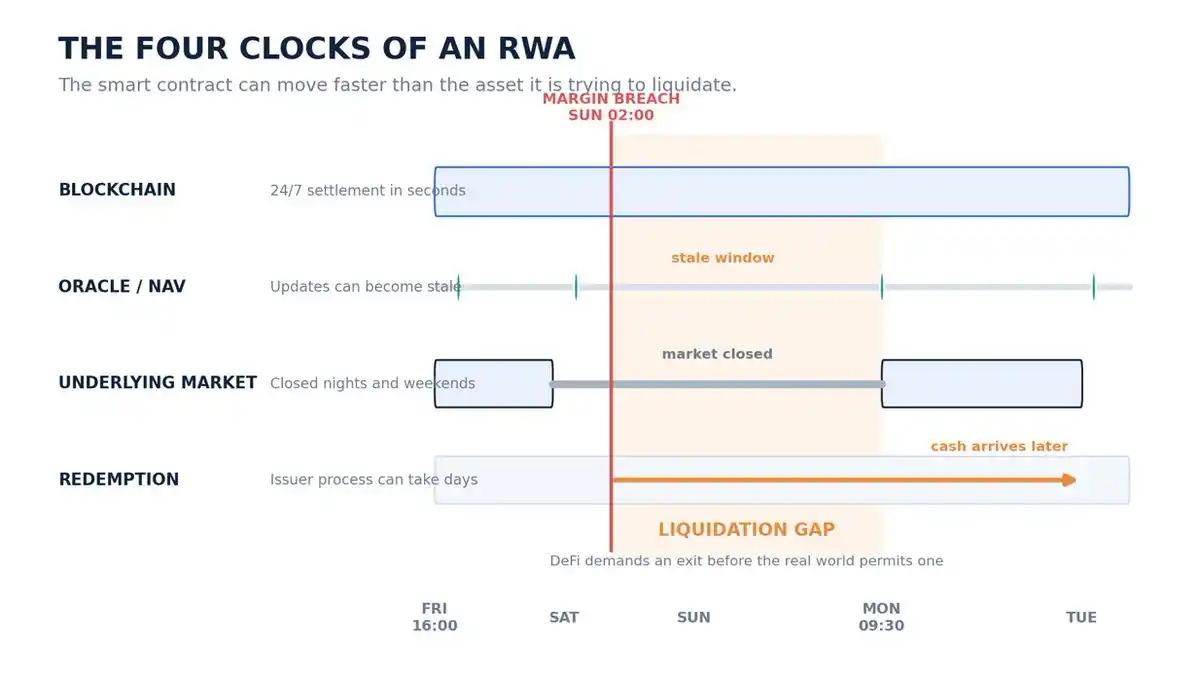
Blockchain settles in seconds, running 24/7. Oracles may update prices hourly or daily. Underlying traditional exchanges close in the evenings and on weekends. Custodians follow banking business days. Asset redemption processes can take 1 day, 5 days, or even 30 days.
Now imagine using such a slow-paced RWA asset to support fast-maturing liabilities on the DeFi side, such as stablecoin loans.
This is maturity transformation, the core model that banks have relied on for centuries: using short-term liabilities to fund long-term, slow-moving assets. This model has practical value, but its risks must be properly priced.
Consider this scenario: at 2 AM on Sunday, an asset hits the liquidation threshold. The smart contract can immediately seize the token, but the underlying real-world market doesn't open until Monday, and the issuer's redemption desk doesn't operate until Tuesday. On-chain liquidation is complete, while real-world asset disposal has just begun.
This creates a liquidation gap—the time difference between DeFi demanding immediate liquidation and the real world not permitting it.
This gap leads to a counterintuitive result: even low-volatility tokenized treasuries used as collateral can be riskier than more volatile crypto-native assets. ETH prices swing wildly but can be traded around the clock; RWA asset prices may appear stable, possibly just because they haven't been marked-to-market for over a dozen hours. A smooth price curve can signal safety, but sometimes it's just a disguise for stale data.
Liquidity is the Exit, Not the TVL Number
There is also a widespread misunderstanding about liquidity.
Liquidity is not TVL, not the existence of a trading pair, nor the issuer's promise to eventually redeem at net asset value. Liquidity refers to the ability, within the time window your liabilities allow, to convert your position into the settlement asset you need, at an acceptable discount.
Use the analogy of a crowded theater: the size of the lobby doesn't indicate safety in a fire; what truly matters is the width of the exit corridors.
An RWA should have at least three exit paths: selling to other market participants, requesting redemption from the issuer, and using the asset as collateral for borrowing to postpone selling. Each path has different latencies, absorption capacities, access restrictions, and potential failure modes.
Market makers willing to hold RWA inventory over the weekend are essentially bridging the gap between the two financial clocks. This balance sheet service should be clearly identified and compensated accordingly.
Therefore, our strategic models should calculate exit value under stress scenarios, not the official book Net Asset Value. That is, the actual realizable price after spreads widen, market makers reduce inventory, redemptions queue up, and stablecoin funding costs surge.
The truly important question is not "What was this asset worth yesterday?" but "How much cash can this position fetch before the protocol loses tolerance?"
Leverage Creates Utility, But Also Plants Fragility
Tokenization grabs most media headlines, but real economic utility comes from leverage.
A house becomes high-value collateral through a mortgage. Treasuries become foundational market instruments via the repo market. The value of stocks is fully unlocked when they support margin trading, lending, shorting, and hedging.
Once an RWA can be used as collateral to borrow stablecoins, it ceases to be merely a tokenized object and becomes balance sheet-level infrastructure. But leverage is also where hidden assumptions turn into real losses.
Collateralization ratios cannot be based solely on historical volatility. The discount factor must also incorporate legal enforceability, oracle data freshness, redemption delays, concentration levels, market maker absorption capacity, custodian risk, governance permissions, and correlation with the funding asset.
This leads to counterintuitive conclusions: in certain market environments, tokenized treasuries should have lower collateralization ratios than ETH. Not because the treasury's economic risk is higher, but because its liquidation and disposal mechanisms are slower and less battle-tested.
DeFi risk is not just the risk of the asset itself, but the asset risk multiplied by the market structure risk.
RWA Risk is a Relationship Graph
Traditional finance manages risk through periodic reports and manually upgraded disposal processes. DeFi needs something more akin to an airplane cockpit: continuous indicator monitoring, explicit risk thresholds, and automatic responses before the engine catches fire.
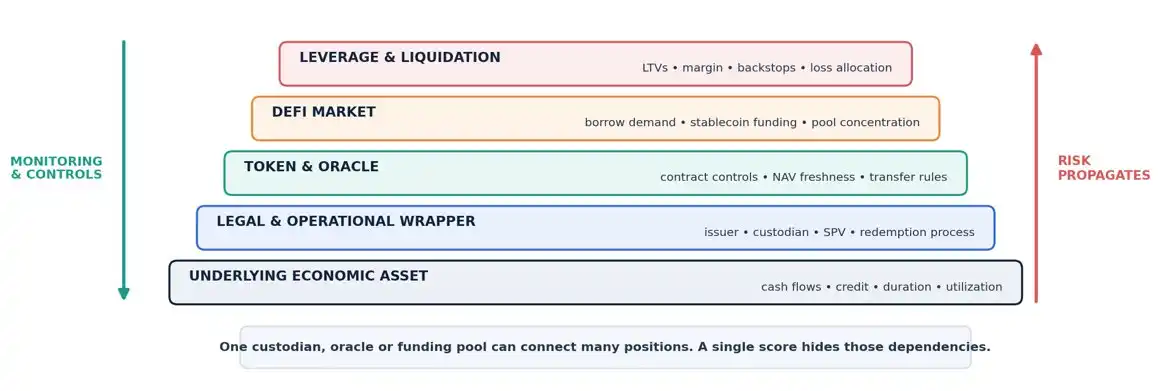
RWA risk should not be compressed into a simple score but modeled as a relationship graph.
Graph nodes include underlying cash flows, legal entities, issuers, custodians, oracles, secondary markets, redemption mechanisms, stablecoin liquidity pools, lending protocols, governance keys, and backstop capital; the edges between nodes represent dependency relationships.
Risk failures rarely occur in isolation. A single custodian may serve multiple tokens, an oracle feeds prices to multiple pools, one stablecoin underpins a large amount of leveraged positions. A minor operational failure can propagate through the relationship graph, ultimately escalating into a liquidity crisis.
Our approach is to integrate asset research, strategy construction, continuous monitoring, exposure management, and risk protection into a complete operational loop. The system needs to continuously monitor redemption queues, market depth, concentration of holdings, borrowing utilization, oracle deviation, reserve changes, deteriorating cash flows, and market maker behavior.
The first wave of risk signals often appears off-chain before being reflected in token prices. Waiting for a price drop to act is like waiting to see smoke before checking if the wiring is overheating.
Treasures are the Gateway, Not the Final Destination
Tokenized treasuries are a natural entry point. The product is standardized and easily understood by the masses. Using a networking analogy, it's the ping test packet of the RWA economy: used to verify if the entire settlement chain—custody, minting, redemption, compliance, pricing—can be connected.
But a financial internet that only transmits short-term treasuries has limited ambition. The more promising frontier lies in computing power and energy assets.
Compute RWA can represent GPU hardware, leasing receivables, pre-purchased compute hours, utilization rate revenue, or data center operator revenue rights. It comes with a completely different risk set, overlaying equipment financing leases, commodity pricing, technological obsolescence depreciation, and actual operational performance. A new generation of chips can change a GPU's revenue curve overnight; its economic aging far outpaces that of a physical building.
Energy assets also face definitional challenges: does this token represent infrastructure? A Power Purchase Agreement (PPA)? A megawatt-hour of electricity? Grid capacity? Project revenue? Or a green credit certificate? Each requires a dedicated oracle solution and liquidation contingency plan.
DeFi can take slow, locally constrained traditional market assets and build programmable revenue distribution, transparent collateral pools, global distribution channels, and dynamic financing tools. But the token must precisely map the underlying economic logic. "Backed by energy assets" in itself does not constitute a risk model.
Tokenized Stocks and Perpetual Contracts
Tokenized stocks will be the largest practical test, connecting two massive systems: global equity ownership and crypto-native leverage.
The primary question is not "Which stocks are already on-chain?" but "What exactly does the holder own?" Direct ownership, revenue rights, structured notes, synthetic tracking products—while price movements may be similar, the associated voting rights, dividends, corporate actions, redemption rights, and bankruptcy outcomes are completely different.
And then come perpetual contracts.
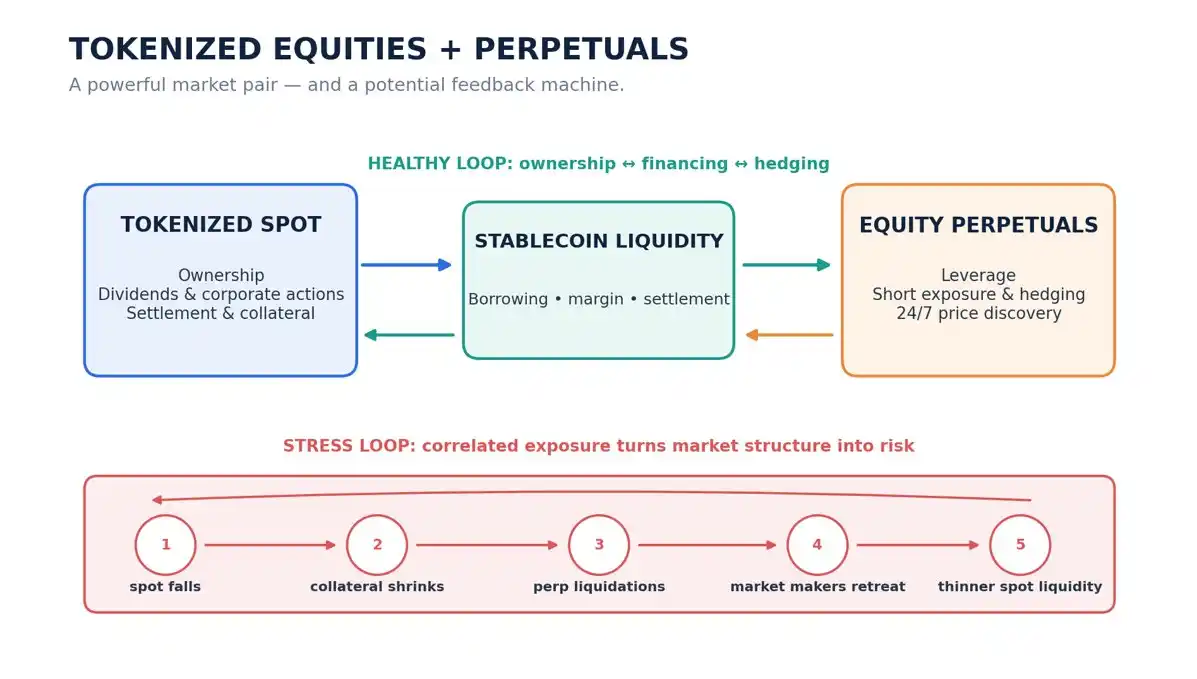
Tokenized spot stocks and stock perpetual contracts should complement each other, much like the spot and futures markets for commodities. The spot anchors ownership, dividends, settlement, and collateral; perpetuals provide leverage, short exposure, hedging, and continuous price discovery. Together, they enable rich market expressions not possible with either product alone.
But they also create highly correlated risks.
Imagine tokenized stocks used as collateral to borrow stablecoins, with the borrowed funds then used to open leveraged long positions in perpetuals of the same stock. The underlying US market is closed over the weekend, token prices drop, collateral assets shrink, triggering perpetual liquidations, market makers retreat, further depressing prices in an already thin spot market.
The solution lies in architectural design: isolated margin domains, concentration limits on holdings, dynamic weekend collateral discounts, liquidity-aware oracles, circuit breakers, cross-market monitoring, and clear backstop capital.
High efficiency doesn't mean the absence of constraints; it means placing constraints where the system is most likely to fail.
The Market System Beyond Tokens
So, without DeFi, does RWA still have meaning?
Yes, but its value is limited. Tokenization can optimize distribution, settlement, transparency, and investment access. But the truly significant opportunity arises the moment the asset enters an open, programmable capital market: the asset becomes collateral, gaining access to financing, enabling hedging, and constructing various structured strategies.
An RWA is truly compatible with DeFi not at the moment of token minting, but when the entire market ecosystem built around it can withstand a risk-fueled weekend.
This is our core argument. The next phase is not about piling up more RWA token logos, but about building the operational layer that transforms legally enforceable rights certificates into resilient financial strategies.
The long-term vision is not "everything can be tokenized," but that physical production assets can be addressed and utilized by software, capital can flow seamlessly between asset classes, and risks are managed at the speed of the market itself.
The token is just the barcode. The market is the machine that truly runs.