Stop Staring at GPUs: CPUs Are Becoming the 'New Bottleneck' in the AI Era

marsbitXuất bản vào 2026-04-13Cập nhật gần nhất vào 2026-04-13

Tóm tắt

In the AI era, while GPUs have long been the focus for computational power, the narrative is shifting as CPUs are increasingly becoming the new bottleneck. By 2026, system performance is more dependent on execution and scheduling capabilities, with CPUs playing a critical role in enabling AI operations. A supply crisis is emerging, with server CPU prices rising about 30% in Q4 2025 due to high demand and production constraints, as GPU orders compete for limited semiconductor capacity. Companies like Google and Intel have deepened collaborations, and Elon Musk is investing in custom CPU solutions for his ventures, highlighting the strategic importance of CPU infrastructure. The shift is driven by the rise of agentic AI, where CPUs handle tasks such as multi-step reasoning, API calls, and data I/O, accounting for 50–90.6% of total latency in intelligent workloads. Expanding context windows in AI models further strain GPU memory, necessitating CPU offloading for key-value cache management. Major players are adopting varied strategies: Intel is strengthening its Xeon processor line and partnerships; AMD is benefiting from increased demand, with server CPU revenue surpassing 40%; and NVIDIA is designing CPUs like Grace to optimize GPU-CPU synergy through high-speed interconnects. The industry is witnessing a rebalancing of compute infrastructure, with CPUs gaining prominence as essential enablers of scalable AI agent systems. By 2030, the CPU market is projected to double to ...

In the years of AI's rapid advancement, the industry has been largely dominated by one logic: computing power determines the ceiling, and GPUs are the core of that computing power.

However, entering 2026, this logic is beginning to shift: model inference is no longer the sole bottleneck; system performance increasingly depends on execution and scheduling capabilities. GPUs remain important, but the key factor determining whether AI can 'run' is gradually shifting to the long-overlooked CPU.

On April 9th, US local time, Google and Intel reached a multi-year agreement to deploy Intel's 'Xeon processors' at scale in global AI data centers, precisely to break this bottleneck. Intel CEO Pat Gelsinger (Note: The original Chinese name 陈立武 is likely a misattribution; the current CEO is Pat Gelsinger) stated bluntly that AI runs on the entire system, and CPUs and IPUs are the key to performance, efficiency, and flexibility. In other words, the CPU, which has been treated as a 'supporting role' for the past two years, is now choking the 'neck' of AI scaling.

Intel CEO Pat Gelsinger stated on social media: Intel is deepening its collaboration with Google, expanding from traditional CPUs to AI infrastructure (such as IPUs), to jointly advance AI and cloud computing capabilities.

The CPU is no longer just a passive supporting component but is becoming one of the key variables in AI infrastructure.

01

A 'Silent' Supply Crisis

While everyone was watching GPU delivery cycles, the tension in the CPU market had already quietly peaked.

According to the latest reports from multiple IT distributors, in the fourth quarter of 2025, the average selling price of server CPUs increased by about 30%. Such an increase is very rare in the relatively mature CPU market.

AMD's Data Center Group head, Forrest Norrod, revealed that CPU demand growth over the past three quarters has been beyond imagination. Currently, AMD's delivery lead times have extended from the original eight weeks to over ten weeks, with some models even facing delays of up to six months.

This shortage is primarily caused by a 'secondary effect' triggering a resource crunch. Industry insiders indicate that due to the extreme tightness of TSMC's 3nm production lines, wafer capacity originally allocated for CPUs is constantly being squeezed out by more profitable GPU orders. This has led to an ironic situation: AI labs have enough GPUs but find they cannot buy enough top-tier CPUs on the market to 'drive' these graphics cards.

Among those caught in this wave of CPU buying frenzy is Elon Musk.

Intel CEO Pat Gelsinger confirmed on social platforms that Musk has commissioned Intel to design and manufacture custom chips for his 'Terafab' project in Texas. This massive project aims to provide a unified computing base for xAI, SpaceX, and Tesla.

Musk's trust in Intel is largely because Intel is trying to embed itself into every layer, from ground-based data centers to orbital computing in space.
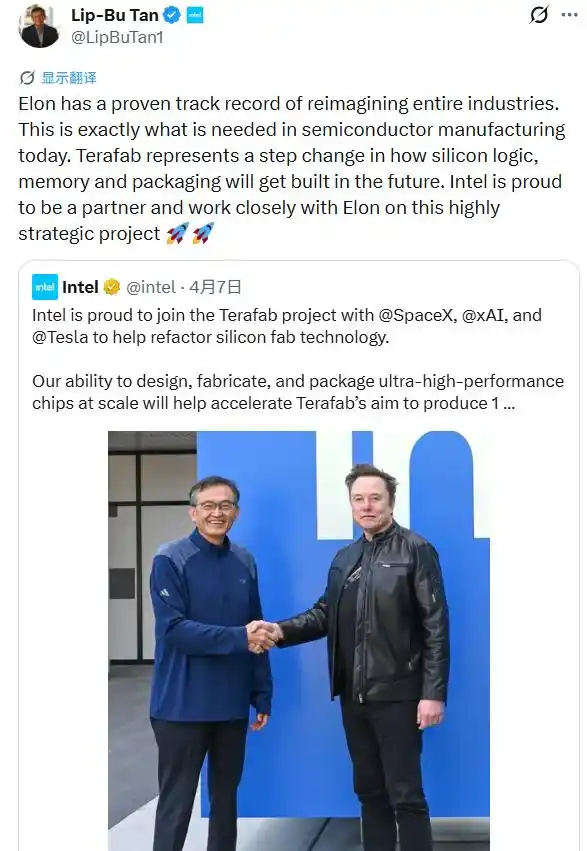
For Intel, this is undoubtedly a shot in the arm. Some industry analysts predicted that AMD's revenue share in the server CPU market would surpass Intel's in 2026, but Intel's deep inertia and manufacturing capabilities within the x86 ecosystem remain chips that major customers like Musk cannot ignore.

This kind of deep cross-industry bundling is elevating the competition in the CPU market from a pure parameter contest to a game of ecosystem and supply chain stability.

02

Why Has the CPU Become the 'Bottleneck'?

The core reason the CPU has suddenly become a bottleneck is that the work it needs to handle has fundamentally changed in the age of agents.

In the traditional chatbot model, the CPU is primarily responsible for scheduling and data processing, while the GPU handles the core inference computation. Since compute-intensive tasks are concentrated on the GPU side, overall latency is usually dominated by the GPU, and the CPU rarely becomes a performance bottleneck.

But agent workloads are completely different. An agent needs to perform multi-step reasoning, call APIs, read and write databases, orchestrate complex business flows, and integrate intermediate results into a final output. Tasks like search, API calls, code execution, file I/O, and result orchestration mostly fall on the CPU and host system side. The GPU is responsible for token generation (i.e., 'thinking'), while the CPU is responsible for translating the 'thoughts' into actual actions.

A paper published by Georgia Tech scholars in November 2025, 'A CPU-Centric Perspective on Agentic AI,' quantified the latency distribution in agent workloads. The study found that the time consumed by tool processing on the CPU side accounts for 50% to 90.6% of the total latency. In some scenarios, the GPU is ready to process the next batch of tasks while the CPU is still waiting for tool calls to return.

Another key factor is the rapid expansion of context windows. In 2024, mainstream models mostly supported 128K to 200K tokens. Entering 2025, models like Gemini 2.5 Pro, GPT-4.1, and Llama 4 Maverick began supporting over 1 million tokens. The KV cache (Key-Value Cache, used to accelerate the Transformer model inference process) grows linearly with the number of tokens, reaching about 200GB at 1 million tokens, far exceeding the 80GB VRAM capacity of a single H100.

One solution to this problem is to offload part of the KV cache to CPU memory. This means the CPU must not only manage orchestration and tool calls but also help bear data that doesn't fit in VRAM. CPU memory capacity, memory bandwidth, and the interconnect speed between the CPU and GPU thus become critical to system performance.

Therefore, CPUs suited for the agent era require low latency, consistent memory access capabilities, and stronger system-level协同 capabilities, rather than单纯 core count expansion.

03

What Are the Vendors Doing? Some Grab Territory, Others Change Designs

Faced with this sudden surge in CPU demand, the major players have completely different strategies.

Intel is the traditional leader in server CPUs. Data from Mercury Research shows that in Q4 2025, Intel still held a 60% share of the server CPU market, AMD had 24.3%, and Nvidia had 6.2%. But Intel has been playing catch-up with new technologies in recent years; this CPU demand explosion is both an opportunity and a test for them.

Intel's current strategy is a two-pronged approach. On one hand, continue selling Xeon processors, deeply绑定 with hyperscale customers like Google; on the other hand, partner with SambaNova to launch a combined solution based on Xeon processors and their self-developed RDU accelerators,主打 the selling point of 'running agent inference without GPUs'. The roadmap for Xeon 6 Granite Rapids and the 18A process will be key tests of whether Intel can turn the tables.

AMD is one of the biggest beneficiaries of this CPU demand surge. In Q4 2025, AMD's Data Center revenue was $5.4 billion, a year-on-year increase of 39%. Fifth-gen EPYC Turin accounted for over half of server CPU revenue, and deployments of cloud instances running EPYC grew over 50% year-on-year. AMD's server CPU revenue share exceeded 40% for the first time.

AMD CEO Lisa Su directly attributed the growth to the development of 'agents'—agent workloads push tasks 'back' to traditional CPU tasks.

In February 2026, AMD also announced a potential deal with Meta worth over $100 billion to supply MI450 GPUs and Venice EPYC CPUs.

However, AMD still has room for improvement in system-level协同, lacking a mature high-speed CPU-GPU interconnect capability类似 NVLink C2C. As agent (Agent) systems place increasing demands on data interaction and协同 efficiency, the importance of this aspect is also gradually rising.

Nvidia's approach to CPU design is completely different from Intel's and AMD's.

The Nvidia Grace CPU has only 72 cores, while AMD EPYC and Intel Xeon typically have 128. Nvidia's AI Infrastructure VP, Dion Harris, explained: 'If you're a hyperscaler, you want to maximize the number of cores per CPU, which basically drives down the cost, the dollar-per-core cost. So it's a business model.'

In other words, in the AI computing体系, the CPU's role is no longer that of a general-purpose workhorse but rather a 'scheduling hub' serving the GPU. If the CPU can't keep up, the expensive GPUs are forced to wait, and overall efficiency drops.

Therefore, Nvidia prioritizes efficient协同 between the CPU and GPU in its design. For example, through the NVLink C2C interconnect, the bandwidth between the CPU and GPU is boosted to about 1.8TB/s, far higher than traditional PCIe, and the CPU can directly access GPU memory, greatly simplifying KV cache management.

Currently, Nvidia sells the Vera CPU as a standalone product. CoreWeave was the first customer. The deal with Meta is even more夸张; this is its first large-scale 'pure Grace deployment,' meaning CPUs deployed大规模 independently without GPUs paired.

Ben Bajarin, Principal Analyst at Creative Strategies, pointed out that in high-intensity system collaboration, the CPU's processing power must keep pace with the accelerator's iteration speed. If there is even a one percent delay in the data通道, the entire AI cluster's economic efficiency suffers significantly. This pursuit of极致 system efficiency is forcing all major players to re-evaluate CPU performance metrics.

Holger Mueller, VP and Principal Analyst at Constellation Research, stated that as AI workloads shift towards agent-driven architectures, the CPU's position is becoming more central. He noted: 'In the agent world, agents need to call APIs and various business applications, tasks most suitable for CPUs to complete.'

He added: 'Currently, there is no consensus on whether GPUs or CPUs are more suitable for handling inference tasks. GPUs have an advantage in model training, and custom ASICs like TPUs have their specialties. But one thing is clear: Google needs to adopt a hybrid processor architecture. Therefore, Google's choice to partner with Intel is reasonable.'

04

Conclusion: In the Agent Era, the Computing Power Balance is Swinging Back

In the latest industry observations, one data point deserves attention. In the massive $38 billion合作协议 between Amazon AWS and OpenAI, the official announcement also explicitly mentioned scaling 'tens of millions of CPUs'.

In recent years, the industry's focus has typically been on those 'hundreds of thousands of GPUs'. However, the fact that cutting-edge labs like OpenAI are proactively treating CPU scale as a key planning variable sends a clear signal: scaling agent workloads must be built upon a massive CPU infrastructure.

Bank of America predicts that by 2030, the global CPU market size could double from the current $27 billion to $60 billion. Almost all of this additional share will be driven by AI.

We are witnessing the expansion of a全新的 infrastructure: big tech is no longer just stacking GPUs but is simultaneously expanding an entire layer of 'CPU scheduling infrastructure' specifically to support the operation of AI agents.

The alliance between Intel and Google, as well as Musk's heavy investment in custom chips, all prove one fact: the winning point in the AI race is moving forward. When computing power is no longer scarce, whoever can solve the system-level 'bottleneck' first will have the last laugh in this trillion-dollar game.

*Special contributor Jin Lu also contributed to this article.

This article is from the WeChat public account 'Tencent Technology', author: Li Hailun, editor: Xu Qingyang


Tiền kỹ thuật số thịnh hành

Câu hỏi Liên quan

QWhy is CPU becoming the new bottleneck in the AI era according to the article?

ACPU is becoming the bottleneck because AI workloads, especially in the agentic AI era, require extensive multi-step reasoning, API calls, database operations, and complex task orchestration. These tasks are primarily handled by the CPU, and studies show that CPU-side tool processing can account for 50% to 90.6% of total latency. Additionally, the expansion of context windows in models requires KV cache offloading to CPU memory, making CPU memory capacity, bandwidth, and interconnect speed critical.

QWhat significant partnership is mentioned in the article to address the CPU bottleneck?

AGoogle and Intel have entered into a multi-year agreement to deploy Intel's Xeon processors globally in AI data centers. This partnership aims to enhance system performance, efficiency, and flexibility by leveraging CPUs and IPUs (Infrastructure Processing Units) as key components in AI infrastructure.

QHow did the CPU market change in Q4 2025 as reported?

AIn Q4 2025, the average selling price of server CPUs increased by approximately 30%, which is rare in the mature CPU market. Delivery cycles extended, with AMD's wait times increasing from eight to over ten weeks, and some models facing delays of up to six months due to supply constraints and competition for wafer capacity from GPU production.

QWhat role does CPU play in agentic AI workloads compared to traditional AI models?

AIn traditional AI models, CPUs mainly handle scheduling and data processing while GPUs perform core inference tasks. In agentic AI, CPUs are responsible for executing multi-step reasoning, calling APIs, reading/writing databases, orchestrating complex workflows, and integrating results—tasks that constitute the majority of the latency. The GPU generates tokens ('thinking'), but the CPU turns those results into actionable outputs.

QHow are major companies like Intel, AMD, and NVIDIA adapting to the increased importance of CPUs in AI?

AIntel is deepening partnerships (e.g., with Google) and developing combinations like Xeon processors with accelerators. AMD is benefiting from increased demand, with its EPYC CPUs seeing significant growth and new large deals (e.g., with Meta). NVIDIA is designing CPUs like Grace with a focus on high-efficiency coordination with GPUs through technologies like NVLink C2C, prioritizing system-level synergy over core count.

Nội dung Liên quan

Sau ba quý liên tiếp suy giảm, thị trường tiền điện tử có thể đón cửa sổ ổn định trong quý III?

Thị trường tiền mã hóa vừa trải qua quý tồi tệ nhất kể từ năm 2022, với vốn hóa giảm 12.6% xuống 2.1 nghìn tỷ USD, khối lượng giao dịch sụt giảm và dòng tiền rút mạnh khỏi các quỹ ETF Bitcoin. Bitcoin và Ethereum lần lượt giảm 14.2% và 25.4% trong quý, đánh dấu sự đảo ngược so với mối tương quan trước đây với các tài sản rủi ro như Nasdaq. Dòng vốn ETF chứng khoán Mỹ ghi nhận dòng ròng rút khoảng 46.7 tỷ USD trong quý II, báo hiệu áp lực bán. Tuy nhiên, dấu hiệu tích cực ban đầu xuất hiện khi các nhà đầu tư dài hạn bắt đầu tích lũy trở lại và dòng ETF có đợt thu hút ngắn hạn. Toàn bộ thị trường hiện tập trung vào cuộc họp của Cục Dự trữ Liên bang Mỹ (FOMC) vào cuối tháng 7. Các tín hiệu chính sách tiền tệ sẽ quyết định xu hướng: tín hiệu ôn hòa có thể đẩy Bitcoin lên vùng 68,000-84,000 USD, trong khi lập trường cứng rắn có thể kéo giá về vùng 50,000-56,000 USD. Tiến trình pháp lý của Đạo luật CLARITY gần như đình trệ, làm giảm kỳ vọng và gia tăng phí rủi ro cho toàn ngành. Trong bối cảnh ảm đạm, hai lĩnh vực nổi bật là thị trường dự đoán (tăng trưởng 48.7%) và bộ sưu tập kỹ thuật số được mã hóa (tăng ~143%), cho thấy sự chuyển dịch nhu cầu thực tế. Nhìn chung, thị trường thiếu động lực cho một đợt tăng trưởng mạnh dựa trên tâm lý. Các quyết định giao dịch trong quý III sẽ chủ yếu xoay quanh diễn biến giá, lựa chọn chính sách và kỳ vọng lãi suất.

marsbit13 giờ trước

Sau ba quý liên tiếp suy giảm, thị trường tiền điện tử có thể đón cửa sổ ổn định trong quý III?

marsbit13 giờ trước

Giao Dịch SpaceX, Đã Mở Khóa: SPCXON Được Giao Dịch Trên WEEX

SpaceX đã thực hiện đợt IPO lớn nhất lịch sử vào tháng 6/2026, nhưng nhiều nhà giao dịch không thể tiếp cận do các rào cản như hạn chế môi giới và khu vực. Sàn giao dịch tiền điện tử WEEX đã giới thiệu SPCXON/USDT, một công cụ token hóa cho phép tiếp cận biến động giá của SpaceX thông qua tài khoản crypto được quyết toán bằng USDT, mà không cần môi giới Mỹ hay tài khoản ngân hàng. Sản phẩm này, xây dựng trên nền tảng cổ phiếu token hóa của Ondo, dành cho các nhà giao dịch bên ngoài Hoa Kỳ. Trường hợp đầu tư dựa trên đà tăng doanh thu Starlink và các cột mốc Starship, trong khi các yếu tố cần thận trọng bao gồm định giá cao, lượng cổ phiếu lưu hành công chúng ít và sự kiện mở khóa cổ phiếu nội bộ sắp tới. Lưu ý quan trọng: SPCXON cung cấp mức tiếp xúc với hiệu quả kinh tế, không phải quyền sở hữu cổ phiếu trực tiếp, và có thể giao dịch ở mức cao hơn hoặc thấp hơn giá trị tài sản ròng. WEEX tích hợp SPCXON cùng các sản phẩm TradFi token hóa khác như MicroStrategy (MSTRON) và Micron (MUON) vào một tài khoản thống nhất, cho phép luân chuyển giữa crypto và cổ phiếu dễ dàng. Sàn cũng đang chạy chiến dịch TradFi Trading Challenge với quỹ thưởng $50,000.

TheNewsCrypto14 giờ trước

Giao Dịch SpaceX, Đã Mở Khóa: SPCXON Được Giao Dịch Trên WEEX

TheNewsCrypto14 giờ trước

BIT Trading Hours: BTC Vẫn Chịu Áp Lực Từ Đường MA 200 Tuần, Bị Từ Chối Có Thể Tái Khởi Động Đợt Giảm, Ngành Lưu Trữ và Bán Dẫn Tăng Mạnh Đêm Qua Bắt Đầu Giảm Trong Khung Giờ Giao Dịch Ban Đêm

Bitcoin (BTC) hiện giao dịch quanh mức $66,000, đối mặt với vùng kháng cự mạnh gần $68,000 - nơi tập trung nhiều lệnh mua trước đó có thể chốt lời. Về mặt kỹ thuật, BTC đang nằm giữa đường trung bình động 200 tuần (MA ~$63,333) và đường trung bình động hàm mũ 200 tuần (EMA ~$68,328). Việc không thể vượt qua mức $68,000 có thể kéo giá về kiểm tra lại vùng hỗ trợ $63,000. Thị trường hiện có tính thanh khoản thấp và được xem là đang trong đợt phục hồi nhẹ. Trên thị trường chứng khoán Mỹ, các chỉ số tương lai giảm nhẹ. Nhóm cổ phiếu bán dẫn và lưu trữ, vốn tăng mạnh vào đêm trước, đã điều chỉnh giảm trong phiên giao dịch ngoài giờ. Tuy nhiên, Super Micro Computer (SMCI) tăng mạnh sau báo cáo doanh thu và đơn đặt hàng tích cực. Dầu thô tăng (trên $91) và lợi suất trái phiếu kho bạc Mỹ tăng cao tiếp tục gây áp lực lên thị trường cổ phiếu và làm dấy lên lo ngại lạm phát. Tại châu Á, thị trường Hàn Quốc phục hồi nhẹ cùng với cổ phiếu công nghệ, trong khi Nhật Bản thận trọng do đồng Yên yếu kỷ lục. Các sự kiện quan trọng sắp tới bao gồm báo cáo thu nhập từ các gã khổng lồ công nghệ như Alphabet, Tesla, IBM; sự kiện AI của AMD; và cuộc họp chính sách tiền tệ của Ngân hàng Trung ương châu Âu.

marsbit14 giờ trước

BIT Trading Hours: BTC Vẫn Chịu Áp Lực Từ Đường MA 200 Tuần, Bị Từ Chối Có Thể Tái Khởi Động Đợt Giảm, Ngành Lưu Trữ và Bán Dẫn Tăng Mạnh Đêm Qua Bắt Đầu Giảm Trong Khung Giờ Giao Dịch Ban Đêm

marsbit14 giờ trước

Chủ tịch CFTC cũ, Chủ tịch Circle Tarbert: Một mặt khuyên bạn chủ nghĩa dài hạn, mặt kia tự mình thoái vốn 30 triệu USD

Tác giả: Zen, PANews Trước tình cảnh cổ phiếu Circle (CRCL) giảm 70% so với đỉnh và bị hạ xếp hạng, Chủ tịch Heath Tarbert - cựu Chủ tịch CFTC - trong một cuộc phỏng vấn ngày 14/7 đã kêu gọi các nhà đầu tư kiên nhẫn và tập trung vào tầm nhìn dài hạn của công ty. Tuy nhiên, hành động của ông lại trái ngược hoàn toàn. Kể từ khi Circle IPO, Tarbert đã không ngừng bán cổ phiếu CRCL thông qua kế hoạch giao dịch 10b5-1 được lập trước, thu về tổng cộng khoảng 30 triệu USD. Ông chưa từng mua lại cổ phiếu trên thị trường mở, ngay cả khi giá cổ phiếu lao dốc. Bài viết nêu bật sự mâu thuẫn giữa lời nói "chủ nghĩa dài hạn" và hành động "thoái vốn" mạnh tay của Tarbert. Sự nghiệp của ông được mô tả là điển hình của "cánh cửa xoay" chính trị-thương mại Mỹ: từ các vị trí cấp cao tại Bộ Tài chính và CFTC, ông nghỉ hưu chỉ 27 ngày trước khi gia nhập Citadel Securities - một nhà tạo lập thị trường lớn - vào thời điểm công ty này đang đối mặt với cuộc điều tra của Quốc hội sau sự kiện GameStop. Sau đó, ông chuyển sang Circle, nơi ông được cho là đã sử dụng kinh nghiệm và quan hệ quản lý để giúp công ty vượt qua các rào cản pháp lý và niêm yết thành công. Bài báo đặt câu hỏi liệu Tarbert có thực sự tin vào tương lai dài hạn của Circle hay không, khi mà ông liên tục chốt lời trong khi lại khuyên các cổ đông nhỏ lẻ giữ vị thế. Nó gợi ý rằng mô hình của ông là tận dụng tối đa kiến thức về chu kỳ chính sách và cơ hội thị trường để biến các nguồn lực và uy tín tích lũy được thành lợi thế nghề nghiệp và tài chính cá nhân, trong khi rủi ro dài hạn được chuyển sang cho các nhà đầu tư tin tưởng vào những tường thuật công khai của ông.

marsbit14 giờ trước

Chủ tịch CFTC cũ, Chủ tịch Circle Tarbert: Một mặt khuyên bạn chủ nghĩa dài hạn, mặt kia tự mình thoái vốn 30 triệu USD

marsbit14 giờ trước

Gate Research: Làn sóng "phố Wall hóa" trong các sản phẩm tài chính tiền điện tử - Cạnh tranh hay Hội tụ?

Gate Research Institute: Sự hòa hợp hay cạnh tranh trong làn sóng "phố Wall hóa" các sản phẩm tài chính tiền mã hóa? Từ tầm nhìn ban đầu về một hệ thống tài chính phi tập trung, loại bỏ trung gian của Bitcoin, thị trường tiền mã hóa đang chứng kiến sự hội tụ mạnh mẽ với tài chính truyền thống (TradFi). Các quỹ ETF Bitcoin, tài sản thế giới thực được mã hóa (RWA) và trái phiếu chính phủ trên chuỗi cho thấy các tổ chức như BlackRock, Fidelity đang đưa tài sản mã hóa vào hệ thống phát hành, định giá, lưu ký và phân phối truyền thống. Tuy nhiên, đây không phải là một trò chơi tổng bằng không. Xu hướng này thể hiện sự bổ sung lẫn nhau: TradFi cung cấp khung pháp lý, mạng lưới phân phối rộng và sự tin cậy, trong khi Crypto mang lại tính mở, thanh khoản toàn cầu 24/7 và khả năng thanh toán lập trình được. Hai hướng đi tiêu biểu minh chứng cho sự hội tụ hai chiều: các sàn giao dịch tiền mã hóa (CEX) như Gate mở rộng sang giao dịch cổ phiếu thực, ETF thông qua cơ sở hạ tầng môi giới truyền thống; trong khi các công ty môi giới truyền thống như Robinhood tích hợp tài sản mã hóa và phát triển tài sản mã hóa (như cổ phiếu mã hóa) để thu hút người dùng. Mục tiêu chung của cả hai hướng là tranh giành "tài khoản tài chính tổng hợp" thế hệ tiếp theo - một điểm vào duy nhất nơi người dùng có thể giao dịch đa dạng tài sản từ cổ phiếu, tiền mã hóa đến RWA. Sự tăng trưởng mạnh mẽ của thị trường RWA, đặc biệt là cổ phiếu mã hóa, bất chấp xu hướng thị trường giảm, cho thấy đây là một xu hướng cấu trúc thực sự. Kết luận, "phố Wall hóa" không có nghĩa là thị trường tiền mã hóa bị TradFi thôn tính. Thay vào đó, đây là một sự chuyển đổi hai chiều, nơi cả hai hệ thống đang cùng nhau định hình lại thị trường vốn thành một cấu trúc hỗn hợp hiệu quả và toàn cầu hơn, với trải nghiệm người dùng liền mạch cho nhiều loại tài sản khác nhau.

marsbit14 giờ trước

Gate Research: Làn sóng "phố Wall hóa" trong các sản phẩm tài chính tiền điện tử - Cạnh tranh hay Hội tụ?

marsbit14 giờ trước

Giao dịch

Giao ngay

Bài viết Nổi bật

Làm thế nào để Mua ERA

Chào mừng bạn đến với HTX.com! Chúng tôi đã làm cho mua Caldera (ERA) trở nên đơn giản và thuận tiện. Làm theo hướng dẫn từng bước của chúng tôi để bắt đầu hành trình tiền kỹ thuật số của bạn.Bước 1: Tạo Tài khoản HTX của BạnSử dụng email hoặc số điện thoại của bạn để đăng ký tài khoản miễn phí trên HTX. Trải nghiệm hành trình đăng ký không rắc rối và mở khóa tất cả tính năng. Nhận Tài khoản của tôiBước 2: Truy cập Mua Crypto và Chọn Phương thức Thanh toán của BạnThẻ Tín dụng/Ghi nợ: Sử dụng Visa hoặc Mastercard của bạn để mua Caldera (ERA) ngay lập tức.Số dư: Sử dụng tiền từ số dư tài khoản HTX của bạn để giao dịch liền mạch.Bên thứ ba: Chúng tôi đã thêm những phương thức thanh toán phổ biến như Google Pay và Apple Pay để nâng cao sự tiện lợi.P2P: Giao dịch trực tiếp với người dùng khác trên HTX.Thị trường mua bán phi tập trung (OTC): Chúng tôi cung cấp những dịch vụ được thiết kế riêng và tỷ giá hối đoái cạnh tranh cho nhà giao dịch.Bước 3: Lưu trữ Caldera (ERA) của BạnSau khi mua Caldera (ERA), lưu trữ trong tài khoản HTX của bạn. Ngoài ra, bạn có thể gửi đi nơi khác qua chuyển khoản blockchain hoặc sử dụng để giao dịch những tiền kỹ thuật số khác.Bước 4: Giao dịch Caldera (ERA)Giao dịch Caldera (ERA) dễ dàng trên thị trường giao ngay của HTX. Chỉ cần truy cập vào tài khoản của bạn, chọn cặp giao dịch, thực hiện giao dịch và theo dõi trong thời gian thực. Chúng tôi cung cấp trải nghiệm thân thiện với người dùng cho cả người mới bắt đầu và người giao dịch dày dạn kinh nghiệm.

Tổng lượt xem 826Xuất bản vào 2025.07.17Cập nhật vào 2026.06.02

Làm thế nào để Mua ERA

Thảo luận

Chào mừng đến với Cộng đồng HTX. Tại đây, bạn có thể được thông báo về những phát triển nền tảng mới nhất và có quyền truy cập vào thông tin chuyên sâu về thị trường. Ý kiến ​​của người dùng về giá của ERA (ERA) được trình bày dưới đây.

活动图片












