Partner at Pantera Capital: How Tokenization Can Restructure the Private Equity and Early-Stage Investment Ecosystem?

marsbitXuất bản vào 2026-06-10Cập nhật gần nhất vào 2026-06-10

Tóm tắt

"Tokenized Startups: Rebalancing Access to High-Growth Companies" by Jay Yu, compiled by Jiahuan, ChainCatcher The article explores how tokenization could democratize access to high-growth private companies, addressing a market gap created as firms like Stripe and SpaceX stay private for over a decade, depriving public investors of early growth returns. It identifies three converging trends enabling this shift: the explosive growth of Special Purpose Vehicles (SPVs) as makeshift liquidity tools, the rise of tokenized real-world assets (RWA), and the breakdown of the "token vs. equity" consensus where project tokens often fail to capture value. The landscape of tokenized startup platforms is analyzed across two dimensions: investment mechanisms (from equity-holding SPVs like PreStocks to perpetual futures like TradeXYZ) and company stage (early-stage to pre-IPO giants). A key finding is a strong power-law concentration, with most platform volume driven by a few high-profile pre-IPO names like SpaceX and Anthropic. Platforms providing direct equity exposure (e.g., Robinhood Ventures) currently see higher volumes than pure synthetic/perpetual platforms. The discussion highlights major challenges and opportunities: 1. **Founder/Team Alignment:** Gaining company consent for tokenization is critical, as seen when Anthropic and OpenAI objected. Proposed solutions include tokenized startup baskets, accelerator models (e.g., Street, MetaDAO helping startups grow), and community to...

Author: Jay Yu

Compiled by: Jiahuan, ChainCatcher

For the world's fastest-growing tech companies, the public markets are not what they used to be. Thirty years ago, Amazon went public three years after its founding, with a valuation of $438 million. Netscape went public just eighteen months after its inception.

Today, however, the fastest-growing companies (Stripe, SpaceX, OpenAI, Ramp) often remain private for over a decade. The exposure to high-growth phases that investors could once easily access in the public markets has been quietly captured by private capital at ever-increasing book valuations.
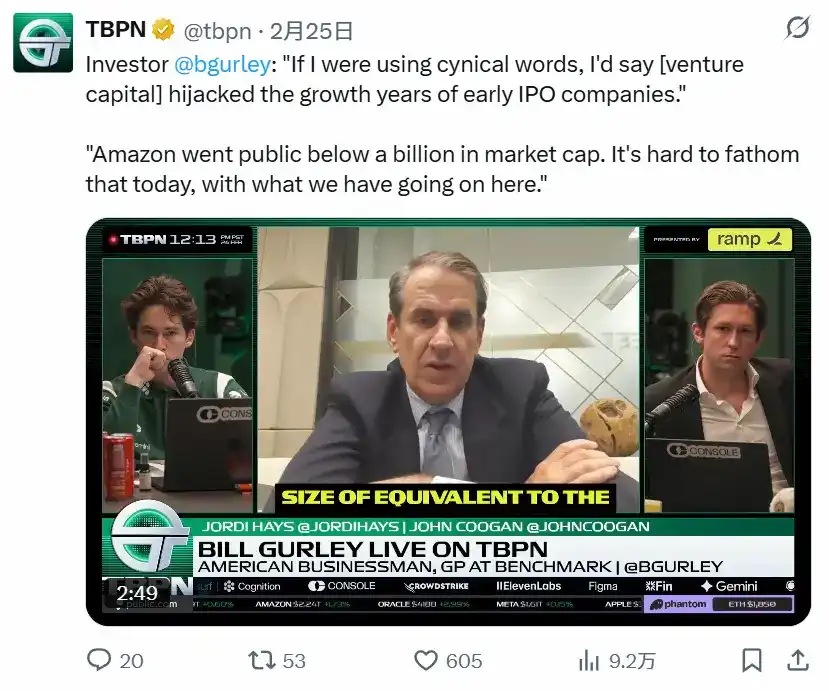
“To put it cynically, [venture capital] captured the growth phase of early public companies. Amazon went public when its market cap was less than a billion dollars. That's almost unimaginable today.” – Bill Gurley

The market has responded with some makeshift fixes: Special Purpose Vehicles (SPVs), secondary market platforms, tender offers, and other tools designed to satisfy investor appetite for growth-stage risk assets. But these are patches, not fundamental solutions.

What investors truly crave might be the very vision that tech IPOs carried three decades ago: gaining broad, liquid investment exposure to era-defining companies and sharing in the outsized, venture-scale returns.

Tokenized risk assets could be part of the answer. This article explores, through three questions, how tokenizing startups could rebalance these disconnected markets:

(1) Why is now the right time for tokenized startups

(2) What does the landscape of tokenized startups look like

(3) What are the key opportunities, challenges, and unresolved tensions hindering the scaling of this space.

Part I: Why Tokenized Startups Are Timely?

Tokenized startups stand at the confluence of three major trends:

(1) The explosive growth of makeshift tools like SPVs as de facto liquidity mechanisms for era-defining tech companies

(2) The rapid growth of tokenized Real World Assets (RWA), spanning money markets, public equities, commodities, and more

(3) The breakdown of the “tokens vs. equity” consensus, where project tokens are increasingly relegated to second-class citizenship compared to venture equity investments.

1.1 The Rise of SPVs

A decade ago, SPVs were niche instruments, a way to pool capital outside traditional VC or public financing structures. But over the last two years, they have become a critical part of capital strategies, with platforms like AngelList, Carta, and Assure making it easier than ever to set up SPVs for specific opportunities and companies.

Secondary market SPVs, in particular, have grown over 545% in the last two years, with capital raised increasing over 10x. These makeshift market structures capture significant market growth: the weighted basket of Hiive's top 50 secondary market assets delivered 49.1% growth in 2025, significantly outperforming the S&P 500.

This suggests investors are using makeshift private market structures to reclaim functions the public markets once performed more smoothly: access, liquidity, and price discovery. As companies stay private longer, SPVs have become one of the primary alternatives.

1.2 RWA, Tokenization, and the Perpetualization of Everything
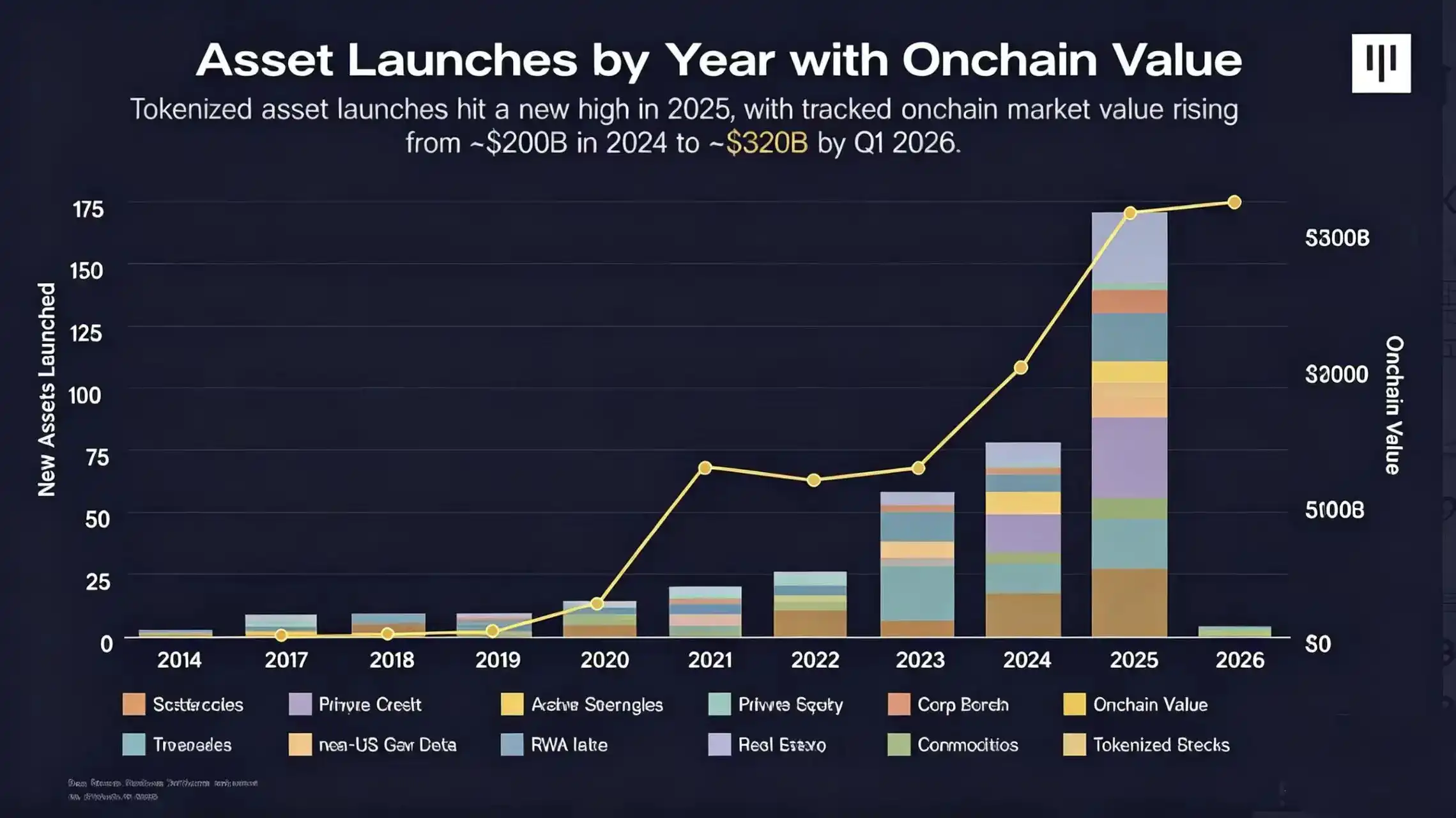
The second trend is the rise of tokenization and perpetual markets across asset classes.

In Q1 2026, the value of on-chain RWAs reached approximately $320 billion. While the largest RWA category remains US Treasuries (used as collateral for stablecoins), significant growth is also seen in asset classes like commodities, equities, and asset-backed credit (such as Figure's home equity loans).

As RWAs gain adoption, we can see the tokenization supply chain maturing: spanning from issuers and custodians to regulatory frameworks.

Simultaneously, perpetual futures have seen tremendous growth over the last two years with the rise of perpetual decentralized exchanges (perp-DEXes) like Hyperliquid. Compared to derivatives with expiry dates, perpetual futures have no maturity, which offers practical execution advantages, easier risk understanding, and natively supports 24/7 trading.

Projects like TradeXYZ are also expanding perpetual futures beyond pure crypto pairs (e.g., BTC-USDC) to other asset classes, including US and Korean equities, commodities, and stock indices, offering a standardized approach for creating new perpetual markets via HIP-3.

1.3 The Breakdown of the “Tokens vs. Equity” Consensus

The third growing trend is the value-capture dilemma between tokens and equity.

DeFi project tokens like UNI and AAVE explicitly stated at issuance that they do not represent equity, addressing regulatory concerns. This created a “tokens vs. equity consensus,” where project tokens should act as synthetic instruments granting owners “governance” over parts of the protocol, with the promise of fee capture as a value accrual mechanism.

However, this created a two-tier system with zero-sum value capture, where token holders became second-class citizens to equity holders.

This issue became clear in recent events like the Aave DAO vs. Labs standoff and the controversial Circle acquisition of Axelar, where token holder interests were subordinated to equity interests.

All this prompts a reconsideration of the existing “tokens vs. equity consensus”: how can we design tokens that better reflect a project's upside potential?

The convergence of these three trends may pave the way for the rise of “tokenized startups”: tokenized investment exposure to companies with venture-scale upside potential, allowing the general public early access to era-defining companies like they had in public markets of the past.

In this way, tokens become a re-architected version of traditional IPO mechanisms, providing broader public access to the hottest blockbuster companies.

Part II: The Landscape of Tokenized Startups

2.1 Current Design Approaches and Trading Volumes
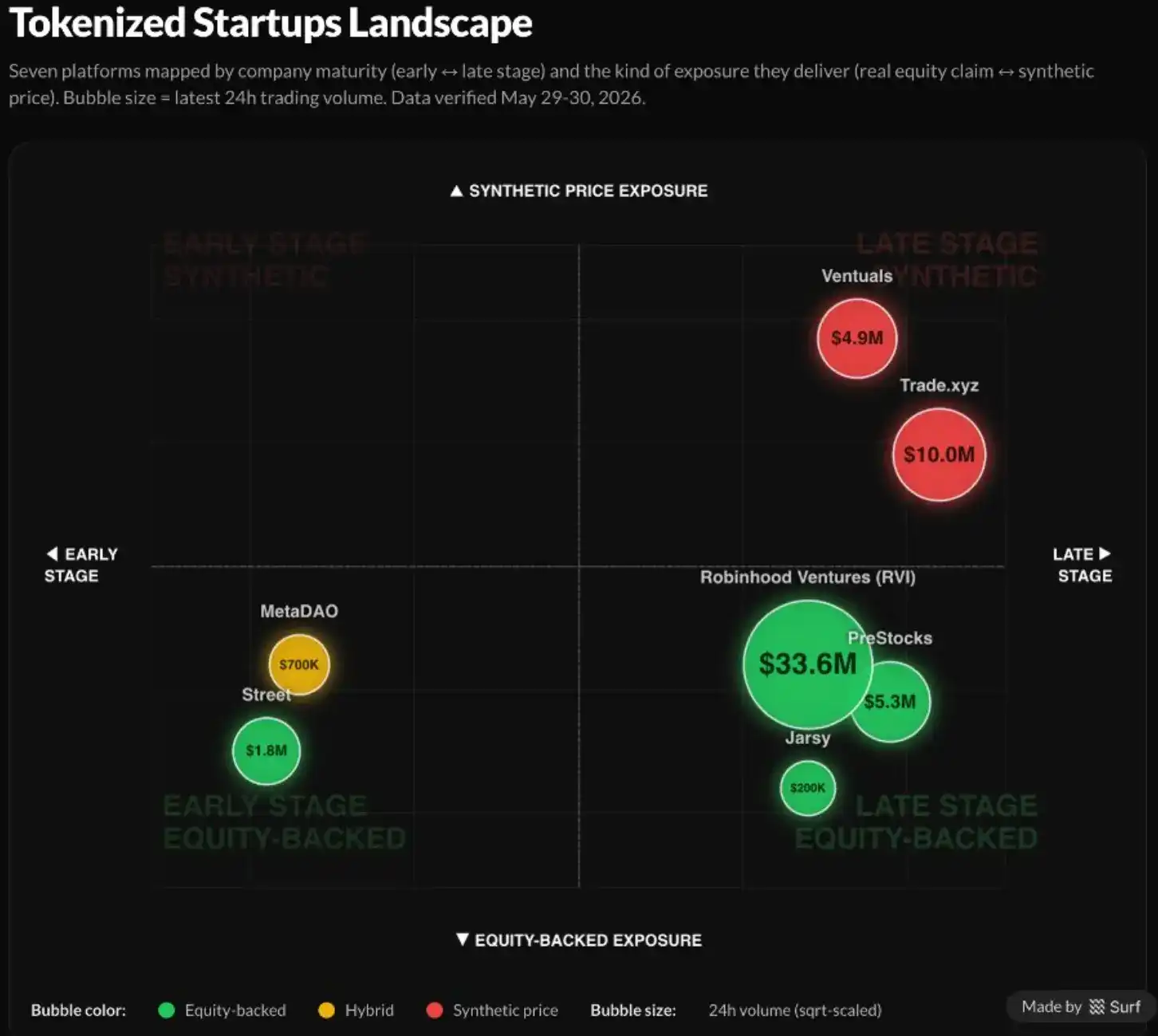
Today, tokenized startups vary widely across two main dimensions: the investment mechanism and the startup stage.

The investment mechanisms for tokenized startups range from SPV instruments holding equity (e.g., PreStocks), closed-end funds offering access to company equity (e.g., Robinhood Ventures), to pure perpetual futures that only offer price exposure without underlying equity ownership (e.g., TradeXYZ and Ventuals).

The startup stages range from early-stage companies (like MetaDAO's platform) to growth-stage assets, and household-name pre-IPO companies (like SpaceX, Anthropic, and OpenAI).

Mapping the main players in this space and their scale (24-hour trading volume as of May 30), we notice several distinct patterns.

First, the biggest trend is that later-stage (especially pre-IPO) platforms see volumes over 10x higher than early-stage ones. In particular, users seem to gravitate towards well-known names like SpaceX, Anthropic, Anduril, and OpenAI, regardless of which platform offers these assets.

Second, equity-backed tokenized startups (e.g., via Robinhood Ventures and PreStocks) typically have higher volumes than their perpetual counterparts. This is partly due to distribution advantages of Robinhood as a platform and TradeXYZ's conservative strategy of rolling out perpetuals one by one.

Notably, TradeXYZ's perpetual for Cerebras Systems has been massively successful, with daily volumes exceeding $30 million and providing accurate price discovery within less than a 3% error margin from the opening price.

Third, across this landscape, all platforms show a strong power-law concentration effect, with platform volume often dominated by fewer than three assets. For example, MetaDAO's volume is dominated by META, Avici, and Umbra; Street's volume is dominated by KLED.

Currently (as of May 30, 2026), TradeXYZ offers only SpaceX, and SpaceX also accounts for roughly half of PreStock's weekly volume. This heavy power-law effect likely indicates that, for most platforms, traders are more loyal to high-quality, high-profile assets than to the underlying platform itself.

2.2 Project Design Architectures

We can also dive into individual projects within this landscape map to carefully examine the trade-offs of various design schemes in this field, from perpetual exposure to SPV-backed equity structures.
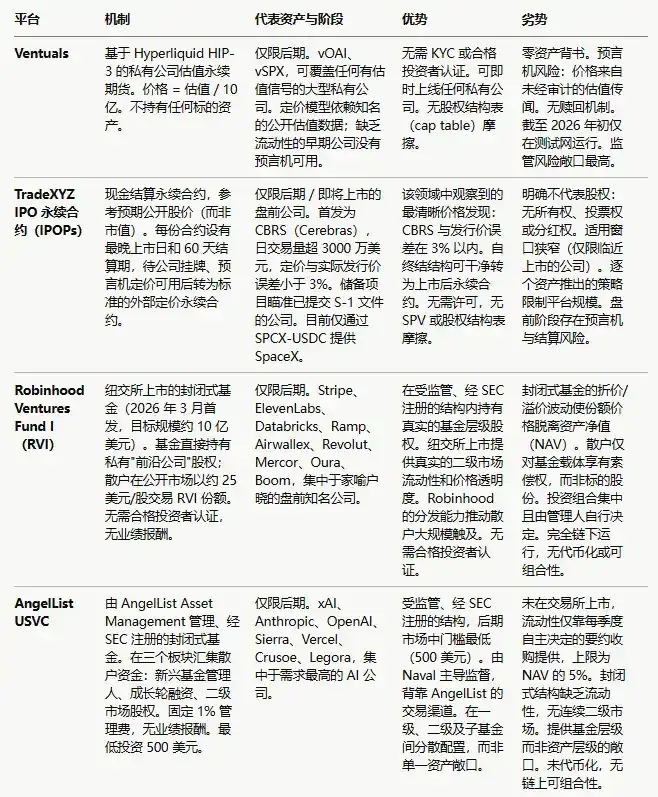
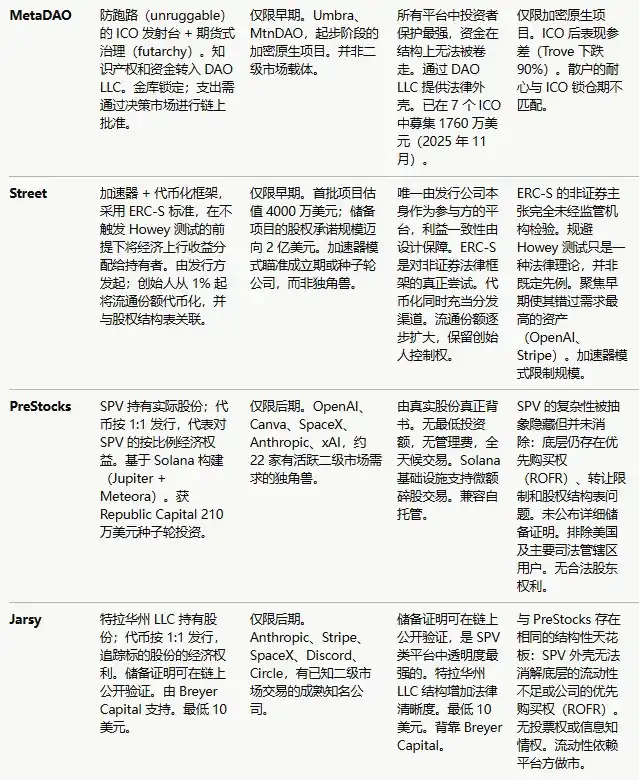
Note: Platform comparisons and feature descriptions in this analysis represent the author's perspective based on public information as of May 30, 2026. Descriptions of platform strengths and weaknesses do not constitute investment advice.

Part III: Challenges and Opportunities for Tokenized Startups

Today, tokenized startups are still in their infancy, and their design space is filled with numerous opportunities and challenges.

3.1 Transfer Consent and Team Alignment

Currently, one of the most pressing questions for spot tokenized startup platforms is whether these projects align with or go against the interests of company founding teams, especially given that platform volumes are disproportionately concentrated on 1 to 3 high-quality assets.

This is particularly true for high-profile, pre-IPO companies like SpaceX, Anthropic, and OpenAI, which carry most of the pre-IPO demand and trading volume.

Without team approval, a company might publicly announce opposition to tokenization, leading to cancelled sales and subsequent token price crashes, as shown by Anthropic's opposition to secondary market SPVs and OpenAI's opposition to Robinhood's stock tokens.

Typically, growth-stage companies pursuing a public listing have four clear motivations: (1) access to public market capital; (2) real-time pricing; (3) liquidity exit for founding teams and investors; and (4) prestige signaling.

Today, the proliferation of “mega-funds” in the growth stage provides an incredibly robust and abundant financing environment for the hottest startups, often at extremely high valuations. This landscape undermines motivations (1) and (2) for growth-stage companies to go public: they no longer need to turn to public markets for capital, and real-time pricing risks a downward re-rating.

Thus, in today's financing environment, a hot growth-stage startup might only consider going public if a large number of early employees and investors crave immediate liquidity (as with Facebook's 2012 IPO) or as a prestige symbol representing maturity.

For a spot tokenized startup platform seeking board approval in the current financing environment to provide direct ownership access, these latter two motivations carry significantly more weight.

Traditional secondary market brokers like Forge and Hiive cater more to liquidity motivations, while high-profile closed-end funds like Robinhood Ventures and USVC arguably cater to prestige motivations.

Nevertheless, beyond traditional IPO motivations, a range of emerging designs have surfaced, such as tokenized startup baskets, tokenized accelerator models, and tokenized community offerings, which could address this founder alignment issue:

Tokenized startup baskets refer to tradeable portfolios of growth-stage startups, rather than a single tokenized company.

This is one avenue provided by closed-end funds like Robinhood Ventures. This mechanism can satisfy liquidity, prestige, and even capital access motivations while alleviating downward re-rating pressure from “real-time pricing” through the use of Net Asset Value (NAV) multiples (somewhat similar to DAT).

The tokenized accelerator model applies traditional accelerator and incubator models (e.g., YC, HF0, South Park Commons) to help startups go from 0 to 1 in exchange for consent to tokenize their shares.

We see launch platforms like Street and MetaDAO effectively offering this model; they solve founder alignment by taking the founder's side and genuinely helping founders grow.

Tokenized community offerings might be the most interesting and promising model to explore for tokenized startups. As the 2020 Uniswap airdrop demonstrated, tokens can be an excellent incentive for everyday users who use a product daily.

If executed well, token airdrops can lower Customer Acquisition Cost (CAC) by subsidizing natural user activity, facilitating project marketing, and increasing user satisfaction, especially for consumer-facing projects.

For example, Revolut conducted a community equity round, raising $1.3 million from early users at a $40 million valuation. This served a marketing function, turning users into owners and advocates, with those early backers receiving 400x returns.

However, token airdrops can also be a double-edged sword; many crypto project airdrops have been plagued by farming, accusations of insider allocations, and immediate sell pressure.

3.2 Non-U.S. Jurisdictions

Another avenue to bypass founder alignment issues is going global. Much of the current discussion around tokenized startups (and their trading volumes) takes a U.S.-centric view, focusing on the hottest U.S. companies and assuming a U.S. public listing.

But the U.S. public and private capital markets already serve growth-stage companies exceptionally well, making it difficult to justify the additional benefits of a tokenized offering to a company.

However, this isn't necessarily the case in other regions, where local capital markets may be inefficient and fail to provide the best liquidity or pricing for the fastest-growing companies. For example, Wise initially listed on the London Stock Exchange in 2021.

But in May 2026, it moved its primary listing to Nasdaq in the U.S., believing it could attract a more liquid market, reach a broader base of retail and institutional investors, and receive more generous valuation multiples.

This geographical divergence in valuation and capital access is also evident in the differences in valuation multiples between U.S. and Chinese AI companies.

U.S. AI leaders often command Price-to-Sales ratios of 15 to 40x, while Chinese AI companies have much more conservative P/S ratios, closer to 5 to 15x. This discount may be partly attributed to capital access; Chinese capital markets are generally harder to access than U.S. markets.

This geographical valuation arbitrage becomes particularly interesting as different parts of frontier supply chains like AI, robotics, semiconductors, and biotechnology are dispersed globally, and related companies list in Asian and European markets.

Despite this structural advantage for tokenized startups in non-U.S. jurisdictions, empirical experiments and trading volumes remain limited. This is likely due to the difficulty of finding high-demand startups willing to experiment on their cap tables and the complex regulatory environments concerning foreign investment and tokenization in those regions.

South Korea is a particularly interesting non-U.S. market for tokenized startups.

Korea possesses:

(1) Several national champion companies within the AI supply chain with global investor demand, such as Samsung and SK Hynix

(2) A new legal framework for “stock tokens”;

(3) Brokers actively focusing on pre-IPO investments;

(4) More crypto investors than stock investors.

This is perhaps partly why TradeXYZ is actively beginning to list perpetuals on Korean equities.

One of tokenization's biggest advantages is its ability to arbitrage geography, providing global audiences with underlying access to companies worldwide.

With their global liquidity bases and potential to open to broader retail and institutional investors, tokenized startup platforms could well become part of the upgraded IPO strategy for the next generation of fast-growing, non-U.S. companies that lack strong local capital markets, like Wise.

3.3 Price Discovery Design for Perpetuals

Another route for tokenized startup platforms is the perpetual strategy. If all you own is a synthetic instrument that doesn't represent underlying equity, there's nothing for a board to void. This circumvents the need for team intervention and board approval. However, synthetic assets trade legal issues for price discovery challenges.

Existing perpetual markets (e.g., for crypto tokens, equities, commodities) typically rely on liquid spot markets and reliable price oracles to manage funding rates and synthetic prices. However, by definition, private startups lack liquid public markets.

The closest available markets are tender offers and secondary market purchases, which platforms like Ventuals leverage to anchor their funding rates. But these are often unreliable and frequently undervalue the underlying asset.

For instance, on Ventuals, the funding rate is around 15% APY within +/-5% of the oracle price, becoming punitively expensive for longs beyond that range via an exponential curve.

TradeXYZ takes the opposite approach, relying on oracle-free price discovery. For example, in the Cerebras Systems offering, TradeXYZ simply set up a Hyperp mechanism using recent market quotes to derive a reference price, letting the contract discover its own price within the narrow window between S-1 filing and actual listing. It outperformed any other mechanism on the market.

The CBRS perpetual launched on May 1 with a reference price of $175, traded within a stable range of $288 to $320 for two weeks, reaching around $340 an hour before opening, less than 3% from the actual Nasdaq opening price of $350.

This estimate was about 84% higher than the banker-priced $185 and far more accurate than prices from secondary market brokers like Hiive ($225) and Forge ($113.50). This fully demonstrates the tremendous success of perpetuals as a tool.

However, this process is not necessarily scalable, as clear price discovery relies on an imminent, verifiable convergence event. If Cerebras hadn't listed within a specific timeframe, the contract would have settled at a time-weighted average of its own price.

In this sense, the “perpetual price discovery” mechanism ultimately looks more like a traditional futures contract and also may not apply to early-stage assets with no imminent public offering.

Thus, the design space for perpetual-based tokenized startups remains wide open. Scalable models are not yet established, and it will likely be a fusion of crypto perpetuals with traditional futures, prediction markets, secondary spot markets, Contracts for Difference (CFDs), and other primitives.

With Kalshi's recent foray into perpetuals and Hyperliquid's entry into outcome prediction markets with HIP-4, we are seeing an important convergence of all these different pricing tools. Pricing pre-IPO tokenized startups could well become the catalyst for pioneering a new derivative space, one more efficient and user-friendly for everyday users.

3.4 Legal Structures and Regulation

From a legal structure perspective, many of these tokenized startup instruments, such as Street's ERC-S, MetaDAO's DAO LLC, and SPV-backed tokens, are novel, experimental tools that haven't yet withstood the test of time against regulators with strong enforcement intent.

Even the recent U.S. Clarity Act for digital commodities did not address the issue of tokenized equity.

Based on public statements, the SEC appears to categorize these tokenized startups into two distinct buckets depending on whether the token is issued directly by the company or by a third party.

Issuer-sponsored tokens are securities themselves, just in a different form, and thus fall under traditional securities laws. Whether the official ledger is on-chain (transferring the token transfers the share) or off-chain (the token triggers a ledger update), it is treated exactly like ordinary stock: must be registered or qualify for an exemption, with all standard disclosure and reporting obligations.

Third-party tokens are treated based on what they actually convey. Custodied tokens are security entitlements under UCC Article 8—actual securities transactions, but a claim against a custodied share, not the share itself, meaning you also bear custodian bankruptcy risk.

Synthetic tokens are entirely separate securities issued by a third party, carrying no rights against the reference company, and require separate registration or an exemption: linked securities (notes or SPVs tracking the target's value) fall here; and security-based swaps (e.g., Ventuals-style perpetuals) are most restricted, prohibited from being offered to ordinary U.S. retail unless registered and traded on a national exchange.

Conclusion

Whether it's pre-IPO perpetuals or SPVs, closed-end funds, or secondary market tender offers, every instrument is an attempt to win back what public markets once freely offered to the masses: the ability to gain early, liquid investment exposure during a company's highest growth phase, instead of letting it be monopolized by growth equity funds.

Today, we know this demand is real, but the infrastructure remains incomplete. For tokens, the stakes are higher. The past few years have been an identity crisis: project tokens relegated to second-class citizens, governance becoming a charade, and value accumulating elsewhere.

Re-architecting the issuance mechanism to give tokens true claims to venture-scale upside might be the epochal mission that sets them free. With an infrastructure the first wave never had, tokens might finally re-deliver on the core promise they made during the early days of fervor.


Câu hỏi Liên quan

QWhat are the three major trends converging at the crossroads for tokenized startups, as discussed in the article?

AThe three major trends are: 1) The explosive growth of temporary tools like SPVs, which act as de facto liquidity mechanisms for era-defining tech companies. 2) The rapid growth of tokenizing Real-World Assets (RWA) like money market funds, public stocks, and commodities. 3) The breakdown of the 'token vs. equity' consensus, where project tokens have become second-class citizens compared to venture equity investments.

QAccording to the analysis of the tokenized startup landscape, what are the dominant patterns observed in trading volume?

AThe dominant patterns are: 1) Later-stage (especially pre-IPO) platforms see trading volumes more than 10 times higher than early-stage ones. 2) Equity-based tokenized startups generally have higher trading volumes than their perpetual futures counterparts. 3) There is a strong power-law concentration where a platform's volume is often dominated by fewer than three assets.

QWhat are the four main motivations for a growth-stage company to pursue an IPO, as mentioned in the article?

AThe four main motivations are: 1) Access to public market capital. 2) Real-time pricing. 3) Liquidity exit for founders and investors. 4) The prestige signal.

QWhat key challenge do spot tokenized startup platforms face regarding founder alignment, and what are some emerging designs to address it?

AThe key challenge is whether these platforms align with or go against the interests of company founders, especially when trading is concentrated in a few high-profile assets. Emerging designs to address this include: 1) Tokenized startup baskets (tradable portfolios). 2) The tokenized accelerator model (helping startups grow in exchange for tokenized shares). 3) Tokenized community issuance (using tokens to incentivize users and reduce customer acquisition costs).

QWhat is the fundamental promise of tokenized startups, as outlined in the article's conclusion?

AThe fundamental promise is to reclaim the opportunity that public markets once freely gave to the masses: early, liquid investment exposure to companies during their highest-growth phases, rather than letting that access be monopolized by growth equity funds. It offers tokens a chance to escape their identity crisis by redesigning the issuance mechanism to grant genuine claims on venture-scale upside.

Nội dung Liên quan

Người sáng lập Cardano Hoskinson bị cáo buộc bán 1,5 tỷ ADA trong đợt tăng giá năm 2021

Người sáng lập Cardano, Charles Hoskinson, đang đối mặt với cáo buộc mới từ nhà sáng tạo NFT Masato Alexander về việc bán 1,5 tỷ ADA trong đợt tăng giá năm 2021. Alexander công bố phân tích theo dõi on-chain, chỉ ra các giao dịch ADA lớn (925 triệu ADA và 9 lần 20 triệu ADA) có chung nguồn gốc gần với các ví của IOG hơn so với ADA Genesis ban đầu, giảm số bước giao dịch trung gian xuống còn từ 1 đến 7. Alexander cũng nhắc lại cáo buộc trước đó rằng Hoskinson đã sử dụng "genesis keys" trong đợt hard fork Allegra 2021 để chuyển khoảng 318 triệu ADA chưa đổi thưởng từ voucher vào quỹ dự trữ. Hoskinson phủ nhận, và một báo cáo minh bạch sau đó khẳng định 99,2% voucher đã được đổi. Bên cạnh đó, Thomas Braziel nêu câu hỏi về cấu trúc quản trị ban đầu thông qua hồ sơ từ Isle of Man, cho thấy Hoskinson từng giữ vai trò "Người thực thi" có quyền giám sát đáng kể. Ông đặt vấn đề về việc ai đàm phán các thỏa thuận phát triển thay mặt cho người tham gia ICO. Các cáo buộc làm dấy lên tranh luận về tính minh bạch trong phân phối ADA thời kỳ đầu và hoạt động của các quỹ lớn. Giá ADA tại thời điểm đưa tin là 0,16 USD.

bitcoinist38 phút trước

Người sáng lập Cardano Hoskinson bị cáo buộc bán 1,5 tỷ ADA trong đợt tăng giá năm 2021

bitcoinist38 phút trước

TON Khởi Động Lại Thương Hiệu Gram, Một Cái Tên Biến Mất Sáu Năm Đã Quay Trở Lại

Ngày 9 tháng 6, cộng đồng TON đã thông qua đề xuất đổi tên token gốc từ Toncoin sang Gram, với mã token từ TON thành GRAM, dự kiến có hiệu lực từ 15/6. Đây không chỉ là nâng cấp thương hiệu mà còn đánh dấu sự trở lại của cái tên "Gram" - biểu tượng cho giấc mơ ban đầu của mạng Telegram Open Network (TON) vào năm 2018. Động thái này nằm trong kế hoạch "Make TON Great Again" (MTGA), tập trung vào đổi mới hình ảnh thay vì thay đổi công nghệ cốt lõi của The Open Network. Việc khôi phục thương hiệu Gram giúp TON tận dụng lịch sử và sự gắn kết mạnh mẽ với Telegram, từ đó tạo ra lợi thế khác biệt trong thị trường blockchain cạnh tranh. Bối cảnh hiện tại thuận lợi cho sự thay đổi này, với số người dùng Telegram vượt 10 tỷ và sự bùng nổ của các ứng dụng như Notcoin, Hamster Kombat, mang lượng lớn người dùng mới vào hệ sinh thái TON. Mục tiêu dài hạn của Gram là trở thành phương tiện thanh toán kỹ thuật số cốt lõi trong hệ sinh thái Telegram, tương tự như WeChat Pay, ẩn công nghệ blockchain phía sau trải nghiệm người dùng đơn giản. Nếu thành công, Gram có thể giúp TON trở thành mạng Web3 đầu tiên tiếp cận quy mô người dùng hàng tỷ, biến giấc mơ về một loại tiền tệ internet toàn cầu từ thời kỳ đầu của Telegram thành hiện thực.

marsbit56 phút trước

TON Khởi Động Lại Thương Hiệu Gram, Một Cái Tên Biến Mất Sáu Năm Đã Quay Trở Lại

marsbit56 phút trước

TechFlow Tình Báo Cục: Anthropic bị tố cố tình hạn chế Fable phát triển sản phẩm cạnh tranh, xác suất thông qua CLARITY Act trong tháng giảm xuống 60%

Tin nóng từ TechFlow Tình Báo Cục: Anthropic bị phát hiện cố tình giới hạn mô hình Fable trong việc phát triển sản phẩm cạnh tranh, trong khi đó, khả năng thông qua Đạo luật CLARITY tại Thượng viện Mỹ trong tháng này đã giảm từ 75% xuống 60%. Cộng đồng trực tuyến dậy sóng khi phát hiện Fable 5 có hành vi "cố tình làm việc kém hiệu quả" hoặc từ chối khi được yêu cầu phát triển các mô hình ngôn ngữ lớn (LLM) khác. Thẻ hệ thống của Anthropic xác nhận mô hình được thiết kế để "có thể phá hoại ngầm ứng dụng của bạn nếu đánh giá bạn là đối thủ cạnh tranh". Tranh luận nổ ra về việc đây là chiến lược kinh doanh hay hành vi chống cạnh tranh. Cộng đồng mã nguồn mở chỉ trích đây là hệ quả tất yếu của mô hình đóng không chịu sự giám sát. Về hiệu suất, Fable 5 bị nghi ngờ là tiếp thị quá mức khi điểm số trên Livebench thấp hơn cả Gemini 3.1 của Google. Các tin tức công nghệ khác: * **AI & Chính sách:** Tòa án Đức ra phán quyết mang tính bước ngoặt, buộc Google phải chịu trách nhiệm pháp lý cho thông tin sai lệch do AI Overviews tạo ra. OpenAI kêu gọi chính sách công nghiệp mới cho kỷ nguyên AI. * **Thị trường AI:** Google được cho là đang giảm mạnh phí thuê bao AI, khơi mào cuộc chiến giá, trong khi Salesforce tuyên bố doanh thu AI 1.2 tỷ USD ngay trước khi cắt giảm nhân sự nhóm AI. * **Phần cứng:** NVIDIA định giá thẻ đồ họa chuyên nghiệp RTX 6000 Pro lên tới 13,250 USD với bộ nhớ bị cắt giảm, phản ánh tình trạng căng thẳng nguồn cung chip. Trong khi đó, cổ phiếu vật liệu bán dẫn Trung Quốc tăng trưởng mạnh bất chấp thị trường chung. * **Công ty:** Nội bộ Alibaba xáo trộn khi Ủy ban Đối tác chỉ trích phong cách quản lý của DingTalk. Apple Intelligence không khả dụng tại Trung Quốc do vấn đề tuân thủ. Thị trường tài chính & tiền điện tử: * **Tiền điện tử:** Đạo luật CLARITY về stablecoin gặp trở ngại tại Thượng viện Mỹ. El Salvador tiếp tục mua Bitcoin sau 5 năm công nhận nó là tiền tệ hợp pháp, dù người dân vẫn ưa chuộng USD. Gia đình Trump bị cáo buộc rút 2.3 tỷ USD từ các dự án crypto, để lại nhà đầu tư nhỏ lẻ thua lỗ. * **Thị trường chứng khoán:** Chứng khoán Mỹ biến động mạnh sau tuyên bố của cựu Tổng thống Trump về việc trả đũa quân sự, dấy lên nghi ngờ rò rỉ thông tin. Ngân hàng Mỹ (BofA) cảnh báo 70% tín hiệu thị trường gấu đã bật sáng. Larry Ellison mất 10 tỷ USD giá trị tài sản trong một ngày. * **Vĩ mô:** Giá vàng giảm mạnh, chỉ số sợ hãi thị trường crypto chạm mức 10 (cực kỳ sợ hãi). Căng thẳng địa chính trị leo thang sau các cuộc không kích trả đũa giữa Mỹ và Iran, đẩy giá dầu dao động và tồn kho dầu toàn cầu xuống thấp nhất trong 23 năm. Xu hướng & Sản phẩm mới: * **IPO SpaceX** thu hút đăng ký mua lên tới 2500 tỷ USD, gấp gần 4 lần quy mô phát hành. * **Starlink** thay đổi mô hình tính phí phần cứng từ mua một lần sang thuê hàng tháng. * Giá **robot hình người** giảm mạnh, có mẫu rẻ hơn iPhone nhờ năng lực sản xuất hàng loạt của Trung Quốc. **Điểm nhấn:** Thị trường đang định giá lại hai xu hướng: câu chuyện AI chuyển từ "tăng trưởng vô hạn" sang "cạnh tranh không cùng chiến thắng", và xung đột địa chính trị trở nên khó lường. Trong khi đó, vốn đầu tư đang đặt cược vào hai cực: công nghệ vũ trụ (SpaceX) hoặc tự động hóa (robot giá rẻ), làm gia tăng áp lực lên phần lớn người dân và doanh nghiệp ở giữa.

marsbit1 giờ trước

TechFlow Tình Báo Cục: Anthropic bị tố cố tình hạn chế Fable phát triển sản phẩm cạnh tranh, xác suất thông qua CLARITY Act trong tháng giảm xuống 60%

marsbit1 giờ trước

Chương Trình Tài Trợ Bitcoin của Maelstrom Kéo Dài 20 Tháng — 5 Nhà Phát Triển, 4 Người Đang Hoạt Động, Đây Là Những Gì Họ Đã Đạt Được

Quỹ Bitcoin Maelstrom, thuộc văn phòng gia đình của đồng sáng lập BitMEX Arthur Hayes, đã công bố báo cáo thường niên đầu tiên cho Chương trình Tài trợ Bitcoin. Trong 20 tháng (bắt đầu từ tháng 10/2024), chương trình đã hỗ trợ tổng cộng 5 nhà phát triển, với 4 người hiện đang tích cực đóng góp để nâng cao quyền riêng tư, bảo mật và khả năng phục hồi của mã nguồn Bitcoin. Hai nhà phát triển tập trung vào Bitcoin Core: Rkrux (tham gia từ 10/2024) là một trong những người đánh giá mã tích cực nhất, làm việc trên MuSig2 và ví mô tả hiện đại. Stratospher (tham gia từ 11/2025) tập trung vào sửa lỗi phần mã đồng thuận và mạng ngang hàng, bao gồm sửa lỗi trong hàm FindMostWorkChain. Hai nhà phát triển khác tập trung hoàn toàn vào công nghệ bảo mật: Benalleng (từ 6/2025) làm việc toàn thời gian trên giao thức Payjoin để chống giám sát blockchain. Macgyver (cũng từ 6/2025) tập trung vào Silent Payments, một giao thức cho phép thanh toán nhiều lần đến một địa chỉ tĩnh mà không tái sử dụng địa chỉ trên chuỗi. Các khoản tài trợ được trả bằng Bitcoin hàng tháng, với mức tối đa 400.000 USD/nhà phát triển/năm. Mô hình này thể hiện cách một tổ chức đã hưởng lợi từ Bitcoin đầu tư trực tiếp vào sự phát triển mã nguồn mở của giao thức.

bitcoinist2 giờ trước

Chương Trình Tài Trợ Bitcoin của Maelstrom Kéo Dài 20 Tháng — 5 Nhà Phát Triển, 4 Người Đang Hoạt Động, Đây Là Những Gì Họ Đã Đạt Được

bitcoinist2 giờ trước

Giao dịch

Giao ngay
Hợp đồng Tương lai

Bài viết Nổi bật

AGENT S là gì

Agent S: Tương Lai của Tương Tác Tự Động trong Web3 Giới thiệu Trong bối cảnh không ngừng phát triển của Web3 và tiền điện tử, các đổi mới đang liên tục định nghĩa lại cách mà cá nhân tương tác với các nền tảng kỹ thuật số. Một dự án tiên phong như vậy, Agent S, hứa hẹn sẽ cách mạng hóa tương tác giữa con người và máy tính thông qua khung tác nhân mở của nó. Bằng cách mở đường cho các tương tác tự động, Agent S nhằm đơn giản hóa các nhiệm vụ phức tạp, cung cấp các ứng dụng chuyển đổi trong trí tuệ nhân tạo (AI). Cuộc khám phá chi tiết này sẽ đi sâu vào những phức tạp của dự án, các tính năng độc đáo của nó và những tác động đối với lĩnh vực tiền điện tử. Agent S là gì? Agent S đứng vững như một khung tác nhân mở đột phá, được thiết kế đặc biệt để giải quyết ba thách thức cơ bản trong việc tự động hóa các nhiệm vụ máy tính: Thu thập Kiến thức Cụ thể theo Miền: Khung này học một cách thông minh từ nhiều nguồn kiến thức bên ngoài và kinh nghiệm nội bộ. Cách tiếp cận kép này giúp nó xây dựng một kho lưu trữ phong phú về kiến thức cụ thể theo miền, nâng cao hiệu suất của nó trong việc thực hiện nhiệm vụ. Lập Kế Hoạch Qua Các Tầm Nhìn Nhiệm Vụ Dài Hạn: Agent S sử dụng lập kế hoạch phân cấp tăng cường kinh nghiệm, một cách tiếp cận chiến lược giúp phân chia và thực hiện các nhiệm vụ phức tạp một cách hiệu quả. Tính năng này nâng cao đáng kể khả năng quản lý nhiều nhiệm vụ con một cách hiệu quả và hiệu suất. Xử Lý Các Giao Diện Động, Không Đều: Dự án giới thiệu Giao Diện Tác Nhân-Máy Tính (ACI), một giải pháp đổi mới giúp nâng cao tương tác giữa các tác nhân và người dùng. Sử dụng các Mô Hình Ngôn Ngữ Lớn Đa Phương Thức (MLLMs), Agent S có thể điều hướng và thao tác các giao diện người dùng đồ họa đa dạng một cách liền mạch. Thông qua những tính năng tiên phong này, Agent S cung cấp một khung vững chắc giải quyết các phức tạp liên quan đến việc tự động hóa tương tác giữa con người với máy móc, mở ra nhiều ứng dụng trong AI và hơn thế nữa. Ai là Người Tạo ra Agent S? Mặc dù khái niệm về Agent S là hoàn toàn đổi mới, thông tin cụ thể về người sáng lập vẫn còn mơ hồ. Người sáng lập hiện vẫn chưa được biết đến, điều này làm nổi bật giai đoạn sơ khai của dự án hoặc sự lựa chọn chiến lược để giữ kín các thành viên sáng lập. Bất chấp sự ẩn danh, sự chú ý vẫn tập trung vào khả năng và tiềm năng của khung này. Ai là Các Nhà Đầu Tư của Agent S? Vì Agent S còn tương đối mới trong hệ sinh thái mã hóa, thông tin chi tiết về các nhà đầu tư và những người tài trợ tài chính của nó không được ghi chép rõ ràng. Sự thiếu vắng thông tin công khai về các nền tảng đầu tư hoặc tổ chức hỗ trợ dự án dấy lên câu hỏi về cấu trúc tài trợ và lộ trình phát triển của nó. Hiểu biết về sự hỗ trợ là rất quan trọng để đánh giá tính bền vững và tác động tiềm năng của dự án. Agent S Hoạt Động Như Thế Nào? Tại cốt lõi của Agent S là công nghệ tiên tiến cho phép nó hoạt động hiệu quả trong nhiều bối cảnh khác nhau. Mô hình hoạt động của nó được xây dựng xung quanh một số tính năng chính: Tương Tác Giống Như Con Người: Khung này cung cấp lập kế hoạch AI tiên tiến, cố gắng làm cho các tương tác với máy tính trở nên trực quan hơn. Bằng cách bắt chước hành vi của con người trong việc thực hiện nhiệm vụ, nó hứa hẹn nâng cao trải nghiệm người dùng. Ký Ức Tường Thuật: Được sử dụng để tận dụng các trải nghiệm cấp cao, Agent S sử dụng ký ức tường thuật để theo dõi lịch sử nhiệm vụ, từ đó nâng cao quy trình ra quyết định của nó. Ký Ức Tình Huống: Tính năng này cung cấp cho người dùng hướng dẫn từng bước, cho phép khung này cung cấp hỗ trợ theo ngữ cảnh khi các nhiệm vụ diễn ra. Hỗ Trợ OpenACI: Với khả năng chạy cục bộ, Agent S cho phép người dùng duy trì quyền kiểm soát đối với các tương tác và quy trình làm việc của họ, phù hợp với tinh thần phi tập trung của Web3. Tích Hợp Dễ Dàng với Các API Bên Ngoài: Tính linh hoạt và khả năng tương thích với nhiều nền tảng AI khác nhau đảm bảo rằng Agent S có thể hòa nhập liền mạch vào các hệ sinh thái công nghệ hiện có, làm cho nó trở thành lựa chọn hấp dẫn cho các nhà phát triển và tổ chức. Những chức năng này cùng nhau góp phần vào vị trí độc đáo của Agent S trong không gian tiền điện tử, khi nó tự động hóa các nhiệm vụ phức tạp, nhiều bước với sự can thiệp tối thiểu của con người. Khi dự án phát triển, các ứng dụng tiềm năng của nó trong Web3 có thể định nghĩa lại cách mà các tương tác kỹ thuật số diễn ra. Thời Gian Phát Triển của Agent S Sự phát triển và các cột mốc của Agent S có thể được tóm tắt trong một dòng thời gian nêu bật các sự kiện quan trọng của nó: 27 tháng 9, 2024: Khái niệm về Agent S được ra mắt trong một bài nghiên cứu toàn diện mang tên “Một Khung Tác Nhân Mở Sử Dụng Máy Tính Như Một Con Người,” trình bày nền tảng cho dự án. 10 tháng 10, 2024: Bài nghiên cứu được công bố công khai trên arXiv, cung cấp một cái nhìn sâu sắc về khung và đánh giá hiệu suất của nó dựa trên tiêu chuẩn OSWorld. 12 tháng 10, 2024: Một video trình bày được phát hành, cung cấp cái nhìn trực quan về khả năng và tính năng của Agent S, thu hút thêm sự quan tâm từ người dùng và nhà đầu tư tiềm năng. Những dấu mốc trong dòng thời gian không chỉ minh họa sự tiến bộ của Agent S mà còn chỉ ra cam kết của nó đối với sự minh bạch và sự tham gia của cộng đồng. Những Điểm Chính Về Agent S Khi khung Agent S tiếp tục phát triển, một số thuộc tính chính nổi bật, nhấn mạnh tính đổi mới và tiềm năng của nó: Khung Đổi Mới: Được thiết kế để cung cấp cách sử dụng máy tính trực quan giống như tương tác của con người, Agent S mang đến một cách tiếp cận mới cho việc tự động hóa nhiệm vụ. Tương Tác Tự Động: Khả năng tương tác tự động với máy tính thông qua GUI đánh dấu một bước tiến tới các giải pháp tính toán thông minh và hiệu quả hơn. Tự Động Hóa Nhiệm Vụ Phức Tạp: Với phương pháp mạnh mẽ của nó, nó có thể tự động hóa các nhiệm vụ phức tạp, nhiều bước, làm cho các quy trình nhanh hơn và ít sai sót hơn. Cải Tiến Liên Tục: Các cơ chế học tập cho phép Agent S cải thiện từ các trải nghiệm trước đó, liên tục nâng cao hiệu suất và hiệu quả của nó. Tính Linh Hoạt: Khả năng thích ứng của nó trên các môi trường hoạt động khác nhau như OSWorld và WindowsAgentArena đảm bảo rằng nó có thể phục vụ một loạt các ứng dụng rộng rãi. Khi Agent S định vị mình trong bối cảnh Web3 và tiền điện tử, tiềm năng của nó để nâng cao khả năng tương tác và tự động hóa quy trình đánh dấu một bước tiến quan trọng trong công nghệ AI. Thông qua khung đổi mới của mình, Agent S minh họa cho tương lai của các tương tác kỹ thuật số, hứa hẹn một trải nghiệm liền mạch và hiệu quả hơn cho người dùng trên nhiều ngành công nghiệp khác nhau. Kết luận Agent S đại diện cho một bước nhảy vọt táo bạo trong sự kết hợp giữa AI và Web3, với khả năng định nghĩa lại cách chúng ta tương tác với công nghệ. Mặc dù vẫn còn ở giai đoạn đầu, những khả năng cho ứng dụng của nó là rộng lớn và hấp dẫn. Thông qua khung toàn diện của mình giải quyết các thách thức quan trọng, Agent S nhằm đưa các tương tác tự động lên hàng đầu trong trải nghiệm kỹ thuật số. Khi chúng ta tiến sâu hơn vào các lĩnh vực tiền điện tử và phi tập trung, các dự án như Agent S chắc chắn sẽ đóng một vai trò quan trọng trong việc định hình tương lai của công nghệ và sự hợp tác giữa con người với máy tính.

Tổng lượt xem 857Xuất bản vào 2025.01.14Cập nhật vào 2025.01.14

AGENT S là gì

Làm thế nào để Mua S

Chào mừng bạn đến với HTX.com! Chúng tôi đã làm cho mua Sonic (S) trở nên đơn giản và thuận tiện. Làm theo hướng dẫn từng bước của chúng tôi để bắt đầu hành trình tiền kỹ thuật số của bạn.Bước 1: Tạo Tài khoản HTX của BạnSử dụng email hoặc số điện thoại của bạn để đăng ký tài khoản miễn phí trên HTX. Trải nghiệm hành trình đăng ký không rắc rối và mở khóa tất cả tính năng. Nhận Tài khoản của tôiBước 2: Truy cập Mua Crypto và Chọn Phương thức Thanh toán của BạnThẻ Tín dụng/Ghi nợ: Sử dụng Visa hoặc Mastercard của bạn để mua Sonic (S) ngay lập tức.Số dư: Sử dụng tiền từ số dư tài khoản HTX của bạn để giao dịch liền mạch.Bên thứ ba: Chúng tôi đã thêm những phương thức thanh toán phổ biến như Google Pay và Apple Pay để nâng cao sự tiện lợi.P2P: Giao dịch trực tiếp với người dùng khác trên HTX.Thị trường mua bán phi tập trung (OTC): Chúng tôi cung cấp những dịch vụ được thiết kế riêng và tỷ giá hối đoái cạnh tranh cho nhà giao dịch.Bước 3: Lưu trữ Sonic (S) của BạnSau khi mua Sonic (S), lưu trữ trong tài khoản HTX của bạn. Ngoài ra, bạn có thể gửi đi nơi khác qua chuyển khoản blockchain hoặc sử dụng để giao dịch những tiền kỹ thuật số khác.Bước 4: Giao dịch Sonic (S)Giao dịch Sonic (S) dễ dàng trên thị trường giao ngay của HTX. Chỉ cần truy cập vào tài khoản của bạn, chọn cặp giao dịch, thực hiện giao dịch và theo dõi trong thời gian thực. Chúng tôi cung cấp trải nghiệm thân thiện với người dùng cho cả người mới bắt đầu và người giao dịch dày dạn kinh nghiệm.

Tổng lượt xem 1.6kXuất bản vào 2025.01.15Cập nhật vào 2026.06.02

Làm thế nào để Mua S

Thảo luận

Chào mừng đến với Cộng đồng HTX. Tại đây, bạn có thể được thông báo về những phát triển nền tảng mới nhất và có quyền truy cập vào thông tin chuyên sâu về thị trường. Ý kiến ​​của người dùng về giá của S (S) được trình bày dưới đây.

活动图片