On the Night of the Fed Rate Cut, the Real Game Is Trump's 'Monetary Power Grab'

marsbitXuất bản vào 2025-12-11Cập nhật gần nhất vào 2025-12-11

Tóm tắt

Tonight marks the Federal Reserve's most anticipated interest rate decision of the year. While a 25-basis-point cut is widely expected, the key variable for risk assets is whether the Fed will restart liquidity injections, potentially through a $45 billion monthly short-term debt purchase program starting in January. This signals a stealth return to quantitative easing. The larger tension stems from an unprecedented shift in monetary power. President Trump is rapidly reshaping the Federal Reserve, not just by replacing its chair but by redrawing the boundaries of monetary authority. The long-held principle of central bank independence is being eroded as the Treasury Department seeks to reclaim control over long-term interest rates, liquidity, and the balance sheet. This transition to a "fiscally dominated monetary era" is the underlying logic connecting recent market events. Despite a 40 billion outflow from Bitcoin ETFs, analysis suggests this was not panic selling but the unwinding of leveraged basis trades, leaving a healthier, less leveraged market. Meanwhile, led by Michael Saylor, made its largest Bitcoin purchase in months ($963 million), and Tom Lee's BitMine significantly increased its Ethereum holdings, signaling strong institutional conviction during the downturn. The macro shift implies higher market volatility as the old order fractures. While improved liquidity may provide a floor for Bitcoin, its longer-term trajectory awaits clarity within this new monetary...

Tonight will bring the most anticipated interest rate cut decision of the year from the Federal Reserve.

The market widely expects a rate cut to be almost a done deal. However, what will truly determine the direction of risk assets in the coming months is not another 25 basis point cut, but a more critical variable: whether the Fed will restart liquidity injections into the market.

This time, Wall Street is not watching interest rates, but the balance sheet.

According to expectations from institutions like Bank of America, Vanguard, and PineBridge, the Fed may announce this week a plan to initiate a $45 billion monthly short-term bond purchase program starting January next year, as a new round of "reserve management operations." In other words, this suggests the Fed might be quietly ushering in an era of "stealth balance sheet expansion," allowing the market to enter a state of liquidity easing even before the rate cut.

But what makes the market nervous is the backdrop against which this is happening—the U.S. is entering an unprecedented period of monetary power restructuring.

Trump is taking over the Fed in a manner far faster, deeper, and more thorough than anyone expected. It's not just about replacing the chair; it's about redrawing the boundaries of power within the monetary system, reclaiming authority over long-term interest rates, liquidity, and the balance sheet from the Fed and handing it back to the Treasury. The independence of the central bank, long considered an "iron law of the system" for decades, is being quietly eroded.

This is also why all seemingly disparate events—from Fed rate cut expectations to ETF fund flows, from MicroStrategy's and Tom Lee's contrarian accumulation, and so on—are actually converging on the same underlying logic: the U.S. is entering a "fiscally dominated monetary era."

And what impact will this have on the crypto market?

MicroStrategy and Others Are Making Their Move

Over the past two weeks, the entire market has been debating the same question: Will MicroStrategy be able to withstand this downturn? Bears have simulated various scenarios of the company's collapse.

But Saylor clearly thinks otherwise.

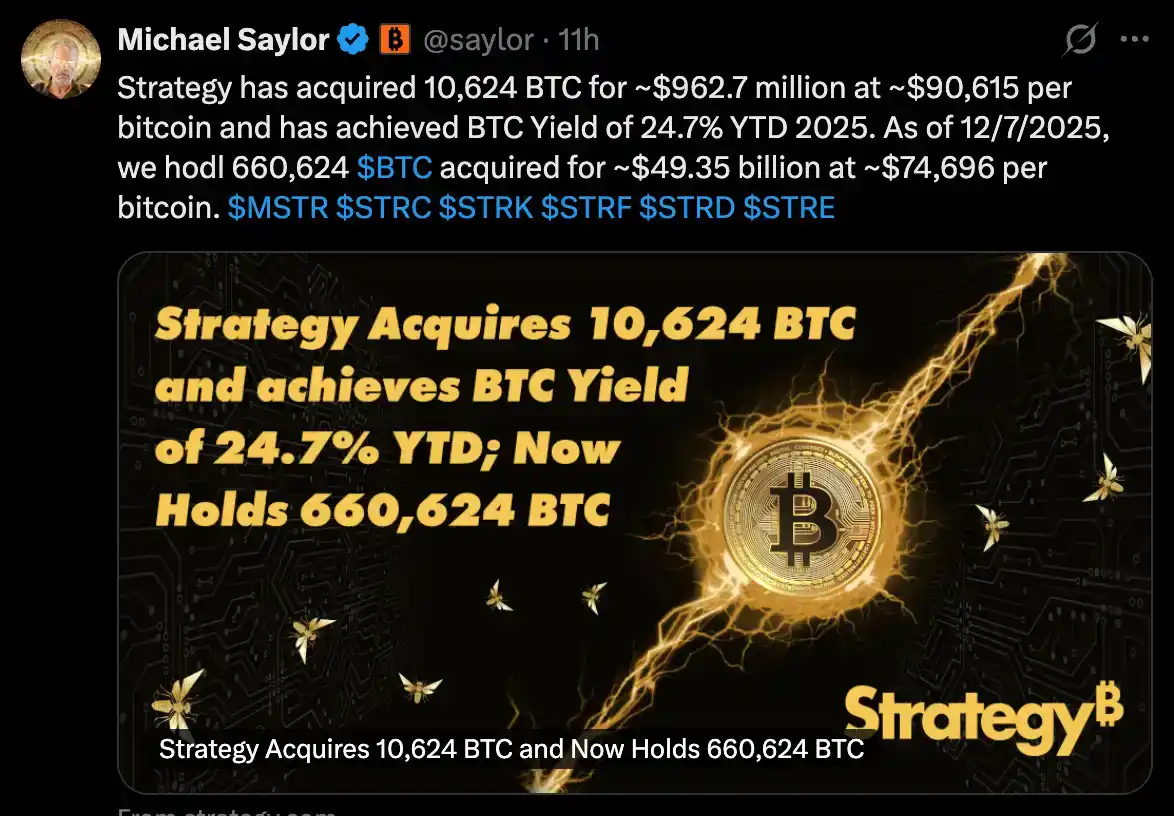
Last week, MicroStrategy increased its Bitcoin holdings by approximately $963 million, to be precise, 10,624 BTC. This is his largest purchase in recent months, even exceeding the sum of his acquisitions over the past three months.

Consider this: the market had been speculating whether MicroStrategy would be forced to sell coins to avoid systemic risk when its mNAV approached 1. Instead, when the price nearly hit that level, he didn't sell; he doubled down, and on such a large scale.
Meanwhile, a similarly dramatic contrarian move was playing out on the ETH side. Tom Lee's BitMine, despite ETH's price plunge and a 60% drawdown in the company's market cap, managed to continuously tap the ATM (at-the-market offering), raising substantial cash, and last week bought $429 million worth of ETH in one go, pushing its holdings to a $12 billion scale.

Even though BMNR's stock price has fallen more than 60% from its high, the team can still consistently raise money through ATM offerings and keep buying.
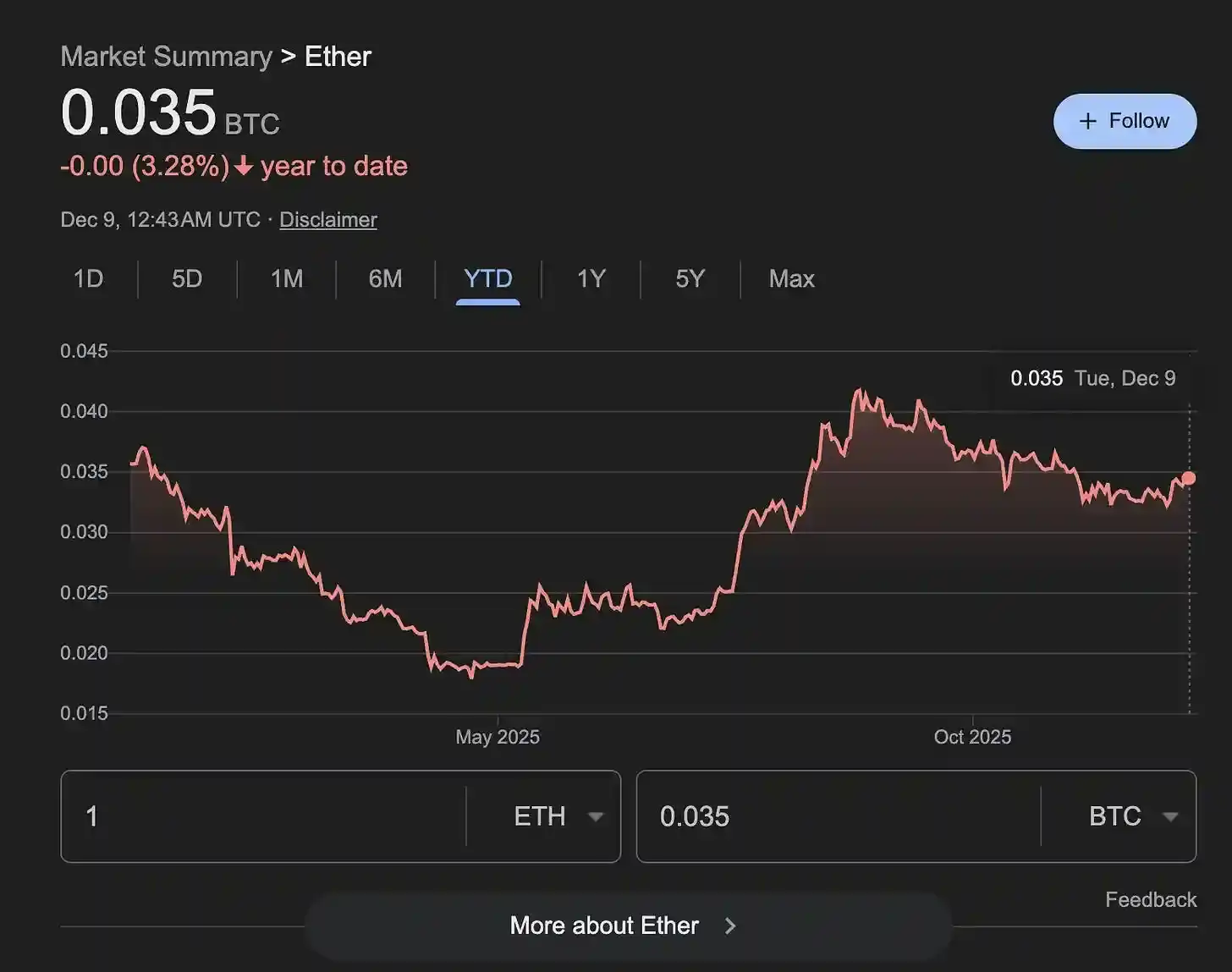
CoinDesk analyst James Van Straten put it more bluntly on X: "MSTR can raise $1 billion in a week, while in 2020, it took them four months to do the same. The exponential trend continues."

If we look at market cap impact, Tom Lee's move is even "heavier" than Saylor's. BTC's market cap is five times that of ETH, so Tom Lee's $429 million buy order has the "double impact" in weight equivalent to Saylor buying $1 billion worth of BTC.

No wonder the ETH/BTC ratio has started to rebound, breaking a three-month downtrend. History has repeated this countless times: whenever ETH leads the recovery, the market enters a brief but fierce "altcoin rebound window."

BitMine now holds $1 billion in cash, and ETH's pullback zone happens to be the perfect place to significantly lower its average cost. In a market where funding is generally tight, institutions that can keep firing are themselves part of the price structure.

ETF Outflows Are Not Flight, But Temporary Withdrawal of Arbitrage Capital

On the surface, Bitcoin ETFs have seen nearly $4 billion in outflows over the past two months, with the price dropping from $125,000 to $80,000, leading the market to quickly draw a crude conclusion: institutions are retreating, ETF investors are panicking, the bull market structure is broken.

But Amberdata offers a completely different explanation.

These outflows are not "value investors fleeing" but "leveraged arbitrage funds being forced to unwind." The primary source is the collapse of a structured arbitrage strategy called the "basis trade." Funds were originally earning a stable spread by "buying spot/shorting futures," but starting in October, the annualized basis fell from 6.6% to 4.4%, spending 93% of the time below the breakeven point, turning arbitrage into losses and forcing the strategy to be dismantled.

This triggered a "two-way action" of ETF selling + futures buybacks.

In traditional terms, capitulation selling typically occurs in extreme emotional environments after continuous declines, where panic peaks, and investors stop trying to cut losses and instead abandon all holdings entirely. Its typical characteristics include: large-scale redemptions across almost all issuers, surging trading volume, cost-indifferent selling pressure, and accompanying extreme sentiment indicators. But this ETF outflow clearly doesn't fit this pattern. Although there were net outflows overall, the direction of funds was inconsistent: for example, Fidelity's FBTC maintained continuous inflows throughout the period, and BlackRock's IBIT even absorbed some incremental funds during the worst phases of net outflows. This shows that the real exodus was only from a minority of issuers, not the entire institutional cohort.

More crucial evidence comes from the distribution of outflows. From October 1 to November 26 (53 days), funds from Grayscale contributed over $900 million in redemptions, accounting for 53% of the total outflow; 21Shares and Grayscale Mini followed closely, together making up nearly ninety percent of the redemption volume. In contrast, BlackRock and Fidelity—the most typical channels for institutional allocation—were net inflows overall. This is completely inconsistent with a true "panic-driven institutional retreat" and looks more like a "localized event."

So, which type of institution was selling? The answer: large funds engaged in basis arbitrage.

The basis trade is essentially a directionally neutral arbitrage structure: funds buy spot Bitcoin (or ETF shares) while shorting futures, profiting from the contango yield. It's a low-risk, low-volatility strategy that attracts significant institutional capital when futures are in contango and funding costs are manageable. However, this model relies on one premise: futures prices must consistently be higher than spot prices, with a stable spread. And starting in October, this premise suddenly disappeared.

According to Amberdata's statistics, the 30-day annualized basis compressed from 6.63% down to 4.46%, with 93% of trading days below the 5% breakeven point required for arbitrage. This meant these trades were no longer profitable, even starting to lose money, forcing funds to exit. The rapid collapse of the basis led to a "systematic unwinding" of arbitrage positions: they had to sell their ETF holdings and simultaneously buy back the futures they had previously shorted to close the arbitrage trade.

This process is clearly visible in market data. The open interest in Bitcoin perpetual contracts fell 37.7% over the same period, a cumulative decrease of over $4.2 billion, with a correlation coefficient of 0.878 to the basis change—almost a synchronous move. This combination of "ETF selling + short covering" is the classic path for basis trade exit; the sudden amplification of ETF outflow规模 was not driven by price panic but was the inevitable result of the arbitrage mechanism collapsing.

In other words, the ETF outflows of the past two months were more like a "liquidation of leveraged arbitrage positions" rather than a "retreat by long-term institutions." It was the unwinding of a highly specialized, structured trade, not panic selling pressure caused by a market sentiment crash.

What's more noteworthy is: after these arbitrage positions are cleared out, the remaining capital structure becomes healthier. Current ETF holdings remain at a high level of approximately 1.43 million Bitcoin, with most shares coming from allocation-oriented institutions, not short-term funds chasing yields. As the leveraged hedging from arbitrageurs is removed, the overall market leverage decreases, there are fewer sources of volatility, and price action will be driven more by "genuine buying and selling forces," not hijacked by forced technical operations.

Amberdata's head of research, Marshall, describes this as a "market reset": after the arbitrage capital retreats, new ETF inflows will be more directional and long-term, structural noise in the market will decrease, and subsequent price movements will more accurately reflect real demand. This means that although it looks like $4 billion flowed out on the surface, it might not be a bad thing for the market itself. On the contrary, it could lay the foundation for the next wave of healthier gains.

If Saylor, Tom Lee, and ETF flows show the attitude of micro-level capital, then the changes happening at the macro level are deeper and more intense. Will the Santa Claus rally come? To find the answer, we might need to look further at the macro picture.

Trump's "Takeover" of the Monetary System

For decades, the Fed's independence has been seen as an "iron law of the system." Monetary power belongs to the central bank, not the White House.

But Trump clearly doesn't agree with this.

Increasing signs show that the Trump team is taking over the Fed in a manner far faster and more thorough than the market expected. It's not just symbolically "replacing the chair with a hawk," but comprehensively rewriting the power distribution between the Fed and the Treasury, changing the balance sheet mechanism, and redefining how the yield curve is priced.

Trump is attempting to restructure the entire monetary system.

Former New York Fed trading desk head Joseph Wang (a long-time researcher of Fed operations) also clearly warned: "The market is clearly underestimating Trump's determination to control the Fed. This change could push the market into a phase of higher risk and higher volatility."

From personnel appointments, policy direction, to technical details, we can see very clear traces.

The most direct evidence comes from personnel arrangements. The Trump camp has placed several key figures in core positions, including Kevin Hassett (former White House economic advisor), James Bessent (key Treasury decision-maker), Dino Miran (fiscal policy智库), and Kevin Warsh (former Fed governor). These individuals share a common trait: they are not traditional "central bank school" and do not insist on central bank independence. Their goal is very clear: to weaken the Fed's monopoly on interest rates, long-term funding costs, and system liquidity, and return more monetary power to the Treasury.

The most symbolic point: it is widely believed that Bessent, considered the most suitable candidate for Fed chair, ultimately chose to remain at the Treasury. The reason is simple: in the new power structure, the Treasury's position can determine the rules of the game more than the Fed chair.

Another important clue comes from changes in term premium.

For the average investor, this indicator might be somewhat unfamiliar, but it is actually the most direct signal for the market to judge "who controls long-term interest rates." Recently, the spread between 12-month and 10-year Treasury yields has approached phase highs again, and this round of increase is not due to an improving economy or rising inflation, but because the market is reassessing: in the future, what determines long-term rates might not be the Fed, but the Treasury.
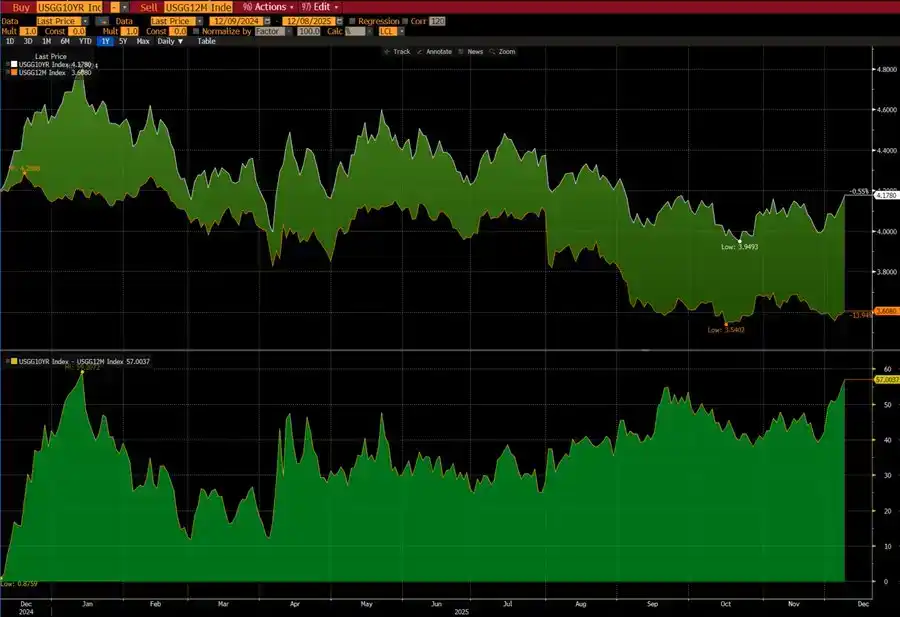
Yields on the 10-year and 12-month Treasury notes are continuing to fall, meaning the market is strongly betting that the Fed will cut rates, and the pace will be faster and more aggressive than previously expected
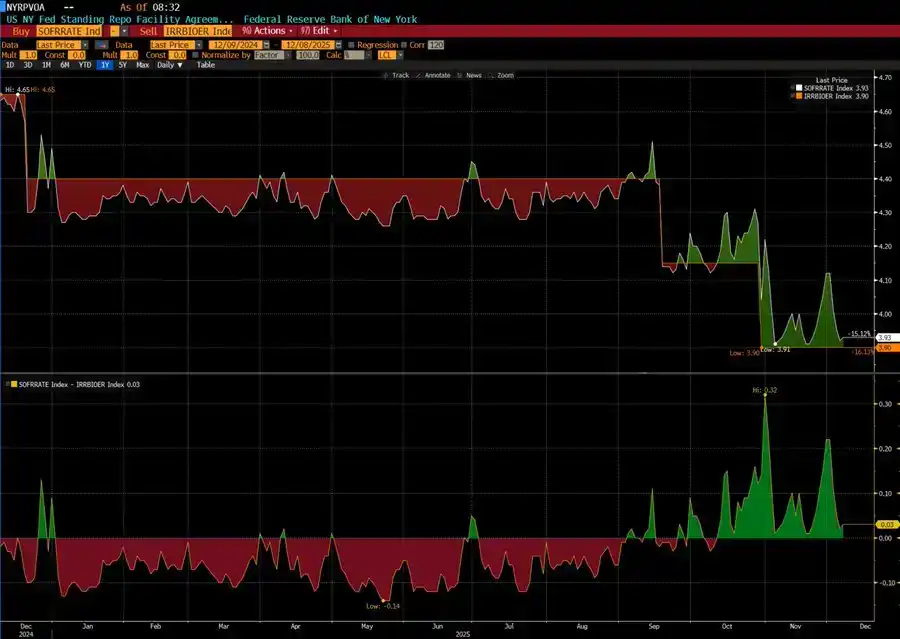
SOFR (Secured Overnight Financing Rate) experienced a cliff-like drop in September, meaning U.S. money market rates suddenly collapsed, signaling a significant loosening in the Fed's policy rate system

The initial spread widening was because the market thought Trump would overheat the economy upon taking office; later, when tariffs and large-scale fiscal stimulus were absorbed by the market, the spread quickly retreated. Now the spread is widening again, reflecting not growth expectations, but uncertainty about the Hassett-Bessent system: if in the future the Treasury controls the yield curve by adjusting debt duration, issuing more short-term debt, compressing long-term debt, etc., then traditional methods of judging long-end rates will become completely obsolete.

More subtle but crucial evidence lies in the balance sheet system. The Trump team frequently criticizes the current "ample reserves system" (where the Fed provides reserves to the banking system by expanding its balance sheet, making the financial system highly dependent on the central bank). But at the same time, they clearly know: current reserves are noticeably tight, and the system actually needs balance sheet expansion to maintain stability.

This contradiction of "opposing balance sheet expansion, yet having to expand" is actually a strategy. They use it as a reason to question the Fed's institutional framework and push for transferring more monetary power back to the Treasury. In other words, they don't want to shrink the balance sheet immediately; they want to use the "balance sheet controversy" as a breakthrough to weaken the Fed's institutional standing.

If we piece these actions together, we see a very clear direction: term premium is compressed, U.S. debt duration is shortened, long-end rates gradually lose independence; banks may be required to hold more U.S. debt; government-sponsored agencies may be encouraged to leverage up and buy mortgage bonds; the Treasury may influence the entire yield structure by increasing short-end debt issuance. Key prices once determined by the Fed will gradually be replaced by fiscal tools.

The result of this might be: gold enters a long-term uptrend, stocks maintain a slow grind higher after volatility, and liquidity gradually improves due to fiscal expansion and repo mechanisms. The market will appear chaotic in the short term, but this is only because the power boundaries of the monetary system are being redrawn.

As for Bitcoin, which the crypto market cares about most, it sits on the periphery of this structural change—not the most direct beneficiary, nor will it be the main battlefield. On the positive side, improved liquidity will put a floor under Bitcoin's price; but looking further out 1-2 years, it will still need to go through a period of re-accumulation, waiting for the framework of the new monetary system to truly become clear.

The U.S. is moving from a "central bank-dominated era" to a "fiscally dominated era."

In this new framework, long-term interest rates may no longer be set by the Fed, liquidity will come more from the Treasury, the central bank's independence will be weakened, market volatility will be greater, and risk assets will face a completely different pricing system.

When the foundation of a system is being rewritten, all prices will behave more "illogically" than usual. But this is a necessary phase as the old order loosens and the new order arrives.

The行情 of the coming months will likely be born from this chaos.

Tiền kỹ thuật số thịnh hành

Câu hỏi Liên quan

QWhat is the main focus of the market regarding the Fed's upcoming interest rate decision, and why?

AThe market is primarily focused not on the interest rate cut itself, but on whether the Federal Reserve will announce a new liquidity injection program, specifically a plan to purchase short-term bonds, which would effectively expand its balance sheet and provide liquidity easing.

QHow are Michael Saylor's MicroStrategy and Tom Lee's BitMine responding to the recent market downturn?

AMicroStrategy made its largest Bitcoin purchase in months, buying approximately $963 million worth of BTC, while BitMine raised cash and purchased $429 million worth of ETH. Both are significantly increasing their crypto holdings despite the price decline, demonstrating a contrarian bullish stance.

QAccording to the analysis, what was the real reason behind the recent outflows from Bitcoin ETFs, and not the reason?

AThe outflows were not due to panic selling or a retreat by long-term institutional investors. Instead, they were primarily caused by the unwinding of 'basis trade' arbitrage strategies, which became unprofitable as the futures premium (contango) collapsed, forcing funds to sell ETF shares and buy back short futures positions.

QWhat fundamental shift in the US monetary system is the article arguing is underway under Trump?

AThe article argues that the US is transitioning from a 'central bank-dominated era' to a 'fiscally dominated monetary era,' where power is shifting from the independent Federal Reserve to the Treasury Department, redefining the control over long-term interest rates, liquidity, and the balance sheet.

QWhat is the expected impact of this potential 'fiscally dominated monetary era' on various asset classes, including Bitcoin?

AGold is expected to enter a long-term upward trend, stocks may maintain a slow grind higher with volatility, and overall liquidity should improve due to fiscal expansion. Bitcoin is on the periphery; it may get a price floor from improved liquidity but likely needs a longer re-accumulation period as the new monetary framework becomes clearer.

Nội dung Liên quan

Cổ phiếu A bị tổn thương nhầm: Sự kiên cường, kỳ vọng và bản lĩnh

Cổ phiếu A-shares bị ảnh hưởng bởi các cú sốc ngoại vi vào tháng 7, nhưng đã thể hiện sức chống chịu mạnh mẽ. Các cổ phiếu công nghệ giảm giá chủ yếu do ảnh hưởng từ việc giảm đòn bẩy tại thị trường Hàn Quốc, trong khi cơ bản ngành vẫn vững chắc với lợi nhuận cao, đặc biệt trong lĩnh vực module quang, sợi quang, với cấu trúc đa ngành và hai câu chuyện nội địa hóa cùng chuỗi cung ứng toàn cầu. Lực lượng "đội tuyển quốc gia" đã mạnh mẽ can thiệp để ổn định thị trường, với các khoản mua vào và tái mua cổ phiếu trị giá hàng trăm tỷ từ các tập đoàn nhà nước, công ty bảo hiểm và quỹ. Hành động này không chỉ cung cấp thanh khoản mà còn gửi tín hiệu mạnh mẽ về điểm đáy, tạo hiệu ứng dẫn dắt cho các định chế dài hạn. Động lực phục hồi nội sinh còn đến từ ba nhóm chính: (1) Tiêu dùng, với CPI tăng và dấu hiệu phục hồi trong ngành rượu bia; (2) Chu kỳ, đặc biệt là nhôm, với lợi nhuận cao, kỳ vọng tăng giá và định giá thấp; (3) Tài chính, với tài sản cổ tức ổn định và định giá hấp dẫn. Sự kết hợp của các yếu tố này cùng với nền tảng công nghệ vững chắc cho thấy A-shares có đủ sức chống chịu và khả năng sớm trở lại trạng thái ổn định.

marsbit27 phút trước

Cổ phiếu A bị tổn thương nhầm: Sự kiên cường, kỳ vọng và bản lĩnh

marsbit27 phút trước

Máy tính lượng tử chưa tới, 1,1 triệu Bitcoin của Satoshi Nakamoto đã trở thành vấn đề trước

Một công cụ chứng minh không tri thức (Project Eleven) có thể giúp ví Bitcoin hiện đại di chuyển tài sản trước các cuộc tấn công lượng tử trong vòng 243 mili giây. Tuy nhiên, khoảng 1,1 triệu BTC được Satoshi Nakamoto khai thác trước năm 2012 (nằm trong khoảng 22.000 địa chỉ P2PK cũ) không thể được cứu bằng công cụ này vì thiếu đường dẫn khóa phân cấp (HD wallet), tạo ra một ngõ cụt mật mã. Vấn đề này đã đẩy cộng đồng Bitcoin vào một cuộc khủng hoảng chính trị hơn là kỹ thuật. Có bốn giải pháp được tranh luận, mỗi giải pháp đều có rủi ro lớn: 1) Bất động, để tiền bị đánh cắp; 2) Đóng băng cưỡng chế các địa chỉ dễ bị tổn thương; 3) Giới hạn dòng tiền rút từ địa chỉ cũ; 4) Phân phối lại tài sản "không chủ". Tất cả đều đe dọa các nguyên tắc cốt lõi của Bitcoin như quyền sở hữu, tính bất biến của sổ cái hay tính lưu trữ giá trị. Thị trường đã bắt đầu định giá rủi ro quản trị này. Một số tổ chức như Jefferies đã giảm nắm giữ Bitcoin do lo ngại về sự không chắc chắn trong việc xử lý các đồng tiền dễ bị tổn thương. Cuộc khủng hoảng niềm tin đã xuất hiện ngay cả trước khi máy tính lượng tử thực tế ra đời, đặt ra câu hỏi cấp bách: Làm thế nào Bitcoin có thể giải quyết gánh nặng của một sự đứt gãy công nghệ lịch sử mà không phá vỡ chính các nguyên tắc sáng lập của nó?

marsbit37 phút trước

Máy tính lượng tử chưa tới, 1,1 triệu Bitcoin của Satoshi Nakamoto đã trở thành vấn đề trước

marsbit37 phút trước

Mặt trận chính của thị trường tăng giá tiếp theo nằm ở đâu? Câu trả lời ẩn giấu trong hai loại tài sản này

Thị trường tiền điện tử đang cho thấy dấu hiệu chạm đáy, và câu hỏi đặt ra là tài sản nào sẽ dẫn dắt đợt tăng giá tiếp theo. Theo phân tích, chủ đề cốt lõi của chu kỳ bull market mới sẽ là sự hội tụ giữa tài chính truyền thống và tài chính trên chuỗi (on-chain), tập trung vào stablecoin, token hóa tài sản, giao dịch 24/7 và thanh toán tức thì. Bài viết chỉ ra hai xu hướng đầu tư chính: 1. **Các ứng dụng tài chính tiền điện tử gốc** (đại diện là Hyperliquid - HYPE): Các nền tảng có doanh thu thực tế, mô hình kinh tế token mạnh (như mua lại và đốt token), đang mở rộng từ giao dịch tiền điện tử sang các tài sản truyền thống như chỉ số chứng khoán và hàng hóa. 2. **Các doanh nghiệp truyền thống trưởng thành áp dụng cơ sở hạ tầng tiền điện tử** (đại diện là Robinhood - HOOD): Các công ty đang tích cực xây dựng và triển khai blockchain (như Robinhood Chain) để cung cấp dịch vụ tài chính mới, như giao dịch cổ phiếu được token hóa, cho thị trường toàn cầu. Sự hội tụ này, với tiềm năng định hình lại hệ thống tài chính toàn cầu, được kỳ vọng sẽ tạo ra chu kỳ tăng giá lớn nhất từ trước đến nay, dựa trên giá trị ứng dụng thực tế và nhắm vào một thị trường rộng lớn hơn. Cơ hội đầu tư nằm ở việc nhận diện và định vị trước vào các dự án và công ty đang thực sự thúc đẩy xu hướng chuyển đổi này.

Foresight News41 phút trước

Mặt trận chính của thị trường tăng giá tiếp theo nằm ở đâu? Câu trả lời ẩn giấu trong hai loại tài sản này

Foresight News41 phút trước

Hành trình vượt qua dự luật Clarity về tiền mã hóa: Con đường thỏa hiệp giữa hai đảng tại Mỹ gai góc khôn lường

Dự luật Clarity về cấu trúc thị trường tiền mã hóa đang trên đường tới Quốc hội Mỹ, nhưng con đường thông qua đầy chông gai do bất đồng giữa hai đảng về các điều khoản đạo đức và quy định "lợi nhuận" (yield). Mặc dù đã đạt được một số thỏa hiệp lưỡng đảng vào tháng 5, sự ủng hộ của đảng Dân chủ vẫn phụ thuộc vào việc giải quyết các điều khoản đạo đức mạnh mẽ cho các quan chức được bầu. Đến tháng 7, vấn đề này càng trở nên cấp thiết, với sự phản đối từ cả một số thành viên đảng Cộng hòa và các cơ quan thực thi pháp luật. Các nhà lập pháp như Thượng nghị sĩ Cynthia Lummis (Cộng hòa) nhấn mạnh các biện pháp bảo vệ người tiêu dùng trong dự luật, trong khi Thượng nghị sĩ Mark Warner (Dân chủ) bày tỏ lo ngại về rủi ro. Nỗ lực hòa giải giữa các ủy ban Thượng viện đang được tiến hành, nhưng triển vọng về một thỏa thuận đạo đức được cả hai bên chấp nhận vẫn chưa chắc chắn. Mục tiêu ngắn hạn của ngành công nghiệp có thể bao gồm một cuộc bỏ phiếu mang tính biểu tượng tại Thượng viện trước kỳ nghỉ tháng 8, với mục tiêu dài hạn là thông qua thành luật vào năm 2026. Dù gặp nhiều trở ngại, quá trình vận động hành lang kiên trì và đàm phán từng phiếu bầu vẫn là chiến thuật then chốt để tiến tới sự đồng thuận lưỡng đạng cần thiết.

marsbit49 phút trước

Hành trình vượt qua dự luật Clarity về tiền mã hóa: Con đường thỏa hiệp giữa hai đảng tại Mỹ gai góc khôn lường

marsbit49 phút trước

Sáng lập Kalshi và Polymarket thù địch sâu sắc? Cuộc chiến thương mại này còn khốc liệt hơn tưởng tượng

Vào tháng 11/2024, FBI đã đột kích căn hộ của Shayne Coplan, nhà sáng lập Polymarket, trong một cuộc điều tra cáo buộc nền tảng này tổ chức đặt cược bất hợp pháp. Phía sau vụ việc là mối thù địch sâu sắc giữa Polymarket và đối thủ cạnh tranh trực tiếp Kalshi, do Tarek Mansour điều hành. Theo bài báo, mối bất hòa không chỉ là cạnh tranh thị phần mà còn là xung đột về đạo đức kinh doanh và triết lý tuân thủ. Kalshii tập trung vào việc xin giấy phép đầy đủ tại Mỹ trước khi hoạt động, trong khi Polymarket ban đầu vận hành ngoài khơi và cho phép người dùng Mỹ truy cập qua VPN. Mansour công khai chỉ trích mô hình của Polymarket là "bất hợp pháp và vô đạo đức". Cuộc chiến đã leo thang trong nhiều năm, lan rộng từ việc tranh giành nhân tài, hợp đồng thương mại (như với Sàn giao dịch Liên lục địa - ICE và Madison Square Garden) đến các cuộc tấn công trên phương tiện truyền thông. Kalshi nhiều lần báo cáo Polymarket với các cơ quan quản lý như CFTC. Mặc dù Polymarket gần đây đã mua lại một công ty có giấy phép Mỹ (QCX) để trở lại thị trường nội địa, nhưng họ vẫn phải đối mặt với sự giám sát chặt chẽ hơn. Đến nửa đầu năm 2025, Kalshi tạm thời dẫn đầu về khối lượng giao dịch và định giá. Tuy nhiên, cuộc cạnh tranh khốc liệt giữa hai gã khổng lồ, được thúc đẩy bởi sự thù ghét cá nhân giữa hai nhà sáng lập, đã định hình ngành công nghiệp thị trường dự đoán non trẻ và thu hút sự chú ý ngày càng lớn từ các nhà quản lý.

marsbit56 phút trước

Sáng lập Kalshi và Polymarket thù địch sâu sắc? Cuộc chiến thương mại này còn khốc liệt hơn tưởng tượng

marsbit56 phút trước

Giao dịch

Giao ngay

Bài viết Nổi bật

AGENT S là gì

Agent S: Tương Lai của Tương Tác Tự Động trong Web3 Giới thiệu Trong bối cảnh không ngừng phát triển của Web3 và tiền điện tử, các đổi mới đang liên tục định nghĩa lại cách mà cá nhân tương tác với các nền tảng kỹ thuật số. Một dự án tiên phong như vậy, Agent S, hứa hẹn sẽ cách mạng hóa tương tác giữa con người và máy tính thông qua khung tác nhân mở của nó. Bằng cách mở đường cho các tương tác tự động, Agent S nhằm đơn giản hóa các nhiệm vụ phức tạp, cung cấp các ứng dụng chuyển đổi trong trí tuệ nhân tạo (AI). Cuộc khám phá chi tiết này sẽ đi sâu vào những phức tạp của dự án, các tính năng độc đáo của nó và những tác động đối với lĩnh vực tiền điện tử. Agent S là gì? Agent S đứng vững như một khung tác nhân mở đột phá, được thiết kế đặc biệt để giải quyết ba thách thức cơ bản trong việc tự động hóa các nhiệm vụ máy tính: Thu thập Kiến thức Cụ thể theo Miền: Khung này học một cách thông minh từ nhiều nguồn kiến thức bên ngoài và kinh nghiệm nội bộ. Cách tiếp cận kép này giúp nó xây dựng một kho lưu trữ phong phú về kiến thức cụ thể theo miền, nâng cao hiệu suất của nó trong việc thực hiện nhiệm vụ. Lập Kế Hoạch Qua Các Tầm Nhìn Nhiệm Vụ Dài Hạn: Agent S sử dụng lập kế hoạch phân cấp tăng cường kinh nghiệm, một cách tiếp cận chiến lược giúp phân chia và thực hiện các nhiệm vụ phức tạp một cách hiệu quả. Tính năng này nâng cao đáng kể khả năng quản lý nhiều nhiệm vụ con một cách hiệu quả và hiệu suất. Xử Lý Các Giao Diện Động, Không Đều: Dự án giới thiệu Giao Diện Tác Nhân-Máy Tính (ACI), một giải pháp đổi mới giúp nâng cao tương tác giữa các tác nhân và người dùng. Sử dụng các Mô Hình Ngôn Ngữ Lớn Đa Phương Thức (MLLMs), Agent S có thể điều hướng và thao tác các giao diện người dùng đồ họa đa dạng một cách liền mạch. Thông qua những tính năng tiên phong này, Agent S cung cấp một khung vững chắc giải quyết các phức tạp liên quan đến việc tự động hóa tương tác giữa con người với máy móc, mở ra nhiều ứng dụng trong AI và hơn thế nữa. Ai là Người Tạo ra Agent S? Mặc dù khái niệm về Agent S là hoàn toàn đổi mới, thông tin cụ thể về người sáng lập vẫn còn mơ hồ. Người sáng lập hiện vẫn chưa được biết đến, điều này làm nổi bật giai đoạn sơ khai của dự án hoặc sự lựa chọn chiến lược để giữ kín các thành viên sáng lập. Bất chấp sự ẩn danh, sự chú ý vẫn tập trung vào khả năng và tiềm năng của khung này. Ai là Các Nhà Đầu Tư của Agent S? Vì Agent S còn tương đối mới trong hệ sinh thái mã hóa, thông tin chi tiết về các nhà đầu tư và những người tài trợ tài chính của nó không được ghi chép rõ ràng. Sự thiếu vắng thông tin công khai về các nền tảng đầu tư hoặc tổ chức hỗ trợ dự án dấy lên câu hỏi về cấu trúc tài trợ và lộ trình phát triển của nó. Hiểu biết về sự hỗ trợ là rất quan trọng để đánh giá tính bền vững và tác động tiềm năng của dự án. Agent S Hoạt Động Như Thế Nào? Tại cốt lõi của Agent S là công nghệ tiên tiến cho phép nó hoạt động hiệu quả trong nhiều bối cảnh khác nhau. Mô hình hoạt động của nó được xây dựng xung quanh một số tính năng chính: Tương Tác Giống Như Con Người: Khung này cung cấp lập kế hoạch AI tiên tiến, cố gắng làm cho các tương tác với máy tính trở nên trực quan hơn. Bằng cách bắt chước hành vi của con người trong việc thực hiện nhiệm vụ, nó hứa hẹn nâng cao trải nghiệm người dùng. Ký Ức Tường Thuật: Được sử dụng để tận dụng các trải nghiệm cấp cao, Agent S sử dụng ký ức tường thuật để theo dõi lịch sử nhiệm vụ, từ đó nâng cao quy trình ra quyết định của nó. Ký Ức Tình Huống: Tính năng này cung cấp cho người dùng hướng dẫn từng bước, cho phép khung này cung cấp hỗ trợ theo ngữ cảnh khi các nhiệm vụ diễn ra. Hỗ Trợ OpenACI: Với khả năng chạy cục bộ, Agent S cho phép người dùng duy trì quyền kiểm soát đối với các tương tác và quy trình làm việc của họ, phù hợp với tinh thần phi tập trung của Web3. Tích Hợp Dễ Dàng với Các API Bên Ngoài: Tính linh hoạt và khả năng tương thích với nhiều nền tảng AI khác nhau đảm bảo rằng Agent S có thể hòa nhập liền mạch vào các hệ sinh thái công nghệ hiện có, làm cho nó trở thành lựa chọn hấp dẫn cho các nhà phát triển và tổ chức. Những chức năng này cùng nhau góp phần vào vị trí độc đáo của Agent S trong không gian tiền điện tử, khi nó tự động hóa các nhiệm vụ phức tạp, nhiều bước với sự can thiệp tối thiểu của con người. Khi dự án phát triển, các ứng dụng tiềm năng của nó trong Web3 có thể định nghĩa lại cách mà các tương tác kỹ thuật số diễn ra. Thời Gian Phát Triển của Agent S Sự phát triển và các cột mốc của Agent S có thể được tóm tắt trong một dòng thời gian nêu bật các sự kiện quan trọng của nó: 27 tháng 9, 2024: Khái niệm về Agent S được ra mắt trong một bài nghiên cứu toàn diện mang tên “Một Khung Tác Nhân Mở Sử Dụng Máy Tính Như Một Con Người,” trình bày nền tảng cho dự án. 10 tháng 10, 2024: Bài nghiên cứu được công bố công khai trên arXiv, cung cấp một cái nhìn sâu sắc về khung và đánh giá hiệu suất của nó dựa trên tiêu chuẩn OSWorld. 12 tháng 10, 2024: Một video trình bày được phát hành, cung cấp cái nhìn trực quan về khả năng và tính năng của Agent S, thu hút thêm sự quan tâm từ người dùng và nhà đầu tư tiềm năng. Những dấu mốc trong dòng thời gian không chỉ minh họa sự tiến bộ của Agent S mà còn chỉ ra cam kết của nó đối với sự minh bạch và sự tham gia của cộng đồng. Những Điểm Chính Về Agent S Khi khung Agent S tiếp tục phát triển, một số thuộc tính chính nổi bật, nhấn mạnh tính đổi mới và tiềm năng của nó: Khung Đổi Mới: Được thiết kế để cung cấp cách sử dụng máy tính trực quan giống như tương tác của con người, Agent S mang đến một cách tiếp cận mới cho việc tự động hóa nhiệm vụ. Tương Tác Tự Động: Khả năng tương tác tự động với máy tính thông qua GUI đánh dấu một bước tiến tới các giải pháp tính toán thông minh và hiệu quả hơn. Tự Động Hóa Nhiệm Vụ Phức Tạp: Với phương pháp mạnh mẽ của nó, nó có thể tự động hóa các nhiệm vụ phức tạp, nhiều bước, làm cho các quy trình nhanh hơn và ít sai sót hơn. Cải Tiến Liên Tục: Các cơ chế học tập cho phép Agent S cải thiện từ các trải nghiệm trước đó, liên tục nâng cao hiệu suất và hiệu quả của nó. Tính Linh Hoạt: Khả năng thích ứng của nó trên các môi trường hoạt động khác nhau như OSWorld và WindowsAgentArena đảm bảo rằng nó có thể phục vụ một loạt các ứng dụng rộng rãi. Khi Agent S định vị mình trong bối cảnh Web3 và tiền điện tử, tiềm năng của nó để nâng cao khả năng tương tác và tự động hóa quy trình đánh dấu một bước tiến quan trọng trong công nghệ AI. Thông qua khung đổi mới của mình, Agent S minh họa cho tương lai của các tương tác kỹ thuật số, hứa hẹn một trải nghiệm liền mạch và hiệu quả hơn cho người dùng trên nhiều ngành công nghiệp khác nhau. Kết luận Agent S đại diện cho một bước nhảy vọt táo bạo trong sự kết hợp giữa AI và Web3, với khả năng định nghĩa lại cách chúng ta tương tác với công nghệ. Mặc dù vẫn còn ở giai đoạn đầu, những khả năng cho ứng dụng của nó là rộng lớn và hấp dẫn. Thông qua khung toàn diện của mình giải quyết các thách thức quan trọng, Agent S nhằm đưa các tương tác tự động lên hàng đầu trong trải nghiệm kỹ thuật số. Khi chúng ta tiến sâu hơn vào các lĩnh vực tiền điện tử và phi tập trung, các dự án như Agent S chắc chắn sẽ đóng một vai trò quan trọng trong việc định hình tương lai của công nghệ và sự hợp tác giữa con người với máy tính.

Tổng lượt xem 961Xuất bản vào 2025.01.14Cập nhật vào 2025.01.14

AGENT S là gì

Làm thế nào để Mua S

Chào mừng bạn đến với HTX.com! Chúng tôi đã làm cho mua Sonic (S) trở nên đơn giản và thuận tiện. Làm theo hướng dẫn từng bước của chúng tôi để bắt đầu hành trình tiền kỹ thuật số của bạn.Bước 1: Tạo Tài khoản HTX của BạnSử dụng email hoặc số điện thoại của bạn để đăng ký tài khoản miễn phí trên HTX. Trải nghiệm hành trình đăng ký không rắc rối và mở khóa tất cả tính năng. Nhận Tài khoản của tôiBước 2: Truy cập Mua Crypto và Chọn Phương thức Thanh toán của BạnThẻ Tín dụng/Ghi nợ: Sử dụng Visa hoặc Mastercard của bạn để mua Sonic (S) ngay lập tức.Số dư: Sử dụng tiền từ số dư tài khoản HTX của bạn để giao dịch liền mạch.Bên thứ ba: Chúng tôi đã thêm những phương thức thanh toán phổ biến như Google Pay và Apple Pay để nâng cao sự tiện lợi.P2P: Giao dịch trực tiếp với người dùng khác trên HTX.Thị trường mua bán phi tập trung (OTC): Chúng tôi cung cấp những dịch vụ được thiết kế riêng và tỷ giá hối đoái cạnh tranh cho nhà giao dịch.Bước 3: Lưu trữ Sonic (S) của BạnSau khi mua Sonic (S), lưu trữ trong tài khoản HTX của bạn. Ngoài ra, bạn có thể gửi đi nơi khác qua chuyển khoản blockchain hoặc sử dụng để giao dịch những tiền kỹ thuật số khác.Bước 4: Giao dịch Sonic (S)Giao dịch Sonic (S) dễ dàng trên thị trường giao ngay của HTX. Chỉ cần truy cập vào tài khoản của bạn, chọn cặp giao dịch, thực hiện giao dịch và theo dõi trong thời gian thực. Chúng tôi cung cấp trải nghiệm thân thiện với người dùng cho cả người mới bắt đầu và người giao dịch dày dạn kinh nghiệm.

Tổng lượt xem 1.9kXuất bản vào 2025.01.15Cập nhật vào 2026.06.02

Làm thế nào để Mua S

Thảo luận

Chào mừng đến với Cộng đồng HTX. Tại đây, bạn có thể được thông báo về những phát triển nền tảng mới nhất và có quyền truy cập vào thông tin chuyên sâu về thị trường. Ý kiến ​​của người dùng về giá của S (S) được trình bày dưới đây.

活动图片