HIP-4 Enables Permissionless Deployment, Can Hyperliquid Kill Polymarket?

marsbitXuất bản vào 2026-07-20Cập nhật gần nhất vào 2026-07-20

Tóm tắt

Hyperliquid announced that its HIP-4 prediction markets will soon support permissionless deployments, similar to its successful HIP-3 model for perpetual contracts. This move aims to ignite growth in its underperforming prediction market segment by allowing third parties to create their own prediction markets upon staking 500,000 HYPE (worth approximately $30 million), with the potential to earn up to 50% fee shares. While this strategy mirrors the approach that propelled HIP-3 and platforms like Trade.xyz to dominance in tokenized trading, the article raises significant challenges for HIP-4. Its current performance is weak, with only $216 million in total volume over three months—pales in comparison to Polymarket's $4.6 billion monthly volume. The high staking barrier may exclude smaller teams, potentially limiting innovation and event diversity. Furthermore, Hyperliquid missed the crucial timing window of the 2026 World Cup, a major catalyst for prediction market activity, which competitors like Polymarket capitalized on heavily. The success of HIP-3 was partly due to perfect timing, such as during the U.S.-Iran conflict when traditional markets were closed. Without a similar catalytic event and facing an established leader like Polymarket, it remains uncertain whether Hyperliquid's "decentralized" strategy can successfully disrupt the prediction market landscape.

Original | Odaily Planet Daily (@OdailyChina)

Author | Golem (@web3_golem)
Just after the World Cup ended, Hyperliquid dropped a "nuclear bomb" into the prediction market sector.

On July 20th, Hyperliquid announced that HIP-4 will support permissionless deployment in the future, just like HIP-3. The staking requirement for HIP-4 deployers is also 500,000 HYPE, which will be locked for 6 months. HIP-4 deployers can set a fee share of up to 50% in the markets they deploy. This feature will first be available on the testnet and then launched on the mainnet.
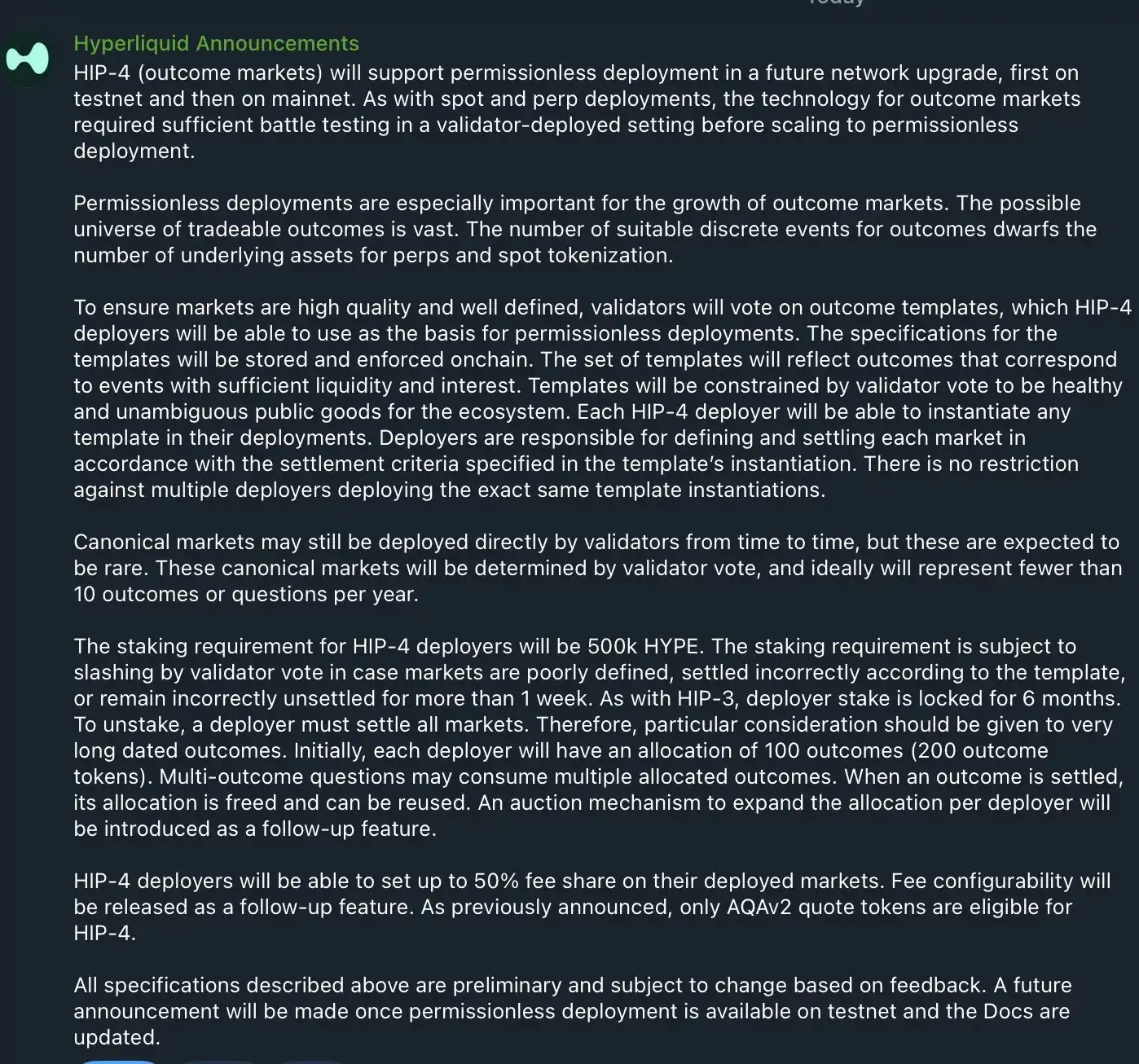
Hyperliquid Announces HIP-4 Open Permissionless Deployment

Although this announcement from Hyperliquid is just a preliminary notice, with the specific opening time for HIP-4 permissionless deployment not yet confirmed, the market has already gotten excited following the news.

Hyperliquid's current status as the world's largest platform for stock tokens and on-chain commodity perpetual contracts, even outpacing traditional financial markets in pricing enterprise IPOs, is largely thanks to its launch of HIP-3 and opening of third-party permissionless creation of perpetual contract markets in October 2025.

Therefore, this time, investors believe Hyperliquid can once again rely on the power of "decentralization" to surpass all the frontrunners in the prediction market sector.

Who Will Be the Next Trade.xyz?

Hyperliquid launched the HIP-4 market on May 2nd, 2026, marking its official entry into the prediction market sector. Before the HIP-4 market went live, the market was generally optimistic that it would become Hyperliquid's next core narrative. However, nearly three months after its launch, its performance can be described as poor.

According to official Hyperliquid data, the cumulative trading volume of the HIP-4 market over the past 3 months is only $216 million, with a daily average trading volume of just $10 million. The peak daily active users reached only 7,000, and the total fee revenue is a mere $442.38. In contrast, DeFiLlama data shows Polymarket's trading volume over the past month reached $4.587 billion, with fees amounting to $50 million.
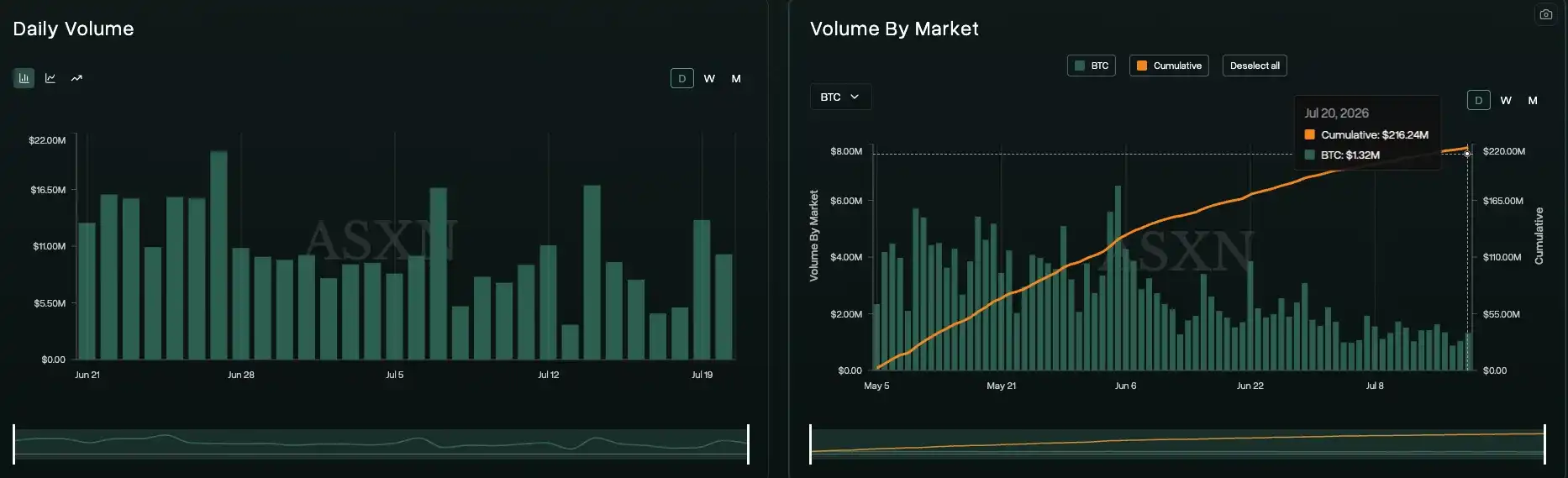
HIP-4 Daily Average Trading Volume and Total Trading Volume

Not only are there few users and low trading volume, but the number of events with resolvable outcomes on HIP-4 is also very limited. Currently, the entire HIP-4 market has only 6 predictive markets, which is a drop in the bucket compared to Polymarket in terms of both quantity and variety.
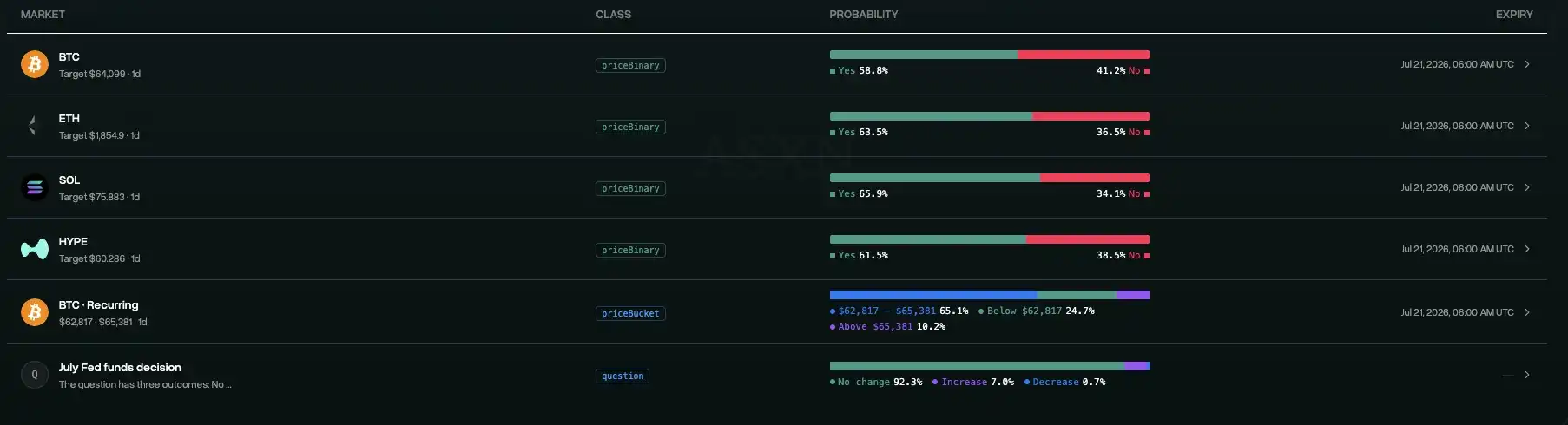
Currently Tradable Events on HIP-4

Given such a vast disparity in scale, Hyperliquid chose to follow the path of dependency, adhering to the successful experience of HIP-3. Since they couldn't build it up themselves, they would give the stage to the community, aiming to create another Trade.xyz within HIP-4.

Hyperliquid opening permissionless deployment for the HIP-4 market is equivalent to Polymarket allowing users to autonomously create predictive market events. Hyperliquid founder Jeff also stated that permissionless deployment is particularly important for the growth of outcome markets (HIP-4) because the scope of outcomes that can be traded is extremely vast. The number of independent events suitable for outcome trading far exceeds the number of underlying assets used for derivatives and real-world asset tokenization.

Moreover, having the community or third parties deploy predictive market events offers greater flexibility. Currently, the creation of predictive market contracts is mainly initiated by the team or reviewed after community proposals. This process is not decentralized enough, and team members cannot possibly pay attention to every niche across all fields. Especially for trending real-world events, this model slows down the time from market reaction to final execution and launch.

On the HIP-4 market, as long as a third party stakes enough HYPE tokens, they can list predictive market events according to their own standards without Hyperliquid team review. Hyperliquid also stipulates that it will not restrict multiple deployers from simultaneously deploying identical events. This will also incentivize healthy competition within the HIP-4 market, as only those who provide users with a wider range of events and deeper liquidity will prevail in the competition.

Hyperliquid's product philosophy has always adhered to a win-win strategy. The HIP-3 market has already nurtured the giant Trade.xyz, which holds over 90% of the HIP-3 market share. The first 10 perpetual contract listings it launched each exceeded $10 billion in trading volume.

Perhaps many teams are already gearing up. On the day Hyperliquid's mainnet opens HIP-4 for permissionless deployment, we will witness a lively "War of the Gods."

Can Hyperliquid Disrupt the Prediction Market Landscape?

But can Hyperliquid really "use one trick to conquer all"?

Firstly, Hyperliquid is no longer what it used to be. The HYPE price remains stable above $60. The requirement for HIP-4 market deployers to stake 500,000 HYPE (approximately $30 million) actually bars small startup teams from entering. Nowadays, a single funding round for a crypto project might not even reach $30 million. And prediction market projects capable of raising $30 million might prefer to develop their own prediction market platforms.

Therefore, the excessively high staking threshold for HIP-4 deployers might drastically reduce the number of third-party competitors. In the end, only "well-funded" prediction market projects would come to attract traffic. The number of tradable independent events would also be limited, severely hampering the innovation momentum of the entire HIP-4 market.

Secondly, Hyperliquid's timing for launching HIP-4 permissionless deployment missed even the last bus. One main reason why 2026 became a year of opportunity for the prediction market sector's development is the recent concentration of major sporting events, especially coinciding with the once-every-four-years World Cup. Various prediction markets were focusing their efforts around World Cup matches. For example, on Polymarket, the total trading volume for the Argentina vs. Spain match event on July 20th alone reached $83.75 million.

But Hyperliquid completely missed this crucial World Cup time window, which is undoubtedly a huge strategic oversight. Even the success of the HIP-3 market was a combination of favorable timing, location, and people. The US-Iran conflict in February this year, which caused fluctuations in international crude oil prices, became a significant catalyst for the HIP-3 market's development. The first day of the war fell on a weekend. With traditional markets closed, traders urgently needing to adjust positions and hedge had to find new tradable markets, and Hyperliquid's HIP-3 market became the first choice.

When Hyperliquid launched HIP-3, it did not emphasize that it was built for stock tokens and commodity tokenization. Yet, it ultimately gave rise to Trade.xyz and Hyperliquid's current leading position in the tokenized trading market. If Hyperliquid had not seized the opportunity presented by the US-Iran conflict, perhaps Hyperliquid would have no place in today's tokenized trading market.

Similarly, having missed the World Cup opportunity, how much confidence can we have that Hyperliquid can now disrupt the prediction market giants?


Tiền kỹ thuật số thịnh hành

Câu hỏi Liên quan

QAccording to the article, what major feature is Hyperliquid planning to implement for HIP-4, and what was the similar feature that contributed to its previous success?

AHyperliquid is planning to implement permissionless deployment for HIP-4, which will allow third parties to create prediction markets. A similar feature, the permissionless creation of perpetual contract markets under HIP-3, was a key factor in Hyperliquid's previous success, particularly leading to the rise of Trade.xyz.

QWhat are the current performance metrics of Hyperliquid's HIP-4 prediction market according to the article, and how do they compare to its main competitor, Polymarket?

AOver the past three months, Hyperliquid's HIP-4 market had a cumulative trading volume of only $216 million, with an average daily volume of around $10 million, a peak daily active user count of 7,000, and total fee revenue of just $442.38. In contrast, in just the past month, Polymarket achieved a trading volume of $45.87 billion and generated $50 million in fees, demonstrating a massive disparity in scale.

QWhat potential issue does the article identify regarding the staking requirement for HIP-4 deployers?

AThe article suggests that the staking requirement for HIP-4 deployers is too high. It requires a stake of 500,000 HYPE (worth approximately $30 million), which could exclude smaller entrepreneurial teams and lead to a significant reduction in potential third-party competitors. This, in turn, might limit the number and variety of tradable independent events and hinder innovation within the HIP-4 ecosystem.

QWhat significant timing opportunities did Hyperliquid miss for the launch of its HIP-4 market, and why were these opportunities important?

AHyperliquid missed the opportunity to launch its HIP-4 market during the recent World Cup, a major event that drove significant activity on competing prediction platforms like Polymarket. The article compares this to the successful timing of HIP-3's launch, which coincided with the US-Iran conflict when traders needed alternative markets. Missing such critical timing windows is seen as a major strategic oversight that could impact HIP-4's ability to compete.

QHow does the article characterize the logic behind Hyperliquid's decision to enable permissionless deployment for HIP-4, and what existing success story is cited as a model?

AThe article characterizes the decision as one of 'path dependence' and a strategic reliance on the successful model of decentralization from HIP-3. Since its own efforts on HIP-4 have performed poorly, Hyperliquid is giving the stage to the community, aiming to replicate the success of Trade.xyz—a major player that emerged from HIP-3's permissionless model—within the prediction market space.

Nội dung Liên quan

BONK bùng nổ 11% nhưng gấu đang chất lệnh: Dữ liệu NÀY cho thấy đợt tăng giá là một cái bẫy

Bonk (BONK) đã dẫn đầu thị trường memecoin trong ngày qua với mức tăng hơn 11%, chủ yếu nhờ sự gia tăng 32% về mức độ quan tâm trên mạng xã hội. Tuy nhiên, đà tăng này diễn ra trong bối cảnh giá BONK đã giảm 31% trong 30 ngày và 58% từ đầu năm. Dữ liệu cho thấy áp lực bán có thể đang gia tăng. Tỷ lệ tài trợ (Funding Rate) trên thị trường phái sinh đã chuyển sang âm ở mức -0.0009%, với tổng vị thế mở 7.82 triệu USD nghiêng về phe bán. Tâm lý thị trường cũng ở vùng tiêu cực (-2.42), không hỗ trợ cho một xu hướng tăng bền vững, đặc biệt với một memecoin không có sản phẩm cơ bản. Mặt khác, thị trường giao ngay (spot) lại cho thấy tín hiệu tích cực. Lượng BONK rút khỏi các sàn giao dịch để nắm giữ đã vượt lượng nạp vào, với dòng tiền ròng rút ra khoảng 880,000 USD và tổng tích lũy ước tính 4.24 triệu USD, đảo ngược xu hướng bán trong ba ngày trước đó. Tóm lại, đà tăng hiện tại của BONK đang đối mặt với sự thận trọng từ thị trường phái sinh và tâm lý tiêu cực, nhưng vẫn được hỗ trợ bởi hoạt động tích lũy mạnh trên thị trường giao ngay.

ambcrypto23 phút trước

BONK bùng nổ 11% nhưng gấu đang chất lệnh: Dữ liệu NÀY cho thấy đợt tăng giá là một cái bẫy

ambcrypto23 phút trước

Cung cố định + Sự cuồng nhiệt của tổ chức, liệu Bitcoin sau khi giảm 50% sẽ lặp lại mô hình bùng nổ giá giống Vàng 20 năm trước?

Bài viết so sánh tiềm năng phát triển giá của Bitcoin với lịch sử tăng trưởng của vàng sau khi ETF vàng ra đời năm 2004, từ đó đạt vốn hóa gần 28 nghìn tỷ USD. Dù Bitcoin đã giảm hơn 50% kể từ đỉnh cao năm 2025, nhiều nhà phân tích, như Eric Balchunas của Bloomberg Intelligence, lập luận rằng các quỹ ETF Bitcoin (như IBIT của BlackRock) có thể tạo ra một lộ trình tăng trưởng và biến động tương tự cho Bitcoin. Cả vàng và Bitcoin đều là công cụ lưu trữ giá trị không sinh lãi, phụ thuộc vào tâm lý nhà đầu tư. Lịch sử ETF vàng cho thấy các chu kỳ tăng mạnh, điều chỉnh sâu và phục hồi kéo dài, nhưng mỗi chu kỳ lại đẩy đỉnh giá lên cao hơn. Với nguồn cung gần như cố định, làn sóng nhu cầu từ các tổ chức thông qua ETF có thể thúc đẩy giá Bitcoin bùng nổ, dù nhu cầu này có thể thất thường. Bài viết nhấn mạnh rằng, mặc dù biến động vẫn lớn, nhu cầu thể chế ổn định thông qua ETF và việc các công ty đa dạng hóa danh mục với tài sản số là những trụ cột quan trọng. Nếu Bitcoin đạt được một phần vai trò lưu trữ giá trị như vàng, tiềm năng tăng giá vẫn rất đáng kể. Tuy nhiên, nhà đầu tư cần kiên nhẫn, phân tán rủi ro và tập trung vào xu hướng dài hạn giữa những biến động ngắn hạn.

marsbit29 phút trước

Cung cố định + Sự cuồng nhiệt của tổ chức, liệu Bitcoin sau khi giảm 50% sẽ lặp lại mô hình bùng nổ giá giống Vàng 20 năm trước?

marsbit29 phút trước

Starknet ra mắt phiên bản Bitcoin bí mật strkBTC, nhắm mục tiêu thị trường tài chính thể chế trên chuỗi

Starknet giới thiệu strkBTC, một phiên bản bitcoin riêng tư nhắm đến thị trường tài chính thể chế trên chuỗi. Với bitcoin chiếm hơn 56% thị trường crypto, việc nó được đưa vào DeFi thông qua token đóng gói đã làm lộ rõ hai vấn đề: mọi giao dịch đều công khai và mối đe dọa từ máy tính lượng tử đối với chữ ký mã hóa hiện tại. strkBTC, được xây dựng trên framework riêng tư STRK20 của Starknet, cung cấp hai chế độ: công khai (như ERC-20 thông thường) và ẩn danh (ẩn số dư và giao dịch). Giải pháp này tích hợp tuân thủ thông qua việc chia sẻ khóa xem (viewing key) với bên kiểm toán độc lập, cho phép tiết lộ khi có yêu cầu quy định. Song song với quyền riêng tư, Starknet cũng giải quyết mối đe dọa lượng tử nhờ kiến trúc STARK dựa trên hàm băm, không dựa vào mật mã đường cong elliptic dễ bị tấn công lượng tử. Starknet đã công bố lộ trình ba giai đoạn để đạt được bảo mật chống lượng tử toàn diện trước "Ngày Q" (Q-day). Mặc dù vẫn còn các thách thức như cơ chế cầu nối (bridge) dựa trên liên minh và cần chờ lộ trình nâng cấp chống lượng tử của Ethereum, strkBTC đại diện cho hướng đi tích hợp quyền riêng tư có thể kiểm soát, khả năng lập trình và độ bền lâu dài, nhằm thu hút sự tham gia của thể chế vào tài chính trên chuỗi.

marsbit33 phút trước

Starknet ra mắt phiên bản Bitcoin bí mật strkBTC, nhắm mục tiêu thị trường tài chính thể chế trên chuỗi

marsbit33 phút trước

Giao dịch

Giao ngay

Bài viết Nổi bật

Làm thế nào để Mua 4

Chào mừng bạn đến với HTX.com! Chúng tôi đã làm cho mua 4 (4) trở nên đơn giản và thuận tiện. Làm theo hướng dẫn từng bước của chúng tôi để bắt đầu hành trình tiền kỹ thuật số của bạn.Bước 1: Tạo Tài khoản HTX của BạnSử dụng email hoặc số điện thoại của bạn để đăng ký tài khoản miễn phí trên HTX. Trải nghiệm hành trình đăng ký không rắc rối và mở khóa tất cả tính năng. Nhận Tài khoản của tôiBước 2: Truy cập Mua Crypto và Chọn Phương thức Thanh toán của BạnThẻ Tín dụng/Ghi nợ: Sử dụng Visa hoặc Mastercard của bạn để mua 4 (4) ngay lập tức.Số dư: Sử dụng tiền từ số dư tài khoản HTX của bạn để giao dịch liền mạch.Bên thứ ba: Chúng tôi đã thêm những phương thức thanh toán phổ biến như Google Pay và Apple Pay để nâng cao sự tiện lợi.P2P: Giao dịch trực tiếp với người dùng khác trên HTX.Thị trường mua bán phi tập trung (OTC): Chúng tôi cung cấp những dịch vụ được thiết kế riêng và tỷ giá hối đoái cạnh tranh cho nhà giao dịch.Bước 3: Lưu trữ 4 (4) của BạnSau khi mua 4 (4), lưu trữ trong tài khoản HTX của bạn. Ngoài ra, bạn có thể gửi đi nơi khác qua chuyển khoản blockchain hoặc sử dụng để giao dịch những tiền kỹ thuật số khác.Bước 4: Giao dịch 4 (4)Giao dịch 4 (4) dễ dàng trên thị trường giao ngay của HTX. Chỉ cần truy cập vào tài khoản của bạn, chọn cặp giao dịch, thực hiện giao dịch và theo dõi trong thời gian thực. Chúng tôi cung cấp trải nghiệm thân thiện với người dùng cho cả người mới bắt đầu và người giao dịch dày dạn kinh nghiệm.

Tổng lượt xem 620Xuất bản vào 2025.10.20Cập nhật vào 2026.06.02

Làm thế nào để Mua 4

Thảo luận

Chào mừng đến với Cộng đồng HTX. Tại đây, bạn có thể được thông báo về những phát triển nền tảng mới nhất và có quyền truy cập vào thông tin chuyên sâu về thị trường. Ý kiến ​​của người dùng về giá của 4 (4) được trình bày dưới đây.

活动图片