ARK Founder Cathie Wood's 2026 Forecast: Gold Peaks, Dollar Rebounds, Bitcoin Charts Its Own Course

marsbitXuất bản vào 2026-01-20Cập nhật gần nhất vào 2026-01-20

Tóm tắt

ARK Invest founder Cathie Wood's 2026 outlook predicts a "Reaganomics on steroids" era for the U.S. economy, driven by deregulation, tax cuts, stable monetary policy, and technological innovation. She anticipates a strong economic rebound from a "coiled spring" state, with productivity surges (4-6% annually) and controlled inflation (possibly negative) fueling 6-8% nominal GDP growth. Wood forecasts a significant dollar rally, similar to the 1980s, which could halt gold's momentum, while Bitcoin may outperform due to its supply constraints and low correlation with other assets. She dismisses AI bubble concerns, arguing that earnings growth will justify high valuations, and expects market returns even with compressed P/E ratios. Key themes include AI-driven capital expenditure booms, corporate tax rates near 10%, and deflationary pressures from innovation.

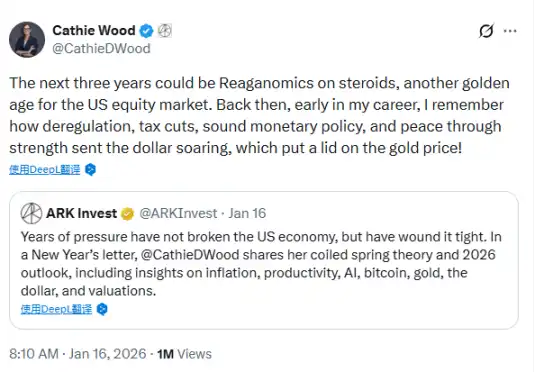
ARK Invest founder Cathie Wood ("Wood Sister") released a macro outlook in her latest New Year's letter to investors for 2026, likening the next three years to "Reaganomics on steroids." She pointed out that with the convergence of deregulation, tax cuts, sound monetary policy, and innovative technology, the U.S. stock market is set to usher in another "golden age," while an impending surge in the U.S. dollar could put an end to gold's upward momentum.
Specifically, Cathie Wood believes that despite continuous real GDP growth over the past three years, the underlying U.S. economy has actually experienced a rolling recession and is currently in a "coiled spring" state, poised for a strong rebound in the coming years. She particularly emphasized that with David Sacks appointed as the first AI and Cryptocurrency Czar to lead deregulation, and the effective corporate tax rate moving towards 10%, U.S. economic growth will receive a significant policy dividend.

At the macro level, Wood predicts that inflation will be further controlled, possibly even turning negative, driven by a productivity boom. She expects the U.S. nominal GDP growth rate to remain in the range of 6% to 8% in the coming years, primarily driven by productivity gains rather than inflation.

In terms of market impact, Wood predicts that the relative advantage of U.S. investment returns will drive the dollar exchange rate significantly higher, replaying the nearly doubling of the dollar in the 1980s. She warned that although gold prices have risen substantially in recent years, the strengthening dollar will suppress gold prices, while Bitcoin, due to its supply mechanism and low asset correlation, will show a different trend from gold.

Regarding investor concerns about market valuation, Wood does not believe an AI bubble has formed. She pointed out that although price-to-earnings ratios are at historically high levels, as AI, robotics, and other technologies drive a productivity explosion, corporate profit growth will digest high valuations, and the market may achieve positive returns while compressing P/E ratios, similar to the bull market path of the mid-to-late 1990s.

Below is the original text of the letter to investors:

Happy New Year to ARK's investors and other supporters! We are very grateful for your support.

As I elaborate in this letter, we truly believe there are many reasons for investors to be optimistic! I hope you enjoy our discussion. From the perspective of economic history, we are at a pivotal moment.

Coiled Spring

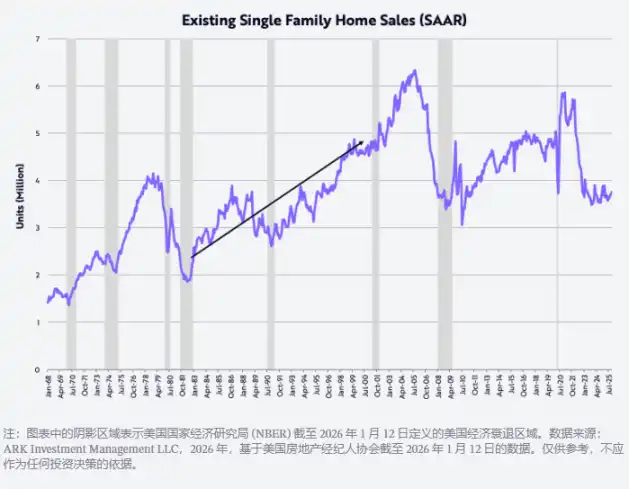
Although U.S. real Gross Domestic Product (GDP) has continued to grow over the past three years, the underlying structure of the U.S. economy has experienced a rolling recession and has gradually become a spring compressed to its limit, likely to rebound strongly in the coming years. In response to supply shocks related to the COVID-19 pandemic, the Federal Reserve raised the federal funds rate from 0.25% in March 2022 to 5.5% by July 2023 over a 16-month period, a record increase of 22 times. This rate hike pushed housing, manufacturing, non-AI-related capital expenditures, and the U.S. middle- and low-income groups into a recession, as shown in the chart below.

Measured by existing home sales, the housing market declined by 40% from an annualized rate of 5.9 million units in January 2021 to 3.5 million units in October 2023. This level was last seen in November 2010, and over the past two years, existing home sales have fluctuated around this level. This indicates how tightly the spring is compressed: the current level of existing home sales is comparable to the early 1980s, when the U.S. population was about 35% smaller than it is now.
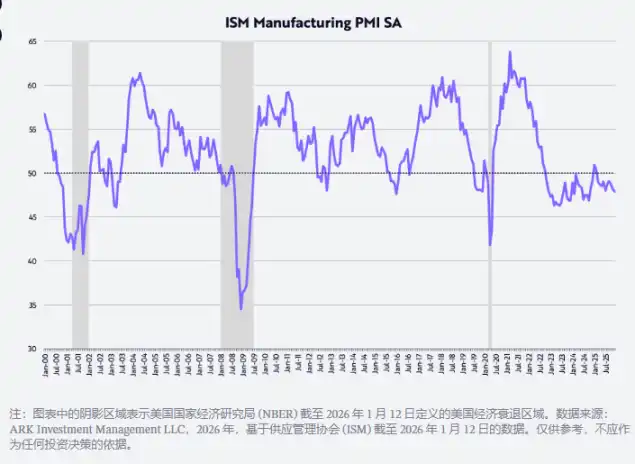
Measured by the U.S. Purchasing Managers' Index (PMI), manufacturing has been in contraction for about three years. According to this diffusion index, 50 is the dividing line between expansion and contraction, as shown below.
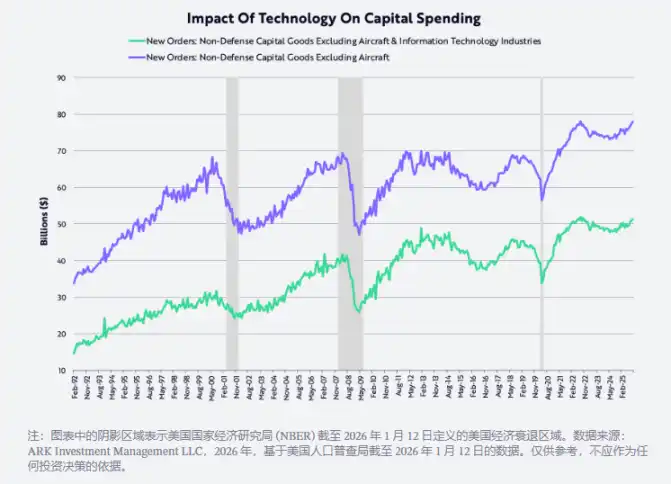
Meanwhile, capital expenditures measured by non-defense capital goods (excluding aircraft) peaked in mid-2022 and have since recovered to that level, whether affected by technology or not. In fact, this capital expenditure indicator struggled for more than 20 years to break through after the tech and telecom bubble burst, until 2021, when COVID-19-related supply shocks forced both digital and physical investment to accelerate. The former spending cap seems to have turned into a spending floor, as AI, robotics, energy storage, blockchain technology, and multi-omics sequencing are ready to enter their golden age. Following the tech and telecom bubble of the 1990s, a peak expenditure of about $70 billion persisted for 20 years; now, as the following chart shows, this could be the strongest capital expenditure cycle in history. We believe an AI bubble is still a long way off!
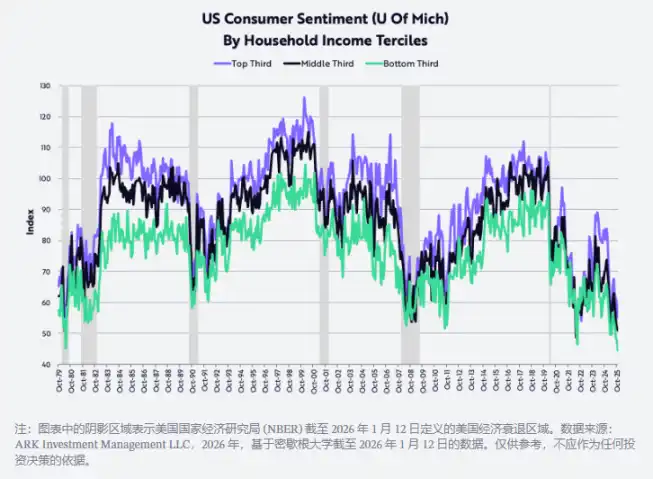
At the same time, data from the University of Michigan shows that confidence among middle- and low-income groups has fallen to its lowest level since the early 1980s. Back then, double-digit inflation and high interest rates severely eroded purchasing power and pushed the U.S. economy into consecutive recessions. Moreover, as shown below, confidence among high-income groups has also declined in recent months. In our view, consumer confidence is currently one of the most tightly compressed "springs" with the greatest rebound potential.
Deregulation, Coupled with Lower Taxes, Inflation, and Interest Rates

Thanks to the combined effects of deregulation, lower taxes (including tariffs), inflation, and interest rates, the rolling recession experienced by the U.S. in recent years could reverse rapidly and dramatically in the coming year and beyond.

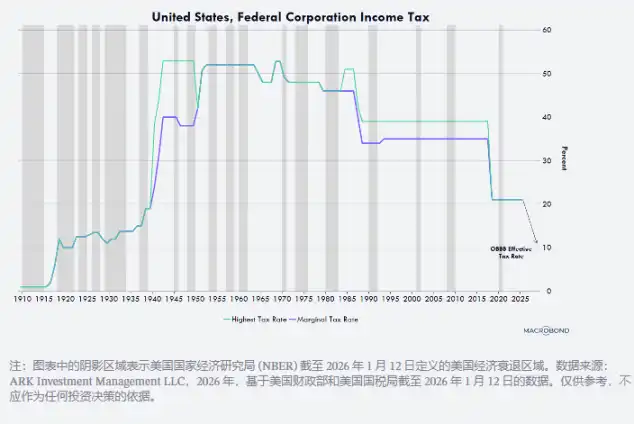
Deregulation is unleashing innovative vitality across various fields, particularly in artificial intelligence and digital assets, led by the first "AI and Cryptocurrency Czar," David Sacks. Meanwhile, reductions in tip, overtime, and social security taxes will provide U.S. consumers with substantial tax refunds this quarter, potentially boosting the annualized growth rate of real disposable income from about 2% in the second half of 2025 to about 8.3% this quarter. Additionally, with accelerated depreciation for manufacturing facilities, equipment, software, and domestic R&D expenditures, the effective corporate tax rate will be pushed down to near 10% (as shown below), corporate tax refunds are expected to rise significantly, and 10% is one of the lowest tax rates globally.

For example, any company that begins construction on a manufacturing plant in the U.S. by the end of 2028 can fully depreciate the building in the first year it is placed in service, instead of over 30 to 40 years as in the past. Equipment, software, and domestic R&D expenditures can also be 100% depreciated in the first year. This cash flow incentive was made permanent in last year's budget bill and is retroactive to January 1, 2025.
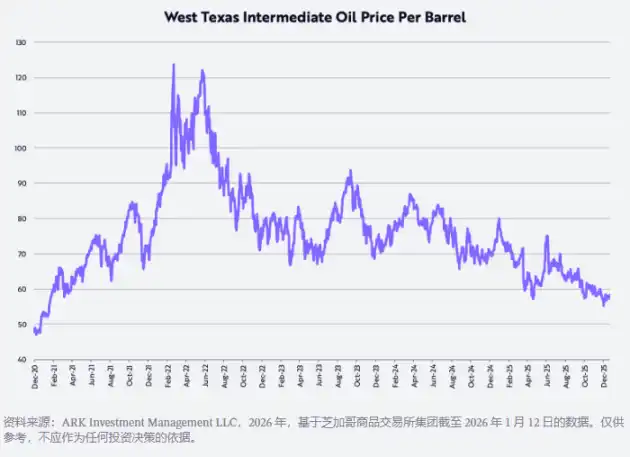
Over the past few years, inflation as measured by the Consumer Price Index (CPI) has stubbornly hovered in the 2% to 3% range, but in the coming years, for several reasons shown below, the inflation rate is likely to fall to a surprisingly low level—possibly even negative. First, West Texas Intermediate (WTI) crude oil prices have fallen by about 53% since the post-COVID peak of about $124 per barrel on March 8, 2022, and are currently down about 22% year-over-year.
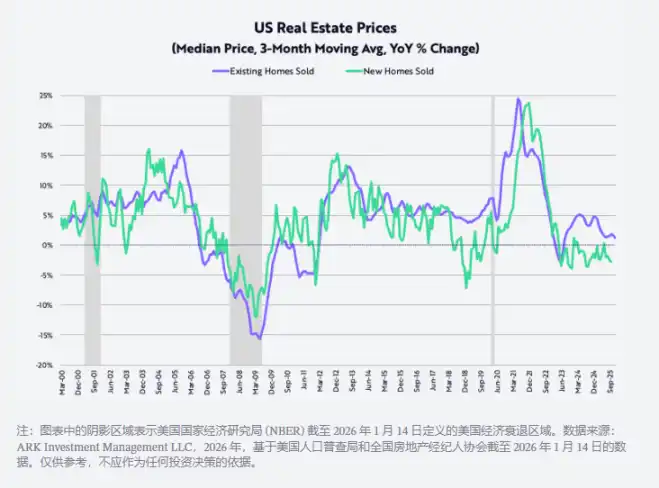
Since peaking in October 2022, the sales price of new single-family homes has fallen by about 15%; meanwhile, the inflation rate for existing single-family home prices—based on a three-month moving average—has dropped from about 24% year-over-year at the post-COVID peak in June 2021 to about 1.3%, as shown below.
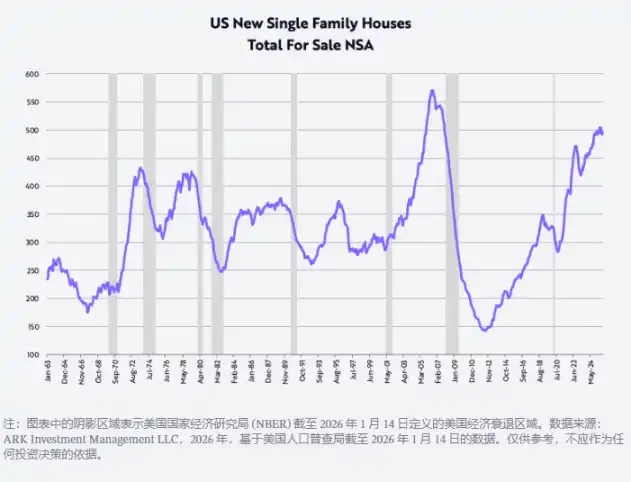
In the fourth quarter, to digest the inventory of nearly 500,000 new single-family homes (the highest level since October 2007, just before the global financial crisis, as shown below), the major homebuilders significantly reduced prices, with year-over-year declines of: Lennar -10%, KBHomes -7%, and DRHorton -3%. The impact of these price declines will be reflected in the Consumer Price Index (CPI) with a lag over the coming years.
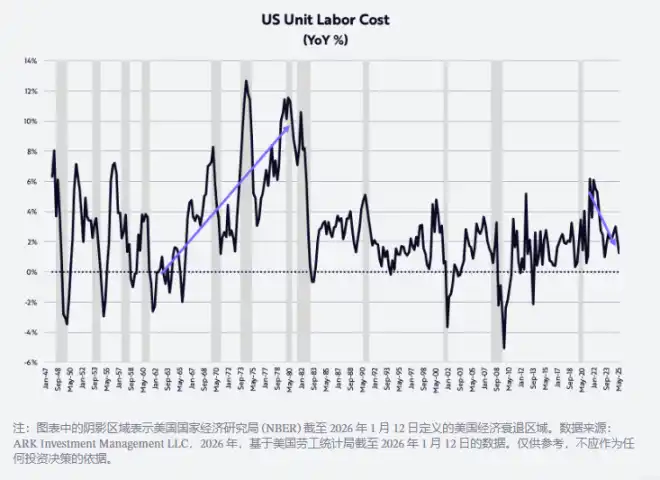
Finally, nonfarm productivity, one of the most powerful forces curbing inflation, grew against the trend in the context of a continuous recession, increasing 1.9% year-over-year in the third quarter. In contrast to a 3.2% increase in compensation per hour worked, the rise in productivity has reduced unit labor cost inflation to 1.2%, as shown below. There is no sign of 1970s-style cost-push inflation in this number!
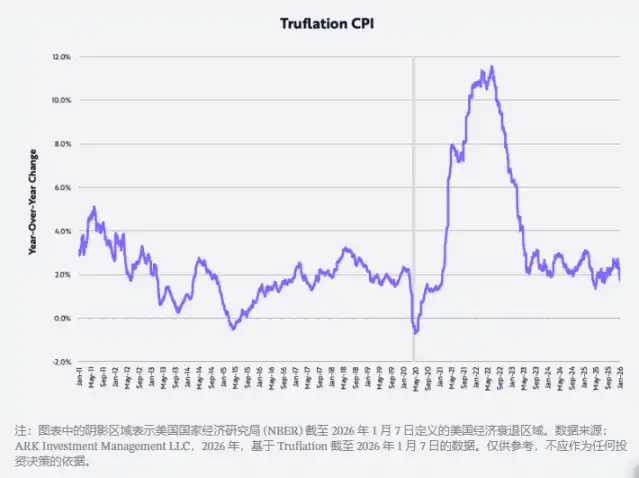
This improvement is also validated: the inflation rate measured by Truflation has recently fallen to 1.7% year-over-year, as shown below, nearly 100 basis points (bps) lower than the inflation rate calculated by the Bureau of Labor Statistics (BLS) based on CPI.
Productivity Boom

Indeed, if our research on technology-driven disruptive innovation is correct, then in the coming years, nonfarm productivity growth should accelerate to 4-6% per year, driven by both cyclical and long-term factors, further reducing unit labor cost inflation. The convergence of the major innovation platforms currently developing—artificial intelligence, robotics, energy storage, public blockchain technology, and multi-omics—is expected not only to drive productivity growth to sustainably new highs but also to create enormous wealth.

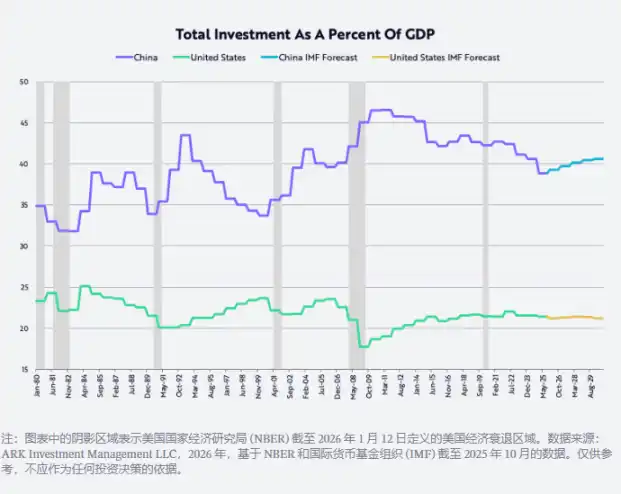
Productivity gains could also correct significant geo-economic imbalances in the global economy. Companies can direct the benefits of productivity gains to one or more of the following four strategic directions: expanding profit margins, increasing R&D and other investments, raising wages, and/or lowering prices. In China, raising wages for more productive employees and/or increasing profit margins could help the economy break free from its structural problem of overinvestment. Since joining the World Trade Organization (WTO) in 2001, China's investment as a percentage of GDP has averaged about 40%, nearly double that of the U.S., as shown below. Raising wages would shift the Chinese economy toward a consumption-oriented model, moving away from a commoditized path.
However, in the short term, technology-driven productivity gains may continue to slow U.S. job growth, pushing the unemployment rate from 4.4% to above 5.0% and prompting the Federal Reserve to continue cutting interest rates. Subsequently, deregulation and other fiscal stimulus measures should amplify the impact of low interest rates and accelerate GDP growth in the second half of 2026. Meanwhile, inflation is likely to continue to slow, not only due to falling oil prices, housing prices, and tariffs but also thanks to technological advancements that boost productivity and reduce unit labor costs.

Surprisingly, AI training costs are falling by 75% annually, while AI inference costs (i.e., the cost of running AI application models) are falling by up to 99% annually (according to some benchmarks). These unprecedented declines in the cost of various technologies should drive a surge in their unit growth. Therefore, we expect the U.S. nominal GDP growth rate to remain in the range of 6% to 8% in the coming years, primarily driven by productivity growth of 5% to 7%, labor force growth of 1%, and an inflation rate of -2% to +1%.

The cumulative deflationary effects of AI and the other four major innovation platforms will shape an economic environment similar to the last major technological revolution period from 1879 to 1929, triggered by the internal combustion engine, electricity, and the telephone. During that period, short-term interest rates moved in sync with nominal GDP growth, while long-term rates responded to the deflationary undercurrents accompanying the technology boom, causing the yield curve to invert by an average of about 100 basis points, as shown below.

Other New Year Thoughts

Gold Price Rise vs. Bitcoin Price Fall

During 2025, the price of gold rose by 65%, while the price of Bitcoin fell by 6%. Many observers attributed the surge in gold prices from $1,600 per ounce in October 2022, at the end of the U.S. stock market bear market, to $4,300, a gain of 166%, to inflation risks. However, another explanation is that global wealth growth (exemplified by the 93% rise in the MSCI World Equity Index) has exceeded the annualized growth rate of global gold supply of about 1.8%. In other words, the incremental demand for gold may have exceeded its supply growth. Interestingly, during the same period, the price of Bitcoin rose by 360%, while its supply grew at an annualized rate of only about 1.3%. It is worth noting that gold and Bitcoin miners may react very differently to these price signals: gold miners respond by increasing gold production, while Bitcoin cannot do this. Mathematically, Bitcoin will grow by about 0.82% annually over the next two years, after which its growth rate will slow to about 0.41% per year.

A Long-Term Perspective on Gold Prices

Measured by the ratio of market capitalization to M2 money supply, the price of gold has only been higher than this level once in the past 125 years, during the Great Depression of the early 1930s. At that time, the gold price was fixed at $20.67 per ounce, while the M2 money supply plummeted by about 30% (as shown below). Recently, the gold-to-M2 ratio has exceeded the previous peak, which occurred in 1980 when inflation and interest rates soared into double digits. In other words, from a historical perspective, the price of gold has reached an extremely high level.

The chart below also shows that the long-term decline in this ratio has been closely related to solid stock market returns. According to research by Ibbotson and Sinquefield, stocks have had a compound annual return of about 10% since 1926. After the ratio reached two major long-term peaks in 1934 and 1980, stock prices as measured by the Dow Jones Industrial Average (DJIA) achieved returns of 670% and 1015% over the 35 and 21 years ending in 1969 and 2001, respectively, representing annualized returns of 6% and 12%. Notably, small-cap stocks had annualized returns of 12% and 13%, respectively.
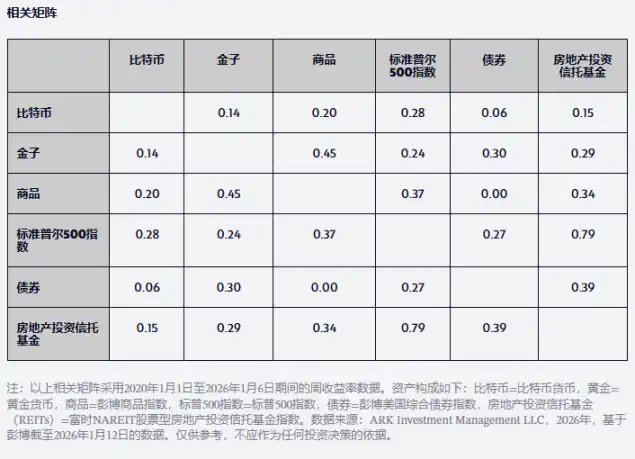
For asset allocators, another important consideration is Bitcoin's relatively low correlation with gold returns and with other major asset classes since 2020, as shown in the table below. Notably, Bitcoin's correlation with gold is even lower than the correlation between the S&P 500 and bonds. In other words, for asset allocators seeking higher risk-adjusted returns in the coming years, Bitcoin should be a good diversification option.
U.S. Dollar Outlook

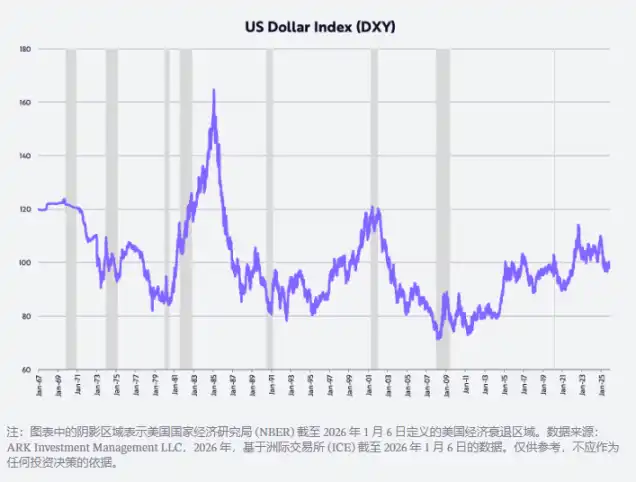
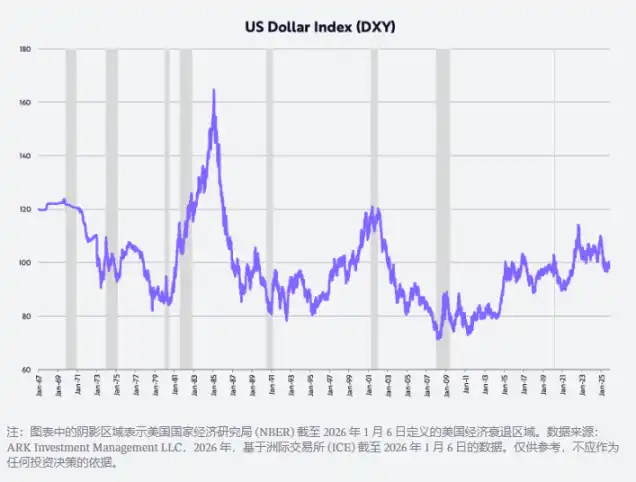
Over the past few years, a popular narrative has been the end of American exceptionalism, with the dollar recording its largest first-half decline since 1973 and its largest full-year decline since 2017. Last year, as measured by the trade-weighted dollar index (DXY), the dollar fell 11% in the first half and 9% for the full year. If our predictions about fiscal policy, monetary policy, deregulation, and U.S.-led technological breakthroughs are correct, then U.S. investment returns will improve relative to the rest of the world, pushing the dollar exchange rate higher. The Trump administration's policies mirror the situation during the Reaganomics era of the early 1980s, when the dollar exchange rate nearly doubled, as shown below.
AI Hype

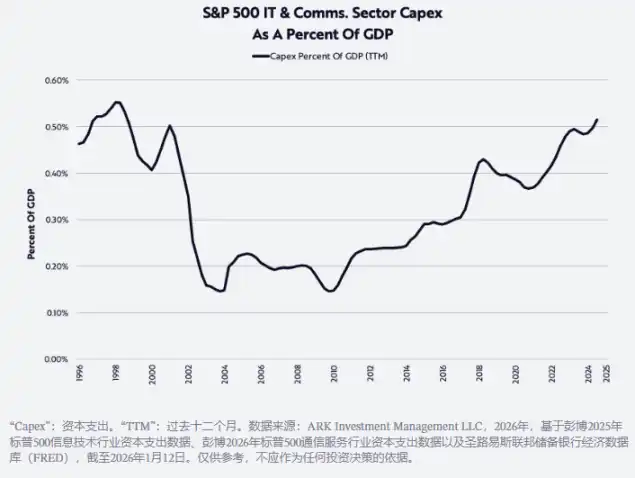
As shown below, the AI boom is driving capital expenditures to their highest levels since the late 1990s. In 2025, investment in data center systems (including computing, networking, and storage equipment) grew by 47% to nearly $500 billion, and is expected to grow another 20% in 2026 to about $600 billion, far above the long-term trend of $150-200 billion annually in the launch of ChatGPT a decade ago. Such massive investment规模 inevitably raises the question: "What is the return on this investment? And where will it be reflected?"
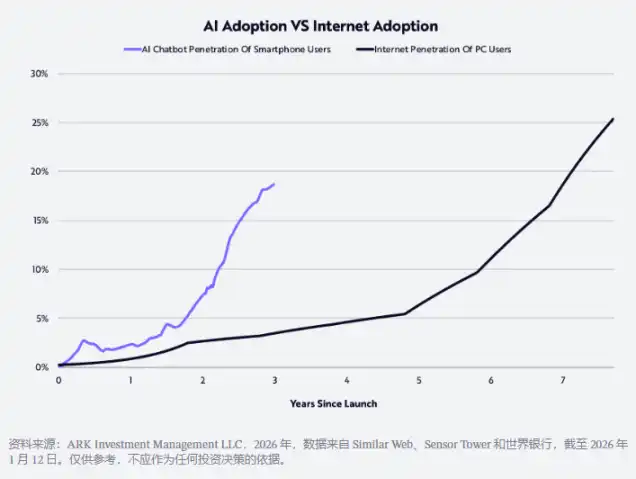
Beyond semiconductors and listed large cloud companies, unlisted AI-native companies are also benefiting from growth and investment returns. AI companies are among the fastest-growing businesses in history. Our research shows that consumer adoption of AI is twice as fast as the adoption of the internet in the 1990s, as shown below.
It is reported that by the end of 2025, OpenAI and Anthropic's annualized revenue will reach $20 billion and $9 billion, respectively, up 12.5 times and 90 times from $1.6 billion and $100 million a year earlier! Rumors suggest that both companies are considering initial public offerings (IPOs) in the next year or two to raise funds for the massive investments required to support their product models.

As Fidji Simo, CEO of OpenAI's applied division, said: "The capabilities of AI models far exceed what most people experience in their daily lives, and 2026 is the year to bridge this gap. The leaders in AI will be those who can translate cutting-edge research into products that are truly useful for individuals, businesses, and developers." This year, with more humane, intuitive, and integrated user experiences, we expect to make substantial progress in this area. ChatGPT Health is an early example, a dedicated section within the ChatGPT platform that helps users improve their health based on their personal health data.

In enterprises, many AI applications are still in their early stages, hindered by bureaucracy, inertia, and/or prerequisites such as restructuring and building data infrastructure, leading to slow progress. By 2026, organizations may realize that they need to use their own data to train models and iterate quickly, or risk being left behind by more aggressive competitors. AI-driven use cases should provide immediate and excellent customer service, faster product launch speeds, and help startups create more value with fewer resources.

Overvalued Market

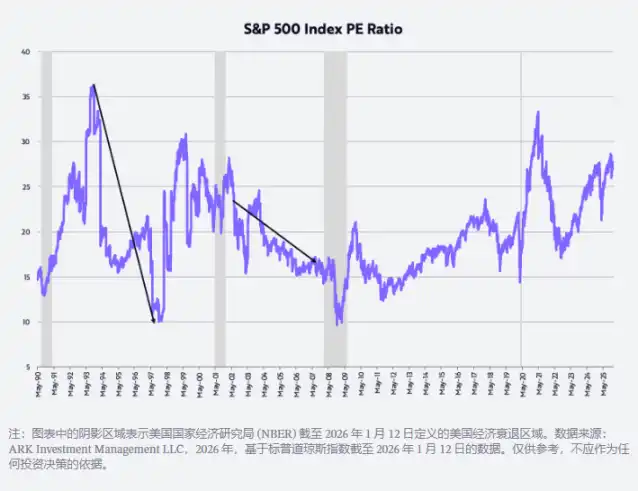
Many investors are concerned about overvalued stock markets, which are currently at historically high levels, as shown below. Our own valuation assumption is that the price-to-earnings (P/E) ratio will fall back to around 20 times, the average of the past 35 years. Some of the most significant bull markets have occurred alongside P/E compression. For example, from mid-October 1993 to mid-November 1997, the S&P 500 had an annualized return of 21%, while its P/E ratio fell from 36 times to 10 times. Similarly, from July 2002 to October 2007, the S&P 500 had an annualized return of 14%, while its P/E ratio fell from 21 times to 17 times. Given our expectations that real GDP growth will be driven by productivity gains and slowing inflation, the same dynamics should reappear in this market cycle, possibly even more significantly.
As always, many thanks to ARK's investors and other supporters, and also to Dan, Will, Katie, and Keith for helping me write this very long New Year's greeting!


Tiền kỹ thuật số thịnh hành

Câu hỏi Liên quan

QWhat are Cathie Wood's main predictions for the US economy and markets by 2026?

ACathie Wood predicts a strong US economic rebound driven by deregulation, tax cuts, and technological innovation. She expects productivity growth of 4-6%, controlled inflation (possibly negative), nominal GDP growth of 6-8%, a surging US dollar, a peak in gold prices, and Bitcoin outperforming due to its low correlation with other assets.

QHow does Cathie Wood justify her view that the AI bubble has not yet formed?

AShe argues that despite high capital expenditure in AI infrastructure (e.g., data centers), the adoption rate of AI is twice as fast as the internet in the 1990s. Companies like OpenAI and Anthropic show explosive revenue growth, and AI-driven productivity gains will justify current investments and valuations.

QWhy does Wood believe the US dollar will strengthen significantly by 2026?

AShe attributes the expected dollar strength to US policy advantages (deregulation, tax cuts), higher relative investment returns, and a productivity boom. This mirrors the 1980s 'Reaganomics' era when the dollar nearly doubled in value.

QWhat is Wood's rationale for predicting a peak in gold prices and Bitcoin's independent performance?

AGold prices have surged due to demand outpacing supply, but historical ratios (e.g., gold/M2) suggest overvaluation. Bitcoin, with its fixed supply growth (~1.3% annually) and low correlation to other assets, is seen as a better diversification tool and less susceptible to dollar strength.

QHow does Wood address concerns about high market valuations in US stocks?

AShe acknowledges high P/E ratios but argues that productivity-driven earnings growth will compress valuations organically. Historical examples (e.g., 1993-1997) show markets can deliver strong returns even as P/E ratios decline if earnings expand sufficiently.

Nội dung Liên quan

Đối thoại với Ray Dalio: Chúng ta đang ở trong bong bóng AI, 1% danh mục đầu tư của tôi là Bitcoin

Ray Dalio, người sáng lập Bridgewater Associates, trong một cuộc phỏng vấn đã chỉ ra rằng thế giới hiện tại đang trong một "AI bubble" (bong bóng AI) cổ điển, với giá tài sản tăng vọt và đầu cơ quá mức. Ông cảnh báo bong bóng có thể vỡ do lãi suất tăng, nguồn cung cổ phiếu dư thừa hoặc khi nhà đầu tư cần tiền mặt trả nợ, dẫn đến suy thoái kinh tế. Đồng thời, Dalio mô tả một "chu kỳ lớn" kéo dài khoảng 80 năm, bao gồm ba động lực chồng chéo: khoảng cách giàu nghèo và xung đột nội bộ, thâm hụt ngân sách chính phủ khổng lồ và thay đổi địa chính trị. Ông nhấn mạnh rằng Mỹ và Anh đang đối mặt với những thách thức trong giai đoạn suy yếu này. Để bảo vệ của cải, Dalio khuyến nghị đa dạng hóa danh mục đầu tư với cổ phiếu, vàng, trái phiếu, bất động sản thay vì chỉ giữ tiền mặt. Ông tiết lộ khoảng 1% danh mục của mình là Bitcoin, nhưng vẫn ưa chuộng vàng vật chất hơn do tính ổn định và vai trò tiền tệ dự trữ. Về tác động của AI, Dalio cho rằng nó không chỉ thay thế lao động chân tay mà còn cả tư duy, làm trầm trọng thêm bất bình đẳng thu nhập. Con người cần phát huy trí tuệ cảm xúc và trực giác - những thứ AI chưa có - và học cách hợp tác với AI. Cuối cùng, ông phân tích những rủi ro của thuế tài sản và xu hướng thế giới có thể trở nên "khu vực hóa" hơn, với các khối như châu Mỹ và châu Á - Thái Bình Dương, trong bối cảnh sự thống trị toàn cầu của Mỹ đang suy yếu.

marsbit2 giờ trước

Đối thoại với Ray Dalio: Chúng ta đang ở trong bong bóng AI, 1% danh mục đầu tư của tôi là Bitcoin

marsbit2 giờ trước

Hơn 7.2 nghìn tỷ won trong một ngày, ngoại hải nước ngoài mua ròng kỷ lục vào thứ Sáu! Phố Wall: Cơn gió ngược về mặt vốn của thị trường chứng khoán Hàn Quốc đã tan biến

Dòng vốn nước ngoài đổ mạnh vào thị trường chứng khoán Hàn Quốc (KOSPI) với mức mua ròng kỷ lục 7,2 nghìn tỷ won chỉ trong ngày 31/7, đánh dấu sự đảo chiều rõ rệt sau nhiều tháng bán ròng mạnh. Theo báo cáo từ Citigroup, áp lực bán từ dòng vốn nước ngoài đã giảm đáng kể, với mức bán ròng tháng 7 thu hẹp còn 9,8 nghìn tỷ won so với mức 48,4 và 44,5 nghìn tỷ won trong tháng 6 và tháng 5. Đồng thời, các quỹ hưu trí và quỹ đầu tư trong nước cũng chuyển sang vị thế mua ròng 1,0 nghìn tỷ won trong tháng 7. Một yếu tố hỗ trợ khác là quy định mới từ Ủy ban Dịch vụ Tài chính Hàn Quốc (FSC), có hiệu lực từ 31/7, siết chặt điều kiện đầu tư vào các ETF có đòn bẩy đối với nhà đầu tư cá nhân. Quy định này đã ngay lập tức làm giảm khoảng 50% khối lượng giao dịch của các ETF này, góp phần kỳ vọng giảm bớt biến động cho thị trường. Citigroup duy trì mục tiêu chỉ số KOSPI ở mức 10.000 điểm, dựa trên các yếu tố thuận lợi như ngành chip bán dẫn ổn định, định giá thị trường thấp, nền tảng kinh tế vững mạnh và các chính sách hỗ trợ. Họ nhận định áp lực dòng vốn ngược chiều đang giảm dần, tạo điều kiện cho các yếu tố cơ bản và chính sách tích cực phát huy tác dụng.

marsbit2 giờ trước

Hơn 7.2 nghìn tỷ won trong một ngày, ngoại hải nước ngoài mua ròng kỷ lục vào thứ Sáu! Phố Wall: Cơn gió ngược về mặt vốn của thị trường chứng khoán Hàn Quốc đã tan biến

marsbit2 giờ trước

Làm thế nào để khiến bản thân trở nên không thể bị thay thế bởi trí tuệ nhân tạo

**Tóm tắt: Làm thế nào để trở nên không thể bị thay thế bởi AI** Bài viết phản đối việc than vãn về AI và thay vào đó đề xuất một giải pháp căn cơ: trở thành một "siêu cá nhân" không thể bị thuê mướn. Mối đe dọa thực sự không phải là AI, mà là tình trạng "nô lệ lương thưởng" – phụ thuộc hoàn toàn vào người khác để sinh tồn, làm công việc nhàm chán mà không có mục đích. Để thoát khỏi vòng luẩn quẩn này và phát triển mạnh trong kỷ nguyên AI, bạn cần trau dồi 5 yếu tố then chốt: 1. **Tính tự chủ:** Khả năng hành động mà không cần chờ chỉ thị. 2. **Khiếu thẩm mỹ:** Khả năng nhận biết điều gì thực sự có giá trị. 3. **Khả năng thuyết phục:** Thu hút sự chú ý và sự công nhận. 4. **Sự kiên trì:** Không sợ thất bại, xem đó là bài học. 5. **Khả năng lặp:** Điều chỉnh dựa trên phản hồi để tiến tới mục tiêu. Giải pháp là đầu tư vào sự nghiệp của chính mình. Trong khi AI giỏi tạo ra "tài sản" (nội dung, code), nó không thể thay thế được khả năng phân biệt thứ gì đáng để tạo ra, làm cho mọi người quan tâm và kiên trì theo đuổi. Trong hai kỹ năng đòn bẩy mạnh mẽ là **Code (Lập trình)** và **Media (Nội dung)**, bài viết nhấn mạnh **Nội dung** quan trọng hơn. Giá trị của nội dung là chủ quan và đòi hỏi sự am hiểu, trải nghiệm mà AI khó có được, tạo không gian cho các cá nhân sáng tạo thực sự. **Cách bắt đầu (Bài tập 15 phút):** 1. **Khai thác nguyên liệu thô của bạn:** Xác định chủ đề bạn am hiểu sâu, vấn đề bạn tự giải quyết được, hay sở thích đặc biệt từ nhỏ. 2. **Xác định "trục phản biện" của bạn:** Tìm ra quan điểm độc đáo của bạn – những điều bạn tin là đúng nhưng số đông lại sai trong lĩnh vực của mình. 3. **Xuất bản ý tưởng đầu tiên:** Kết hợp câu trả lời từ bước 1 và 2, tạo ra một nội dung (bài đăng, video) và đăng nó lên. Hành động này mang lại phản hồi thực tế, bắt đầu quá trình học hỏi, lặp lại và phát triển kỹ năng thuyết phục. Bằng cách xây dựng một sự nghiệp xoay quanh con người thật, trải nghiệm thật và góc nhìn độc đáo của mình thông qua nội dung, bạn có thể tạo ra giá trị mà AI không thể sao chép, từ đó trở nên không thể thay thế.

marsbit4 giờ trước

Làm thế nào để khiến bản thân trở nên không thể bị thay thế bởi trí tuệ nhân tạo

marsbit4 giờ trước

Nhờ việc tung xúc xắc, chìa khóa Bitcoin được lưu trữ offline, nhưng không phải ai cũng muốn làm điều này

Cảm biến từ cuộc tranh cãi gần đây xung quanh lỗ hổng trong ví phần cứng Coldcard, bài viết thảo luận về phương pháp tạo seed (cụm từ khôi phục) cho ví Bitcoin bằng cách xúc xắc vật lý. Mỗi lần xúc xắc công bằng cung cấp khoảng 2,6 bit entropy (thước đo tính ngẫu nhiên). Để đạt mức entropy an toàn cho một seed 12 từ (128 bit), cần khoảng 50 lần xúc xắc; Coldcard khuyến nghị 99 lần để đạt mức bảo mật cao hơn. Lợi thế chính của phương pháp này là tách biệt hoàn toàn với bất kỳ lỗi phần cứng hoặc phần mềm nào trong trình tạo số ngẫu nhiên của thiết bị, từ đó bảo vệ seed chính của ví. Tuy nhiên, bài viết cảnh báo rằng trong sự cố Coldcard, các chức năng phụ khác của thiết bị (như tạo ví giấy, khóa đa chữ ký, mật mã phiên USB) vẫn có thể bị ảnh hưởng nếu chúng dựa vào trình tạo số lỗi, ngay cả khi seed chính được tạo an toàn bằng xúc xắc. Nhược điểm lớn của việc dùng xúc xắc là quá trình thủ công, dễ xảy ra sai sót, tốn thời gian và không thực tế cho đa số người dùng mới. Người dùng có thể ghi chép sai, sử dụng xúc xắc gian lận, hoặc để lộ chuỗi kết quả. Do đó, mặc dù có nền tảng toán học vững chắc, phương pháp này đòi hỏi sự tỉ mỉ cao và không phải là giải pháp khả thi cho việc áp dụng Bitcoin rộng rãi. Bài viết kết luận rằng mục tiêu dài hạn vẫn là phát triển phần cứng/phần mềm tạo số ngẫu nhiên mạnh mẽ và đáng tin cậy, trong khi vẫn giữ phương pháp thủ công như một tùy chọn cho người dùng có kinh nghiệm. Cuối cùng, bài viết đưa ra khuyến nghị cho chủ sở hữu Coldcard: cập nhật firmware, kiểm tra các chức năng phụ đã sử dụng và xem xét các biện pháp bảo mật bổ sung như ví đa chữ ký kết hợp nhiều nhà sản xuất để giảm thiểu rủi ro từ một điểm yếu đơn lẻ.

cryptonews.ru7 giờ trước

Nhờ việc tung xúc xắc, chìa khóa Bitcoin được lưu trữ offline, nhưng không phải ai cũng muốn làm điều này

cryptonews.ru7 giờ trước

Giao dịch

Giao ngay

Bài viết Nổi bật

AGENT S là gì

Agent S: Tương Lai của Tương Tác Tự Động trong Web3 Giới thiệu Trong bối cảnh không ngừng phát triển của Web3 và tiền điện tử, các đổi mới đang liên tục định nghĩa lại cách mà cá nhân tương tác với các nền tảng kỹ thuật số. Một dự án tiên phong như vậy, Agent S, hứa hẹn sẽ cách mạng hóa tương tác giữa con người và máy tính thông qua khung tác nhân mở của nó. Bằng cách mở đường cho các tương tác tự động, Agent S nhằm đơn giản hóa các nhiệm vụ phức tạp, cung cấp các ứng dụng chuyển đổi trong trí tuệ nhân tạo (AI). Cuộc khám phá chi tiết này sẽ đi sâu vào những phức tạp của dự án, các tính năng độc đáo của nó và những tác động đối với lĩnh vực tiền điện tử. Agent S là gì? Agent S đứng vững như một khung tác nhân mở đột phá, được thiết kế đặc biệt để giải quyết ba thách thức cơ bản trong việc tự động hóa các nhiệm vụ máy tính: Thu thập Kiến thức Cụ thể theo Miền: Khung này học một cách thông minh từ nhiều nguồn kiến thức bên ngoài và kinh nghiệm nội bộ. Cách tiếp cận kép này giúp nó xây dựng một kho lưu trữ phong phú về kiến thức cụ thể theo miền, nâng cao hiệu suất của nó trong việc thực hiện nhiệm vụ. Lập Kế Hoạch Qua Các Tầm Nhìn Nhiệm Vụ Dài Hạn: Agent S sử dụng lập kế hoạch phân cấp tăng cường kinh nghiệm, một cách tiếp cận chiến lược giúp phân chia và thực hiện các nhiệm vụ phức tạp một cách hiệu quả. Tính năng này nâng cao đáng kể khả năng quản lý nhiều nhiệm vụ con một cách hiệu quả và hiệu suất. Xử Lý Các Giao Diện Động, Không Đều: Dự án giới thiệu Giao Diện Tác Nhân-Máy Tính (ACI), một giải pháp đổi mới giúp nâng cao tương tác giữa các tác nhân và người dùng. Sử dụng các Mô Hình Ngôn Ngữ Lớn Đa Phương Thức (MLLMs), Agent S có thể điều hướng và thao tác các giao diện người dùng đồ họa đa dạng một cách liền mạch. Thông qua những tính năng tiên phong này, Agent S cung cấp một khung vững chắc giải quyết các phức tạp liên quan đến việc tự động hóa tương tác giữa con người với máy móc, mở ra nhiều ứng dụng trong AI và hơn thế nữa. Ai là Người Tạo ra Agent S? Mặc dù khái niệm về Agent S là hoàn toàn đổi mới, thông tin cụ thể về người sáng lập vẫn còn mơ hồ. Người sáng lập hiện vẫn chưa được biết đến, điều này làm nổi bật giai đoạn sơ khai của dự án hoặc sự lựa chọn chiến lược để giữ kín các thành viên sáng lập. Bất chấp sự ẩn danh, sự chú ý vẫn tập trung vào khả năng và tiềm năng của khung này. Ai là Các Nhà Đầu Tư của Agent S? Vì Agent S còn tương đối mới trong hệ sinh thái mã hóa, thông tin chi tiết về các nhà đầu tư và những người tài trợ tài chính của nó không được ghi chép rõ ràng. Sự thiếu vắng thông tin công khai về các nền tảng đầu tư hoặc tổ chức hỗ trợ dự án dấy lên câu hỏi về cấu trúc tài trợ và lộ trình phát triển của nó. Hiểu biết về sự hỗ trợ là rất quan trọng để đánh giá tính bền vững và tác động tiềm năng của dự án. Agent S Hoạt Động Như Thế Nào? Tại cốt lõi của Agent S là công nghệ tiên tiến cho phép nó hoạt động hiệu quả trong nhiều bối cảnh khác nhau. Mô hình hoạt động của nó được xây dựng xung quanh một số tính năng chính: Tương Tác Giống Như Con Người: Khung này cung cấp lập kế hoạch AI tiên tiến, cố gắng làm cho các tương tác với máy tính trở nên trực quan hơn. Bằng cách bắt chước hành vi của con người trong việc thực hiện nhiệm vụ, nó hứa hẹn nâng cao trải nghiệm người dùng. Ký Ức Tường Thuật: Được sử dụng để tận dụng các trải nghiệm cấp cao, Agent S sử dụng ký ức tường thuật để theo dõi lịch sử nhiệm vụ, từ đó nâng cao quy trình ra quyết định của nó. Ký Ức Tình Huống: Tính năng này cung cấp cho người dùng hướng dẫn từng bước, cho phép khung này cung cấp hỗ trợ theo ngữ cảnh khi các nhiệm vụ diễn ra. Hỗ Trợ OpenACI: Với khả năng chạy cục bộ, Agent S cho phép người dùng duy trì quyền kiểm soát đối với các tương tác và quy trình làm việc của họ, phù hợp với tinh thần phi tập trung của Web3. Tích Hợp Dễ Dàng với Các API Bên Ngoài: Tính linh hoạt và khả năng tương thích với nhiều nền tảng AI khác nhau đảm bảo rằng Agent S có thể hòa nhập liền mạch vào các hệ sinh thái công nghệ hiện có, làm cho nó trở thành lựa chọn hấp dẫn cho các nhà phát triển và tổ chức. Những chức năng này cùng nhau góp phần vào vị trí độc đáo của Agent S trong không gian tiền điện tử, khi nó tự động hóa các nhiệm vụ phức tạp, nhiều bước với sự can thiệp tối thiểu của con người. Khi dự án phát triển, các ứng dụng tiềm năng của nó trong Web3 có thể định nghĩa lại cách mà các tương tác kỹ thuật số diễn ra. Thời Gian Phát Triển của Agent S Sự phát triển và các cột mốc của Agent S có thể được tóm tắt trong một dòng thời gian nêu bật các sự kiện quan trọng của nó: 27 tháng 9, 2024: Khái niệm về Agent S được ra mắt trong một bài nghiên cứu toàn diện mang tên “Một Khung Tác Nhân Mở Sử Dụng Máy Tính Như Một Con Người,” trình bày nền tảng cho dự án. 10 tháng 10, 2024: Bài nghiên cứu được công bố công khai trên arXiv, cung cấp một cái nhìn sâu sắc về khung và đánh giá hiệu suất của nó dựa trên tiêu chuẩn OSWorld. 12 tháng 10, 2024: Một video trình bày được phát hành, cung cấp cái nhìn trực quan về khả năng và tính năng của Agent S, thu hút thêm sự quan tâm từ người dùng và nhà đầu tư tiềm năng. Những dấu mốc trong dòng thời gian không chỉ minh họa sự tiến bộ của Agent S mà còn chỉ ra cam kết của nó đối với sự minh bạch và sự tham gia của cộng đồng. Những Điểm Chính Về Agent S Khi khung Agent S tiếp tục phát triển, một số thuộc tính chính nổi bật, nhấn mạnh tính đổi mới và tiềm năng của nó: Khung Đổi Mới: Được thiết kế để cung cấp cách sử dụng máy tính trực quan giống như tương tác của con người, Agent S mang đến một cách tiếp cận mới cho việc tự động hóa nhiệm vụ. Tương Tác Tự Động: Khả năng tương tác tự động với máy tính thông qua GUI đánh dấu một bước tiến tới các giải pháp tính toán thông minh và hiệu quả hơn. Tự Động Hóa Nhiệm Vụ Phức Tạp: Với phương pháp mạnh mẽ của nó, nó có thể tự động hóa các nhiệm vụ phức tạp, nhiều bước, làm cho các quy trình nhanh hơn và ít sai sót hơn. Cải Tiến Liên Tục: Các cơ chế học tập cho phép Agent S cải thiện từ các trải nghiệm trước đó, liên tục nâng cao hiệu suất và hiệu quả của nó. Tính Linh Hoạt: Khả năng thích ứng của nó trên các môi trường hoạt động khác nhau như OSWorld và WindowsAgentArena đảm bảo rằng nó có thể phục vụ một loạt các ứng dụng rộng rãi. Khi Agent S định vị mình trong bối cảnh Web3 và tiền điện tử, tiềm năng của nó để nâng cao khả năng tương tác và tự động hóa quy trình đánh dấu một bước tiến quan trọng trong công nghệ AI. Thông qua khung đổi mới của mình, Agent S minh họa cho tương lai của các tương tác kỹ thuật số, hứa hẹn một trải nghiệm liền mạch và hiệu quả hơn cho người dùng trên nhiều ngành công nghiệp khác nhau. Kết luận Agent S đại diện cho một bước nhảy vọt táo bạo trong sự kết hợp giữa AI và Web3, với khả năng định nghĩa lại cách chúng ta tương tác với công nghệ. Mặc dù vẫn còn ở giai đoạn đầu, những khả năng cho ứng dụng của nó là rộng lớn và hấp dẫn. Thông qua khung toàn diện của mình giải quyết các thách thức quan trọng, Agent S nhằm đưa các tương tác tự động lên hàng đầu trong trải nghiệm kỹ thuật số. Khi chúng ta tiến sâu hơn vào các lĩnh vực tiền điện tử và phi tập trung, các dự án như Agent S chắc chắn sẽ đóng một vai trò quan trọng trong việc định hình tương lai của công nghệ và sự hợp tác giữa con người với máy tính.

Tổng lượt xem 1.1kXuất bản vào 2025.01.14Cập nhật vào 2025.01.14

AGENT S là gì

Làm thế nào để Mua S

Chào mừng bạn đến với HTX.com! Chúng tôi đã làm cho mua Sonic (S) trở nên đơn giản và thuận tiện. Làm theo hướng dẫn từng bước của chúng tôi để bắt đầu hành trình tiền kỹ thuật số của bạn.Bước 1: Tạo Tài khoản HTX của BạnSử dụng email hoặc số điện thoại của bạn để đăng ký tài khoản miễn phí trên HTX. Trải nghiệm hành trình đăng ký không rắc rối và mở khóa tất cả tính năng. Nhận Tài khoản của tôiBước 2: Truy cập Mua Crypto và Chọn Phương thức Thanh toán của BạnThẻ Tín dụng/Ghi nợ: Sử dụng Visa hoặc Mastercard của bạn để mua Sonic (S) ngay lập tức.Số dư: Sử dụng tiền từ số dư tài khoản HTX của bạn để giao dịch liền mạch.Bên thứ ba: Chúng tôi đã thêm những phương thức thanh toán phổ biến như Google Pay và Apple Pay để nâng cao sự tiện lợi.P2P: Giao dịch trực tiếp với người dùng khác trên HTX.Thị trường mua bán phi tập trung (OTC): Chúng tôi cung cấp những dịch vụ được thiết kế riêng và tỷ giá hối đoái cạnh tranh cho nhà giao dịch.Bước 3: Lưu trữ Sonic (S) của BạnSau khi mua Sonic (S), lưu trữ trong tài khoản HTX của bạn. Ngoài ra, bạn có thể gửi đi nơi khác qua chuyển khoản blockchain hoặc sử dụng để giao dịch những tiền kỹ thuật số khác.Bước 4: Giao dịch Sonic (S)Giao dịch Sonic (S) dễ dàng trên thị trường giao ngay của HTX. Chỉ cần truy cập vào tài khoản của bạn, chọn cặp giao dịch, thực hiện giao dịch và theo dõi trong thời gian thực. Chúng tôi cung cấp trải nghiệm thân thiện với người dùng cho cả người mới bắt đầu và người giao dịch dày dạn kinh nghiệm.

Tổng lượt xem 2.1kXuất bản vào 2025.01.15Cập nhật vào 2026.06.02

Làm thế nào để Mua S

Thảo luận

Chào mừng đến với Cộng đồng HTX. Tại đây, bạn có thể được thông báo về những phát triển nền tảng mới nhất và có quyền truy cập vào thông tin chuyên sâu về thị trường. Ý kiến ​​của người dùng về giá của S (S) được trình bày dưới đây.

活动图片