Inflation Has Not Improved. Will Warsh Support a Rate Hike on Friday?

marsbitXuất bản vào 2026-08-27Cập nhật gần nhất vào 2026-08-27

Tóm tắt

U.S. inflation remained stubbornly high in July, with the PCE price index holding at a year-on-year increase of 3.7%, unchanged from June and still far above the Federal Reserve's 2% target. The core PCE index also stayed flat at 3.3%. While inflation did not worsen, the fact that it did not improve either has increased market expectations for further interest rate hikes. Futures pricing now indicates a higher probability of a rate increase in September and fully prices in one hike by year-end. The economic backdrop is mixed. Second-quarter GDP growth was revised to 1.5%, but underlying components like consumer spending and business investment were robust. However, inflation-adjusted consumer spending stalled in July, and real incomes have barely grown over the past year, eroding purchasing power. The data provides arguments for both sides of the policy debate. The "wait-and-see" camp points to the lack of acceleration in inflation and upcoming methodological changes that may lower reported figures. The "pro-hike" camp highlights that inflation remains hotter than forecasts, sticky services prices, rising diesel and chip costs, and renewed trade tensions with Canada. All eyes are now on Fed Chair Kevin Warsh's upcoming speech at Jackson Hole for clarity on his policy stance. With inflation persistently above target for over five years and midterm elections approaching where prices are a key issue, the pressure for decisive action is mounting. The speech carries significant...

Early Wednesday morning, the U.S. Commerce Department released the latest inflation figures.

The inflation rate, as measured by the PCE price index, rose 3.7% year-on-year in July, exactly the same as in June. This marks its 65th consecutive month above the Federal Reserve's 2% target. Second-quarter GDP grew at an annualized rate of 1.5%, identical to the initial estimate from last month and slower than the first quarter's 2.1%. Meanwhile, after adjusting for inflation, consumer spending in July did not increase at all.

The New York Times summarized the report in one sentence: America's stubborn inflation problem did not get worse in July, but it did not get better either. The issue is that in the current atmosphere within the Federal Reserve, "not getting better" is itself an answer.

Why Does "Unchanged" Raise Rate Hike Odds?

Because economists expected it to fall. A Reuters survey predicted 3.6%, while the actual figure came out at 3.7%. The month-on-month figure also exceeded expectations, with overall prices rising 0.2% (expected 0.1%), compared to a 0.1% decline in June, which had been the weakest month since April 2020. Core PCE (excluding volatile food and energy) rose 3.3% year-on-year, again identical to June, with the month-on-month rate increasing from 0.1% to 0.2%.

Upon the data release, fed funds futures showed the probability of a September rate hike jumped from about 36% to around 44%. Traders have fully priced in one rate hike by the end of the year.

Omair Sharif, founder of the forecasting firm Inflation Insights, gave the shortest possible assessment: "This is a rate-hike supportive report."

Heather Long, Chief Economist at Navy Federal Credit Union, was more comprehensive: "The United States still has an inflation problem. The latest data gives (Warsh) time to wait and see, but he must be clearer about what he's watching closely and what circumstances would lead him to hike."

The dollar hit its biggest gain in nearly four weeks that day, recouping roughly half of the losses incurred after Treasury Secretary Besant intervened to support the bond market last week. The Bloomberg Dollar Spot Index rose as much as 0.3%, while the yen fell 0.2% to 159.45.

How Did Rate Hike Probability Get Here?

PCE peaked at 7.2% in June 2022, and the steepest round of rate hikes since the 1980s subsequently pulled it back onto a path toward 2%. That path was interrupted last year. A round of import tariffs following Trump's return to the White House pushed up prices for a wide range of goods.

In late February this year, the U.S. and Israel took action against Iran. Before the war started, PCE was 2.9%. The conflict shut down roughly one-fifth of global oil supply, sending energy prices spiraling upward and pushing PCE to a three-year high of 4.1% in May.

Six months on, a final resolution to the conflict remains distant, but the intensity of fighting has decreased, and oil prices along with the wave of inflation they fueled have receded from their late-spring highs.

They receded to 3.7%, and then stalled there.

The trouble is, new tariff pressures are on the way: Last Friday, U.S. negotiations with its second-largest trading partner, Canada, broke down. New tariffs on $20 billion worth of Canadian goods have taken effect, and both sides have since announced additional retaliatory measures set to take effect in the coming months.

The nuance of this report is that both the camp advocating for patience and the camp advocating for a rate hike can find ammunition in it.

The camp advocating for patience sees that: inflation did not worsen; high oil prices, aside from specific categories like airfare, have barely spread throughout the broader economy; and starting next month, the Bureau of Economic Analysis will change how it calculates prices for a subset of services (portfolio management services, software, and computer accessories) – an adjustment that is likely to lower measured inflation.

The camp advocating for a rate hike sees that: both headline and core inflation in July were hotter than forecasters expected; service prices excluding housing (an indicator some officials view as a gauge of underlying price pressure) rose faster than in June; diesel prices are near record highs, which will push up the cost of far more than one category of goods; the AI boom is pushing up chip prices; and the trade war with Canada has just reignited.

And the most fundamental argument has nothing to do with the monthly data: inflation has been above target for over five years. The argument from this camp is that the central bank must act decisively, or risk losing credibility.

But in reality, the economy is cooling. This is the most easily overlooked, and most critical, half of the report.

In July, inflation-adjusted consumer spending saw zero growth, after posting strong gains in the previous two months. In nominal terms, personal income rose 0.4% and consumer spending rose 0.2%, both exceeding expectations; but after subtracting inflation, real growth was zero.

Even more telling is income: compared to a year ago, inflation-adjusted income rose only 0.2%, and it had been negative for many months prior.

In other words, even as the inflation rate number is coming down, five years of cumulative price increases have eroded incomes. This explains why in consumer confidence surveys, most Americans remain pessimistic about the economy and their own financial situation.

What Will Warsh Say on Friday?

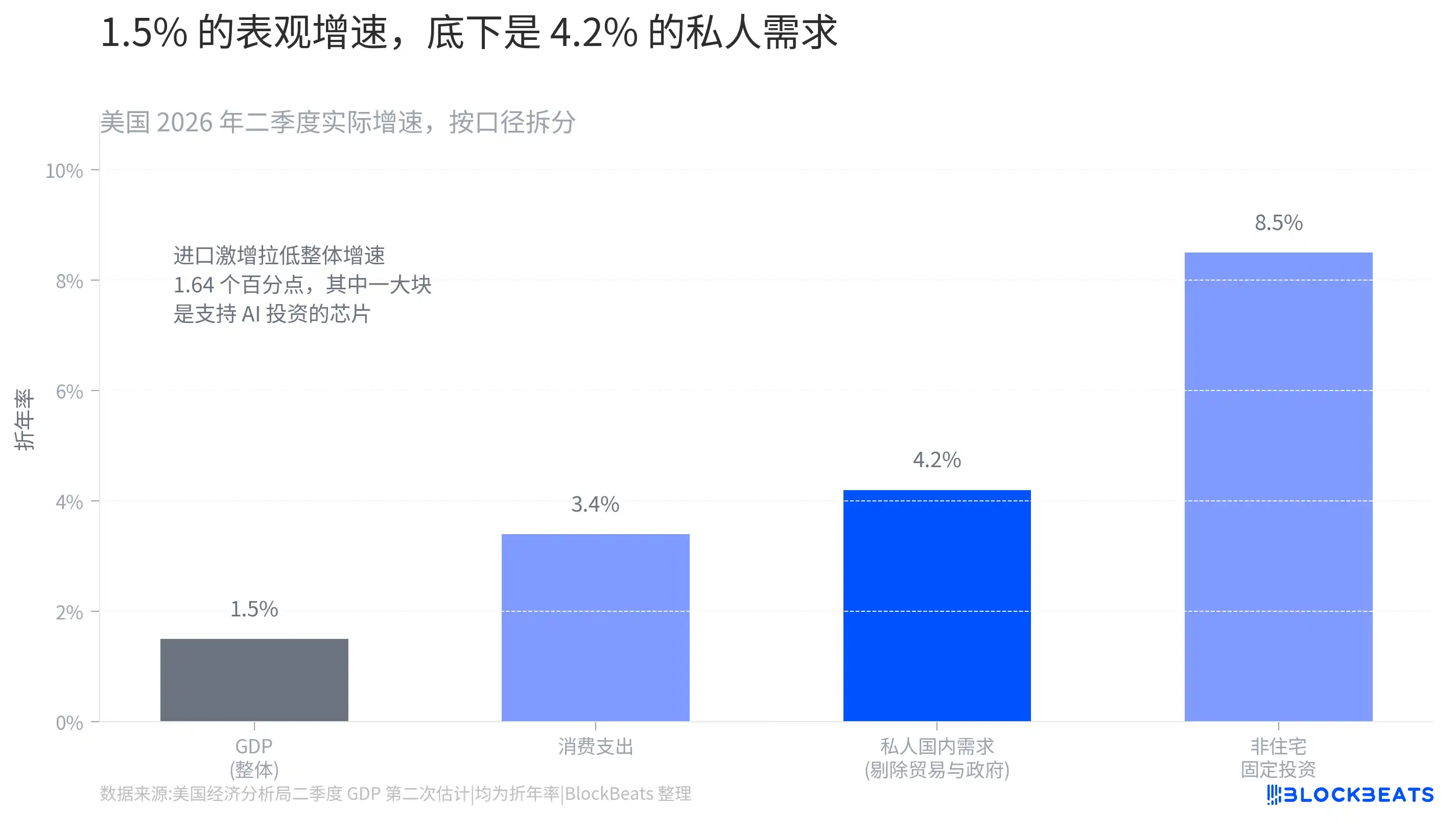
Second-quarter GDP at 1.5% sounds mediocre. But the underlying structure is nothing like that.

Consumer spending, which accounts for over two-thirds of U.S. economic activity, grew at an annualized rate of 3.4%, revised up from the initial estimate of 3.2%; in the first quarter, this figure was only 0.5%. Business investment excluding residential structures grew 8.5%, reflecting the heat of AI investment. And a specific measure of the economy's intrinsic strength – final sales to private domestic purchasers, which strips out volatile government spending and trade – grew 4.2%, the strongest in over three years, revised up from the initial 3.9%; in the first quarter, it was 1.7%.
Housing investment also rose, for the first time since late 2024.

So what dragged the 1.5% figure down? Imports.

Imports surged at a 12.5% annualized rate in the second quarter, with a significant chunk being computer chips and related products supporting AI investment. GDP only counts domestic production, and imports are subtracted – this single item alone knocked off 1.64 percentage points. Government spending fell 1%, with non-defense outlays pulling back sharply, also acting as a drag.

Thus, a strange picture emerges: chips bought to build AI are depressing this country's growth number.

The second-quarter GDP will have a third and final revision, to be released on September 30th.

The landing point for all this data is the podium at Jackson Hole this Friday.

Federal Reserve Chairman Kevin Warsh will deliver his first major speech since taking office. He has promised to end above-target inflation but has yet to give any hint as to whether he believes inflation can subside on its own without a rate hike. Wednesday's data did not show that it can.

The policy rate has been parked in the 3.5% to 3.75% range since last December. At the July meeting, three officials voted against, advocating for a 25 basis point rate hike.

Bank of America FX strategist Alex Cohen highlighted the uncertainty surrounding the speech: "There is clear two-way risk around Warsh's Jackson Hole speech. It remains a wild card."

And beyond all this, there is another timeline: the midterm elections are 10 weeks away. Gasoline prices remain high due to the war with Iran, the president is threatening new tariffs on Canada and China, and AI infrastructure spending is pushing up prices for computers, gaming consoles, and semiconductors.

Prices are becoming a core issue in this election.

Câu hỏi Liên quan

QAccording to the article, why did the unchanged July PCE inflation rate of 3.7% actually increase the probability of a Fed rate hike?

AThe unchanged rate of 3.7% was seen as increasing the probability of a rate hike because economists had forecast a decrease to 3.6%. The 'no improvement' outcome, along with monthly figures coming in hotter than expected, was interpreted by markets as data supporting a more hawkish Fed stance.

QWhat are the two main opposing views within the Fed cited in the article, based on the July inflation report?

AOne view advocates for waiting, citing that inflation did not worsen, high oil prices haven't broadly diffused, and upcoming methodological changes may lower measured inflation. The other view advocates for hiking rates, citing that overall and core inflation were hotter than forecasts, certain service prices are rising faster, and prolonged above-target inflation risks damaging the Fed's credibility.

QHow does the article explain the paradox of a seemingly weak 1.5% Q2 GDP growth rate alongside strong underlying economic components?

AThe article explains that components like consumer spending (3.4%) and business investment (8.5% excluding housing) were strong. The weak 1.5% headline figure was primarily dragged down by a surge in imports (12.5%), especially AI-related chips, which are subtracted in GDP calculation, and a decrease in government spending.

QWhat key uncertainty does the article highlight regarding Fed Chairman Kevin Warsh's upcoming Jackson Hole speech?

AThe article highlights that a key uncertainty is whether Chairman Warsh will signal a belief that inflation can fall back to target without further rate hikes. His speech presents 'clear two-way risk' as he has promised to end above-target inflation but hasn't yet hinted at his policy leaning.

QBeyond the immediate economic data, what two broader factors does the article mention as contributing to ongoing price pressures and political significance?

AThe article mentions upcoming new tariffs following the collapsed U.S.-Canada trade talks and the high price of gasoline due to the Iran conflict as factors contributing to price pressures. It notes that prices have become a core issue with the midterm elections 10 weeks away.

Nội dung Liên quan

Toàn thị trường cùng lúc tích trữ Bitcoin, BTC có thể thử thách vùng áp lực 86,000 USD?

**Tóm tắt:** Một đợt thanh lý vị thế short kỷ lục đã kích hoạt đợt phục hồi khoảng 26% cho Bitcoin từ mức đáy giữa tháng 8. Khác với các đợt bật tăng trước chủ yếu do đòn bẩy, lần này có sự hỗ trợ mua thực chất: ETF Bitcoin Mỹ ghi nhận dòng tiền ròng mạnh nhất trong tuần, Bitcoin liên tục rời khỏi sàn giao dịch và tất cả các nhóm ví trên chuỗi đều tích lũy đồng bộ. Thị trường đã giảm đòn bẩy đáng kể sau đợt thanh lý, với tỷ lệ tài trợ duy trì quanh mức trung lập. Các chỉ báo chu kỳ cho thấy thị trường vẫn ở giai đoạn sớm. Tuy nhiên, đợt phục hồi hiện đang đối mặt với thử thách lớn: vùng cung tập trung dày đặc ở mức 81.000 - 86.000 USD. Khu vực này tập hợp nhiều mức giá cân bằng chi phí của người nắm giữ dài hạn, lệnh bán trên sổ lệnh, và các kích hoạt thanh lý tiềm năng. Thị trường quyền chọn định giá kỳ vọng Bitcoin sẽ củng cố trong phạm vi này. Chìa khóa để đà tăng tiếp tục là khả năng vượt qua và củng cố vững chắc trên vùng kháng cự 83.300 USD, cùng với dòng tiền ETF duy trì. Ngược lại, nếu giá phá vỡ hỗ trợ quan trọng quanh mức chi phí của người nắm giữ ngắn hạn (70.000 USD) và vùng sàn 62.000 - 65.000 USD, đợt phục hồi có nguy cơ bị xóa sổ.

marsbit30 phút trước

Toàn thị trường cùng lúc tích trữ Bitcoin, BTC có thể thử thách vùng áp lực 86,000 USD?

marsbit30 phút trước

Khi quyền sở hữu bất động sản chuyển sang kỹ thuật số: Quyền, rủi ro và tính thanh khoản của bạn thay đổi thế nào?

Bất động sản là một trong những tài sản lớn nhất thế giới nhưng lại kém thanh khoản. Việc số hóa (token hóa) bất động sản, đặc biệt là bất động sản thương mại (CRE), đang thu hút sự chú ý như một giải pháp. OneAsset, một dự án có trụ sở tại Dubai, tập trung vào việc xây dựng cơ sở hạ tầng tuân thủ cho loại hình tài sản này. Thay vì tập trung vào việc chia nhỏ tài sản một cách đơn thuần, OneAsset nhấn mạnh chất lượng tài sản cơ bản và khung pháp lý vững chắc. Mỗi bất động sản được đặt trong một "kho tài sản" độc lập, có công ty mục đích đặc biệt (SPV) riêng để cách ly rủi ro phá sản, định giá độc lập và minh bạch thông tin. Token đại diện cho quyền lợi kinh tế có thể thực thi pháp lý thông qua SPV này, chứ không phải quyền sở hữu trực tiếp tài sản vật chất. OneAsset tin rằng tính thanh khoản thực sự đến từ chất lượng tài sản (vị trí, dòng tiền ổn định, khách thuê tốt), chứ không phải chỉ từ việc chia nhỏ. Nền tảng này hướng tới các nhà đầu tư tổ chức chuyên nghiệp và áp dụng phương châm "thiết kế dựa trên quy định", bắt đầu từ thị trường Dubai với khung pháp lý rõ ràng từ Cơ quan Quản lý Tài sản Ảo (VARA). Về lâu dài, việc chuẩn hóa dữ liệu về định giá, hợp đồng thuê và dòng tiền không chỉ cải thiện minh bạch mà còn có thể biến các token bất động sản thành tài sản "máy móc có thể đọc được", mở đường cho việc quản lý danh mục đầu tư tự động bởi AI (AiFi). Tóm lại, token hóa bất động sản không chỉ là công nghệ mà cần tập trung vào chất lượng tài sản, quyền lợi pháp lý và quản lý vận hành cơ bản.

marsbit59 phút trước

Khi quyền sở hữu bất động sản chuyển sang kỹ thuật số: Quyền, rủi ro và tính thanh khoản của bạn thay đổi thế nào?

marsbit59 phút trước

LIT liên tục lập đỉnh mới, Lighter đã làm đúng điều gì?

Từ ngày 20/8, đồng LIT của sàn giao dịch phái sinh perp Lighter - có đội ngũ định lượng từng làm tại Citadel - liên tục lập đỉnh mới, đạt mức cao nhất 3.8 USD vào ngày 26/8, tăng gần 5 lần so với mức đáy tháng 3. Một yếu tố then chốt là nguồn cung lưu hành hiện tại của LIT chỉ chiếm khoảng 25% tổng cung, với phần lớn token của đội ngũ và nhà đầu tư bị khóa đến tháng 12/2026. Áp lực bán chủ yếu đến từ phần thưởng staking, tương đối thấp. Lighter cũng thực hiện mua lại và đốt token mạnh mẽ, với 17.3 triệu LIT đã được đốt, tương đương 6.92% nguồn cung lưu hành. Về mặt công nghệ, Lighter giải quyết "bộ ba bất khả thi" của phái sinh on-chain bằng cách xây dựng một ZK Rollup chuyên biệt cho giao dịch. Khác với các L1 độc lập như Hyperliquid (hy sinh bảo mật để đạt hiệu suất) hoặc các L2 chung như Arbitrum (gặp hạn chế về phí và độ trễ), Lighter tận dụng bảo mật của Ethereum đồng thời đạt được hiệu suất cao nhờ động cơ chứng minh (prover) tùy chỉnh. Hệ thống này đạt độ trễ khớp lệnh dưới 5 mili giây. Điểm khác biệt lớn nhất nằm ở việc mã hóa các quy tắc giao dịch (như ưu tiên khớp lệnh, công thức thanh lý) trực tiếp vào mạch zk-SNARK (ZK circuit). Điều này cho phép kiểm chứng bằng mật mã rằng mọi giao dịch, đặc biệt là thanh lý, đều được thực thi chính xác và minh bạch, một lợi thế quan trọng về mặt niềm tin và tuân thủ. Lighter cũng kế thừa các đảm bảo bảo mật từ Ethereum, như cơ chế thoát hiểm (escape hatch) cho phép người dùng rút tiền trực tiếp trên L1 nếu bị kiểm duyệt, và khả năng tiếp cận thanh khoản đa chuỗi dễ dàng mà không cần cầu nối phức tạp. Kiến trúc song song LighterEVM cho phép động cơ giao dịch lõi chạy độc lập với môi trường hợp đồng thông minh chung, đảm bảo tốc độ khớp lệnh không bị ảnh hưởng bởi tắc nghẽn trên các ứng dụng khác. Gần đây, thời gian xác minh khối trung bình của Lighter đã được giảm mạnh từ 5.3 phút xuống còn khoảng 1 phút nhờ các cải tiến tối ưu. Sự kết hợp giữa hiệu suất cao, quy tắc giao dịch có thể kiểm chứng bằng mật mã và bảo mật kế thừa từ Ethereum tạo nên câu chuyện thuyết phục cho các đối tác như Robinhood và các tổ chức tài chính truyền thống, giúp Lighter tạo ra lộ trình khác biệt trong thị trường perp DEX cạnh tranh khốc liệt.

marsbit1 giờ trước

LIT liên tục lập đỉnh mới, Lighter đã làm đúng điều gì?

marsbit1 giờ trước

Ảnh hưởng đến hai thế hệ, Meta bị buộc phải bồi thường 18 tỷ USD

Năm 1998, một vụ kiện lịch sử khiến các công ty thuốc lá phải trả 2060 tỷ USD và thay đổi toàn ngành. 28 năm sau, kịch bản tương tự lặp lại với Meta. Ngày 26/8, Meta đã đạt thỏa thuận với các công tố viên của 52 tiểu bang và vùng lãnh thổ Mỹ, đồng ý chi trả tối đa khoảng 180 tỷ USD trong 10 năm và bắt buộc phải thay đổi một loạt tính năng trên Instagram và Facebook. Đây được coi là một trong những dàn xếp dân sự lớn nhất từng có với một công ty công nghệ, lần đầu tiên buộc mạng xã hội phải thay đổi cốt lõi sản phẩm vì cáo buộc "gây nghiện cho trẻ em". Vụ kiện do các tiểu bang dẫn đầu, cáo buộc Meta cố ý thiết kế các tính năng như luồng thông tin vô hạn, đề xuất thuật toán và thông báo liên tục để khiến giới trẻ nghiện, đồng thời thu thập trái phép dữ liệu trẻ em dưới 13 tuổi. Meta chọn dàn xếp khi phiên tòa mới diễn ra 8 ngày, cho thấy họ ý thức rõ rủi ro từ phán quyết của bồi thẩm đoàn. Điểm quan trọng nhất của thỏa thuận không nằm ở tiền phạt, mà ở các thay đổi sản phẩm bắt buộc kéo dài 10 năm: giới hạn thời gian sử dụng 2 giờ/ngày cho thanh thiếu niên 13-17 tuổi, chặn truy cập từ nửa đêm đến 6h sáng, giảm thông báo trong giờ học, ẩn số lượt thích, cung cấp tùy chọn luồng tin không dùng thuật toán, siết chặt xác minh tuổi và có kiểm toán độc lập giám sát. Meta còn thiết kế điều khoản khéo léo: khoảng 53 tỷ USD trong tổng số 180 tỷ USD chỉ được chi trả nếu YouTube và TikTok cũng đồng ý áp dụng biện pháp tương tự và mỗi nền tảng trả khoảng 50 tỷ USD. Điều này nhằm tránh tình trạng người dùng trẻ chỉ đơn giản chuyển sang các nền tảng khác, đồng thời gây sức ép buộc cả ngành cùng thay đổi. Sự kiện này được so sánh với "thời khắc thuốc lá" năm 1998. Khung pháp lý coi thiết kế gây nghiện của mạng xã hội như một "mối phiền toái công cộng" tương tự ô nhiễm công nghiệp có thể định hình lại rủi ro pháp lý cho toàn ngành. Áp lực hiện cũng đang nhắm vào TikTok, Snap và YouTube. Thỏa thuận với Meta có thể đánh dấu sự thay đổi căn bản trong nhận thức xã hội về tác động của mạng xã hội đối với giới trẻ.

marsbit1 giờ trước

Ảnh hưởng đến hai thế hệ, Meta bị buộc phải bồi thường 18 tỷ USD

marsbit1 giờ trước

Báo cáo giải thích của Morgan Stanley: Doanh thu trung tâm dữ liệu của Semtech tăng 39% so với quý trước, sản lượng chip quang 1.6T thúc đẩy kết quả kinh doanh lên tầm cao mới

Báo cáo nghiên cứu từ Morgan Stanley ngày 25/8 cho thấy doanh thu Data Center của Semtech đạt 100 triệu USD trong Q2, tăng 39% so với quý trước và 91% so với cùng kỳ, thiết lập mức cao kỷ lục mới. Động lực chính đến từ nhu cầu mạnh mẽ liên tục cho 800G FiberEdge và tốc độ chứng nhận nhanh hơn dự kiến cho 1.6T FiberEdge. Dự kiến trong Q3, 1.6T FiberEdge và CopperEdge sẽ chiếm hơn 50% doanh thu Data Center. Dự báo cho Q3 rất mạnh mẽ, với doanh thu Data Center dự kiến đạt khoảng 145 triệu USD, tăng 45% theo quý và 160% theo năm. Nhu cầu cho 800G tiếp tục vượt kỳ vọng, trong khi việc triển khai hàng loạt ACC (Active Copper Cable) tại các khách hàng hyperscale chính vào Q4 sẽ tạo thêm đà tăng trưởng. Morgan Stanley nâng dự báo doanh thu Data Center cho năm tài chính 2027 lên mức tăng trưởng khoảng 140%. Tỷ suất lợi nhuận gộp được cải thiện nhanh chóng, với hướng dẫn cho Q3 là 58.3%, tăng 380 điểm cơ bản. Việc tách rời hoạt động kinh doanh module sẽ tiếp tục nâng cao cấu trúc tỷ suất lợi nhuận. Bên cạnh Data Center, hoạt động kinh dựa trên LoRa cũng đạt mức cao kỷ lục. Về dài hạn, Semtech đang mở rộng bố cục trong lĩnh vực truyền thông quang học thông qua kiến trúc tuyến tính hiện có và danh mục sản phẩm photon học từ việc mua lại Hiefo, nhắm mục tiêu vào các lĩnh vực NPO, CPO và 3.2T. Morgan Stanley nâng mục tiêu giá cổ phiếu Semtech từ 175 USD lên 195 USD, dựa trên hệ số P/E Non-GAAP 34.5x cho EPS ước tính năm 2028 là 5.66 USD. Hãng duy trì đánh giá Trung lập do định giá đã đầy đủ và cần xác minh khả năng thực thi của các sản phẩm Data Center mới, nhưng thừa nhận rằng việc liên tục vượt kỳ vọng ở Data Center và cải thiện tỷ suất lợi nhuận gộp vẫn có thể thúc đẩy điều chỉnh tăng thêm các dự báo lợi nhuận.

marsbit1 giờ trước

Báo cáo giải thích của Morgan Stanley: Doanh thu trung tâm dữ liệu của Semtech tăng 39% so với quý trước, sản lượng chip quang 1.6T thúc đẩy kết quả kinh doanh lên tầm cao mới

marsbit1 giờ trước

Giao dịch

Giao ngay
活动图片