Soaring Over Tenfold Within the Year: The Frenzy Over SK Hynix Leveraged Products

marsbitXuất bản vào 2026-06-23Cập nhật gần nhất vào 2026-06-23

Tóm tắt

South China Morning Post The leveraged ETF tracking SK Hynix has surged over tenfold year-to-date, fueled by intense market speculation on the memory chip sector. By June 22, the value of the 'South Korea 2x Long SK Hynix ETF' listed in Hong Kong had skyrocketed by more than 1,061% since the start of the year, while its asset size exploded over twenty times from the end of last year. The rally is driven by AI-driven demand for high-bandwidth memory (HBM), with SK Hynix recently sampling its next-generation HBM4E product. However, industry professionals warn of significant risks. Leveraged ETFs magnify both gains and losses. During a recent market correction, while the underlying SK Hynix stock fell 19.1%, its double-leveraged ETF dropped nearly 38%. Korean regulators noted that such products could theoretically lose 60% in a single day. Additionally, these ETFs face risks like time decay in volatile markets, liquidity spirals during mass redemptions, and extreme price dislocations from market-making failures, as seen in early June when an ETF moved opposite to its underlying stock. The trading is predominantly driven by retail investors, with institutional capital largely absent due to the products' high volatility. Analysts caution that with the semiconductor sector at elevated valuations and facing geopolitical and supply chain uncertainties, leveraged ETFs pose a substantial threat of amplified losses for uninformed investors.

Source:Shanghai Securities News

Fueled by intense market capital interest in memory chips, as of June 22, the South China Double Long SK Hynix ETF has seen its year-to-date gains break through tenfold. Concurrently, the ETF's asset scale has skyrocketed by over twenty times compared to the end of last year.

However, industry insiders caution that against the backdrop of semiconductor sector valuations being at historical highs and growing divergence between bullish and bearish sentiments, the risks of leveraged products magnifying losses in both directions are accelerating. Retail investors need to maintain a sufficiently prudent attitude towards such instruments.

South China Double Long SK Hynix ETF Surges Over Tenfold Year-to-Date

Since 2026, the global semiconductor rally has continued its furious pace. In the A-share market, core storage stocks like GigaDevice, Deming Li, and Jiangbolong have persistently climbed; overseas market fervor remains unabated, with South Korean memory giant SK Hynix's stock price continuing its ascent. On June 22, SK Hynix briefly surpassed Samsung Electronics in market capitalization during trading hours, touching the top spot in the South Korean stock market. Its closing price rose 5.61% on the day.

Previously, SK Hynix announced it had delivered samples of its 12-layer HBM4E to key customers. This product is a new-generation high-performance DRAM designed for AI scenarios.

According to industry observers, compared to HBM4, HBM4E achieves dual upgrades in performance and energy efficiency, with a maximum pin speed reaching 16 Gbps and energy efficiency improving by over 20%. Leveraging a new interface and architecture design, it can reduce transmission latency and maintain stable operation under high-bandwidth conditions, thereby enhancing both the data processing capabilities for AI training and inference and the overall computational efficiency of next-generation AI data centers and large-scale computing systems.

Zhou Jingxiang, Fund Manager of Noah Research Select Fund, told the Shanghai Securities News reporter that the core driver of this memory upcycle stems from the explosive demand for SSD storage driven by AI inference computing power, and industry prosperity may trend upward throughout the year.

Leveraged ETFs linked to core chip leaders like SK Hynix and Samsung Electronics have also experienced epic-level market performance.

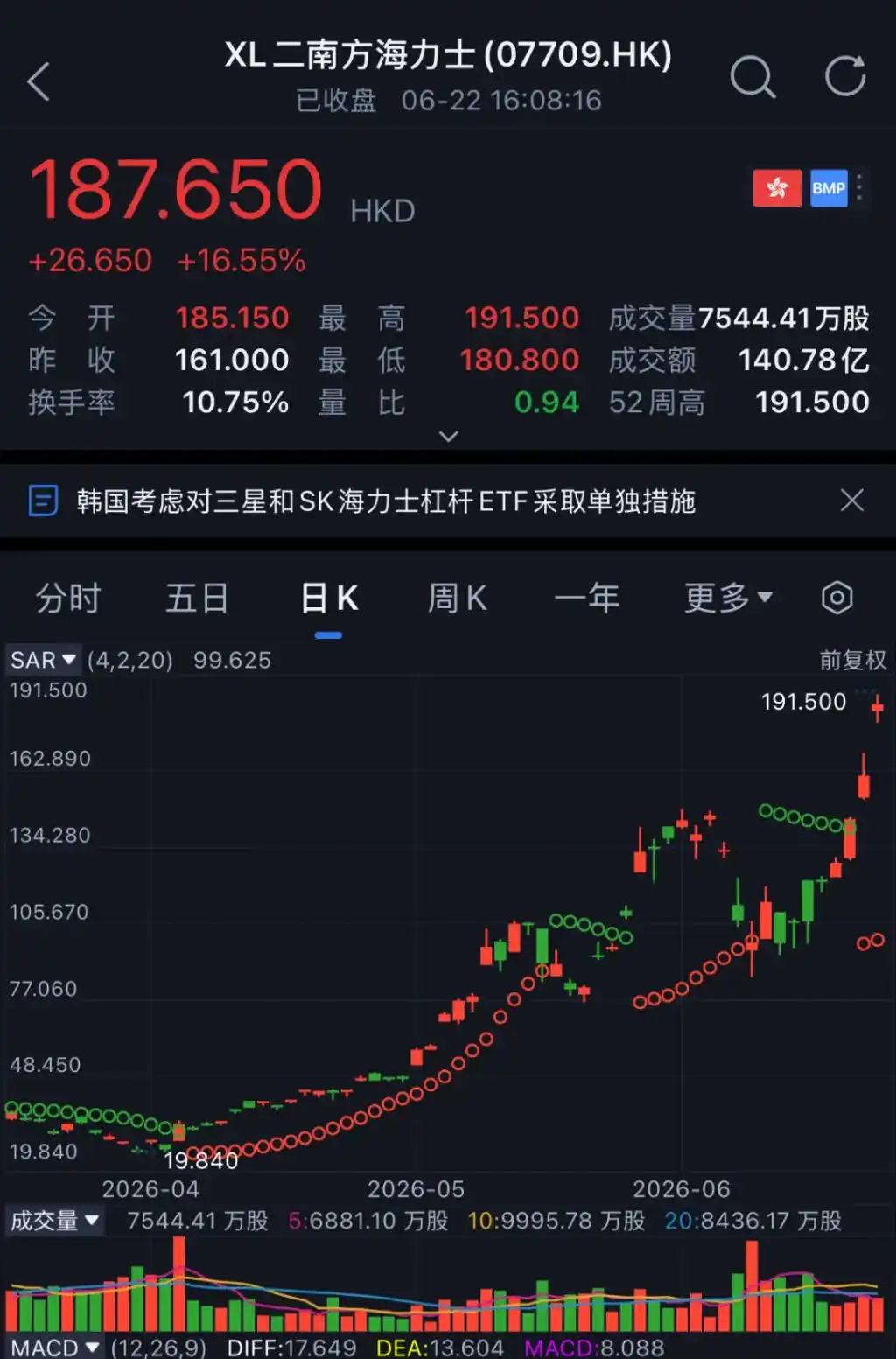
As of the close on June 22, the South China Double Long SK Hynix ETF listed in the Hong Kong market surged 16.55% in a single day, with year-to-date cumulative gains reaching a staggering 1061.92%. The product officially debuted on the Hong Kong Stock Exchange on October 16, 2025, with an initial size of approximately HK$24 million. However, as the storage rally intensified, the product's scale experienced explosive growth – reaching $14.418 billion as of June 18, a meteoric rise of 21.7 times from $636 million at the end of last year.
The South China Double Long Samsung Electronics ETF has also seen substantial capital inflows. Data shows that as of June 18, its size reached $4.4 billion. Following a 215.96% surge in scale in May, its size has grown by over 50% again since June.

However, dissecting the capital structure reveals that the leveraged ETF trading market currently exhibits a highly distinct feature of retail investor dominance, with institutional capital largely absent.

"The vast majority of institutions do not allocate to leveraged ETFs; only a small number of hedge funds use them as tools for short-term swing trading," a senior foreign fund manager candidly told this newspaper. Long-term allocation funds like pensions seek stable, long-term returns, which are completely mismatched with the high-volatility, high-risk return profile of leveraged products. Individual investors constitute the core purchasing group for such products.

Beware of Potential Volatility Risks

From an industry perspective, leveraged ETFs are typical "double-edged swords" that amplify both returns and risks. They can multiply investment returns during upward market phases; however, when the market turns downward, the magnitude of losses is similarly magnified. With growing divergence in global semiconductor sector outlooks and multiple uncertainties intertwining across geopolitics, industry dynamics, and valuations, the hidden risks within leveraged ETFs are continuously being exposed. Investors need to remain highly vigilant.

Recent severe market volatility has vividly demonstrated the destructive power of leveraged product losses. The South Korean Financial Supervisory Service's monitoring report released on June 18 showed that during the period from May 27 to June 12, while the underlying Samsung Electronics stock experienced a maximum drawdown of 18.0%, the corresponding two-times leveraged long ETF suffered a maximum drawdown of 35.9%, with losses nearly doubling. The SK Hynix stock drawdown was 19.1%, but its two-times leveraged ETF drawdown expanded further to 38%. Regulatory authorities have repeatedly warned that with South Korean individual stocks having a daily price limit of ±30%, two-times leveraged products theoretically face maximum single-day losses of up to 60%. Under extreme market conditions, principal capital can be severely depleted.

Beyond the routine amplification of volatility risk, leveraged ETFs have also experienced extreme abnormal scenarios where their price action completely diverges from the underlying stock, inflicting massive losses on retail investors chasing highs in the short term. In early June this year, a two-times leveraged ETF tracking SK Hynix exhibited divergent performance for two consecutive trading days: On June 8, while the underlying SK Hynix stock fell nearly 8%, the ETF surged nearly 50% against the trend; the next day, when the underlying stock rose sharply over 13%, the ETF plummeted by 40% intraday.

Addressing this abnormal volatility, the product issuer, Korea Investment Management, explained that the root cause was insufficient market maker liquidity. During the closing auction period, market makers are not obligated to provide mandatory quotes. A large volume of market buy orders pushed the fund price higher, creating a significant premium. When market liquidity recovered the following day, prices rapidly converged to fair value, causing substantial drawdowns for investors who entered at the previous day's elevated prices.

A fund analyst in Shanghai systematically dissected multiple potential risks of leveraged ETFs, both long-term and short-term: Firstly, due to the derivative structure employing daily leverage resetting, high market volatility environments can lead to time decay. Even if the underlying stock price returns to its previous high, the fund's net asset value may still suffer permanent losses. Secondly, leverage amplifies both gains and losses. With the overall semiconductor sector valuation currently at historical highs, any collective pullback would trigger drawdown impacts far exceeding those of the underlying stocks. If concentrated redemptions occur after sustained product scale inflation, it could also trigger a liquidity spiral, further exacerbating price declines. Thirdly, the trading volume of leveraged products in the South Korean market is nearing that of leading chip stocks themselves. Massive retail capital concentrated in one-sided bets creates a positive feedback loop, continuously boosting buying pressure during rallies, while batch stop-loss selling accelerates declines during downturns, significantly elevating market fragility.

Uncertainties at the industry chain fundamental level can also amplify the volatility risks of leveraged products. Sheng Jin, Portfolio Director at Value Partners, told this newspaper reporter that the semiconductor industry chain is long and deeply intertwined with globalized specialization. The variables affecting valuations are complex and intertwined. Any single variable, such as a company's quarterly earnings falling short of expectations or adjustments in global industrial policies, can quickly disrupt existing valuation logic, triggering violent sector fluctuations, which high-leverage products will synchronously magnify in impact.

Câu hỏi Liên quan

QWhat is the year-to-date return of the Leverage Product linked to SK Hynix mentioned in the article as of June 22nd?

AThe article states that the year-to-date return of the Southern Leverage Product (ETF) that provides two times the daily return of SK Hynix has exceeded 1000%, specifically reaching 1061.92%.

QWhat are the main risks associated with leveraged ETFs like the one tracking SK Hynix, as highlighted in the article?

AThe article highlights several key risks: 1) Magnified losses during market downturns, as losses are amplified just like gains. 2) The potential for permanent value erosion due to 'volatility decay' inherent in the daily resetting leverage structure. 3) Liquidity risks, where a lack of market makers can lead to extreme price dislocations from the underlying asset, causing severe losses for investors. 4) Increased market fragility due to a high concentration of retail investors engaging in one-sided bets, which can amplify price swings.

QAccording to the article, what is the core driver of the current upcycle in the memory chip sector?

AAccording to Zhou Jingxiang, a fund manager cited in the article, the core driver of the current memory upcycle is the explosive demand for SSD storage brought about by AI inference computing power.

QWhat specific product advancement from SK Hynix is mentioned as contributing to its market performance?

AThe article mentions that SK Hynix announced it had sent samples of its next-generation high-performance DRAM, the 12-layer HBM4E, to key customers. This product is designed for AI scenarios and offers upgrades in both performance and energy efficiency compared to HBM4.

QWhat unusual price behavior did a leveraged ETF tracking SK Hynix exhibit in early June, and what was the cited reason?

AIn early June, a two-times leveraged ETF tracking SK Hynix exhibited a price dislocation from the underlying stock. On June 8th, the stock fell nearly 8%, but the ETF surged nearly 50%. The next day, the stock rose over 13%, but the ETF plunged 40% intraday. The product manager, Korea Investment Management Company, attributed this abnormal volatility to insufficient market maker liquidity during the closing auction period, which led to a large premium. When liquidity normalized, the price sharply corrected to its fair value.

Nội dung Liên quan

Vốn hóa thị trường SK Hynix lần đầu vượt Samsung sau 26 năm, công ty chứng khoán Hàn Quốc kỳ vọng tăng 50%

SK Hynix lần đầu tiên trong 26 năm vượt Samsung về vốn hóa thị trường, chạm mức 208 nghìn tỷ won vào ngày 22/6. Mã cổ phiếu này đã tăng tích lũy hơn 340% trong năm, thúc đẩy bởi nhu cầu HBM trong kỷ nguyên AI. Hanwha Investment & Securities đã điều chỉnh mạnh mục tiêu giá lên 430.000 won, cao nhất trong giới môi giới Hàn Quốc, với lập luận rằng các hợp đồng cung cấp dài hạn (LTA) và nhu cầu HBM đã thay đổi cơ bản tính biến động lợi nhuận của ngành bán dẫn bộ nhớ, giúp công ty duy trì tỷ suất lợi nhuận trên 30% ngay cả trong chu kỳ suy yếu. Nhiều công ty chứng khoán khác cũng đồng loạt nâng mục tiêu giá, nhấn mạnh sự thay đổi trong khuôn khổ định giá ngành, chuyển từ mô hình cổ phiếu chu kỳ sang có thể so sánh với các hãng bán dẫn hàng đầu như TSMC. Kết quả kinh doanh quý I/2026 của SK Hynix cho thấy doanh thu lần đầu vượt 50 nghìn tỷ won, với tỷ suất lợi nhuận hoạt động kỷ lục 72%, chủ yếu nhờ thị phần HBM chiếm 70-80% toàn cầu. Các báo cáo dự báo tình trạng thiếu hụt nguồn cung DRAM toàn cầu có thể kéo dài đến cuối năm 2027. Dù giá cổ phiếu giảm hơn 5% trong phiên giao dịch chính thức ngày 23/6 sau khi chạm mốc 300.000 won trong khớp lệnh trước giờ, nhiều nhà đầu tư vẫn coi đây là cơ hội mua vào. Một số cảnh báo rằng việc vượt qua Samsung về vốn hóa có thể là dấu hiệu quá nóng trong ngắn hạn.

marsbit10 phút trước

Vốn hóa thị trường SK Hynix lần đầu vượt Samsung sau 26 năm, công ty chứng khoán Hàn Quốc kỳ vọng tăng 50%

marsbit10 phút trước

Giá thuê GPU giảm 30% trong ba tuần, Chuỗi giá trị AI đang 'di cư' từ NVIDIA sang chip bộ nhớ

Giá thuê GPU (cụ thể là chip B200 của Nvidia) đã giảm khoảng 30% trong ba tuần, từ mức cao 6,11 USD/giờ vào cuối tháng 5 xuống còn 4,22 USD/giờ. Sự sụt giảm này làm dấy lên nghi ngờ về tính bền vững của câu chuyện "khan hiếm sức mạnh tính toán" vốn là trụ cột cho định giá trong ngành AI. Trong khi đó, thị trường bán dẫn chứng kiến sự phân hóa rõ rệt. Chỉ số ETF bán dẫn SMH tăng 15% trong tháng qua, với các công ty bộ nhớ như Micron và SanDisk bùng nổ gần 60%. Ngược lại, cổ phiếu Nvidia lại giảm khoảng 3% trong cùng kỳ. Điều này cho thấy dòng tiền và sự chú ý của thị trường đang dịch chuyển dọc theo chuỗi giá trị AI, từ linh kiện xử lý (GPU) sang linh kiện lưu trữ (bộ nhớ), nơi được cho là đang trở thành nút thắt cổ chai mới. Nguyên nhân giá thuê GPU giảm được cho là do nguồn cung được cải thiện: quy trình sản xuất chip của TSMC tốt hơn, nguồn cung HBM3e từ SK Hynix và Micron dồi dào hơn, và nhiều nhà cung cấp đám mây mới có hàng tồn kho B200. Áp lực giá có thể còn tăng khi thế hệ chip Blackwell Ultra B300 sắp ra mắt. Tuy nhiên, thị trường hợp đồng dài hạn vẫn nóng. Các hợp đồng thuê GPU trị giá hàng tỉ USD, như thỏa thuận giữa Google và SpaceX, cho thấy nhu cầu cơ bản vẫn mạnh mẽ. Rủi ro chính của Nvidia không nằm ở nhu cầu, mà ở khả năng định giá khi giá thuê hạ nhiệt có thể gây áp lực lên biên lợi nhuận của khách hàng và cuối cùng là đơn đặt hàng. Báo cáo thu nhập sắp tới của Micron sẽ là chỉ số quan trọng để xác nhận liệu câu chuyện "siêu chu kỳ bộ nhớ" và sự dịch chuyển giá trị sang lĩnh vực này có còn đúng không. Đối với nhà đầu tư, vấn đề không phải là hoài nghi về triển vọng AI, mà là xác định lại vị trí quyền định giá trong chuỗi cung ứng đang thay đổi này.

marsbit19 phút trước

Giá thuê GPU giảm 30% trong ba tuần, Chuỗi giá trị AI đang 'di cư' từ NVIDIA sang chip bộ nhớ

marsbit19 phút trước

Từ Corning đến Ciena, Cơ hội cho Cổ phiếu Tăng gấp 10 lần trong Chuỗi Cung ứng Truyền thông Quang AI

**Tóm tắt: Từ Corning đến Ciena – Cơ hội cổ phiếu tăng 10 lần trong chuỗi cung ứng viễn thông quang học cho AI** Nhu cầu dữ liệu khổng lồ từ trung tâm dữ liệu AI đang thúc đẩy một cuộc chuyển đổi tất yếu từ cáp đồng sang công nghệ quang học, do các giới hạn vật lý về khoảng cách, nhiệt và điện năng của cáp đồng. Các cơ hội đầu tư lớn nhất thường nằm ở các nhà cung cấp thiết yếu trong toàn bộ chuỗi cung ứng quang học, hơn là chỉ ở những công ty nổi tiếng nhất. **Các công ty trọng điểm được phân tích:** * **Corning (GLW):** Nhà sản xuất sợi quang hàng đầu với công nghệ vượt trội, có hợp đồng dài hạn trị giá hàng chục tỷ USD từ tất cả các gã khổng lồ công nghệ (Meta, Amazon, Google, Microsoft, OpenAI, Nvidia). Lợi nhuận tăng trưởng nhanh hơn nhiều so với doanh thu, cho thấy quyền định giá và hiệu quả quy mô. * **Amphenol (APH):** Chuyên về bộ kết nối và cáp tốc độ cao (cả đồng và quang), là động lực tăng trưởng chính trong các trung tâm dữ liệu AI. Công ty mua lại thành công và có định giá hấp dẫn so với tốc độ tăng trưởng. * **Credo Technology (CRDO):** Cầu nối giữa thế giới cáp đồng và quang học, với chip tiết kiệm năng lượng. Tăng trưởng doanh thu ấn tượng nhưng rủi ro tập trung khách hàng cao. * **Ciena (CIEN):** Dẫn đầu về công nghệ quang học mạch kết hợp, cho phép tải nhiều dữ liệu hơn trên các sợi quang hiện có mà không cần lắp đặt mới. Sổ đặt hàng tích lũy kỷ lục, nhưng định giá đã phản ánh nhiều triển vọng. * **AXT (AXTI):** Nhà cung cấp vật liệu nền tảng (tấm wafer Indium Phosphide) quan trọng cho tất cả laser quang học, tạo ra nút cổ chai trong chuỗi cung ứng. Rủi ro đáng kể từ quy định xuất khẩu của Trung Quốc và định giá rất cao. * **VEO Solutions (VIAV):** "Người bán xẻng" trong ngành, cung cấp thiết bị kiểm tra cần thiết cho mọi liên kết và thiết bị quang học trước khi vận hành. Hưởng lợi bất kể công ty nào chiến thắng. **Lựa chọn ETF:** Quỹ ETF FOTO (Tuttle Capital Pure Play Photonics Fund) cung cấp cách tiếp cận tập trung vào chủ đề quang học thuần túy, nhưng còn mới và quy mô nhỏ. **Kết luận:** Sự chuyển đổi từ đồng sang quang là không thể tránh khỏi. Các nhà đầu tư nên xem xét toàn bộ bản đồ chuỗi cung ứng, từ vật liệu, linh kiện đến thiết bị hệ thống và kiểm tra, để xác định các công ty được hưởng lợi nhiều nhất từ làn sóng đầu tư cơ sở hạ tầng AI này.

marsbit38 phút trước

Từ Corning đến Ciena, Cơ hội cho Cổ phiếu Tăng gấp 10 lần trong Chuỗi Cung ứng Truyền thông Quang AI

marsbit38 phút trước

20 Tuổi Sáng Lập, Tuyển Nhân Viên 18 Tuổi, Được Nhà Đầu Tư 19 Tuổi Gây Quỹ

**Tóm tắt tiếng Việt:** Ngành công nghiệp AI, đặc biệt là mô hình lớn (LLM), đang tạo ra một cơn sốt "trẻ hóa" chưa từng có. Các tập đoàn công nghệ lớn và công ty khởi nghiệp săn đón những nhân tài trẻ tuổi, thậm chí là học sinh cấp 3, sinh viên, bằng các gói lương khổng lồ. Thực tập sinh AI 17 tuổi có thể nhận lương theo ngày lên tới 5.500 RMB, trong khi sinh viên mới tốt nghiệp xuất sắc có thể được trả 3-6 triệu RMB/năm, vượt xa mức lương của các quản lý cấp cao nhiều kinh nghiệm trong ngành internet truyền thống. Tiêu chuẩn tuyển dụng ưu tiên "AI Native" – những người trẻ lớn lên cùng công nghệ, có tư duy phù hợp và khả năng thích ứng nhanh với các đột phá kỹ thuật mới. Kinh nghiệm làm việc lâu năm đôi khi trở thành gánh nặng. Làn sóng này cũng lan sang giới đầu tư, nơi các quỹ mới thành lập chuyên đầu tư vào các nhà sáng lập sinh sau năm 1998. Một hệ sinh thái những người trẻ tuổi – nhà nghiên cứu, nhà sáng lập, nhà đầu tư – đang kết nối và hỗ trợ lẫn nhau, thách thức các quy tắc và thế hệ đi trước. Tuy nhiên, mặt trái của sự hào phóng dành cho tài năng trẻ là khoảng cách thu nhập và cơ hội ngày càng lớn. Áp lực cạnh tranh khốc liệt, việc tiếp cận các vị trí tốt thường phụ thuộc nhiều vào mạng lưới quan hệ và sự giới thiệu từ bên trong. Trong khi một bộ phận thanh niên tài năng được tưởng thưởng xứng đáng, nhiều chuyên gia công nghệ ở độ tuổi 30+ cảm thấy bị đe dọa và bỏ lại phía sau, phải vật lộn để chuyển đổi trong một thế giới mà "sự trừng phạt dành cho sự bình thường chưa bao giờ khắc nghiệt đến thế". Sự thay đổi quyền lực này được minh họa rõ nét qua việc các CEO trẻ tuổi hơn thay thế các lãnh đạo kỳ cựu, như trường hợp ở Alibaba.

marsbit1 giờ trước

20 Tuổi Sáng Lập, Tuyển Nhân Viên 18 Tuổi, Được Nhà Đầu Tư 19 Tuổi Gây Quỹ

marsbit1 giờ trước

Người muốn mua đã mua xong: Cơn sốt nhà đầu tư nhỏ lẻ SpaceX dần nguội lạnh, áp lực bán thực sự vẫn chưa đến vào tháng 8

Tác giả: Tyler Durden (ZeroHedge) Bài viết phân tích đợt giảm mạnh của cổ phiếu SpaceX (SPCX) sau đợt IPO lịch sử. Cổ phiếu mở cửa ở 150 USD vào ngày 12/6, nhanh chóng tăng vọt lên mức cao kỷ lục 225 USD vào ngày 16/6 nhờ làn sóng mua vào cuồng nhiệt từ các nhà đầu tư nhỏ lẻ, những người đã bơm một lượng kỷ lục 405 triệu USD trong 5 ngày giao dịch đầu tiên. Tuy nhiên, động lực này đã nhanh chóng cạn kiệt. Sau khi đạt đỉnh, dòng tiền từ nhà đầu tẻ bán lẻ sụp đổ và SPCX bắt đầu chuỗi giảm ba ngày liên tiếp, đỉnh điểm là mức sụt 16.4% vào thứ Hai, xóa sổ 6000 tỷ USD vốn hóa và đưa giá cổ phiếu quay trở lại mức gần 150 USD - giá mở cửa ban đầu. Nguyên nhân chính cho đợt bán tháo được cho là do nhận thức về áp lực bán khổng lồ sắp tới. Hiện chỉ có 5% cổ phiếu lưu hành tự do, trong khi 95% còn lại đang bị khóa. Theo lịch trình mở khóa, đến đầu tháng 9, các cổ đông nội bộ có thể bán ra tối đa 44% cổ phần, làm tăng nguồn cung lưu hành lên khoảng 900%. Các chuyên gia cảnh báo rằng tất cả những người muốn mua có lẽ đã mua xong, trong khi áp lực bán thực sự vẫn chưa bắt đầu. Sự sụp đổ của SpaceX có nguy cơ kéo theo sự điều chỉnh trên diện rộng hơn đối với các cổ phiếu công nghệ vốn dựa vào động lực và sự lạc quan của nhà đầu tẻ nhỏ lẻ.

marsbit1 giờ trước

Người muốn mua đã mua xong: Cơn sốt nhà đầu tư nhỏ lẻ SpaceX dần nguội lạnh, áp lực bán thực sự vẫn chưa đến vào tháng 8

marsbit1 giờ trước

Giao dịch

Giao ngay
Hợp đồng Tương lai
活动图片