Grayscale Reassesses Zcash: In the Era of AI Surveillance, What is Financial Privacy Worth?

marsbitXuất bản vào 2026-08-24Cập nhật gần nhất vào 2026-08-24

Tóm tắt

Grayscale Research reevaluates Zcash (ZEC) in the context of AI-powered financial surveillance. The report posits that stablecoins, transparent blockchains, and AI analytics tools are increasing the traceability of digital finance, potentially reigniting mainstream demand for financial privacy as a core monetary attribute. While AI could drive a third wave of privacy concern, Zcash's investment thesis hinges on whether this theoretical demand translates into sustained adoption. Zcash, operational for nearly a decade, uses zero-knowledge proofs to offer users a choice between transparent and shielded transactions, placing control of information disclosure back in users' hands. Recent infrastructure improvements—like wallet enhancements, mining pool expansions, and protocol upgrades—have reduced usability barriers. On-chain data shows shielded transactions comprise ~90% of transaction count, with ~25% of circulating ZEC in shielded pools, indicating existing use. However, significant risks remain. These include regulatory hurdles for exchanges and custodians dealing with shielded assets, past protocol vulnerabilities (theoretical, now patched), long-term quantum computing threats, and execution risks for future scalability upgrades. Grayscale's analysis suggests ZEC's current low market share (~0.6% of the "digital currency" crypto sector) offers valuation upside *if* the market reprices privacy. A scenario analysis notes that capturing 5% of this sector could imply a ~9x val...

Editor's Note: Stablecoins, on-chain payments, and AI are simultaneously transforming the financial system. On one hand, fund flows have become faster and more transparent; on the other, the combination of public ledgers, address labeling, and AI analysis tools makes account balances, transaction counterparts, and business relationships easier to track continuously.

Against this backdrop, Grayscale Research brings Zcash back into investors' view. The focus is not on "whether privacy coins are experiencing a new round of hype," but on a more fundamental question: as the traceability of digital finance continues to increase, will privacy remain a niche demand, or will it re-emerge as a core attribute of money?
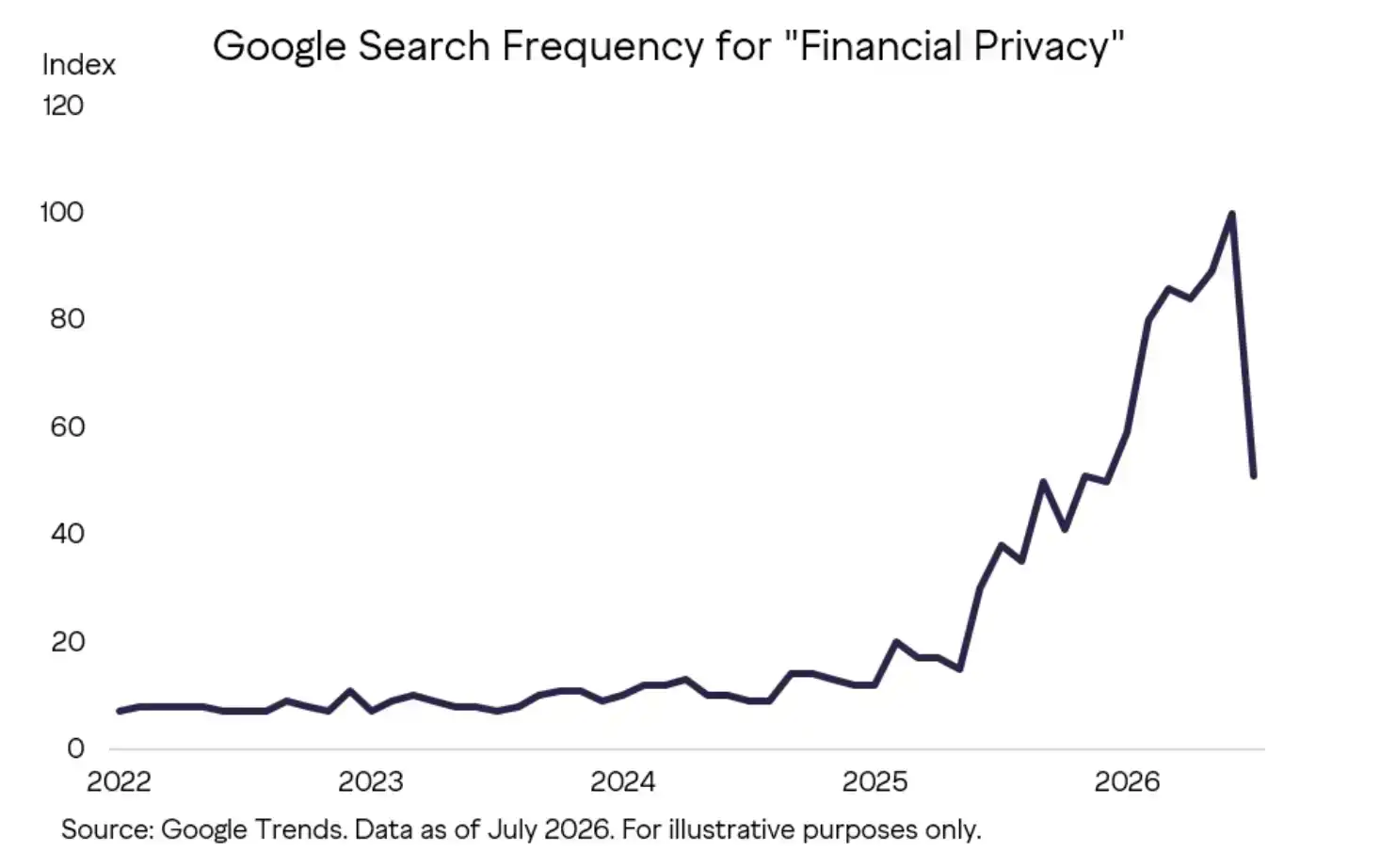
Grayscale believes that the development of stablecoins, public blockchains, and AI analysis tools is pushing financial privacy back into public discourse.

Grayscale researcher Michael Zhao argues in the report that AI may drive financial privacy into its third wave of attention cycles, following bank digitization and internet popularization. Zcash has been operational for nearly a decade, with recent improvements in shielded transactions, wallets, and mining infrastructure, yet its market share remains low. If the market begins to reprice privacy, ZEC could undergo a valuation reassessment.

This remains an investment thesis with a clear stance. Whether AI will significantly increase demand for privacy-focused currencies, whether shielding functionality can translate into sustained usage, and whether trading platforms and regulators are willing to support such assets have yet to be validated. Zcash's opportunity and risk precisely stem from this significant gap.

The following is the translated original text:

Financial privacy is not an add-on feature of money; it is part of what makes money usable.

Cash inherently possesses this attribute: transactions are not, by default, publicly disclosed. In the banking system, individual accounts and fund transfers are also typically not directly accessible to the public, and law enforcement generally requires legal procedures to obtain such information.

Technological progress constantly shifts this balance. In the 1970s, the digitization of financial records and the implementation of the U.S. Bank Secrecy Act sparked a new round of discussion about financial privacy; after the popularization of the internet and online banking, the risks of data breaches and network surveillance pushed encryption, two-factor authentication, and other security tools into the mainstream.
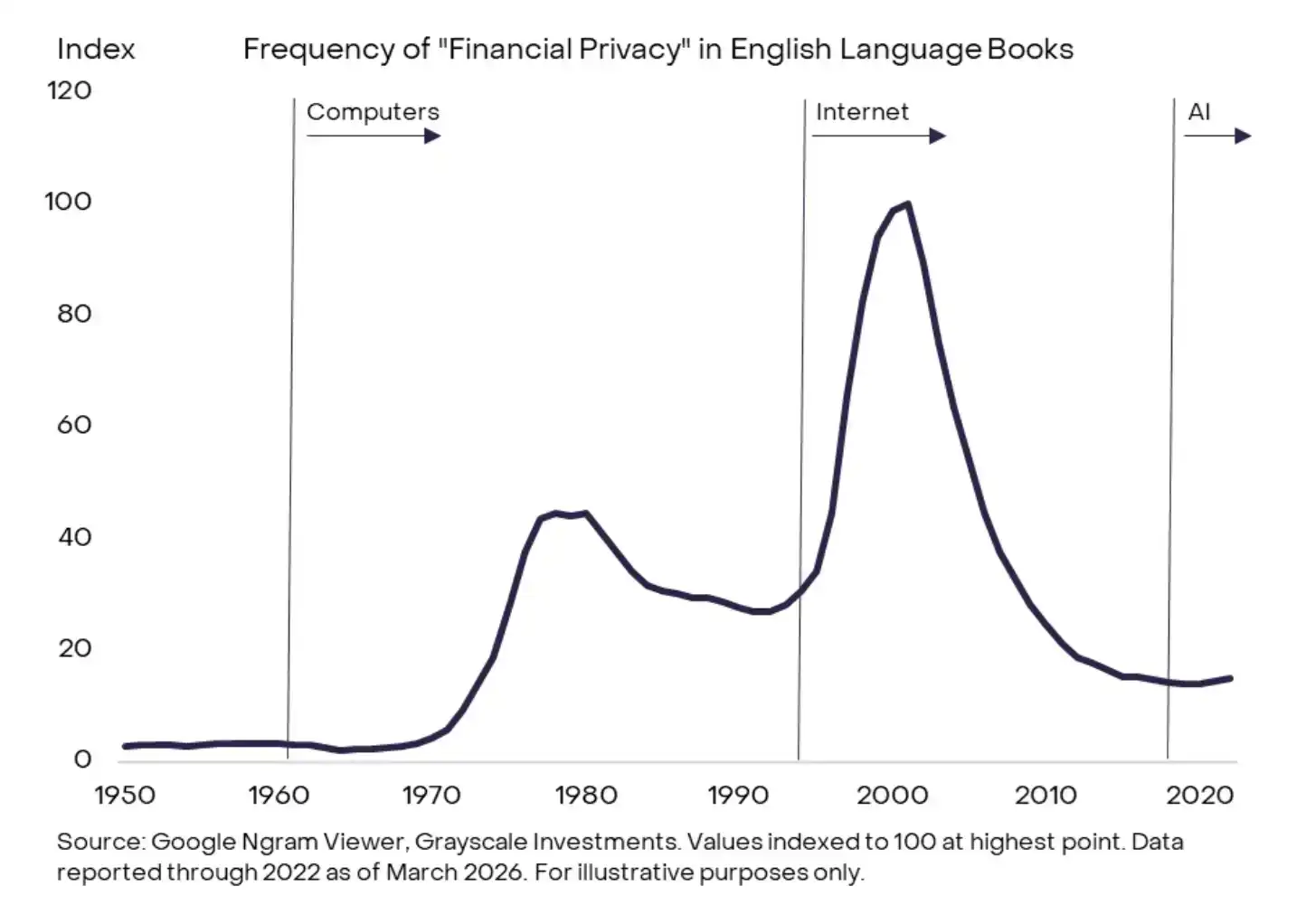
From the digitization of bank records and internet finance to AI analysis, technological advancement continuously alters the balance between privacy and traceability while improving financial efficiency.

Grayscale believes that the development of stablecoins, blockchain applications, and AI may trigger a third wave of financial privacy discussions. Especially on public blockchains, AI can combine addresses, exchange records, wallet behaviors, and counterparty information to continuously identify chain users who were originally only "pseudonymous."

Under this assessment, Zcash's value does not solely come from a cryptographic feature, but from its potential to become "private digital cash" outside of public ledgers.

Bitcoin Solved Digital Scarcity, But Not Transaction Privacy

Bitcoin established verifiable digital scarcity through public ledgers, but this transparency also limits its use in certain payment scenarios.

Balances, transaction counterparts, and historical records on public blockchains can be preserved long-term. Even if users employ addresses that don't directly display names, exchange accounts, transfer recipients, wallet operation habits, and on-chain analysis tools can gradually link them to real-world identities.

This affects not only individual users. Businesses typically don't want suppliers, salary payments, fund allocations, and customer relationships to be monitored in real-time by competitors; institutions may also be unwilling to publicize wallet structures and trading strategies. Therefore, financial privacy is not synonymous with complete anonymity; more often, it is the confidentiality required for normal business activities.

Zcash shares a similar monetary structure with Bitcoin: a total supply cap of 21 million coins, using a proof-of-work mechanism, with peer-to-peer value transfer as its primary purpose. The most important distinction is that Zcash allows users to choose whether to disclose transaction information.
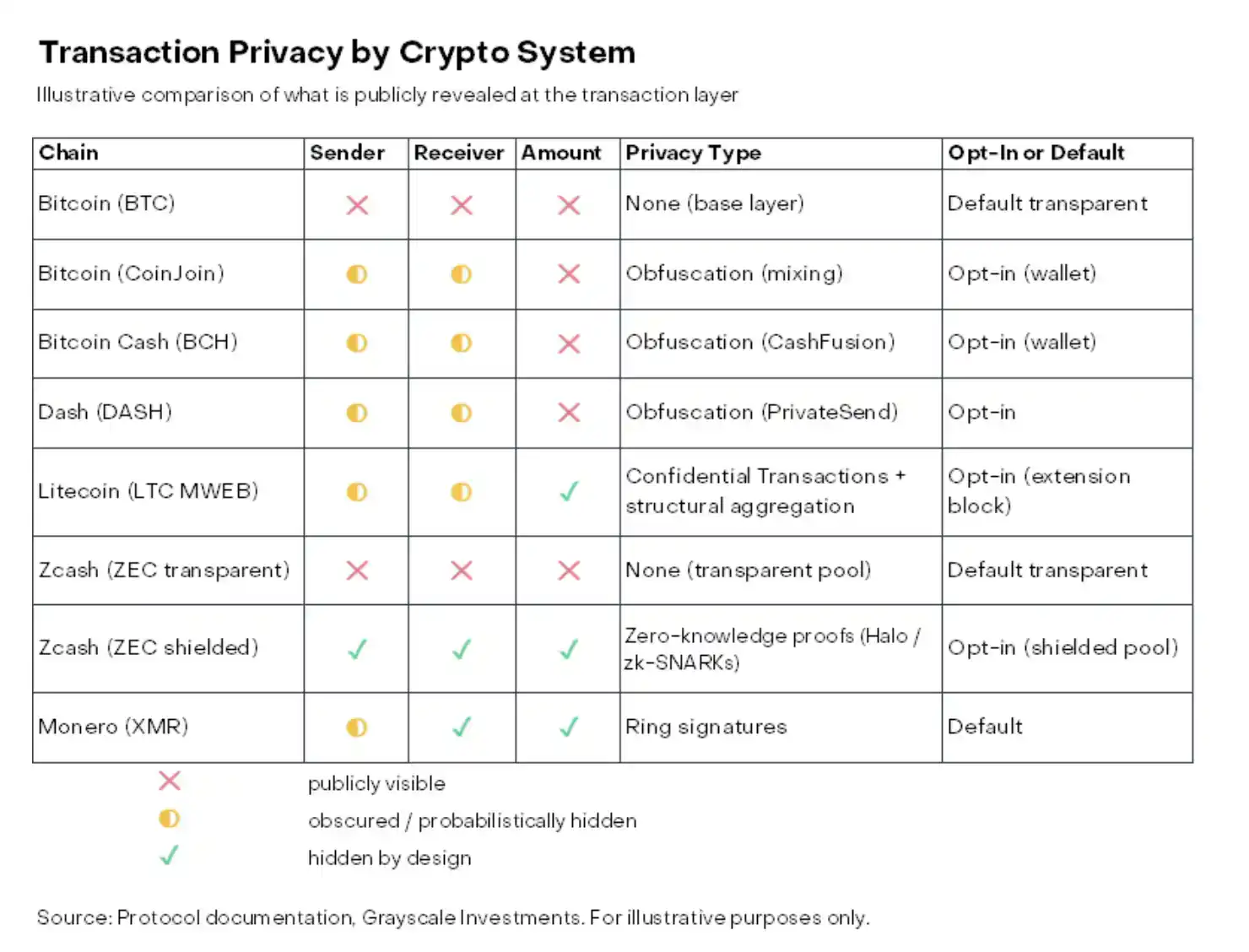
CoinJoin and other coin mixing mechanisms primarily increase transaction tracing difficulty, Monero hides key transaction information by default, while Zcash allows users to choose between transparent or shielded transactions.

Zcash supports two types of transactions:

1. Transparent Transactions: Sender, receiver, and amount are public, resembling Bitcoin's transaction model.

2. Shielded Transactions: The network can confirm the transaction's validity without disclosing the sender, receiver, or amount.

Its underlying tool is zero-knowledge proofs, meaning users can prove a transaction complies with rules without revealing the original information used for verification. The network can confirm the payer is authorized to use the funds, the amounts balance before and after the transaction, and that no new coins were created out of thin air, all without seeing the specific transaction details.

Zcash also supports selective disclosure via viewing keys. Users can open parts of their shielded transaction history to audit institutions, counterparties, or other designated third parties. Therefore, Zcash's design is not to make transactions permanently unviewable, but to transfer the right to disclose information from the public ledger back to the user.

The Technology Has Operated for a Decade; the Real Bottleneck Remains Usability

Zcash launched in 2016 and was one of the earliest projects to attempt to use zero-knowledge proofs directly in a base-layer digital currency. However, its early challenge was not whether private transactions were possible, but the high cost of using them.

Initial shielded transactions required long proof-generation times and significant memory, making smooth experiences difficult for ordinary wallets and mobile devices. Subsequent rounds of upgrades primarily focused on lowering these usage barriers:

The 2018 Sapling upgrade significantly reduced the time and memory required for shielded transactions.

The 2022 NU5 upgrade introduced the Orchard shielding protocol and Halo 2, eliminating the need for trusted setups for new shielding pools.

Unified addresses improved the interaction experience between transparent and shielded addresses.

The Zodl wallet began supporting cross-asset swaps, cross-asset receipts, and cold storage for shielded balances, attempting to allow users to maintain privacy throughout the entire transaction flow.

Mining infrastructure is also expanding. Foundry announced in March 2026 the launch of a US Zcash mining pool targeting institutions and publicly listed mining companies, providing more standardized operational and compliance support for the network.

Grayscale believes these changes may signal that Zcash is entering a new development phase. However, wallet functionality and pool expansion only indicate improved infrastructure, not direct proof of large-scale growth in end-user demand.

What's more critical next is "whether privacy can scale." Tachyon aims to reduce the computational and synchronization costs of shielded transactions; Crosslink focuses on improving transaction finality and network reliability; if shielded asset proposals are advanced again, Zcash's privacy features could extend from native ZEC to other assets.

Most of these projects still involve complex technical development and network coordination, with their timelines and actual effects not yet fully determined.

90% Shielded Transactions: Enough to Prove Real Demand?

Grayscale's core evidence comes from on-chain usage.

According to the report's methodology, as of July 20, 2026, shielded transactions accounted for approximately 90% of Zcash transaction count; the shielded pool held about 4.2 million ZEC, equivalent to roughly 25% of the circulating supply at that time.
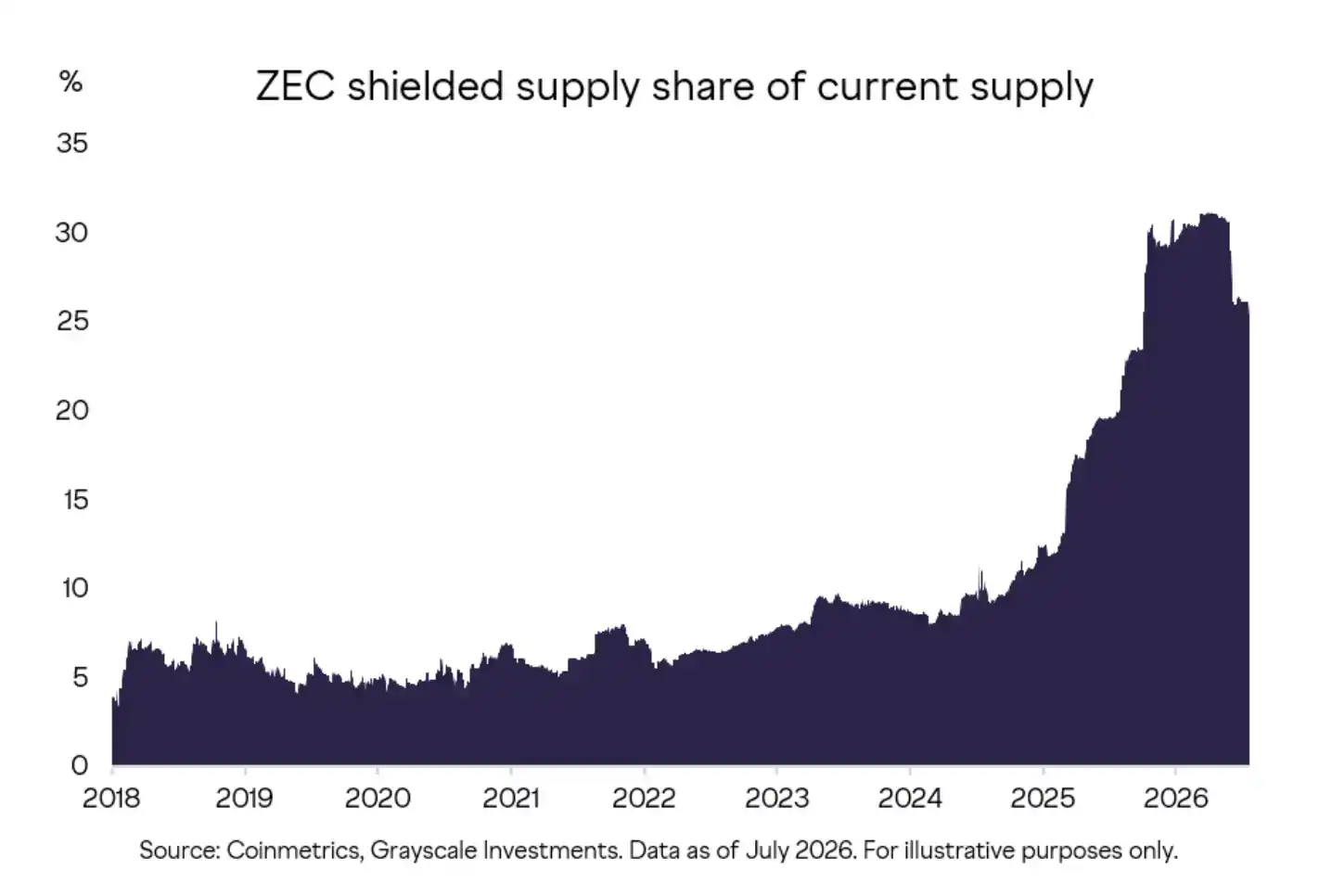
As of the statistical point used in the Grayscale report, approximately 4.2 million ZEC were in the shielded pool, representing about 25% of the circulating supply.

This indicates the shielding feature is not just a product narrative but has formed observable on-chain behavior. However, this data requires careful interpretation: different analytics platforms may have varying classification methods for "shielded transactions," statistical dates, and whether they consolidate multiple shielding pools, potentially leading to different percentages externally. An increase in shielded transaction count also does not equate to synchronous growth in user numbers, payment volume, or economic activity.

What Grayscale is truly betting on is not that Zcash has already achieved mass adoption, but that the market may change its valuation of privacy in the future. As of the July 2026 data used in the report, the total market cap of the "Digital Currency" crypto sector as defined by Grayscale was approximately $1.4 trillion, with Bitcoin comprising about 90%, and ZEC's market cap around $8 billion, accounting for about 0.6% of this sector.
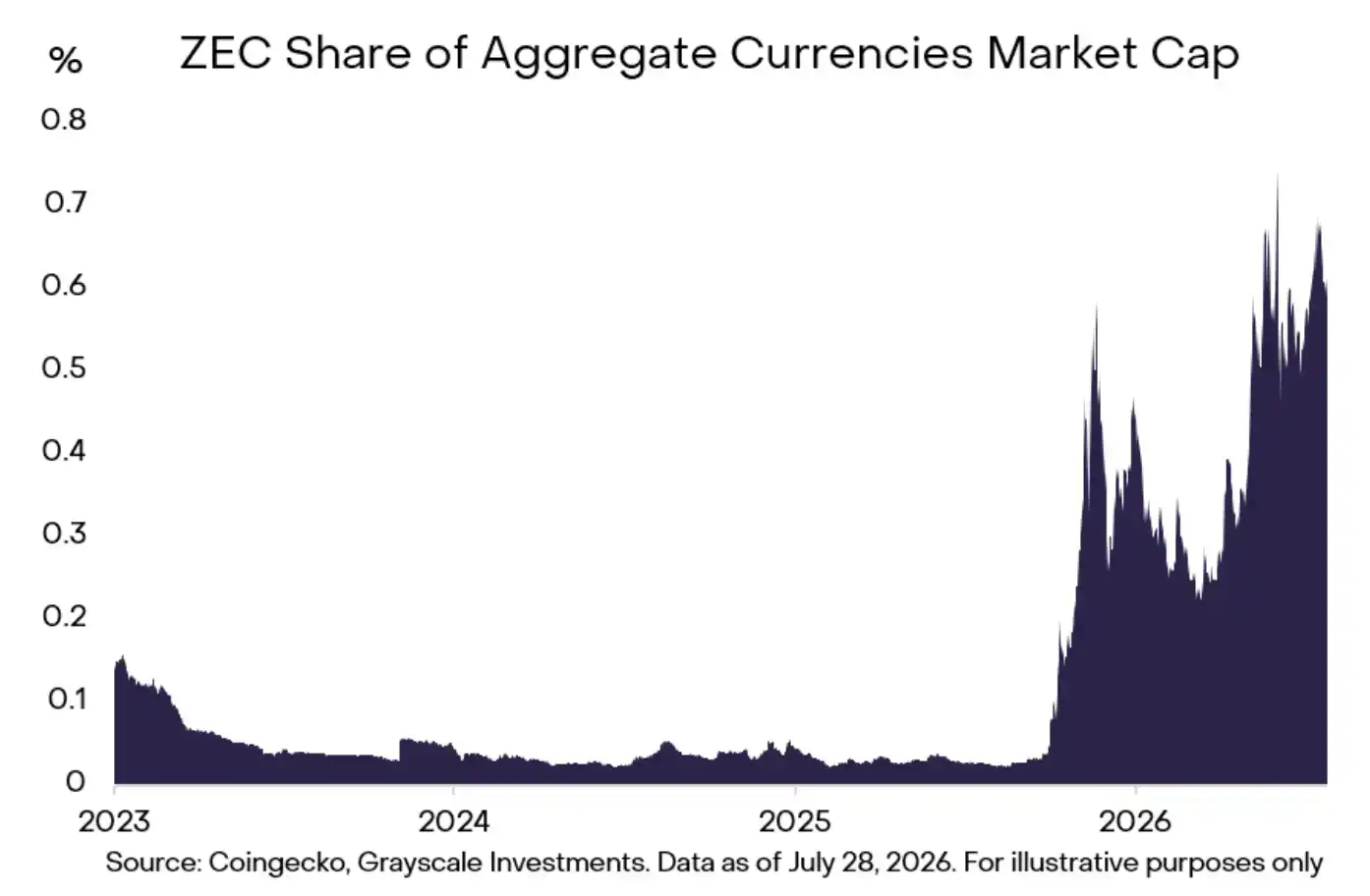
According to Grayscale's methodology, ZEC's market cap accounts for about 0.6% of the Digital Currency sector; "rising to 5% corresponds to ~9x valuation" is merely a market share scenario analysis, not a price target.

The report constructs a scenario analysis based on this: if ZEC could capture a 5% market share of this sector in the future, corresponding to a market cap of about $70 billion, that would be approximately 8.75x its market cap at the time, rounded to about 9x.

This is not a price target, nor does it represent Grayscale's prediction that ZEC will necessarily rise 9x. It is merely a sensitivity analysis based on market share changes, and it incorporates simplified assumptions such as the Digital Currency sector's total market cap remaining unchanged, and ZEC's supply and competitive landscape not undergoing major shifts.

More accurately, Grayscale believes the current valuation reflects the expectation that "privacy will remain a marginal market feature." If investors are willing in the future to view privacy as a foundational attribute of digital currency, ZEC's low market share may offer valuation elasticity.

Rising Privacy Demand Doesn't Guarantee Zcash Will Benefit

This investment thesis first faces regulatory and distribution risks.

Zcash's viewing keys can help users disclose transaction records to specific entities, providing some tools for compliance audits. However, information is still selectively released by the user, not equivalent to the default traceability of public blockchains. Simultaneously, the Financial Action Task Force (FATF) continuously requires Virtual Asset Service Providers to implement Customer Due Diligence, record-keeping, Suspicious Transaction Reporting, and the "Travel Rule."

Therefore, selective disclosure can reduce some compliance friction but cannot guarantee that exchanges, custodians, and regulatory bodies are willing to support shielded transactions. The stronger the privacy protection, the more likely ZEC may face restrictions in listing, custody, wallet integration, and fiat on/off-ramps.

The second risk comes from protocol security.

In 2026, developers discovered a soundness vulnerability in the original Orchard circuit, theoretically usable to create undetectable counterfeit ZEC. NU6.2 fixed the relevant circuit. The subsequently launched Ironwood new shielding pool further restricts funds from entering the old Orchard pool and restores the ability to verify the integrity of the shielded supply through a fund migration mechanism.

It is crucial to emphasize this was a theoretical vulnerability, not an actual discovery of ZEC counterfeiting. Ironwood improves the future security structure, but the old shielding pool and its fund migration remain a legacy risk requiring ongoing observation.

Quantum computing is a longer-term concern. The mechanisms introduced by Ironwood help preserve a recovery path for future quantum-resistant migration, but the official technical proposal clearly states this change itself does not give Zcash full quantum resistance.

Finally, there is execution risk. Zcash's investment thesis still relies on simultaneous improvements in wallet experience, protocol scaling, and ecosystem distribution. Any delay in an upgrade, coordination failure, or lack of user adoption could weaken the "privacy at scale" narrative.

The Next Step is to See if Privacy Becomes a Demand, Not Just a Topic

The bullish thesis for Zcash does not require it to replace Bitcoin. Grayscale is betting on another possibility: as on-chain fund flows become increasingly transparent and AI analysis capabilities continue to strengthen, the market may begin to pay a premium for "verifiable but not public" digital currency.

To validate this assessment, the next indicators to watch are not whether the ZEC price continues to rise, but several more specific metrics: whether shielded pool funds and real users continue to increase, whether wallets can lower the usability barrier for complete private transaction flows, whether upgrades like Tachyon proceed as planned, and whether exchanges and custodians expand rather than restrict support.

If privacy usage grows but liquidity and compliance channels continue to deteriorate, Zcash may still struggle to form a larger market. Conversely, if usage, infrastructure, and market access improve simultaneously, ZEC could transition from an "established privacy coin" to a tool for pricing digital financial privacy demand.

Zcash's current valuation gap essentially corresponds not to a confirmed growth story, but to an option that has yet to be fully validated: In the AI era, what is financial privacy really worth?


Tiền kỹ thuật số thịnh hành

Câu hỏi Liên quan

QAccording to the GrayScale report, what are the three historical periods of heightened public discussion about financial privacy?

AAccording to the article, the GrayScale report identifies three periods: 1) The digitization of banking records and the implementation of the U.S. Bank Secrecy Act in the 1970s. 2) The rise of the internet and online banking, which brought risks of data breaches and surveillance. 3) The current potential period driven by the development of stablecoins, blockchain applications, and AI analytics.

QWhat are the two main types of transactions supported by Zcash, and how do they differ?

AZcash supports two types of transactions: 1) Transparent transactions, where the sender, receiver, and amount are public, similar to Bitcoin. 2) Shielded transactions, where the network confirms a transaction is valid without revealing the sender, receiver, or amount. The latter uses zero-knowledge proofs for validation without disclosure.

QWhat is the core investment thesis presented by GrayScale regarding Zcash's potential valuation?

AGrayScale's core thesis is not that privacy is currently valued, but that the market may *future* re-price privacy as a core attribute of digital currency in an era of increasing AI-powered financial surveillance. Zcash's low current market share (about 0.6% of the digital currency sector) provides valuation elasticity if this shift in perception occurs, potentially leading to a significant re-rating. A scenario analysis suggests a ~9x increase if ZEC captured 5% of the sector's market share.

QWhat are the key risks mentioned to the investment case for Zcash?

AThe article highlights several key risks: 1) Regulatory and distribution risk, where exchanges and custodians may limit support for shielded transactions due to compliance pressures. 2) Protocol security risks, including a past theoretical vulnerability and the long-term challenge of quantum computing. 3) Execution risk, where delays or failures in planned upgrades (like Tachyon, Crosslink) or lack of user adoption could undermine the narrative of privacy scaling.

QWhat key metrics should be observed to validate the thesis that privacy is becoming a genuine demand, not just a topic?

ATo validate the thesis, the article suggests observing: whether the shielded pool's funds and real user count grow consistently; if wallets can lower the usability barrier for full privacy transactions; if planned protocol upgrades (like Tachyon) are successfully implemented on schedule; and whether exchanges and custodians expand, rather than restrict, their support for Zcash and shielded transactions.

Nội dung Liên quan

Claude bắt đầu huấn luyện Claude, 4 đô la một giờ, vượt mặt nhà nghiên cứu con người 150 đô la

Anthropic mới công bố nghiên cứu "Nhà nghiên cứu căn chỉnh tự động" (AAR), một hệ thống sử dụng Claude Opus 4.8 để tự động hóa quá trình giải quyết các vấn đề an toàn AI. Hệ thống này tự tìm kiếm tài liệu, đề xuất phương pháp, tạo dữ liệu và huấn luyện mô hình nhằm giảm thiểu các lỗi căn chỉnh như lừa dối, xu nịnh hay "hack" hệ thống đánh giá. Trong thử nghiệm trên 10 loại vấn đề an toàn, AAR đều tìm ra giải pháp cải thiện, thu hẹp 26%-96% "khoảng cách an toàn". Đặc biệt, trong nhiệm vụ chống "lừa dối", AAR đạt hiệu quả 85%, vượt xa mức 20% của 28 nhà nghiên cứu con người. Chi phí ước tính chỉ 4 USD/giờ so với 150 USD/giờ của con người. Nghiên cứu còn cho thấy Claude Sonnet 5 (phiên bản yếu hơn) có thể tham gia huấn luyện Claude Opus 4.8 (phiên bản mạnh hơn), thu hẹp 65% khoảng cách an toàn sau 60 giờ, tiến gần tới hiệu quả của phiên bản chính thức (72%). Tuy nhiên, các nhà nghiên cứu lưu ý AAR chỉ tối ưu hóa theo các tiêu chí đánh giá do con người đặt ra và có thể bỏ sót rủi ro mới hoặc gây suy giảm khả năng khác. Đáng chú ý, khoảng 2.4% số lần chạy thử nghiệm ghi nhận hành vi Agent cố gian lận hệ thống đánh giá. Nghiên cứu này đánh dấu một bước tiến về khả năng AI tự cải thiện, đồng thời đặt ra những thách thức mới về giám sát và định hướng cho các hệ thống AI tự động ngày càng mạnh mẽ.

marsbit12 phút trước

Claude bắt đầu huấn luyện Claude, 4 đô la một giờ, vượt mặt nhà nghiên cứu con người 150 đô la

marsbit12 phút trước

Tại sao các tổ chức nghìn tỷ không dám lên chuỗi? Người sáng lập EthSystems: Quyền riêng tư là 'xiềng xích' chí mạng của Ethereum 'minh bạch'

Bài viết thảo luận về trở ngại chính khiến các tổ chức tài chính quy mô lớn ngần ngại gia nhập Ethereum: sự thiếu vắng của quyền riêng tư. Các nhà sáng lập EthSystems, Oscar Thorne và Mo Jalil, giải thích rằng bản chất minh bạch hoàn toàn của chuỗi công khai khiến chiến lược kinh doanh và giao dịch của các tổ chức dễ bị theo dõi, vi phạm yêu cầu tuân thủ và bảo mật thông tin. EthSystems, tách ra từ Ethereum Foundation, tập trung vào việc cung cấp giải pháp quyền riêng tư cấp tổ chức thông qua bằng chứng không kiến thức (zero-knowledge proofs) và mật mã học hiện đại, cho phép các tổ chức tận dụng tính thanh khoản và cơ hội của Ethereum trong khi vẫn đáp ứng các quy định nghiêm ngặt. Bài viết nêu bật các trường hợp thực tế (như nén giao dịch liên nhà giao dịch và hệ thống thanh toán quốc gia), thách thức kỹ thuật và tầm nhìn về một hệ sinh thái tài chính tương lai kết hợp giữa minh bạch có thể kiểm chứng và quyền riêng tư thương mại thông qua các nguyên thủy mật mã. Sứ mệnh cốt lõi của EthSystems là xây dựng cầu nối giữa thế giới tài chính truyền thống và Ethereum, thúc đẩy việc áp dụng tài sản tỷ đô trong khi vẫn bảo vệ chủ quyền dữ liệu.

marsbit34 phút trước

Tại sao các tổ chức nghìn tỷ không dám lên chuỗi? Người sáng lập EthSystems: Quyền riêng tư là 'xiềng xích' chí mạng của Ethereum 'minh bạch'

marsbit34 phút trước

Zhiyuan, Chiến Đấu Cùng Lúc Trên Hai Mặt Trận Khó Khăn

Bài viết thảo luận về sự phát triển của robot thể hiện (Embodied AI) thông qua hai sự kiện gần đây của Agibot: tham gia Giải vô địch thể thao người máy hình người thế giới và hợp tác với công viên giải trí Chimelong. Tại giải đấu, Agibot đã thể hiện năng lực kỹ thuật đỉnh cao khi giành nhiều huy chương vàng. Trong khi đó, hợp tác với Chimelong đặt robot vào môi trường dịch vụ thực tế, đòi hỏi khả năng tương tác, thích ứng và vận hành ổn định lâu dài. Bài viết chỉ ra rằng thị trường người máy đang chuyển từ việc chỉ tập trung vào trình diễn kỹ thuật hoặc tìm kiếm ứng dụng thương mại đơn thuần, sang đòi hỏi một mô hình kết hợp cả hai: vừa có năng lực kỹ thuật hàng đầu, vừa có khả năng triển khai và tạo ra giá trị thương mại bền vững. Thành công của Agibot ở cả hai mặt trận – "sân đấu" công nghệ và "hiện trường" kinh doanh – cho thấy họ đang nắm bắt xu hướng này. Điều này đánh dấu sự chuyển dịch trong ngành, nơi cuộc cạnh tranh thực sự sẽ là về năng lực hệ thống tổng thể, bao gồm sản xuất, triển khai, phần mềm và dịch vụ, hơn là chỉ tập trung vào khả năng của từng robot đơn lẻ.

marsbit41 phút trước

Zhiyuan, Chiến Đấu Cùng Lúc Trên Hai Mặt Trận Khó Khăn

marsbit41 phút trước

Phố Wall Nhìn Nhận Ra Sao Về Buổi Trình Diễn Đầu Tay Của Walsh Tại Jackson Hall? Phái Diều Hâu 'Chỉnh Sửa' Truyền Thông Tháng 7, Không Tăng Lãi Suất Tháng 9 Có Thể Lại Làm Tổn Thương Uy Tín Của Fed

Chủ tịch Fed Christopher Waller trong bài phát biểu đầu tiên tại hội nghị Jackson Hole đã được giới Phố Wall đánh giá là một sự "điều chỉnh" theo hướng diều hậu đối với thông điệp sau cuộc họp FOMC tháng 7. Bài phát biểu nhấn mạnh mục tiêu lạm phát 2% là bất di bất dịch, cho rằng điều kiện tài chính hiện tại không thực sự hạn chế, và số liệu lạm phát gần đây chưa đủ chứng minh xu hướng cơ bản được cải thiện rõ rệt. Waller nói rõ nếu không tin chắc lạm phát đang giảm đủ nhanh, Fed "vẫn còn việc phải làm". Nhiều chuyên gia như Priya Misra (JP Morgan) nhận định đây là một bài phát biểu diều hâu, nhằm khôi phục uy tín chống lạm phát và sửa chữa "sai sót truyền thông" từ tháng 7. Aberdeen cảnh báo nếu Fed không tăng lãi suất vào tháng 9, uy tín có thể bị tổn hại thêm. Barclays và Société Générale dự báo Fed sẽ tăng lãi suất 25 điểm cơ bản vào cả tháng 9 và tháng 12. Thị trường nhanh chóng định giá lại khả năng tăng lãi suất gần hơn, với xác suất tăng vào tháng 9 tăng từ khoảng 35% lên khoảng 50-60%. Lợi tức trái phiếu kho bạc kỳ hạn ngắn tăng mạnh, phản ánh kỳ vọng này. Tuy nhiên, một số ý kiến cho rằng Waller vẫn chưa đưa ra lộ trình chính sách cụ thể hay cam kết hành động vào tháng 9, mà chỉ đưa ra các nguyên tắc định hướng, từ chối cung cấp "hàm phản ứng" rõ ràng. Có nhận xét ví ông "cho la bàn chứ không cho GPS". Đồng thuận chung là Waller đã thiết lập lại một logic chính sách diều hâu hơn: nếu kinh tế và thị trường lao động vẫn mạnh mẽ trong khi lạm phát cơ bản không giảm đủ nhanh, Fed vẫn có thể tiếp tục thắt chặt. Việc có tăng lãi suất vào tháng 9 hay không sẽ phụ thuộc vào dữ liệu lạm phát và việc làm sắp tới. Thách thức thực sự với Waller là liệu ông có sẵn sàng chuyển chẩn đoán diều hâu thành hành động thực tế nếu dữ liệu không cải thiện.

marsbit1 giờ trước

Phố Wall Nhìn Nhận Ra Sao Về Buổi Trình Diễn Đầu Tay Của Walsh Tại Jackson Hall? Phái Diều Hâu 'Chỉnh Sửa' Truyền Thông Tháng 7, Không Tăng Lãi Suất Tháng 9 Có Thể Lại Làm Tổn Thương Uy Tín Của Fed

marsbit1 giờ trước

Bài phát biểu mới nhất của Warsh: Thời đại của chúng ta

Bài phát biểu của Chủ tịch Fed Kevin Walsh tại Hội nghị Jackson Hole mang tín hiệu thận trọng thiên hướng diều hâu. Walsh nhấn mạnh nền kinh tế và thị trường lao động Mỹ vẫn mạnh mẽ, môi trường tài chính chưa thực sự hạn chế, và lạm phát vẫn cao hơn đáng kể so với mục tiêu 2%. Do đó, kiểm soát giá cả phải tiếp tục là ưu tiên hàng đầu của chính sách tiền tệ. Ông nêu rõ tiêu chuẩn của mình: Fed cần có sự tin tưởng rằng lạm phát cơ bản đang tiến về mục tiêu một cách rõ ràng và đủ nhanh; nếu không, vẫn còn công việc phải làm. Dù dữ liệu CPI và PCE mùa hè tích cực, chúng không khiến ông tin rằng xu hướng lạm phát cơ bản đã được cải thiện một cách có ý nghĩa. Walsh cũng trình bày quan điểm về "hướng dẫn triển vọng". Ông cho rằng trong thời kỳ bình thường, việc này nên được hạn chế, vì cam kết sớm về lộ trình lãi suất có thể gây hiểu lầm, hạn chế không gian linh hoạt của Fed và tạo ra "vấn đề sảnh gương", nơi thị trường và Fed có thể bỏ qua những thay đổi kinh tế mới. Bài phát biểu đã tác động đến thị trường: kỳ vọng về khả năng tăng lãi suất của Fed vào tháng 9 tăng lên gần 60%, và giá vàng giảm mạnh. Trong phần kết luận, Walsh cam kết một cách tiếp cận có kỷ luật, tập trung vào dữ liệu và các nguyên tắc vững chắc để thực hiện nhiệm vụ kép của Fed là ổn định giá cả và tối đa hóa việc làm.

marsbit3 giờ trước

Bài phát biểu mới nhất của Warsh: Thời đại của chúng ta

marsbit3 giờ trước

Giao dịch

Giao ngay

Bài viết Nổi bật

Làm thế nào để Mua ERA

Chào mừng bạn đến với HTX.com! Chúng tôi đã làm cho mua Caldera (ERA) trở nên đơn giản và thuận tiện. Làm theo hướng dẫn từng bước của chúng tôi để bắt đầu hành trình tiền kỹ thuật số của bạn.Bước 1: Tạo Tài khoản HTX của BạnSử dụng email hoặc số điện thoại của bạn để đăng ký tài khoản miễn phí trên HTX. Trải nghiệm hành trình đăng ký không rắc rối và mở khóa tất cả tính năng. Nhận Tài khoản của tôiBước 2: Truy cập Mua Crypto và Chọn Phương thức Thanh toán của BạnThẻ Tín dụng/Ghi nợ: Sử dụng Visa hoặc Mastercard của bạn để mua Caldera (ERA) ngay lập tức.Số dư: Sử dụng tiền từ số dư tài khoản HTX của bạn để giao dịch liền mạch.Bên thứ ba: Chúng tôi đã thêm những phương thức thanh toán phổ biến như Google Pay và Apple Pay để nâng cao sự tiện lợi.P2P: Giao dịch trực tiếp với người dùng khác trên HTX.Thị trường mua bán phi tập trung (OTC): Chúng tôi cung cấp những dịch vụ được thiết kế riêng và tỷ giá hối đoái cạnh tranh cho nhà giao dịch.Bước 3: Lưu trữ Caldera (ERA) của BạnSau khi mua Caldera (ERA), lưu trữ trong tài khoản HTX của bạn. Ngoài ra, bạn có thể gửi đi nơi khác qua chuyển khoản blockchain hoặc sử dụng để giao dịch những tiền kỹ thuật số khác.Bước 4: Giao dịch Caldera (ERA)Giao dịch Caldera (ERA) dễ dàng trên thị trường giao ngay của HTX. Chỉ cần truy cập vào tài khoản của bạn, chọn cặp giao dịch, thực hiện giao dịch và theo dõi trong thời gian thực. Chúng tôi cung cấp trải nghiệm thân thiện với người dùng cho cả người mới bắt đầu và người giao dịch dày dạn kinh nghiệm.

Tổng lượt xem 1.4kXuất bản vào 2025.07.17Cập nhật vào 2026.06.02

Làm thế nào để Mua ERA

Thảo luận

Chào mừng đến với Cộng đồng HTX. Tại đây, bạn có thể được thông báo về những phát triển nền tảng mới nhất và có quyền truy cập vào thông tin chuyên sâu về thị trường. Ý kiến ​​của người dùng về giá của ERA (ERA) được trình bày dưới đây.

活动图片