On July 29th local time in the United States, chip giant Qualcomm announced its financial results for the third quarter of fiscal year 2026 (corresponding to the second quarter of the calendar year) ended June 28th.
The earnings report shows that Qualcomm's third-quarter revenue was $9.947 billion, a year-on-year increase of 4%, exceeding the analyst average expectation of $9.67 billion compiled by the London Stock Exchange Group (LSEG), and also reaching the upper limit of the company's previously provided performance guidance.
In the third quarter, Qualcomm's net profit was $2.002 billion, a significant 25% decrease compared to $2.666 billion in the same period last year. Diluted earnings per share were $1.87. On a Non-GAAP basis, net profit was $2.356 billion, a year-on-year decline of 23%, with corresponding earnings per share of $2.21.
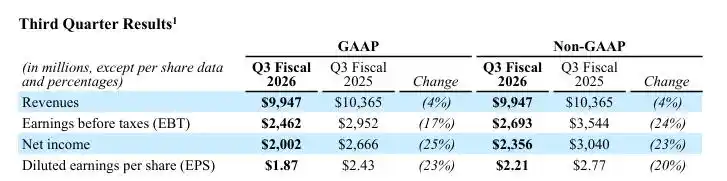
Qualcomm Q3 Revenue and Profit Data
The core reason for "increased revenue without increased profit" is the comprehensive rise in semiconductor industry input costs.
Qualcomm pointed out in its earnings report that costs in areas such as wafer fabrication, assembly, testing, advanced packaging, memory, and other materials are all increasing. These cost pressures directly impacted the company's profitability.
The report shows that the pre-tax profit margin of Qualcomm's QCT division, responsible for chip sales, was 26%, down 4 percentage points from 30% in the same period last year. The pre-tax profit margin of the technology licensing division QTL also decreased from 71% to 69%.
Facing continued pressure on the cost side, Cristiano Amon said bluntly in an interview: "Costs have gone up, and prices will follow. We are simply passing on the significant cost increases we are facing."
Previously, on July 24th, Qualcomm had already issued a notification letter to customers, announcing that it would implement double-digit percentage price increases across its entire chip series starting September 1st.
Amon emphasized that a temporary disconnect between costs and pricing has led to a slight temporary decline in gross margin, and the price increase is precisely to restore profitability to historical levels.
In terms of returning capital to shareholders, Qualcomm returned a total of $2.3 billion in the third quarter, including $973 million in cash dividends, equivalent to $0.92 per share, and $1.4 billion paid through the repurchase of 8 million ordinary shares.
As the company's profit guidance for the fourth quarter fell below market expectations, its stock price fell more than 5% in after-hours trading.
01 Smartphone Chips Bottom Out, Automotive Chips Surge
As Qualcomm's core revenue source, its semiconductor business (QCT) generated revenue of $8.504 billion for the quarter, a year-on-year decrease of 5%. This decline was primarily dragged down by its largest internal revenue segment, the handset business, while the automotive and IoT businesses showed strong growth resilience.
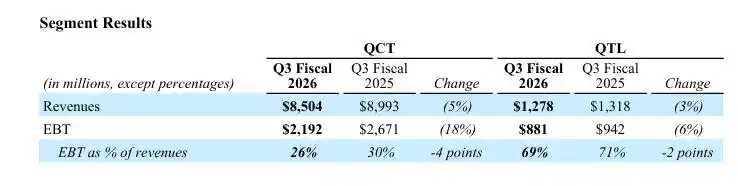
Qualcomm Q3 QCT and QTL Division Revenue Data
The earnings report shows that within the QCT division, handset revenue in the third quarter fell to $5.086 billion, a year-on-year decline of 20%. This performance reflects the complex difficulties currently facing the smartphone market.
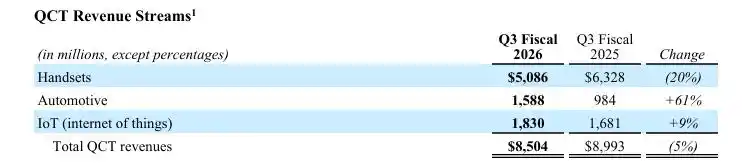
Qualcomm Q3 QCT Division Segment Financial Data
From a demand structure perspective, due to rising memory prices, consumer preferences within the high-end smartphone category are shifting towards lower-priced models within the same series and older models from the previous year, directly affecting Qualcomm's revenue and profit mix.
At the macro level, the entire smartphone industry is under significant pressure. According to Counterpoint Research data, global smartphone shipments in the second quarter of 2026 fell 11% year-on-year.
Bernstein analyst Stacy Rasgon commented, "The smartphone industry is not in good shape. Memory prices are rising, and AI is consuming a lot of supply. So, there isn't much supply left for smartphone makers. We've seen unit growth turn negative."
The Chinese market became a key focus this quarter. Qualcomm management's assessment is that revenue from Chinese smartphone manufacturers bottomed out in the second quarter as customers worked through excess inventory.
Amon mentioned that due to rising memory costs, smartphone manufacturers are forced to raise prices, which in turn suppresses demand and hurts Qualcomm's profit margins.
In stark contrast to the contraction in the phone business, the QCT automotive business was the biggest highlight of the quarter.
The QCT division's automotive business recorded revenue of $1.588 billion for the quarter, a 61% increase compared to $984 million in the same period last year. This marks the 23rd consecutive quarter of double-digit year-on-year revenue growth for this business. This performance also significantly exceeded Wall Street expectations of approximately $1.4 billion.
Alongside the earnings release, Qualcomm also announced a long-term agreement with BMW to supply digital cockpit and advanced driver-assistance systems (ADAS) chips for BMW's future vehicle platforms over the next decade.
The Internet of Things (IoT) business within the QCT division also performed steadily, with third-quarter revenue of $1.830 billion, a year-on-year increase of 9%. This business covers emerging areas such as low-power industrial uses, smart glasses, and robotics, showing good momentum for diversified development.
Turning to the parallel technology licensing division QTL, third-quarter revenue was $1.278 billion, a slight year-on-year decrease of 3%, slightly above the analyst average expectation of $1.26 billion surveyed by StreetAccount. The division's pre-tax profit margin was 69%, remaining a stable profit source for Qualcomm.
02 Betting Big on Data Centers
Facing structural challenges in the smartphone market and the potential decline in Apple's business share, Qualcomm is accelerating its diversification strategy, targeting the AI data center market and a broader ecosystem of intelligent devices.
Regarding the relationship with Apple, CEO Amon provided a key expectation. He stated that due to supply constraints, Qualcomm's component share in the upcoming iPhone would drop to well below the previously estimated 20%. He attributed this to supply availability issues and stated bluntly: "We are, to some extent, replacing Apple with the data center business."
In the data center field, Qualcomm is expanding rapidly. Amon said the goal of achieving $5 billion in data center revenue next year remains on track.
Previously, at the investor day in June, Qualcomm showcased a complete data center product line and servers, including AI accelerators, CPUs, memory, and rack-level servers. CFO Akash Palkhiwala predicted at that time that data center products would generate $5 billion in revenue in fiscal year 2027.
Amon further predicted in this earnings report that the year-on-year revenue growth of non-handset businesses, including data centers, would accelerate from 24% in fiscal 2026 to over 60% in fiscal 2027, calling this an important inflection point in the execution of the growth strategy.
To lay the software groundwork for this grand vision, Qualcomm completed the acquisition of AI programming technology company Modular in the third quarter. The company plans to officially announce its AI software platform at an event in August. Amon emphasized at the beginning of the earnings report that this acquisition aims to "create an open software foundation for generative AI and agents."
According to data from the previous investor day, Qualcomm aims to grow total revenue from non-handset businesses to $40 billion by fiscal year 2029, nearly double the target shared in November 2024.
03 Margin Pressure Continues
Looking ahead to the fourth quarter, Qualcomm's guidance indicates that the impacts of cost pressures and product mix changes will persist.
Qualcomm expects fourth-quarter fiscal 2026 revenue to be between $9.7 billion and $10.5 billion, with the midpoint roughly in line with the analyst average expectation of $10.02 billion. Within this, QCT chip business revenue is expected to be between $8.4 billion and $9.0 billion, and QTL technology licensing revenue is expected to be between $1.2 billion and $1.4 billion.
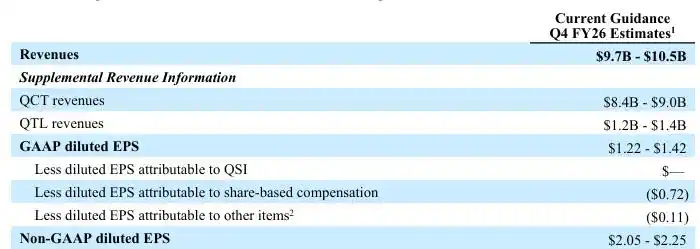
Qualcomm Q4 Financial Guidance
However, the profit guidance still fell short of expectations.
Qualcomm expects fourth-quarter Non-GAAP diluted earnings per share to be between $2.05 and $2.25, while the LSEG-compiled analyst average expectation was $2.36. On a GAAP basis, the earnings per share guidance range is $1.22 to $1.42. Qualcomm stated that this includes $0.72 in stock-based compensation costs and $0.11 in costs from other items.
From this perspective, Qualcomm's upcoming across-the-board chip price increase may not immediately offset the short-term pain caused by current cost increases and smartphone market weakness.
Management has factored these headwinds into its outlook for the fourth quarter and reiterated that the positive impact on gross margins from the pricing changes will materialize over time after they take effect on September 1st.
This article is from the WeChat public account "Tencent Technology", author: Worth Following