Qualcomm and Arm Fall Together: The Bill for Memory Price Hikes Finally Arrives at Mobile Chip Companies

marsbitXuất bản vào 2026-07-30Cập nhật gần nhất vào 2026-07-30

Tóm tắt

After posting Q2 FY2026 results, Qualcomm and Arm both saw their shares decline, reflecting the impact of memory price increases on the smartphone chip sector. Qualcomm's revenue of $9.95B slightly beat expectations, but EPS of $2.21 fell short. More concerning was its guidance for next quarter, with EPS projections below analyst estimates. The company directly attributed a >$1.50 per share annual EPS headwind to rising memory costs and supply constraints in Android phones, prompting planned price hikes. While automotive revenue grew 61% and is approaching one-third of phone revenue, the mobile segment declined 20%. Qualcomm also confirmed a significant reduction in its modem share for the upcoming iPhone and outlined a plan for data center revenue to replace all Apple-related income by FY2027. Arm's results surpassed expectations with revenue of $1.29B and EPS of $0.45, and its guidance was also strong. However, its stock fell. Key concerns included royalty revenue failing to set a new record and a downward revision to full-year royalty growth guidance from ~20% to the high-teens, citing weak smartphone demand and high memory prices. Despite robust growth in its data center business, Arm's premium valuation (over 100x forward P/E) means even beating expectations isn't enough to push the stock higher, as any sign of uncertainty is magnified. Ongoing global antitrust investigations add another risk factor. The situation highlights a broader shift. Memory price surges, which...

After the U.S. stock market closed on July 29th, Qualcomm and Arm released their earnings reports one after the other.

Starting with Qualcomm. Its revenue was $9.947 billion, exceeding the consensus estimate of $9.67 billion. However, non-GAAP earnings per share (EPS) were $2.21, missing the expected $2.23. More crucially, the guidance for the next fiscal quarter is revenue of $9.7 billion to $10.5 billion and EPS of $2.05 to $2.25. According to Reuters' statistics, the market consensus was $2.36 per share, meaning even the upper end of Qualcomm's guidance is below expectations. This isn't 'beating expectations'; it's revenue beating, profits slightly missing, and guidance significantly missing.

Now, Arm. Its shareholder letter was clean, with revenue of $1.289 billion and adjusted EPS of $0.45 both exceeding expectations, and next-quarter guidance also beating. Its stock price fell 8.11% that day, a drop that occurred during the regular trading session before the earnings release. After the report came out, the stock barely moved, but then fell another 7% to 8% in after-hours trading following the conference call. A Bloomberg news article URL still contained the phrase 'beat doesn't impress', while the displayed headline had been changed to 'Arm Drops as Smartphone Slowdown Outweighs Data Center Growth'.

What happened in between? Both companies mentioned the same word in their reports: memory.

Phone Shrinks, Cars Keep It Alive

A page in Qualcomm's official earnings presentation materials specifically addressed the Android phone business. It stated that due to memory price increases and supply constraints, Android phone revenue for the QCT segment in fiscal 2026 is expected to decline approximately 20% year-over-year, dragging down full-year EPS by more than $1.50. It also announced price increases for its products effective September 1st to pass on rising input costs.

This page is the most direct evidence in these two reports. The memory price surge translated to KRW 89.49 trillion in operating profit for Samsung, and here for Qualcomm, it's a bill itemized down to $1.50 per share.

It's also visible in gross margins. Qualcomm's GAAP gross margin this quarter was 53.1%, compared to 55.6% last year. According to a transcript of the call, management described QCT gross margins as 'slightly below our historical range', attributing it to rising memory and other input costs.
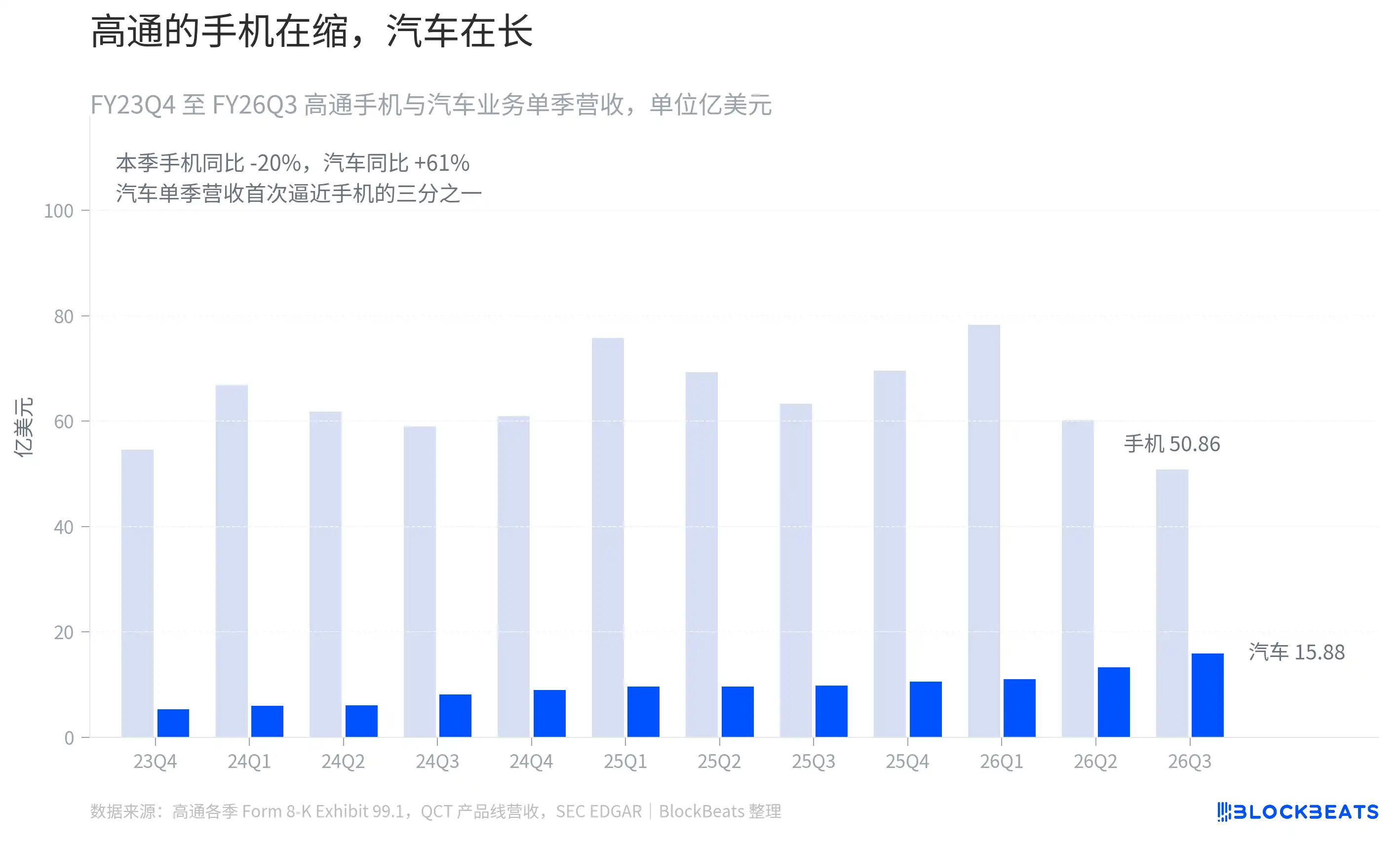
This quarter, handset revenue was $5.086 billion, down 20% year-over-year. Automotive revenue was $1.588 billion, up 61%, marking the 23rd consecutive quarter of double-digit growth. The distance between these two bars on the chart is narrowing rapidly, with automotive quarterly revenue approaching one-third of handset revenue for the first time.

There's a longer-term issue on the phone side as well. The official presentation states that due to supply constraints, the decline in revenue from Apple products will accelerate starting in the fourth fiscal quarter, "Our share of modems on the upcoming iPhone is expected to be significantly lower than the previous 20% estimate." According to the call transcript, CFO Akash Palkhiwala said Apple revenue will decline by about 50% from the September quarter to the December quarter.

CEO Cristiano Amon offered an even more memorable line during the call. According to Reuters, he said, "We've essentially replaced Apple with data center." The official statement was more cautious, with the presentation materials stating that the year-over-year increase in non-handset revenue in fiscal 2027 will replace all Apple product revenue from fiscal 2026.

The data center line is currently a timeline. The official revenue path is approximately $300 million in fiscal 2026, $5 billion in fiscal 2027, and over $15 billion in fiscal 2029. Of the $5 billion in fiscal 2027, there are custom chips for two hyperscale customers, each contributing over $1 billion. One has been made public: Meta signed a strategic agreement with Qualcomm for a multi-generation CPU roadmap, with the first Dragonfly C1000 not entering production until the second half of 2028.

Seaport Global analyst Jay Goldberg was less generous in his assessment to Reuters, stating Qualcomm "is seeing Android share shift away from it and already lost nearly all of its remaining share at Apple."

Arm's Conference Call Had a Problem

Arm's shareholder letter contained some very nice numbers. Data center royalties more than doubled year-over-year, the second consecutive quarter of doubling. Cumulative shipments of Neoverse architecture cores exceeded 1.5 billion, with the most recent 500 million cores shipped in just 9 months, while the first 1 billion took 6 years. The letter also cited IDC data, stating that spending on Arm-based accelerated server platforms nearly doubled in the past two quarters and has already surpassed x86 platforms.
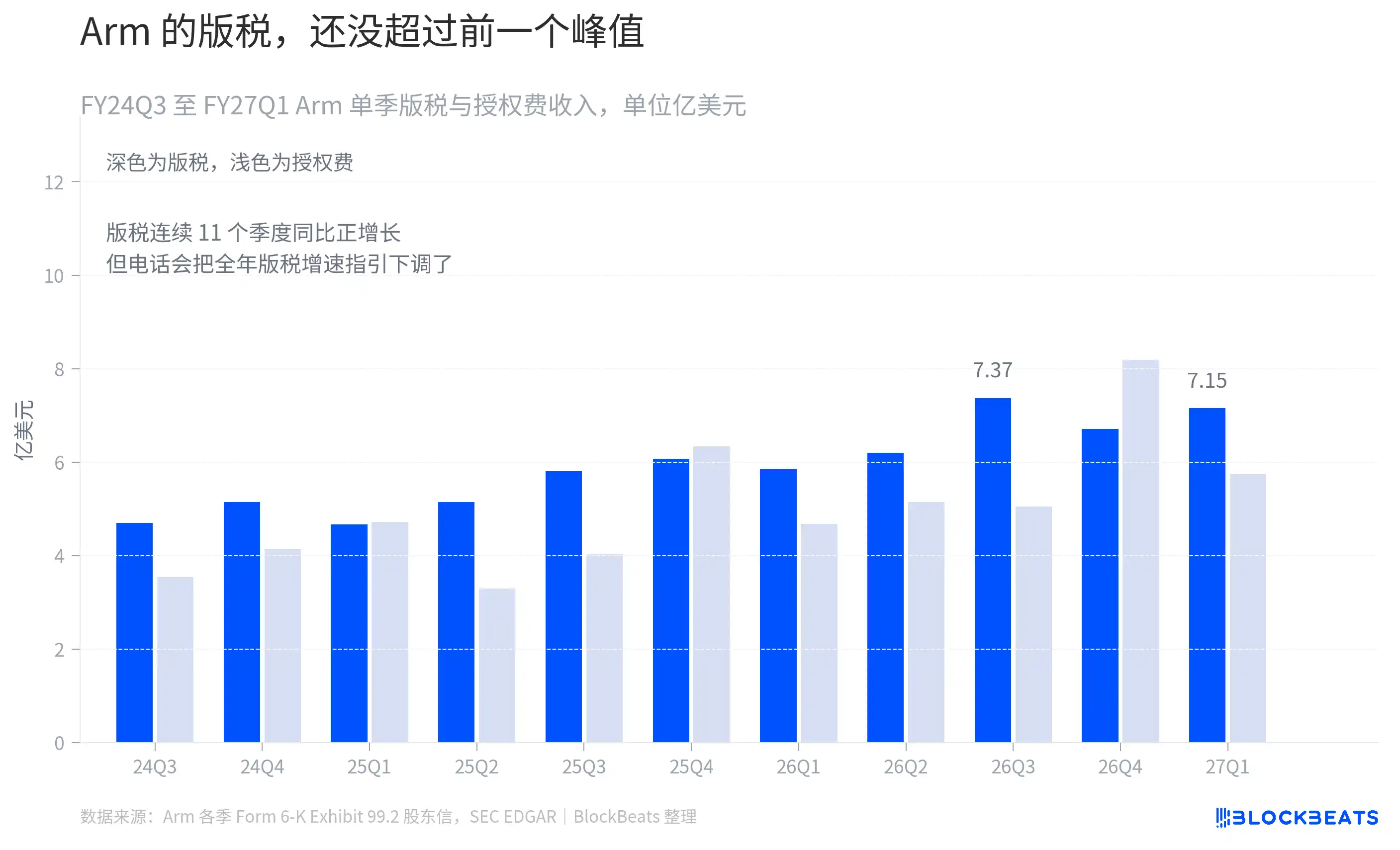
The dark line on the chart tells a different story. This quarter's royalty revenue was $715 million, up 22% year-over-year, but it did not surpass the $737 million from Q3 of fiscal 2026. That remains Arm's quarterly royalty peak. The licensing fee line has always been volatile, with year-over-year growth swinging between -15% and +72%. The market has always focused on the smoothly ascending royalty line, and this quarter that line did not hit a new high.

What really turned the stock lower was a guidance cut during the call. According to the call record, Arm lowered its full-year royalty growth guidance from approximately 20% previously to the high teens, citing weakness in the smartphone market and high memory prices, and expecting a double-digit decline in the phone market. For the next quarter's segment guidance, licensing fees are expected to grow about 30% year-over-year, while royalties are only in the low teens percentage.

Why No Rally Even After Beating Expectations?

Based on the July 29th close, Arm's forward price-to-earnings (P/E) ratio is 103.66 times, Qualcomm's is 15.22 times—a difference of 6.8 times. Another comparison is more telling: Arm's forward P/E is 5.4 times higher than Nvidia's 19.07 times, while Nvidia's trailing twelve-month revenue is $253.49 billion, 49 times that of Arm.
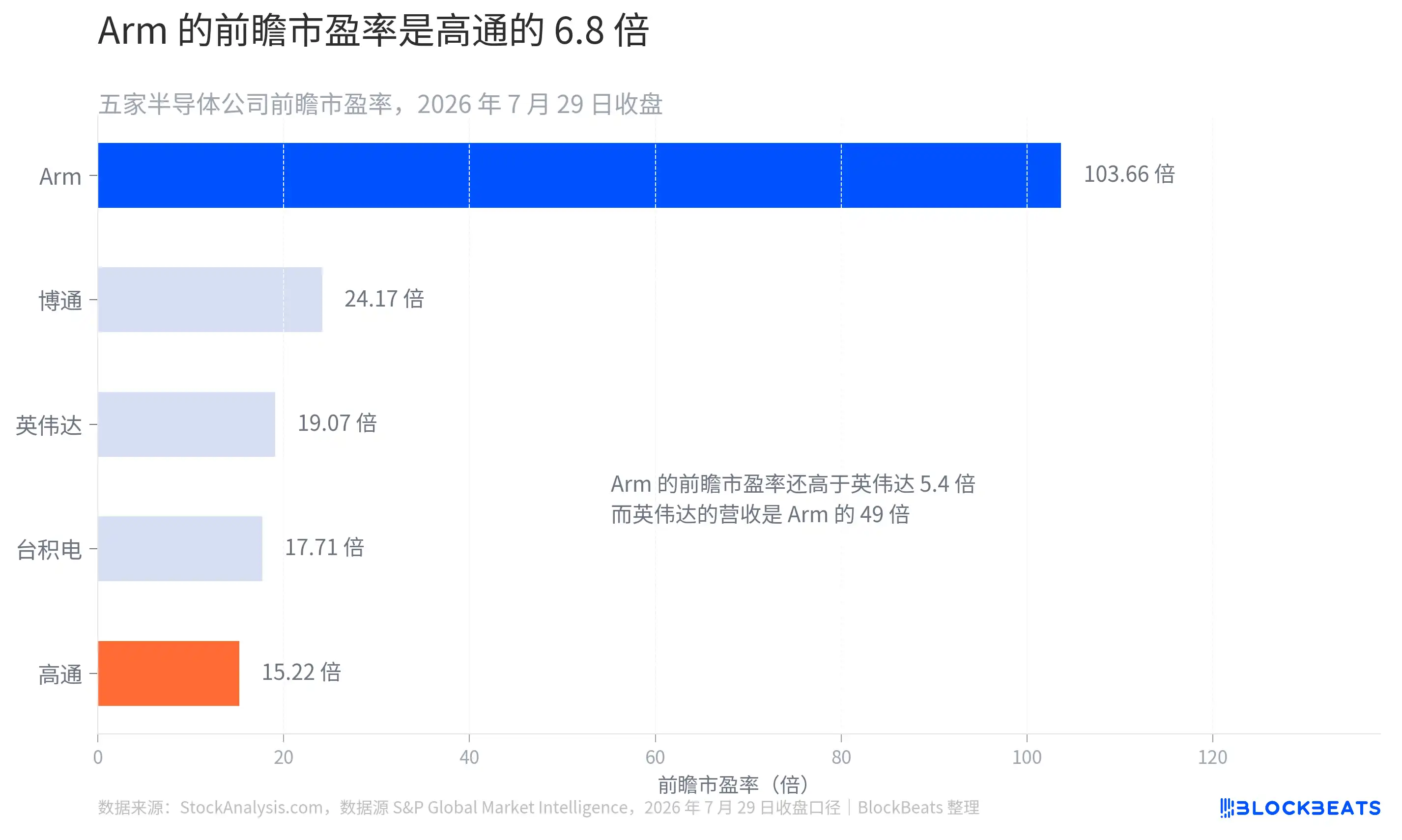
A TechTimes post-earnings analysis explained this mechanism clearly, stating that at a forward P/E of 100 to 120 times, "a clean beat no longer pushes the stock price higher." This sentence explains a class of phenomena, not just Arm's. When valuation has already discounted growth for several years into the future, the function of earnings reports shifts from providing surprises to confirming assumptions, and any deviation from confirmation gets amplified.

There's another variable most reports didn't mention. According to reports, the U.S. Federal Trade Commission launched a formal antitrust investigation into Arm starting in May 2026, examining whether its launch of in-house AGI CPUs could weaken or lead to refusal to license CPU architecture to competitors, with parallel investigations in Korea and by the European Commission. If regulators ultimately mandate non-discriminatory pricing, the margin assumptions in Arm's long-term model targeting $25 billion revenue by fiscal 2031 would need to be recalculated.

Arm's in-house chip line did see progress this quarter. The shareholder letter said customer demand for its AGI CPUs now exceeds $2 billion, spanning fiscal years 2027 and 2028, double the $1 billion opportunity disclosed last quarter, with new customers including multiple clients in the U.S. and China. Jefferies' estimate to Reuters was more optimistic than the company's, suggesting this business could reach $18 billion by fiscal 2031, above Arm's own $15 billion estimate.

It's Not Just About Two Companies

According to statistics, the Philadelphia Semiconductor Index fell 18.2% in July, after doubling in the first half of this year. Nineteen tech stocks fell more than 25% in July, most of them semiconductors, and seven of those still have triple-digit gains year-to-date.

The arrangement of points in the chart below is clear: the ones that fell the most in July are generally the ones that rose the most this year. SanDisk fell 40.4% in July but is still up 471% year-to-date. Micron fell 26.5% in July, up 197% year-to-date. Arm fell 36.6% in July, up 105.7% year-to-date.
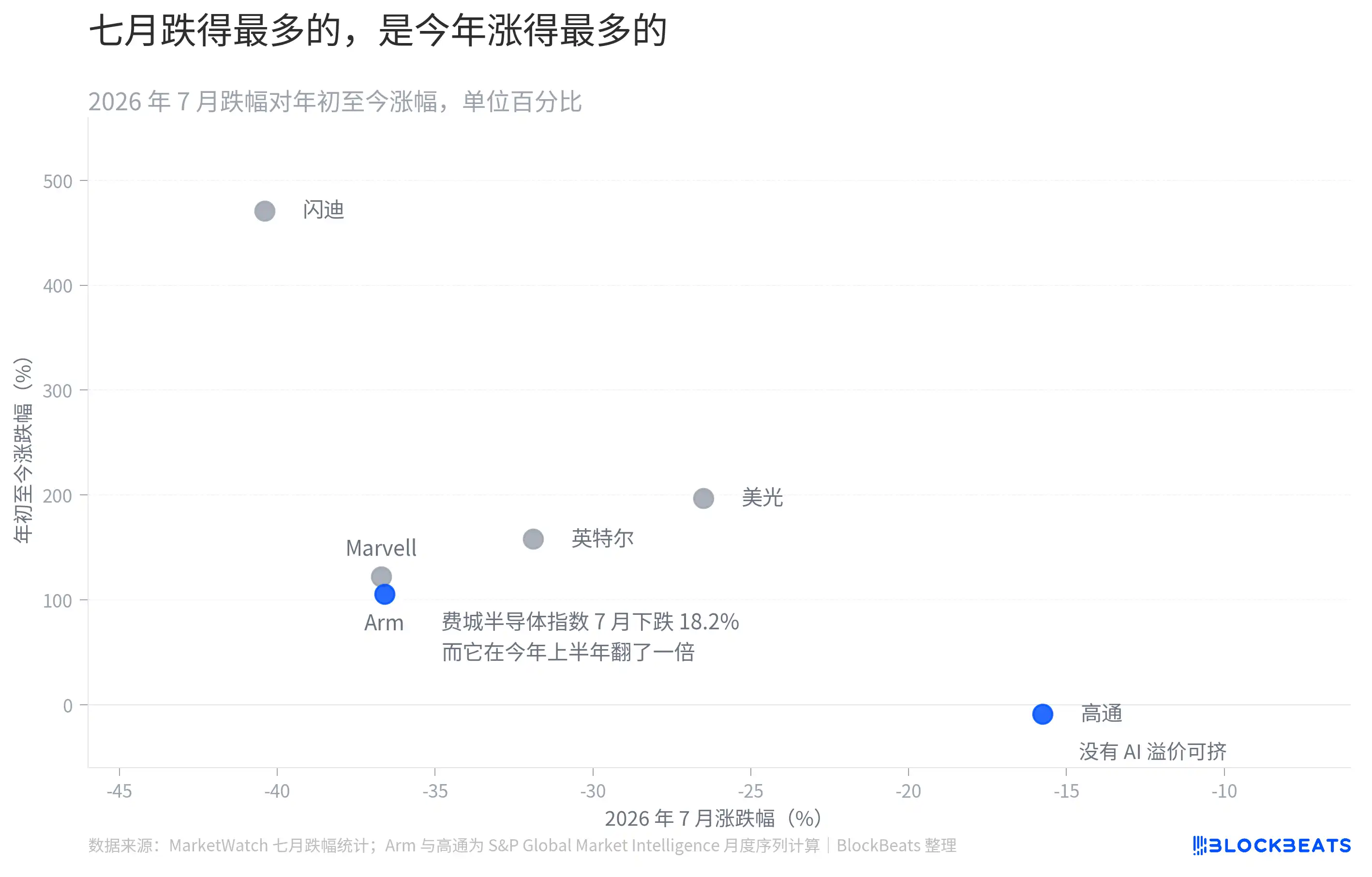
Qualcomm is the exception. It fell 15.75% in July and is down 8.99% year-to-date. It's not in the group with squeezed valuations because it has no AI premium to squeeze. The consensus rating from thirty-six analysts is Hold, with an average target price of $220.57, about 40% above the current price. Forty analysts give Arm a consensus Buy rating.

Two other earnings reports from the same day can be viewed together. Microsoft revenue of $90 billion, Azure growth of 43%, its stock rose about 8% after hours at one point. Meta revenue of $60.8 billion, growth of 28%, but net profit declined, its stock fell 8% to 10% after hours. Samsung's operating profit hit a record, but its stock barely moved that day.

The memory price surge allowed Samsung to earn in one quarter what Nvidia earned at its peak, while the other half of the same bill was accounted for by Qualcomm and Arm, each writing it once in their respective reports.


Tiền kỹ thuật số thịnh hành

Câu hỏi Liên quan

QWhy did Qualcomm's stock decline despite its revenue beating expectations?

AQualcomm's stock declined because its future guidance was significantly below market expectations. While its revenue of $99.47 billion exceeded estimates, its Q2 EPS guidance of $2.05 to $2.25 was below the consensus estimate of $2.36. Furthermore, the company cited rising memory costs and supply constraints negatively impacting its Android phone business, expecting a ~20% year-over-year revenue decline in FY2026 and a drag of over $1.50 on full-year EPS. The loss of significant Apple modem share and a faster-than-expected decline in Apple revenue also contributed to investor concerns.

QWhat specific factor negatively impacted both Qualcomm and Arm's financial results according to their reports?

ABoth Qualcomm and Arm explicitly cited rising memory (storage) costs and supply constraints as key factors negatively impacting their financial results. Qualcomm noted it contributed to a lower Android phone revenue forecast and pressured gross margins. Arm attributed its downgraded royalty growth guidance partly to weak smartphone market conditions driven by high memory prices.

QHow did Arm's performance differ between its royalty and licensing businesses in the reported quarter?

AArm's performance showed divergence. Its licensing fee revenue, which is volatile, grew. However, its more stable and closely watched royalty revenue of $715 million, while up 22% year-over-year, did not reach a new all-time high, falling short of the $737 million peak from the previous quarter (Q3 FY2026). This failure of the royalty stream to set a new record was a point of concern for investors.

QWhy didn't Arm's stock price rise even though it reported earnings that beat expectations?

AArm's stock did not rise because, at a forward P/E ratio of over 100 times, its valuation had already priced in significant future growth. A simple earnings beat was no longer sufficient to drive the price higher. Instead, the market focused on negatives such as the downgraded full-year royalty growth guidance and the failure of royalty revenue to hit a new record. Additionally, potential regulatory risks from antitrust investigations into its AGI CPU business posed a threat to its long-term profitability model.

QWhat contrasting trend is highlighted in the semiconductor sector's performance for July versus the first half of the year?

AThe article highlights a sharp reversal in the semiconductor sector. The Philadelphia Semiconductor Index fell 18.2% in July, following a performance where it had doubled in the first half of the year. Many semiconductor stocks that rose the most in the first half (e.g., Arm, Micron, SanDisk with triple-digit gains) were among the biggest decliners in July, indicating a market correction or valuation squeeze, particularly for stocks with high AI-related premiums. Qualcomm was an exception as it lacked such a premium and had underperformed year-to-date.

Nội dung Liên quan

Dash triển khai tính năng bảo mật ZK dựa trên Zcash

Dash đã triển khai tính năng bảo mật ZK dựa trên giao thức Orchard của Zcash trong Dash Platform v4.0. Đây là một cơ chế bảo mật tích hợp trực tiếp vào giao thức, cho phép ẩn số dư, người gửi, người nhận và số tiền trong các giao dịch được bảo vệ (shielded transactions). Tính năng này tồn tại song song với cơ chế CoinJoin truyền thống của Dash, hướng đến trải nghiệm nhanh hơn trên ví di động. Người dùng có thể chuyển Dash từ mạng lõi (Core) vào shielded pool, thực hiện giao dịch riêng tư, và rút tiền trở lại Core. Dash Platform sử dụng đơn vị credits (1 DASH = 100 tỷ credits) cho các hoạt động này. Công nghệ sử dụng bằng chứng không tiết lộ thông tin (ZK-proof) và cấu trúc SumTree để ngăn chặn gian lận như chi tiêu gấp đôi. Việc đồng bộ hóa ví để phát hiện giao dịch đến được báo cáo là nhanh chóng (khoảng 21 giây trong bản thử nghiệm). Các ví di động hỗ trợ chính thức sẽ sớm được phát hành. Trong tương lai, Dash có kế hoạch mở rộng shielded pool cho các token gốc trên nền tảng, tăng cường khả năng bảo mật cho tài sản kỹ thuật số và NFT, đồng thời duy trì kết nối trực tiếp với thị trường thông qua Dash.

cryptonews.ru24 phút trước

Dash triển khai tính năng bảo mật ZK dựa trên Zcash

cryptonews.ru24 phút trước

Nhà đầu tư nổi tiếng 'chỉ trích' Nvidia: Sự thịnh vượng của AI quá phụ thuộc vào họ

Hai nhà đầu tư nổi tiếng Phố Wall, Mark Cuban và Michael Burry, đã cảnh báo về mạng lưới sinh thái AI khổng lồ của Nvidia. Cuban so sánh sự bùng nổ AI hiện tại với bong bóng dotcom, chỉ ra rằng thay vì nhiều startup IPO, chính Nvidia đang đóng vai trò "đỡ đầu" bằng cách tài trợ cho khách hàng mua GPU, khiến họ dễ tổn thương nếu cơn sốt AI suy giảm. Ông lo ngại chỉ cần một đột phá từ đối thủ hoặc một sai sót của Nvidia cũng có thể khiến toàn bộ hệ thống sụp đổ. Giám đốc điều hành Nvidia, Jensen Huang, cũng thừa nhận vai trò then chốt của công ty trong việc duy trì sự thịnh vượng AI. Trong khi đó, Michael Burry chỉ ra rằng giá hoán đổi rủi ro tín dụng (CDS) 5 năm của Nvidia tăng vọt, phản ánh lo ngại thị trường về rủi ro tài chính. Ông cho rằng Nvidia đang mở rộng quá mức thông qua nhiều thỏa thuận, đẩy chi tiêu vòng lặp lên quy mô khổng lồ và phần lớn nhu cầu thực tế đến từ tài trợ vòng, không phải từ khách hàng cuối. Cả hai nhà đầu tư đều chỉ trích sự phát triển quá mức của cơ sở hạ tầng AI, có thể dẫn đến dư thừa năng lực và các khoản đầu tư vào chip, trung tâm dữ liệu có nguy cơ lỗi thời nhanh chóng. Burry tiết lộ đã tăng vị thế bán khống và nắm giữ quyền chọn bán đối với cổ phiếu Nvidia.

marsbit25 phút trước

Nhà đầu tư nổi tiếng 'chỉ trích' Nvidia: Sự thịnh vượng của AI quá phụ thuộc vào họ

marsbit25 phút trước

OpenAI, Mã Nguồn Mở

OpenAI đã chính thức mở mã nguồn công cụ bảo mật Codex Security CLI - một công cụ dòng lệnh và SDK TypeScript. Nó tự động phát hiện, xác minh và sửa chữa lỗ hổng bảo mật trong mã nguồn. Quy trình làm việc gồm ba bước: đọc toàn bộ kho mã để tạo mô hình mối đe dọa, tìm lỗ hổng dựa trên ngữ cảnh và kiểm tra chúng trong môi trường sandbox. Trong 30 ngày đầu, công cụ này đã quét hơn 1,2 triệu lần commit và phát hiện 792 lỗ hổng nghiêm trọng cùng hơn 10.000 lỗ hổng nguy cơ cao. Tuy nhiên, những người dùng thử nghiệm đầu tiên báo cáo về chi phí cao đáng kể và một số vấn đề kỹ thuật. Công cụ mặc định sử dụng mô hình GPT-5.6-Sol với mức giá API đắt đỏ, dẫn đến hóa đơn tăng vọt chỉ sau một lần quét mã. Một số người dùng còn gặp phải tình trạng giới hạn tài khoản và lỗi trong quá trình quét. Việc phát hành mã nguồn này diễn ra sau khi Jensen Huang (CEO NVIDIA) công khai ủng hộ AI nguồn mở. Dù vậy, OpenAI chủ yếu mở mã phần ứng dụng, còn phần mô hình lõi vẫn được giữ kín. Sự kiện này đánh dấu một bước tiến trong việc áp dụng AI Agent vào lĩnh vực bảo mật mã nguồn, mở ra cơ hội cho cộng đồng phát triển tiếp tục cải tiến công cụ này.

marsbit27 phút trước

OpenAI, Mã Nguồn Mở

marsbit27 phút trước

Giao dịch

Giao ngay

Bài viết Nổi bật

Làm thế nào để Mua CHIP

Chào mừng bạn đến với HTX.com! Chúng tôi đã làm cho mua USD.AI (CHIP) trở nên đơn giản và thuận tiện. Làm theo hướng dẫn từng bước của chúng tôi để bắt đầu hành trình tiền kỹ thuật số của bạn.Bước 1: Tạo Tài khoản HTX của BạnSử dụng email hoặc số điện thoại của bạn để đăng ký tài khoản miễn phí trên HTX. Trải nghiệm hành trình đăng ký không rắc rối và mở khóa tất cả tính năng. Nhận Tài khoản của tôiBước 2: Truy cập Mua Crypto và Chọn Phương thức Thanh toán của BạnThẻ Tín dụng/Ghi nợ: Sử dụng Visa hoặc Mastercard của bạn để mua USD.AI (CHIP) ngay lập tức.Số dư: Sử dụng tiền từ số dư tài khoản HTX của bạn để giao dịch liền mạch.Bên thứ ba: Chúng tôi đã thêm những phương thức thanh toán phổ biến như Google Pay và Apple Pay để nâng cao sự tiện lợi.P2P: Giao dịch trực tiếp với người dùng khác trên HTX.Thị trường mua bán phi tập trung (OTC): Chúng tôi cung cấp những dịch vụ được thiết kế riêng và tỷ giá hối đoái cạnh tranh cho nhà giao dịch.Bước 3: Lưu trữ USD.AI (CHIP) của BạnSau khi mua USD.AI (CHIP), lưu trữ trong tài khoản HTX của bạn. Ngoài ra, bạn có thể gửi đi nơi khác qua chuyển khoản blockchain hoặc sử dụng để giao dịch những tiền kỹ thuật số khác.Bước 4: Giao dịch USD.AI (CHIP)Giao dịch USD.AI (CHIP) dễ dàng trên thị trường giao ngay của HTX. Chỉ cần truy cập vào tài khoản của bạn, chọn cặp giao dịch, thực hiện giao dịch và theo dõi trong thời gian thực. Chúng tôi cung cấp trải nghiệm thân thiện với người dùng cho cả người mới bắt đầu và người giao dịch dày dạn kinh nghiệm.

Tổng lượt xem 730Xuất bản vào 2026.04.21Cập nhật vào 2026.06.02

Làm thế nào để Mua CHIP

Thảo luận

Chào mừng đến với Cộng đồng HTX. Tại đây, bạn có thể được thông báo về những phát triển nền tảng mới nhất và có quyền truy cập vào thông tin chuyên sâu về thị trường. Ý kiến ​​của người dùng về giá của CHIP (CHIP) được trình bày dưới đây.

活动图片