Hyperliquid First Discloses HIP-4 Permissionless Deployment Specifications: Threshold Aligns with HIP-3, but Adds a Template Approval Layer

Foresight NewsXuất bản vào 2026-07-20Cập nhật gần nhất vào 2026-07-20

Tóm tắt

Hyperliquid founder Jeff Yan announced plans for permissionless deployment of HIP-4 outcome markets in a future network upgrade, moving from testnet to mainnet. This follows the initial, validator-voted deployment phase on mainnet that began in May. The announcement details key mechanisms for the permissionless phase. The staking requirement is set at 500,000 HYPE (locked for 6 months), matching HIP-3. A core new feature is a "template system": validators will vote on and store standardized market templates on-chain, and deployers can only create markets by instantiating these pre-approved templates. This aims to ensure market quality and clarity. Deployers will also have an initial quota of 100 outcomes (200 tokens), which refreshes after settlements. The reasoning for permissionless deployment is the vast potential universe of tradable events for prediction markets, which far exceeds the finite assets available for perpetual contracts. While HIP-4 has seen $370M in volume over 78 days, its market share remains small compared to established players. The model mirrors HIP-3's successful expansion of perpetual contracts after opening deployment. Rules include slashing stakes for unclear definitions or incorrect/delayed settlements. This incentivizes short-duration markets, as long-term settlements would lock capital and quota for extended periods. The template system addresses definition clarity but does not prevent potential liquidity fragmentation or market concentration,...


Author:angelilu, Foresight News


Hyperliquid founder Jeff Yan posted an announcement about HIP-4 on his Discord, stating that outcome markets will support permissionless deployment in an upcoming network upgrade, first on testnet and then on mainnet.


The wording of the announcement is that, just like the deployment of spot and perpetual contracts, this outcome markets technology needs to undergo sufficient real-world testing in an environment deployed by validators before it can be expanded to permissionless deployment.
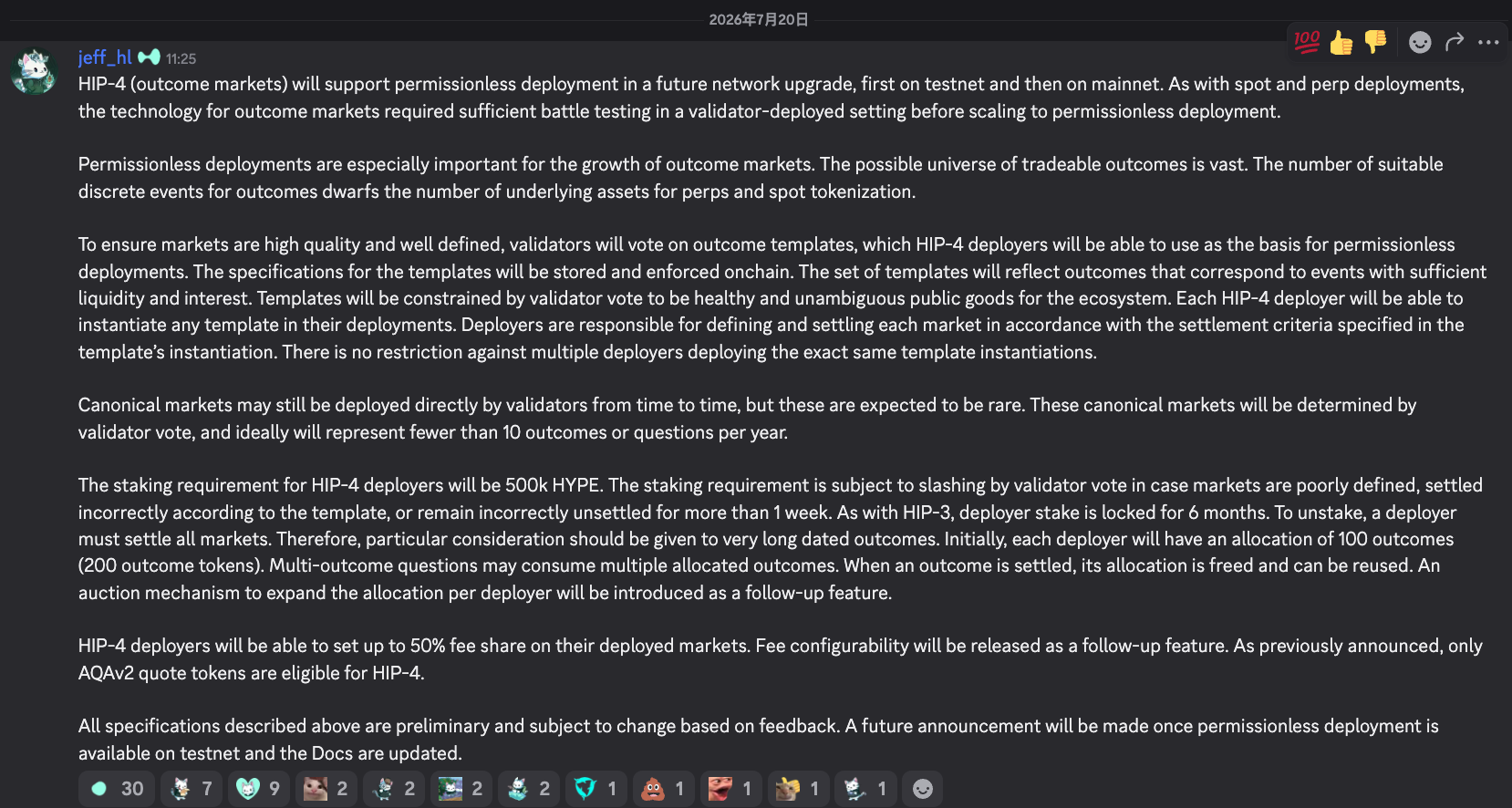


The announcement did not give a specific date and noted at the end that all specifications are preliminary and may be adjusted based on feedback. However, it disclosed a set of mechanism details that had not been made public in detail before.


What Stage Has HIP-4 Reached Now?


On February 2, 2026, the Hyperliquid team announced HIP-4, introducing a new primitive called "Outcome Trading." According to the official documentation definition, outcome contracts are fully collateralized, with settlement prices falling within a fixed range. They are suitable for prediction markets and bounded option-like instruments, introducing nonlinear characteristics and dated contracts, and involve no leverage or liquidation. Each outcome market has two directions, each corresponding to a token, typically labeled Yes and No, with their order books merged to share liquidity. A "question" is a collection of outcomes, where exactly one outcome will settle as Yes.


In the same month, HIP-4 went live on testnet. On May 2nd, it officially launched on mainnet, with the first market being a cyclic binary outcome market, settling daily at 06:00 UTC based on the BTC mark price on HyperCore, with zero fees for opening positions. Subsequently, Hyperliquid extended outcome markets to off-chain events, with the first off-chain market being "May CPI YoY."


However, this mainnet phase is "validator-deployed." Which markets to open are decided by validator votes, and external parties cannot launch markets themselves. Therefore, this new announcement is about the upcoming next phase.


Why Is Permissionless Deployment Necessary?


The reason given by Hyperliquid founder Jeff Yan in the announcement is straightforward: within outcome markets, the universe of tradable outcomes is extremely vast. The number of discrete events suitable for outcome contracts far exceeds the number of underlying assets for perpetual contracts and spot tokenization. The underlying assets for perpetual contracts are finite - coins, stocks, commodities, indices - they can be counted. However, real-world events that can be bet on are infinite. Relying on validators to vote on listing them one by one can never keep up with supply and demand.


To understand the urgency of permissionless deployment, one must first look at the actual performance of HIP-4 on mainnet over these two and a half months.


Over 78 days since HIP-4 launch, cumulative trading volume reached $370 million, with a cumulative number of trades reaching 7 million. The peak daily volume occurred on June 27th, at $12.96 million.

https://hl.eco/hip4
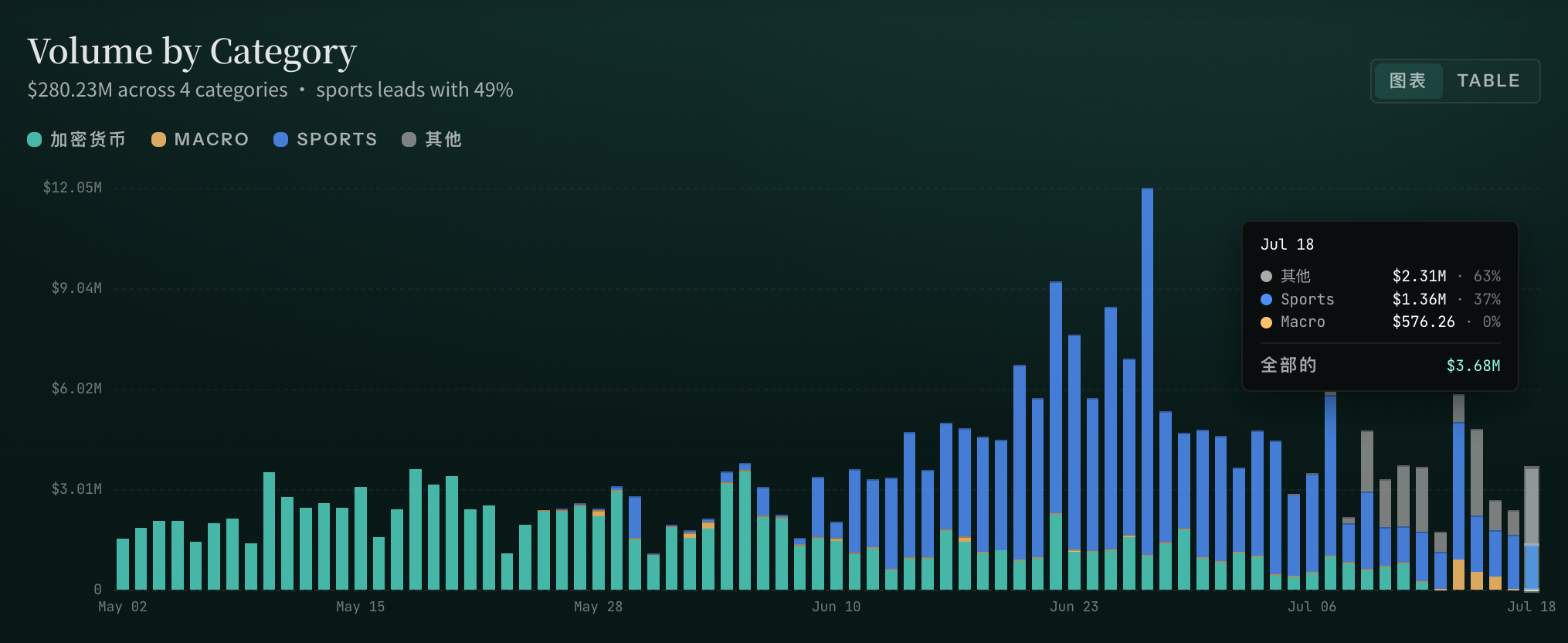

From May 2nd to early June, trading was almost entirely from cryptocurrency categories, with daily volume between $1 million and $3.5 million. When the World Cup started on June 11th, sports categories instantly took over, pushing volume to three to four times the previous baseline.
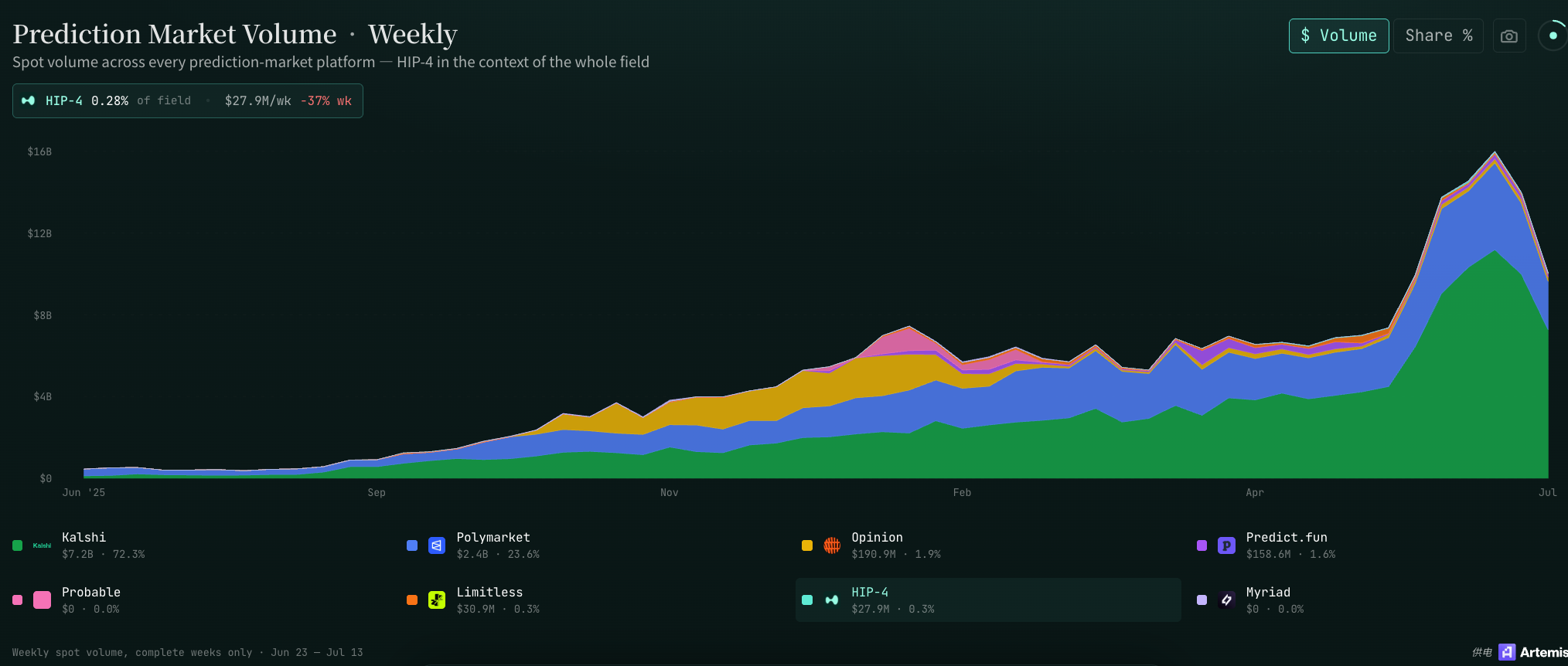


The figures from competitors during the same period are of another order of magnitude. Taking weekly data as an example, for the week of July 13th (during the World Cup), the weekly trading volumes for Kalshi and Polymarket were $7.2 billion and $2.4 billion respectively, while HIP-4's trading volume was $27.9 million. HIP-4's market share in prediction markets was only 0.3%.


But this logic has already been successfully validated once on Hyperliquid. HIP-3 allowed anyone to deploy perpetual contract markets after staking HYPE. It launched on October 13, 2025, and subsequently listed Nvidia, Tesla, gold, crude oil, S&P 500, and other underlying assets.


According to HIP-3 Ecosystem data, as of the time of writing, HIP-3's historical trading volume is $387.72 billion, and open interest has grown from about $790 million in January 2026 to $3.43 billion in July; HIP-3's share of Hyperliquid's trading volume reached 47.2% at the time of writing. Opening up the supply side indeed brought explosive growth.


Several New Mechanisms for HIP-4


Therefore, at the end of the World Cup, when all prediction markets are exploring new underlying assets, Hyperliquid announced several new mechanisms for HIP-4 at this time.
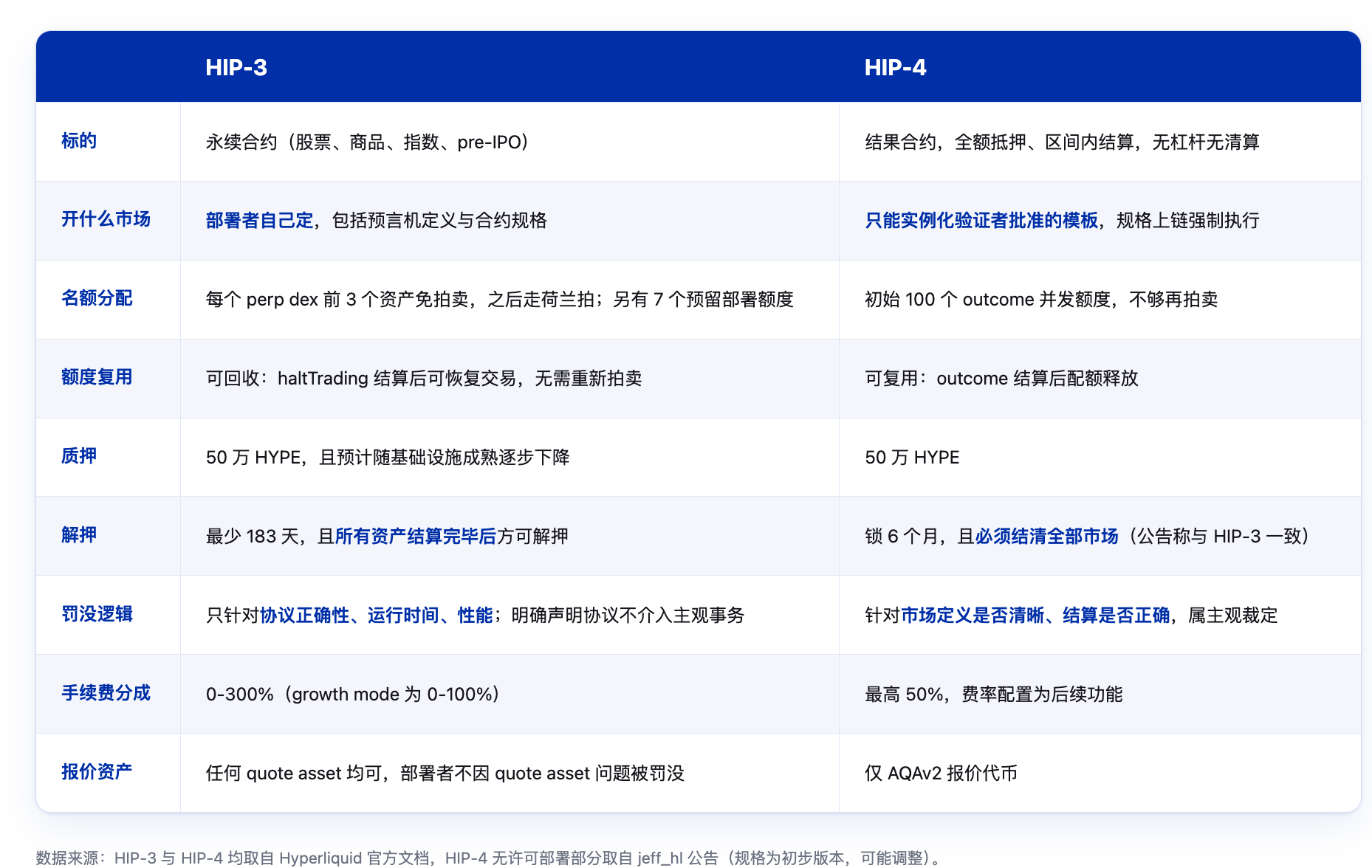


Staking Threshold is 500,000 HYPE Tokens


As for the staking threshold for HIP-4 deployers, this announcement is the first time Hyperliquid has publicly explained the staking requirements for HIP-4 permissionless deployment. Previously, community speculation placed the number at 1 million HYPE, twice that of HIP-3. This announcement states it's 500,000 HYPE, aligning with HIP-3. Staked tokens will be locked for 6 months and may be slashed if market definitions are unclear or settlements are delayed.


Template System


The template system is the core of this design. To ensure market quality and clear definitions, validators will vote on "outcome templates." Template specifications are stored on-chain and enforced. HIP-4 deployers can only perform permissionless deployment based on these templates, filling in parameters themselves to instantiate specific markets. The announcement requires that templates must be "healthy and unambiguous public goods for the ecosystem" and that corresponding events must have sufficient liquidity and attention. Deployers are responsible for defining and settling each market according to the settlement criteria specified when instantiating the template. The announcement explicitly does not restrict multiple deployers from deploying identical template instances.


Why add this layer? It's related to the product form. Perpetual contracts have continuous prices; if the market is off, it corrects itself. Outcome contracts settle at a definite value upon expiration; once the settlement is judged incorrectly, money is directly awarded to the wrong side.


Quota System


The quota system is another new element. Each deployer is initially allocated 100 outcomes (200 outcome tokens). One outcome corresponds to YES and NO two tokens. Multi-outcome questions consume multiple outcomes; for example, a five-choice question is split into five binary outcomes, occupying five. The quota is released and can be reused after an outcome settles; this is a concurrent upper limit, not a lifetime limit. The announcement states that an auction mechanism will be introduced later to expand an individual deployer's quota.


Slashing and Locking


Slashing and locking determine what this market will ultimately become. Stakes can be slashed by validator vote for three reasons: unclear market definition, failure to settle correctly according to the template, and failure to settle correctly for over a week. As with HIP-3, deployer stakes are locked for 6 months, and all markets must be settled before unstaking. The announcement itself warns that special caution is needed for very long-term outcomes.


The consequence of this rule is very practical. Launching a market that settles two years later means 500,000 HYPE is locked for two years, and the quota is also occupied the entire time. Rational deployers will only create markets with short cycles and frequent settlements. The difference in product form between HIP-4 and Polymarket is not entirely a strategic choice; it's also a result pushed by the mechanism.


Additionally, deployers can set up to 50% fee share for the markets they deploy; fee rate configuration will be released as a subsequent feature; only AQAv2 quote tokens can be used for HIP-4; validators may still occasionally deploy outcome markets directly, but it is expected to be very rare, aiming for fewer than 10 outcomes or questions per year.


Issues Not Addressed by the Template System


From the HIP-3 experience, there are aspects worth HIP-4 being cautious about.


hl.eco shows HIP-3 currently has 8 active deployers and 204 markets, but Trade.XYZ alone accounts for over 90% of all HIP-3 open interest. Some analyses indicate that this high concentration by a single deployer may constitute a structural/centralization risk for Hyperliquid.
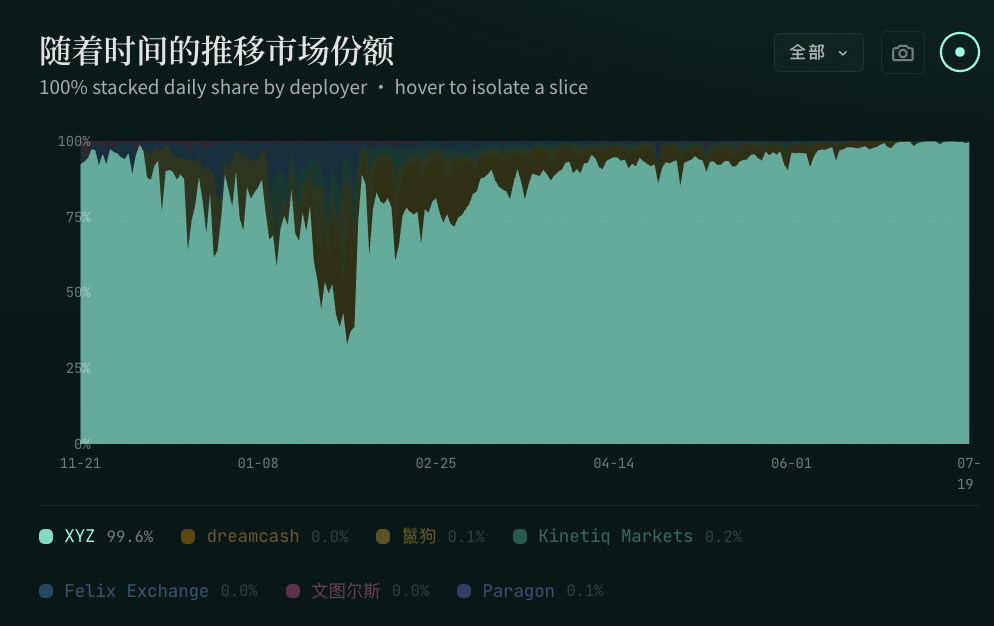


The template system in these new HIP-4 rules governs market quality, not market share. Where users trade depends on depth. HIP-4 explicitly allows multiple deployers to instantiate identical templates, which sounds like encouraging competition. However, if the same question is opened as five identical markets, liquidity will only be further fragmented, ultimately still converging towards the deepest pool.


Tiền kỹ thuật số thịnh hành

Câu hỏi Liên quan

QWhat is the main announcement regarding HIP-4 made by Hyperliquid founder Jeff Yan?

AJeff Yan announced that Outcome Markets (HIP-4) will support permissionless deployment in an upcoming network upgrade, first on testnet and then on mainnet. This will allow external users to deploy their own markets.

QWhat are the two key reasons provided in the article for HIP-4 needing permissionless deployment?

AFirst, the universe of tradable outcomes for prediction markets is vast and practically infinite, far exceeding the finite number of underlying assets for perpetual contracts. Second, the success of HIP-3's permissionless deployment for perpetual contracts demonstrated that opening up the supply side leads to explosive growth.

QWhat is the staking requirement for a HIP-4 deployment, and how does it compare to HIP-3?

AThe staking requirement for HIP-4 permissionless deployment is 500,000 HYPE, which is the same as the requirement for HIP-3. The staked tokens will be locked for 6 months and are subject to slashing for issues like unclear market definitions or delayed settlements.

QWhat is the 'template system' for HIP-4, and what is its primary purpose?

AThe template system requires validators to vote on and approve 'outcome templates' which are stored on-chain. HIP-4 deployers can then use these approved templates to create specific markets by filling in parameters. Its purpose is to ensure market quality, definition clarity, and that events have sufficient liquidity and attention.

QAccording to the article, what is a potential issue that the new HIP-4 rules do not solve, based on experience with HIP-3?

AThe new rules, including the template system, focus on market quality but do not address the potential problem of market concentration. Similar to HIP-3 where a single deployer dominates the open interest, liquidity in HIP-4 might still consolidate into a few deep markets even if multiple identical markets are allowed, leading to fragmented liquidity.

Nội dung Liên quan

Sau ba quý liên tiếp suy giảm, thị trường tiền điện tử có thể đón cửa sổ ổn định trong quý III?

Thị trường tiền mã hóa vừa trải qua quý tồi tệ nhất kể từ năm 2022, với vốn hóa giảm 12.6% xuống 2.1 nghìn tỷ USD, khối lượng giao dịch sụt giảm và dòng tiền rút mạnh khỏi các quỹ ETF Bitcoin. Bitcoin và Ethereum lần lượt giảm 14.2% và 25.4% trong quý, đánh dấu sự đảo ngược so với mối tương quan trước đây với các tài sản rủi ro như Nasdaq. Dòng vốn ETF chứng khoán Mỹ ghi nhận dòng ròng rút khoảng 46.7 tỷ USD trong quý II, báo hiệu áp lực bán. Tuy nhiên, dấu hiệu tích cực ban đầu xuất hiện khi các nhà đầu tư dài hạn bắt đầu tích lũy trở lại và dòng ETF có đợt thu hút ngắn hạn. Toàn bộ thị trường hiện tập trung vào cuộc họp của Cục Dự trữ Liên bang Mỹ (FOMC) vào cuối tháng 7. Các tín hiệu chính sách tiền tệ sẽ quyết định xu hướng: tín hiệu ôn hòa có thể đẩy Bitcoin lên vùng 68,000-84,000 USD, trong khi lập trường cứng rắn có thể kéo giá về vùng 50,000-56,000 USD. Tiến trình pháp lý của Đạo luật CLARITY gần như đình trệ, làm giảm kỳ vọng và gia tăng phí rủi ro cho toàn ngành. Trong bối cảnh ảm đạm, hai lĩnh vực nổi bật là thị trường dự đoán (tăng trưởng 48.7%) và bộ sưu tập kỹ thuật số được mã hóa (tăng ~143%), cho thấy sự chuyển dịch nhu cầu thực tế. Nhìn chung, thị trường thiếu động lực cho một đợt tăng trưởng mạnh dựa trên tâm lý. Các quyết định giao dịch trong quý III sẽ chủ yếu xoay quanh diễn biến giá, lựa chọn chính sách và kỳ vọng lãi suất.

marsbit37 phút trước

Sau ba quý liên tiếp suy giảm, thị trường tiền điện tử có thể đón cửa sổ ổn định trong quý III?

marsbit37 phút trước

Giao Dịch SpaceX, Đã Mở Khóa: SPCXON Được Giao Dịch Trên WEEX

SpaceX đã thực hiện đợt IPO lớn nhất lịch sử vào tháng 6/2026, nhưng nhiều nhà giao dịch không thể tiếp cận do các rào cản như hạn chế môi giới và khu vực. Sàn giao dịch tiền điện tử WEEX đã giới thiệu SPCXON/USDT, một công cụ token hóa cho phép tiếp cận biến động giá của SpaceX thông qua tài khoản crypto được quyết toán bằng USDT, mà không cần môi giới Mỹ hay tài khoản ngân hàng. Sản phẩm này, xây dựng trên nền tảng cổ phiếu token hóa của Ondo, dành cho các nhà giao dịch bên ngoài Hoa Kỳ. Trường hợp đầu tư dựa trên đà tăng doanh thu Starlink và các cột mốc Starship, trong khi các yếu tố cần thận trọng bao gồm định giá cao, lượng cổ phiếu lưu hành công chúng ít và sự kiện mở khóa cổ phiếu nội bộ sắp tới. Lưu ý quan trọng: SPCXON cung cấp mức tiếp xúc với hiệu quả kinh tế, không phải quyền sở hữu cổ phiếu trực tiếp, và có thể giao dịch ở mức cao hơn hoặc thấp hơn giá trị tài sản ròng. WEEX tích hợp SPCXON cùng các sản phẩm TradFi token hóa khác như MicroStrategy (MSTRON) và Micron (MUON) vào một tài khoản thống nhất, cho phép luân chuyển giữa crypto và cổ phiếu dễ dàng. Sàn cũng đang chạy chiến dịch TradFi Trading Challenge với quỹ thưởng $50,000.

TheNewsCrypto43 phút trước

Giao Dịch SpaceX, Đã Mở Khóa: SPCXON Được Giao Dịch Trên WEEX

TheNewsCrypto43 phút trước

BIT Trading Hours: BTC Vẫn Chịu Áp Lực Từ Đường MA 200 Tuần, Bị Từ Chối Có Thể Tái Khởi Động Đợt Giảm, Ngành Lưu Trữ và Bán Dẫn Tăng Mạnh Đêm Qua Bắt Đầu Giảm Trong Khung Giờ Giao Dịch Ban Đêm

Bitcoin (BTC) hiện giao dịch quanh mức $66,000, đối mặt với vùng kháng cự mạnh gần $68,000 - nơi tập trung nhiều lệnh mua trước đó có thể chốt lời. Về mặt kỹ thuật, BTC đang nằm giữa đường trung bình động 200 tuần (MA ~$63,333) và đường trung bình động hàm mũ 200 tuần (EMA ~$68,328). Việc không thể vượt qua mức $68,000 có thể kéo giá về kiểm tra lại vùng hỗ trợ $63,000. Thị trường hiện có tính thanh khoản thấp và được xem là đang trong đợt phục hồi nhẹ. Trên thị trường chứng khoán Mỹ, các chỉ số tương lai giảm nhẹ. Nhóm cổ phiếu bán dẫn và lưu trữ, vốn tăng mạnh vào đêm trước, đã điều chỉnh giảm trong phiên giao dịch ngoài giờ. Tuy nhiên, Super Micro Computer (SMCI) tăng mạnh sau báo cáo doanh thu và đơn đặt hàng tích cực. Dầu thô tăng (trên $91) và lợi suất trái phiếu kho bạc Mỹ tăng cao tiếp tục gây áp lực lên thị trường cổ phiếu và làm dấy lên lo ngại lạm phát. Tại châu Á, thị trường Hàn Quốc phục hồi nhẹ cùng với cổ phiếu công nghệ, trong khi Nhật Bản thận trọng do đồng Yên yếu kỷ lục. Các sự kiện quan trọng sắp tới bao gồm báo cáo thu nhập từ các gã khổng lồ công nghệ như Alphabet, Tesla, IBM; sự kiện AI của AMD; và cuộc họp chính sách tiền tệ của Ngân hàng Trung ương châu Âu.

marsbit45 phút trước

BIT Trading Hours: BTC Vẫn Chịu Áp Lực Từ Đường MA 200 Tuần, Bị Từ Chối Có Thể Tái Khởi Động Đợt Giảm, Ngành Lưu Trữ và Bán Dẫn Tăng Mạnh Đêm Qua Bắt Đầu Giảm Trong Khung Giờ Giao Dịch Ban Đêm

marsbit45 phút trước

Chủ tịch CFTC cũ, Chủ tịch Circle Tarbert: Một mặt khuyên bạn chủ nghĩa dài hạn, mặt kia tự mình thoái vốn 30 triệu USD

Tác giả: Zen, PANews Trước tình cảnh cổ phiếu Circle (CRCL) giảm 70% so với đỉnh và bị hạ xếp hạng, Chủ tịch Heath Tarbert - cựu Chủ tịch CFTC - trong một cuộc phỏng vấn ngày 14/7 đã kêu gọi các nhà đầu tư kiên nhẫn và tập trung vào tầm nhìn dài hạn của công ty. Tuy nhiên, hành động của ông lại trái ngược hoàn toàn. Kể từ khi Circle IPO, Tarbert đã không ngừng bán cổ phiếu CRCL thông qua kế hoạch giao dịch 10b5-1 được lập trước, thu về tổng cộng khoảng 30 triệu USD. Ông chưa từng mua lại cổ phiếu trên thị trường mở, ngay cả khi giá cổ phiếu lao dốc. Bài viết nêu bật sự mâu thuẫn giữa lời nói "chủ nghĩa dài hạn" và hành động "thoái vốn" mạnh tay của Tarbert. Sự nghiệp của ông được mô tả là điển hình của "cánh cửa xoay" chính trị-thương mại Mỹ: từ các vị trí cấp cao tại Bộ Tài chính và CFTC, ông nghỉ hưu chỉ 27 ngày trước khi gia nhập Citadel Securities - một nhà tạo lập thị trường lớn - vào thời điểm công ty này đang đối mặt với cuộc điều tra của Quốc hội sau sự kiện GameStop. Sau đó, ông chuyển sang Circle, nơi ông được cho là đã sử dụng kinh nghiệm và quan hệ quản lý để giúp công ty vượt qua các rào cản pháp lý và niêm yết thành công. Bài báo đặt câu hỏi liệu Tarbert có thực sự tin vào tương lai dài hạn của Circle hay không, khi mà ông liên tục chốt lời trong khi lại khuyên các cổ đông nhỏ lẻ giữ vị thế. Nó gợi ý rằng mô hình của ông là tận dụng tối đa kiến thức về chu kỳ chính sách và cơ hội thị trường để biến các nguồn lực và uy tín tích lũy được thành lợi thế nghề nghiệp và tài chính cá nhân, trong khi rủi ro dài hạn được chuyển sang cho các nhà đầu tư tin tưởng vào những tường thuật công khai của ông.

marsbit1 giờ trước

Chủ tịch CFTC cũ, Chủ tịch Circle Tarbert: Một mặt khuyên bạn chủ nghĩa dài hạn, mặt kia tự mình thoái vốn 30 triệu USD

marsbit1 giờ trước

Gate Research: Làn sóng "phố Wall hóa" trong các sản phẩm tài chính tiền điện tử - Cạnh tranh hay Hội tụ?

Gate Research Institute: Sự hòa hợp hay cạnh tranh trong làn sóng "phố Wall hóa" các sản phẩm tài chính tiền mã hóa? Từ tầm nhìn ban đầu về một hệ thống tài chính phi tập trung, loại bỏ trung gian của Bitcoin, thị trường tiền mã hóa đang chứng kiến sự hội tụ mạnh mẽ với tài chính truyền thống (TradFi). Các quỹ ETF Bitcoin, tài sản thế giới thực được mã hóa (RWA) và trái phiếu chính phủ trên chuỗi cho thấy các tổ chức như BlackRock, Fidelity đang đưa tài sản mã hóa vào hệ thống phát hành, định giá, lưu ký và phân phối truyền thống. Tuy nhiên, đây không phải là một trò chơi tổng bằng không. Xu hướng này thể hiện sự bổ sung lẫn nhau: TradFi cung cấp khung pháp lý, mạng lưới phân phối rộng và sự tin cậy, trong khi Crypto mang lại tính mở, thanh khoản toàn cầu 24/7 và khả năng thanh toán lập trình được. Hai hướng đi tiêu biểu minh chứng cho sự hội tụ hai chiều: các sàn giao dịch tiền mã hóa (CEX) như Gate mở rộng sang giao dịch cổ phiếu thực, ETF thông qua cơ sở hạ tầng môi giới truyền thống; trong khi các công ty môi giới truyền thống như Robinhood tích hợp tài sản mã hóa và phát triển tài sản mã hóa (như cổ phiếu mã hóa) để thu hút người dùng. Mục tiêu chung của cả hai hướng là tranh giành "tài khoản tài chính tổng hợp" thế hệ tiếp theo - một điểm vào duy nhất nơi người dùng có thể giao dịch đa dạng tài sản từ cổ phiếu, tiền mã hóa đến RWA. Sự tăng trưởng mạnh mẽ của thị trường RWA, đặc biệt là cổ phiếu mã hóa, bất chấp xu hướng thị trường giảm, cho thấy đây là một xu hướng cấu trúc thực sự. Kết luận, "phố Wall hóa" không có nghĩa là thị trường tiền mã hóa bị TradFi thôn tính. Thay vào đó, đây là một sự chuyển đổi hai chiều, nơi cả hai hệ thống đang cùng nhau định hình lại thị trường vốn thành một cấu trúc hỗn hợp hiệu quả và toàn cầu hơn, với trải nghiệm người dùng liền mạch cho nhiều loại tài sản khác nhau.

marsbit1 giờ trước

Gate Research: Làn sóng "phố Wall hóa" trong các sản phẩm tài chính tiền điện tử - Cạnh tranh hay Hội tụ?

marsbit1 giờ trước

Giao dịch

Giao ngay

Bài viết Nổi bật

Làm thế nào để Mua 4

Chào mừng bạn đến với HTX.com! Chúng tôi đã làm cho mua 4 (4) trở nên đơn giản và thuận tiện. Làm theo hướng dẫn từng bước của chúng tôi để bắt đầu hành trình tiền kỹ thuật số của bạn.Bước 1: Tạo Tài khoản HTX của BạnSử dụng email hoặc số điện thoại của bạn để đăng ký tài khoản miễn phí trên HTX. Trải nghiệm hành trình đăng ký không rắc rối và mở khóa tất cả tính năng. Nhận Tài khoản của tôiBước 2: Truy cập Mua Crypto và Chọn Phương thức Thanh toán của BạnThẻ Tín dụng/Ghi nợ: Sử dụng Visa hoặc Mastercard của bạn để mua 4 (4) ngay lập tức.Số dư: Sử dụng tiền từ số dư tài khoản HTX của bạn để giao dịch liền mạch.Bên thứ ba: Chúng tôi đã thêm những phương thức thanh toán phổ biến như Google Pay và Apple Pay để nâng cao sự tiện lợi.P2P: Giao dịch trực tiếp với người dùng khác trên HTX.Thị trường mua bán phi tập trung (OTC): Chúng tôi cung cấp những dịch vụ được thiết kế riêng và tỷ giá hối đoái cạnh tranh cho nhà giao dịch.Bước 3: Lưu trữ 4 (4) của BạnSau khi mua 4 (4), lưu trữ trong tài khoản HTX của bạn. Ngoài ra, bạn có thể gửi đi nơi khác qua chuyển khoản blockchain hoặc sử dụng để giao dịch những tiền kỹ thuật số khác.Bước 4: Giao dịch 4 (4)Giao dịch 4 (4) dễ dàng trên thị trường giao ngay của HTX. Chỉ cần truy cập vào tài khoản của bạn, chọn cặp giao dịch, thực hiện giao dịch và theo dõi trong thời gian thực. Chúng tôi cung cấp trải nghiệm thân thiện với người dùng cho cả người mới bắt đầu và người giao dịch dày dạn kinh nghiệm.

Tổng lượt xem 620Xuất bản vào 2025.10.20Cập nhật vào 2026.06.02

Làm thế nào để Mua 4

Thảo luận

Chào mừng đến với Cộng đồng HTX. Tại đây, bạn có thể được thông báo về những phát triển nền tảng mới nhất và có quyền truy cập vào thông tin chuyên sâu về thị trường. Ý kiến ​​của người dùng về giá của 4 (4) được trình bày dưới đây.

活动图片