Trump Shares ‘Greatest Bitcoin Explanation Of All Time’—Is It A Hint?

bitcoinistXuất bản vào 2025-07-21Cập nhật gần nhất vào 2025-07-21

Tóm tắt

In a late‑night Truth Social post on July 21, President Donald Trump embedded a video of Coin Center research director Peter Van Valkenburgh’s 2018 Senate...

Trusted Editorial content, reviewed by leading industry experts and seasoned editors. Ad Disclosure

In a late‑night Truth Social post on July 21, President Donald Trump embedded a video of Coin Center research director Peter Van Valkenburgh’s 2018 Senate testimony and declared it the “greatest Bitcoin explanation of all time,” urging supporters to watch the full clip.

The video, recorded during a Banking Committee hearing on the nascent crypto ecosystem, presents Van Valkenburgh’s core argument that Bitcoin is “the world’s first public digital payments infrastructure.” “It lets you send and receive value to and from anyone in the world using nothing more than a computer and an internet connection,” he tells lawmakers, later calling the protocol “a computer‑science breakthrough” that could rival “the birth of the Internet” for its impact on human freedom.

Report On The Strategic Bitcoin Reserve Incoming?

Trump’s public endorsement lands on the eve of a self‑imposed deadline. On January 23 the president signed Executive Order 14178, instructing a high‑level Working Group on Digital Asset Markets to deliver—within 180 days—a sweeping set of legislative and regulatory recommendations on cryptocurrencies. The report is due July 22.

Rumors circulating on X suggest that tomorrow’s document will, for the first time, publish an official inventory of federal Bitcoin holdings, consolidate those coins into the Strategic Bitcoin Reserve created by a March 6 order, and outline “budget‑neutral” mechanisms to expand the reserve without new taxpayer outlays.

Independent tallies suggest the numbers are substantial. Chainalysis estimates that wallets controlled by US agencies contain roughly 200,000 BTC—about $20.4 billion at current prices—making Washington the largest sovereign holder of Bitcoin.

However, it is not quite clear if the US government still owns all of them. In December 2024, weeks before Trump’s inauguration, a federal judge authorized the Justice Department to liquidate 69,370 BTC seized from the Silk Road hacker known as “Individual X,” a haul then worth about $6.5 billion. Prior to the election, coins were transferred to Coinbase Prime under the Biden administration.

Trump’s March order takes the opposite tack, forbidding sales of reserve Bitcoin and directing Treasury and Commerce to devise cost‑neutral acquisition strategies.

The president’s post also caps “Crypto Week.” On Friday Trump signed the GENIUS Act, the first federal statute governing dollar‑backed stablecoins, while the House advanced the CLARITY Act and the Anti‑CBDC Surveillance State Act, measures that would shift much enforcement to the Commodity Futures Trading Commission and bar a Federal Reserve digital currency.

Whether the Working Group’s report will echo Van Valkenburgh’s assertion that “Bitcoin is the world’s first globally accessible public money” remains to be seen. But with the president now personally amplifying that message—and with the policy blueprint due within hours—Washington’s next move on crypto will soon move from speculation to the public record.

At press time, BTC traded at $118,216.
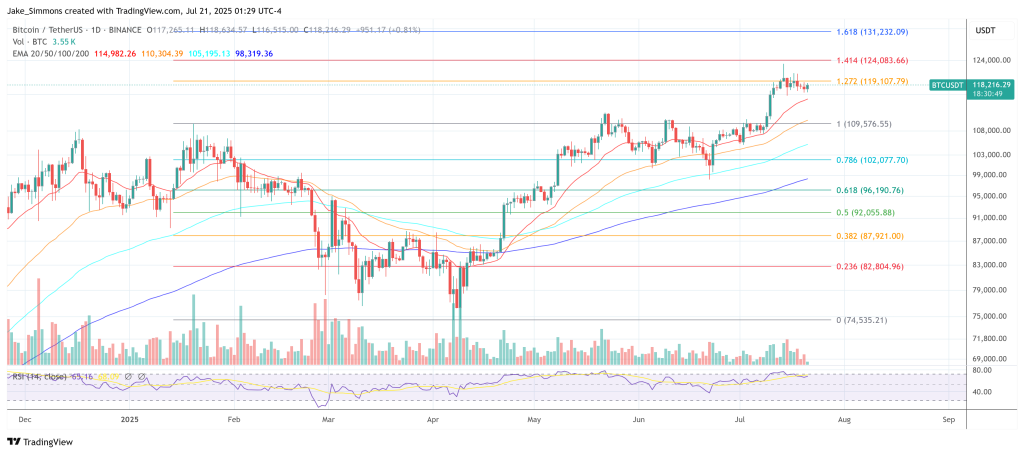
Bitcoin price
BTC stalls below the 1.272 Fib, 1-day chart | Source: BTCUSDT on TradingView.com
Featured image from YouTube, chart from TradingView.com
Editorial Process for bitcoinist is centered on delivering thoroughly researched, accurate, and unbiased content. We uphold strict sourcing standards, and each page undergoes diligent review by our team of top technology experts and seasoned editors. This process ensures the integrity, relevance, and value of our content for our readers.

Jake Simmons has been a Bitcoin enthusiast since 2016. Ever since he heard about Bitcoin, he has been studying the topic every day and trying to share his knowledge with others. His goal is to contribute to Bitcoin's financial revolution, which will replace the fiat money system. Besides BTC and crypto, Jake studied Business Informatics at a university. After graduation in 2017, he has been working in the blockchain and crypto sector. You can follow Jake on Twitter at @realJakeSimmons.

Nội dung Liên quan

Tại sao 14,336 giao dịch ETH của hacker UXLINK đặt ra câu hỏi mới cho DeFi

Hoạt động gần đây trên blockchain cho thấy kẻ khai thác lỗ hổng UXLINK đang tích cực rửa số tiền đánh cắp để gây khó khăn cho việc truy vết. Vụ việc xảy ra vào tháng 9/2025, khi hacker lợi dụng lỗ hổng 'delegateCall' để chiếm quyền ví đa chữ ký của dự án, tạo ra hàng tỷ token UXLINK bất hợp pháp và rút khoảng 4,5 triệu USD tài sản tiền mã hóa. Sau đó, kẻ tấn công đã chuyển đổi phần lớn số tiền sang DAI và ETH. Đáng chú ý, trong hai tuần qua, họ đã gửi tổng cộng 14.336,6 ETH vào Tornado Cash – một dịch vụ trộn tiền – để che giấu nguồn gốc, với lần gửi gần đây nhất trị giá hơn 8,1 triệu USD. Song song đó, một ví liên quan đến Mining Express – một dự án được cho là mô hình Ponzi đã sụp đổ – cũng bắt đầu tái phân bổ tài sản bằng cách chuyển đổi 5.004 ETH lấy 8,8 triệu DAI và sau đó chuyển một phần vào Tornado Cash. Các sự việc này làm nổi bật một khoảng trống lớn trong hệ sinh thái DeFi: mặc dù cho phép chuyển tài sản không cần cấp phép một cách trơn tru, nhưng vẫn thiếu các cơ chế hiệu quả để ngăn chặn hoặc xử lý các dòng tiền bất hợp pháp một khi chúng đã được đưa vào hệ thống. Điều này đặt ra yêu cầu cấp thiết về việc tăng cường phối hợp liên mạng và triển khai các hệ thống phát hiện đe dọa thời gian thực để bảo vệ tính phi tập trung và quyền riêng tư của người dùng.

ambcrypto4 giờ trước

Tại sao 14,336 giao dịch ETH của hacker UXLINK đặt ra câu hỏi mới cho DeFi

ambcrypto4 giờ trước

Bài viết mới nhất của Lý Phi Phi: Khi video tạo sinh, robot và NVIDIA đều tự xưng là mô hình thế giới, chúng ta cần một phân loại học

Trong bài viết mới nhất của mình, giáo sư Lý Phi Phi đã phân loại và làm rõ khái niệm "mô hình thế giới" đang bị sử dụng một cách lộn xộn trong lĩnh vực AI hiện nay. Bà đề xuất một cách phân loại chức năng dựa trên vòng lặp POMDP cổ điển (tác nhân → hành động → trạng thái → quan sát → tác nhân), chia các hệ thống được gọi là "mô hình thế giới" thành ba loại chính: 1. **Bộ kết xuất (Renderer):** Đầu ra là các quan sát (pixel). Mục tiêu là độ trung thực về mặt thị giác. Ví dụ: các mô hình tạo video từ văn bản như Sora, hay hệ thống tương tác như Genie. Chúng tạo ra hình ảnh đẹp nhưng không nhất thiết tuân thủ vật lý chính xác. 2. **Bộ mô phỏng (Simulator):** Đầu ra là trạng thái thế giới. Mục tiêu là độ chính xác về cấu trúc hình học, vật lý và động lực học. Chúng phục vụ cả con người (kiến trúc sư, nhà thiết kế) và các chương trình máy tính (robot, xe tự hành) để tính toán và đào tạo. Đây được coi là trung tâm then chốt bị đánh giá thấp. 3. **Bộ lập kế hoạch (Planner):** Đầu ra là các hành động. Cho một quan sát và mục tiêu, nó quyết định tác nhân nên làm gì tiếp theo. Ví dụ: các mô hình VLA (Vision-Language-Action). Đây là lĩnh vực thú vị nhất nhưng cũng non trẻ nhất, với khoảng cách lớn giữa demo trong phòng thí nghiệm và ứng dụng thực tế. Bài viết nhấn mạnh ba loại này không tách biệt mà chia sẻ hiểu biết cơ bản chung về thế giới. Xu hướng quan trọng hiện nay là sự hợp nhất giữa chúng, hướng tới một **mô hình thế giới thống nhất** có thể chuyển đổi linh hoạt giữa kết xuất, mô phỏng và lập kế hoạch tùy theo nhu cầu. Sản phẩm Marble của World Labs là một bước đi theo hướng này, cùng lúc tạo ra cả dữ liệu hình ảnh (Gaussian splatting) và dữ liệu vật lý (collision mesh) từ một mô hình duy nhất. Tóm lại, trong khi mô hình ngôn ngữ cho phép máy móc "nói" về thế giới, thì mô hình thế giới chính là con đường để chúng thực sự hiểu, tưởng tượng, suy luận và tương tác với thế giới vật lý.

marsbit5 giờ trước

Bài viết mới nhất của Lý Phi Phi: Khi video tạo sinh, robot và NVIDIA đều tự xưng là mô hình thế giới, chúng ta cần một phân loại học

marsbit5 giờ trước

Giao dịch

Giao ngay
活动图片