Coinbase Rebrands Wallet Experience Under Base App: Adding Social And App Features

bitcoinistXuất bản vào 2025-07-18Cập nhật gần nhất vào 2025-07-18

Tóm tắt

Base, the Ethereum layer-2 network built by Coinbase, has officially unveiled a major evolution in its product strategy with the...

Trusted Editorial content, reviewed by leading industry experts and seasoned editors. Ad Disclosure

Base, the Ethereum layer-2 network built by Coinbase, has officially unveiled a major evolution in its product strategy with the launch of the Base App—a reimagined version of the Coinbase Wallet. This move marks the beginning of a new chapter, positioning Base as a frontrunner in the race to build the first true “everything app” for Web3.

More than just a rebrand, the Base App represents a fundamental shift in vision. Inspired by platforms like WeChat, the app bundles trading, payments, messaging, social features, and dApp discovery into a single user interface. The goal? To onboard the next wave of users beyond the crypto-native community and push blockchain-powered experiences into the mainstream.

The Layer-2 chain is aiming to offer a seamless, blockchain-native environment where users can chat, transact, invest, and interact without needing multiple apps or complex wallets. The timing aligns with growing calls for better user experience in Web3, and the company is betting that vertical integration through the chain can deliver it.

Base Unveils Web3 “Everything App” At Los Angeles Conference

The launch of the new Base App was officially announced during a conference in Los Angeles, where the company laid out its vision for a blockchain-native future. In a promotional video shared during the event, the company declared: “Coinbase Wallet is now much more than a wallet. Your new home to create, earn, trade, discover apps, and chat with friends all in one place.”

The message was clear: The app isn’t just an upgrade—it’s a full transformation into a multi-functional Web3 platform designed to rival the utility of mainstream tech super apps. The video continued, “Move money. Bring your identity wherever you go. Own your social graph. Use markets 24/7. Chat with your friends.”

This sweeping vision includes tight integration with decentralized exchanges like Aerodrome Finance and Uniswap, enabling seamless token trading within the app. Users can access markets, execute trades, and interact with DeFi protocols without leaving the platform.

Coinbase CEO and co-founder Brian Armstrong echoed this strategic shift on X, writing: “Coinbase Wallet has evolved. The Base app is your new onchain home to post, earn, trade, chat, and connect.”

By combining DeFi, social media, identity, and communication, Base is positioning itself as a serious contender to build Web3’s first mass-market application. Whether this new direction succeeds will depend on adoption beyond the crypto-native crowd, but the foundation is being laid.

Coinbase (COIN) Nears Major Resistance

Coinbase Global Inc. (NASDAQ: COIN) is approaching a critical resistance level, with its stock trading at $398.20 after gaining +2.88% this week. The weekly chart shows a strong bullish trend, fueled by momentum that began in mid-May. After clearing prior resistance around $320, COIN is now testing the psychologically important $400 level—a zone that previously marked a major rejection point in early 2022.
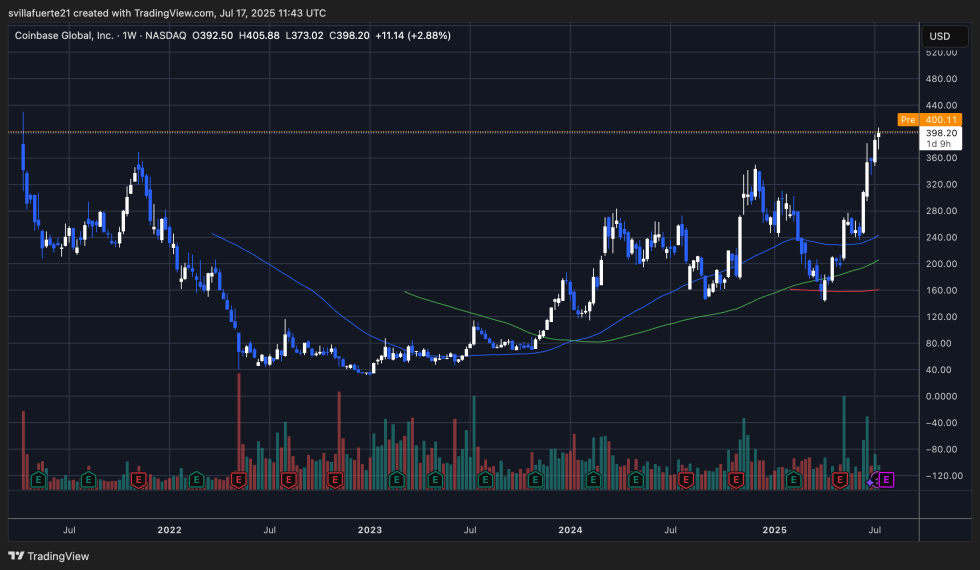
COIN testing critical resistance | Source: COIN chart on TradingView

Volume has picked up significantly during this recent rally, signaling strong institutional and retail participation. Technically, the 50-week moving average has crossed above the 100-week, confirming medium-term bullish momentum. Additionally, the 200-week moving average is flattening, which suggests the long-term downtrend may be ending.

A decisive breakout and close above $400 would open the door for a move toward the $450–$475 range, with the $500 mark acting as a potential magnet if bullish momentum continues. However, if the $400 barrier holds, a pullback to the $340–$360 area is likely, especially if broader market conditions weaken.

Featured image from Dall-E, chart from TradingView

Editorial Process for bitcoinist is centered on delivering thoroughly researched, accurate, and unbiased content. We uphold strict sourcing standards, and each page undergoes diligent review by our team of top technology experts and seasoned editors. This process ensures the integrity, relevance, and value of our content for our readers.

Sebastian's journey into the world of crypto began four years ago, driven by a fascination with the potential of blockchain technology to revolutionize financial systems. His initial exploration focused on understanding the intricacies of various crypto projects, particularly those focused on building innovative financial solutions. Through countless hours of research and learning, Sebastian developed a deep understanding of the underlying technologies, market dynamics, and potential applications of cryptocurrencies. As his knowledge grew, Sebastian felt compelled to share his insights with others. He began actively contributing to online discussions on platforms like X and LinkedIn, focusing on fintech and crypto-related content. His goal was to expose valuable trends and insights to a wider audience, fostering a deeper understanding of the rapidly evolving crypto landscape. Sebastian's contributions quickly gained recognition, and he became a trusted voice in the online crypto community. To further enhance his expertise, Sebastian pursued a UC Berkeley Fintech: Frameworks, Applications, and Strategies certification. This rigorous program equipped him with valuable skills and knowledge regarding Financial Technology, bridging the gap between traditional finance (TradFi) and decentralized finance (DeFi). The certification deepened his understanding of the broader financial landscape and its intersection with blockchain technology. Sebastian's passion for finance and writing is evident in his work. He enjoys delving into financial research, analyzing market trends, and exploring the latest developments in the crypto space. In his spare time, Sebastian can often be found immersed in charts, studying 10-K forms, or engaging in thought-provoking discussions about the future of finance. Sebastian's journey as a crypto analyst and investor has been marked by a relentless pursuit of knowledge and a dedication to sharing his insights. His ability to navigate the complex world of crypto, combined with his passion for financial research and communication, makes him a valuable asset to the industry. As the crypto landscape continues to evolve, Sebastian remains at the forefront, providing valuable insights and contributing to the growth of this revolutionary technology.

Nội dung Liên quan

Tại sao 14,336 giao dịch ETH của hacker UXLINK đặt ra câu hỏi mới cho DeFi

Hoạt động gần đây trên blockchain cho thấy kẻ khai thác lỗ hổng UXLINK đang tích cực rửa số tiền đánh cắp để gây khó khăn cho việc truy vết. Vụ việc xảy ra vào tháng 9/2025, khi hacker lợi dụng lỗ hổng 'delegateCall' để chiếm quyền ví đa chữ ký của dự án, tạo ra hàng tỷ token UXLINK bất hợp pháp và rút khoảng 4,5 triệu USD tài sản tiền mã hóa. Sau đó, kẻ tấn công đã chuyển đổi phần lớn số tiền sang DAI và ETH. Đáng chú ý, trong hai tuần qua, họ đã gửi tổng cộng 14.336,6 ETH vào Tornado Cash – một dịch vụ trộn tiền – để che giấu nguồn gốc, với lần gửi gần đây nhất trị giá hơn 8,1 triệu USD. Song song đó, một ví liên quan đến Mining Express – một dự án được cho là mô hình Ponzi đã sụp đổ – cũng bắt đầu tái phân bổ tài sản bằng cách chuyển đổi 5.004 ETH lấy 8,8 triệu DAI và sau đó chuyển một phần vào Tornado Cash. Các sự việc này làm nổi bật một khoảng trống lớn trong hệ sinh thái DeFi: mặc dù cho phép chuyển tài sản không cần cấp phép một cách trơn tru, nhưng vẫn thiếu các cơ chế hiệu quả để ngăn chặn hoặc xử lý các dòng tiền bất hợp pháp một khi chúng đã được đưa vào hệ thống. Điều này đặt ra yêu cầu cấp thiết về việc tăng cường phối hợp liên mạng và triển khai các hệ thống phát hiện đe dọa thời gian thực để bảo vệ tính phi tập trung và quyền riêng tư của người dùng.

ambcrypto5 giờ trước

Tại sao 14,336 giao dịch ETH của hacker UXLINK đặt ra câu hỏi mới cho DeFi

ambcrypto5 giờ trước

Bài viết mới nhất của Lý Phi Phi: Khi video tạo sinh, robot và NVIDIA đều tự xưng là mô hình thế giới, chúng ta cần một phân loại học

Trong bài viết mới nhất của mình, giáo sư Lý Phi Phi đã phân loại và làm rõ khái niệm "mô hình thế giới" đang bị sử dụng một cách lộn xộn trong lĩnh vực AI hiện nay. Bà đề xuất một cách phân loại chức năng dựa trên vòng lặp POMDP cổ điển (tác nhân → hành động → trạng thái → quan sát → tác nhân), chia các hệ thống được gọi là "mô hình thế giới" thành ba loại chính: 1. **Bộ kết xuất (Renderer):** Đầu ra là các quan sát (pixel). Mục tiêu là độ trung thực về mặt thị giác. Ví dụ: các mô hình tạo video từ văn bản như Sora, hay hệ thống tương tác như Genie. Chúng tạo ra hình ảnh đẹp nhưng không nhất thiết tuân thủ vật lý chính xác. 2. **Bộ mô phỏng (Simulator):** Đầu ra là trạng thái thế giới. Mục tiêu là độ chính xác về cấu trúc hình học, vật lý và động lực học. Chúng phục vụ cả con người (kiến trúc sư, nhà thiết kế) và các chương trình máy tính (robot, xe tự hành) để tính toán và đào tạo. Đây được coi là trung tâm then chốt bị đánh giá thấp. 3. **Bộ lập kế hoạch (Planner):** Đầu ra là các hành động. Cho một quan sát và mục tiêu, nó quyết định tác nhân nên làm gì tiếp theo. Ví dụ: các mô hình VLA (Vision-Language-Action). Đây là lĩnh vực thú vị nhất nhưng cũng non trẻ nhất, với khoảng cách lớn giữa demo trong phòng thí nghiệm và ứng dụng thực tế. Bài viết nhấn mạnh ba loại này không tách biệt mà chia sẻ hiểu biết cơ bản chung về thế giới. Xu hướng quan trọng hiện nay là sự hợp nhất giữa chúng, hướng tới một **mô hình thế giới thống nhất** có thể chuyển đổi linh hoạt giữa kết xuất, mô phỏng và lập kế hoạch tùy theo nhu cầu. Sản phẩm Marble của World Labs là một bước đi theo hướng này, cùng lúc tạo ra cả dữ liệu hình ảnh (Gaussian splatting) và dữ liệu vật lý (collision mesh) từ một mô hình duy nhất. Tóm lại, trong khi mô hình ngôn ngữ cho phép máy móc "nói" về thế giới, thì mô hình thế giới chính là con đường để chúng thực sự hiểu, tưởng tượng, suy luận và tương tác với thế giới vật lý.

marsbit6 giờ trước

Bài viết mới nhất của Lý Phi Phi: Khi video tạo sinh, robot và NVIDIA đều tự xưng là mô hình thế giới, chúng ta cần một phân loại học

marsbit6 giờ trước

Giao dịch

Giao ngay
活动图片