Solana Spot ETFs Achieve Major Benchmark Following Months Of Their Debut

bitcoinistPublished on 2026-03-11Last updated on 2026-03-11

Abstract

Despite a bearish crypto market, Solana Spot ETFs have achieved a major milestone, amassing nearly $1 billion in inflows since their October 2025 debut. This represents 2% of SOL's market cap in just 18 weeks—a rate significantly faster than Bitcoin ETFs. The growth highlights strong institutional demand and Solana's increasing integration into traditional finance. Additionally, Solana has become a hub for on-chain activity, processing a record $650 billion in stablecoin volume in February 2026, underscoring its role as a leading network for digital asset liquidity and capital movement.

Despite the ongoing bearish condition of the broader cryptocurrency market, Solana is demonstrating underlying strength, but not in price action. A few months after their historic debut, the Solana Spot Exchange-Traded Funds (ETFs) have reached a notable milestone, reflecting robust institutional and retail demand for the products.

Months After Launch, Solana Spot ETFs See Major Growth

Solana has found its way to the cryptocurrency spotlight once again with the notable growth of its Spot ETFs. A fresh report shows that the Spot SOL ETFs have now hit a crucial milestone just a few months after the products were launched, marking a significant step in the altcoin’s growing integration into traditional financial markets.

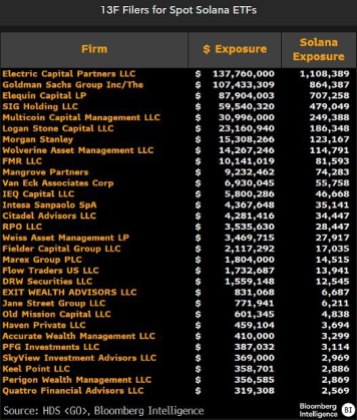
These investment vehicles are starting to show significant traction in terms of inflows, trading activity, and overall market presence amid intense demand from both institutional participants and crypto-native investors. Kyle Doops, a market expert and host of the Crypto Banter show, reported that the products have amassed nearly $1 billion in inflows since launching in late October 2025.

Such massive inflows underscore how demand for regulated exposure to SOL has picked up pace as investors search for new ways to access the evolving blockchain ecosystem. Furthermore, the milestone indicates growing institutional confidence in the network’s long-term potential.
Source: Chart from Kyle Doops on X

When compared to SOL’s market cap, this ETF’s net inflows represents a 2% of that value, achieved in roughly 18 weeks. For the Bitcoin Spot ETFs, it took the products about 55 weeks to reach a similar share, indicating the massive interest in the SOL ETFs and underscoring the increasing role of alternative crypto assets within the broader ETF landscape.

It is worth noting that the majority of investors in the ETFs over time appear to be market makers and crypto investment firms, and not retail players. With this wave of institutional investors, SOL ETFs continues to maintain its position as one of the fastest-growing funds in history.

SOL, A Hub For On-Chain Capital Movement

In the waning market landscape, Solana continues to stand out as a leader in on-chain finance and capital movements. The founder and Chief Executive Officer (CEO) of Sensei Holdings, Solana Sensei, revealed on X that the network’s stablecoin activity in the past month was massive, signaling a sharp increase in on-chain transactions and liquidity moving across its ecosystem.

According to the expert, around $650 billion in stablecoin volume moved on SOL in February alone, which is more than twice the previous high from late 2025. SOL network’s expanding function as a high-throughput center for digital asset liquidity is shown by this monthly spike. As finance evolves, stablecoins are emerging as one of the main pillars of cryptocurrency adoption, and the SOL network is where the majority of the traffic is occurring.

SOL trading at $85 on the 1D chart | Source: SOLUSDT on Tradingview.com

Related Questions

QWhat major milestone have Solana Spot ETFs achieved a few months after their debut?

ASolana Spot ETFs have amassed nearly $1 billion in inflows since their launch in late October 2025.

QHow does the inflow growth of Solana Spot ETFs compare to that of Bitcoin Spot ETFs in terms of time to reach 2% of the asset's market cap?

AIt took Solana Spot ETFs roughly 18 weeks to reach inflows representing 2% of SOL's market cap, while Bitcoin Spot ETFs took about 55 weeks to achieve a similar share.

QAccording to the article, who are the majority of investors in the Solana Spot ETFs?

AThe majority of investors in the Solana Spot ETFs appear to be market makers and crypto investment firms, rather than retail players.

QWhat significant on-chain activity was reported for the Solana network in February, as mentioned in the article?

AAround $650 billion in stablecoin volume moved on the Solana network in February alone, which was more than twice the previous high from late 2025.

QWhat does the massive inflow into Solana Spot ETFs indicate about institutional sentiment towards the network?

AThe massive inflows underscore growing institutional confidence in the Solana network's long-term potential and the increasing role of alternative crypto assets within the broader ETF landscape.

Related Reads

a16z: AI's 'Amnesia', Can Continuous Learning Cure It?

The article "a16z: AI's 'Amnesia' – Can Continual Learning Cure It?" explores the limitations of current large language models (LLMs), which, like the protagonist in the film *Memento*, are trapped in a perpetual present—unable to form new memories after training. While methods like in-context learning (ICL), retrieval-augmented generation (RAG), and external scaffolding (e.g., chat history, prompts) provide temporary solutions, they fail to enable true internalization of new knowledge. The authors argue that compression—the core of learning during training—is halted at deployment, preventing models from generalizing, discovering novel solutions (e.g., mathematical proofs), or handling adversarial scenarios. The piece introduces *continual learning* as a critical research direction to address this, categorizing approaches into three paths: 1. **Context**: Scaling external memory via longer context windows, multi-agent systems, and smarter retrieval. 2. **Modules**: Using pluggable adapters or external memory layers for specialization without full retraining. 3. **Weights**: Enabling parameter updates through sparse training, test-time training, meta-learning, distillation, and reinforcement learning from feedback. Challenges include catastrophic forgetting, safety risks, and auditability, but overcoming these could unlock models that learn iteratively from experience. The conclusion emphasizes that while context-based methods are effective, true breakthroughs require models to compress new information into weights post-deployment, moving from mere retrieval to genuine learning.

marsbit2h ago

a16z: AI's 'Amnesia', Can Continuous Learning Cure It?

marsbit2h ago

Can a Hair Dryer Earn $34,000? Deciphering the Reflexivity Paradox in Prediction Markets

An individual manipulated a weather sensor at Paris Charles de Gaulle Airport with a portable heat source, causing a Polymarket weather market to settle at 22°C and earning $34,000. This incident highlights a fundamental issue in prediction markets: when a market aims to reflect reality, it also incentivizes participants to influence that reality. Prediction markets operate on two layers: platform rules (what outcome counts as a win) and data sources (what actually happened). While most focus on rules, the real vulnerability lies in the data source. If reality is recorded through a specific source, influencing that source directly affects market settlement. The article categorizes markets by their vulnerability: 1. **Single-point physical data sources** (e.g., weather stations): Easily manipulated through physical interference. 2. **Insider information markets** (e.g., MrBeast video details): Insiders like team members use non-public information to trade. Kalshi fined a剪辑师 $20,000 for insider trading. 3. **Actor-manipulated markets** (e.g., Andrew Tate’s tweet counts): The subject of the market can control the outcome. Evidence suggests Tate’sociated accounts coordinated to profit. 4. **Individual-action markets** (e.g., WNBA disruptions): A single person can execute an event to profit from their pre-placed bets. Kalshi and Polymarket handle these issues differently. Kalshi enforces strict KYC, publicly penalizes insider trading, and reports to regulators. Polymarket, with its anonymous wallet-based system, has historically been more permissive, arguing that insider information improves market accuracy. However, it cooperated with authorities in the "Van Dyke case," where a user traded on classified government information. The core paradox is reflexivity: prediction markets are designed to discover truth, but their financial incentives can distort reality. The more valuable a prediction becomes, the more likely participants are to influence the event itself. The market ceases to be a mirror of reality and instead shapes it.

marsbit3h ago

Can a Hair Dryer Earn $34,000? Deciphering the Reflexivity Paradox in Prediction Markets

marsbit3h ago

Trading

Spot
Futures

Hot Articles

Discussions

Welcome to the HTX Community. Here, you can stay informed about the latest platform developments and gain access to professional market insights. Users' opinions on the price of SOL (SOL) are presented below.

活动图片