Zhipu, Afraid of Becoming the Next MiniMax

marsbitОпубликовано 2026-07-12Обновлено 2026-07-12

Введение

Title: Zhipu, Fearing to Become the Next MiniMax In July 2026, amid the success of its coding-focused AI, Zhipu's founder, Tang Jie, issued an internal letter titled "The Giant Wave Has Come." It notably avoided celebrating recent triumphs, such as Zhipu's trillion-HKD market cap and booming MaaS revenue driven by its GLM-5.2 model in coding applications. Instead, the letter pivoted the narrative to future-oriented concepts like Long Horizon Task, Autonomous Agents, Self-Evolving systems, and AGI. This strategic shift in messaging followed the sharp devaluation of its competitor, MiniMax. After its lock-up period expired, MiniMax's stock plummeted as the market began evaluating it with traditional SaaS metrics like ARR and user growth, rather than as a frontier AI pioneer. Seeing this, Tang Jie aimed to preempt a similar revaluation of Zhipu. He fears that if the market starts viewing Zhipu primarily as a profitable "AI coding company," its valuation would become anchored to conventional financial metrics, losing the premium associated with AGI potential. Therefore, the letter reframed Zhipu's mission. While acknowledging that coding was the current commercial driver, Tang positioned Zhipu on the "infrastructure path," akin to OpenAI and Anthropic. The new focus is on developing agents capable of complex, long-term planning and autonomous operation—moving from assisting individuals (OPC: One Person Company) to automating entire organizations (NPC: No People Company). This ...

Author | Hua Hua

Over the past six months, Zhipu has been the most glamorous company in China's AI industry.

Its market capitalization once exceeded one trillion Hong Kong dollars, its MaaS platform ARR reached 1.7 billion yuan, increasing 60-fold over the past year. The open-source GLM-5.2 closely tracks core metrics of Claude Opus 4.8 and GPT-5.5. On July 8th, the first batch of stocks were released from lock-up, and the stock price withstood the test without a collapse-like correction.

In such a situation, what would a company typically do?

Celebrate, thank the team, and continue sprinting for the second half of the year.

But Zhipu's founder, Tang Jie, did not.

On July 11th, he sent an internal letter of nearly 4,000 words titled "The Giant Wave Has Arrived."

There was hardly any celebration in it. Not a single number discussed revenue. Not a single paragraph reviewed the achievements of the past six months.

The keywords repeated throughout the letter were: Long Horizon Task. Autonomous Agent. Self-Evolving. AGI (Artificial General Intelligence). Safety and Governance.

A more unusual detail is that he hardly mentioned Coding.

Coding, the very thing that directly propelled Zhipu's market cap from hundreds of billions to trillions, seemed deliberately avoided in this letter.

Why?

What Tang Jie worries about most is no longer whether Zhipu can continue to rise.

It's whether the capital market will start using traditional internet SaaS (Software as a Service) models or financial metrics for generalized internet platform companies to price Zhipu's assets.

This is the real reason he wrote this letter.

I. MiniMax Has Already Stepped on the Mine for Zhipu

Just a few days before Tang Jie sent his letter, MiniMax taught the entire industry a lesson on valuation reconstruction.

In early July, after the lock-up expiration, MiniMax's stock price plummeted continuously, and its market cap fell below one trillion Hong Kong dollars.

The reasons for the plunge are complex: model iteration falling short of expectations, a decline in overall market risk appetite, and the broader background of global AI concept stocks collectively facing pressure in Q2 2026. Expectations of Fed rate hikes rising and widespread contraction in corporate IT budgets made capital increasingly cautious towards high-valuation, low-profit AI companies.

But the most fundamental reason is that the capital market switched its scoring criteria.

Lock-up expiration meant early investors had their first opportunity for a large-scale exit. The secondary market and institutional LPs (Limited Partners) also began asking a new question: How much is this company really worth? The underlying logic of the valuation model changed completely. The measurement shifted to ARR, growth rate, user retention, and the payback period for customer acquisition costs.

This system is entirely the valuation logic of internet and traditional SaaS companies.

Once entering this system, MiniMax's valuation anchor dropped from being a top-tier Chinese large model company with infinite imagination to being a C-end AI application tool company with annual revenue of several billion yuan.

A trillion? Too expensive.

Zhipu certainly saw this. The timeline is too obvious: MiniMax crashed just days before; Tang Jie sent his letter on July 11th. Zhipu's own stock price also dropped from a trillion to 730 billion Hong Kong dollars after the lock-up expiration.

The same script could replay at any moment. The only difference is: Tang Jie decided to preempt it.

II. Trillion Market Cap Relies on Coding, Yet Tang Jie Shelved It

Let's go back a year.

At the beginning of 2025, the entire industry was still immersed in the reasoning (Reasoning) revolution brought by DeepSeek. Whether it was reinforcement learning's Chain-of-Thought (CoT) or the shift of computational resources towards reasoning, everyone was talking about Reasoning. Zhipu made a decision that seemed inconspicuous at the time: reallocate resources and shift the R&D focus from general chat capabilities entirely to Coding.

Many didn't understand.

Later, Tang Jie gave his explanation: After the emergence of DeepSeek R1, the Chat paradigm was essentially over. What truly determines the competitiveness of the next generation of models is no longer who chats more like a human, but who can actually get work done.

Coding is the most efficient validation scenario.

History proved he bet correctly. Over the past year, the fastest-growing track for AI commercialization was not chat and search, nor video generation, but AI-assisted software development.

The reason is straightforward. A programmer works 8 hours a day; AI saves them 2 hours. This ROI (Return on Investment) is clearly calculable. Large language models found their first user group truly willing to pay continuously.

Globally, Anthropic is the most extreme case. In early 2024, its ARR was less than $100 million. With Claude's breakthrough in code generation and engineering capabilities, its commercial revenue exploded, surpassing $47 billion in June 2026. GitHub Copilot became one of Microsoft's fastest-growing commercial products over the past year, with enterprise customer numbers increasing significantly year-over-year.

Zhipu rode the same wave of红利.

If the story stopped here, Zhipu should keep talking about Coding, keep talking about revenue. That's also what capital wants to hear the most.

But Tang Jie hardly mentioned it.

Why?

There is a default iron law in the capital market: A story, once it starts being realized, is no longer the future.

When Apple first launched the iPhone, the market traded on smartphones. After smartphones became widespread, the market began trading on service revenue. After service revenue was realized, Apple started trading on AI again. The same with Microsoft: Office when it was about Office, Azure when it was about cloud, Copilot when it came out, then AI.

Capital never pays the highest premium for a realized story over the long term; it is always looking for the next target.

The more successful Coding is today, the closer Zhipu gets to being positioned as traditional IT infrastructure and mature software services.

Once the market starts defaulting to AI Coding as a stable, standardized software service, capital will ask: After Coding, what's next? MiniMax had no answer, so it was repriced.

Tang Jie needs an answer. And he must say it himself before the market asks.

Hence, in the entire letter, Coding is invisible. The real protagonists become Long Horizon Task, Autonomous Agent, Self-Evolving.

This is not a technical route change; it is a narrative switch regarding Zhipu's company valuation model.

The purpose is only one: before capital has a chance to label Zhipu a "Coding company," secure the label of "AGI company."

The valuation logic for an AGI company is completely different. In the short term, the capital market can ignore revenue, retention, and unit economics. It looks at: How far are you from AGI? Where do you rank on this path?

Under this logic, Zhipu's comparable companies are OpenAI, Anthropic, Google DeepMind. OpenAI and Anthropic valuations are on the trillion-dollar level.

III. Agent is Technology, and Also the Next Round's Valuation Chip

Zhipu is not the only company talking about Agents at this moment.

Looking back at the actions of global top players over the past year.

Starting with GPT-5, OpenAI's product focus shifted entirely to Operator, Deep Research, Computer Use—no longer answering questions but completing tasks. All of Anthropic's updates this year revolve around Computer Use and Agent loops. What Google promotes most is no longer chat, but the Agent ecosystem.

The global leaders turned almost simultaneously, not only because of technological maturity but also for a more practical reason: Coding has become the present; Agent needs to be the future.

Tang Jie's letter actually makes this logic very clear. He proposed a conceptual evolution: from OPC (One Person Company) to NPC (No People Company).

Coding solves AI writing code for programmers. Agents solve AI doing work for entire organizations. From writing code to making products to running businesses.

In the letter, he breaks this path into three mountains: Long Horizon Task, planning and execution spanning weeks or months; Autonomous Agent System, autonomously driven, collaboratively working groups of agents; Self-Evolving, AI training AI, evolutionary speed breaking free from human limitations.

Then he announced the "Touch High Plan," a strategic investment over the next two years, and directly stated: Not pursuing short-term application monetization.

From a technical perspective, this is an R&D direction choice. From a capital perspective, this is a valuation system choice.

These concepts share a common feature: they have not yet been commercialized. Without commercialization, the market cannot price based on revenue. If revenue-based pricing isn't possible, only future potential can be priced.

This is precisely the game rules OpenAI and Anthropic have played most adeptly over the past two years. Every time the market asks about revenue, throw out a new technological milestone; once the milestone is digested, throw out a bigger vision. Always stay half a step ahead of capital, keeping capital in a state of chasing rather than scrutinizing.

Tang Jie is learning this trick.

He even quoted Google DeepMind's "From AGI to ASI" report in his letter, saying that even if the capabilities of a single model plateau at human level, as long as computing power continues to grow, superintelligence might be forcibly squeezed out.

Should investors be excited or terrified hearing this? It depends on what they prefer to hold: an internet company with revenue or an AGI company that might change the world.

IV. Chinese Large Models Heading Towards a Two-Polar Elimination Race

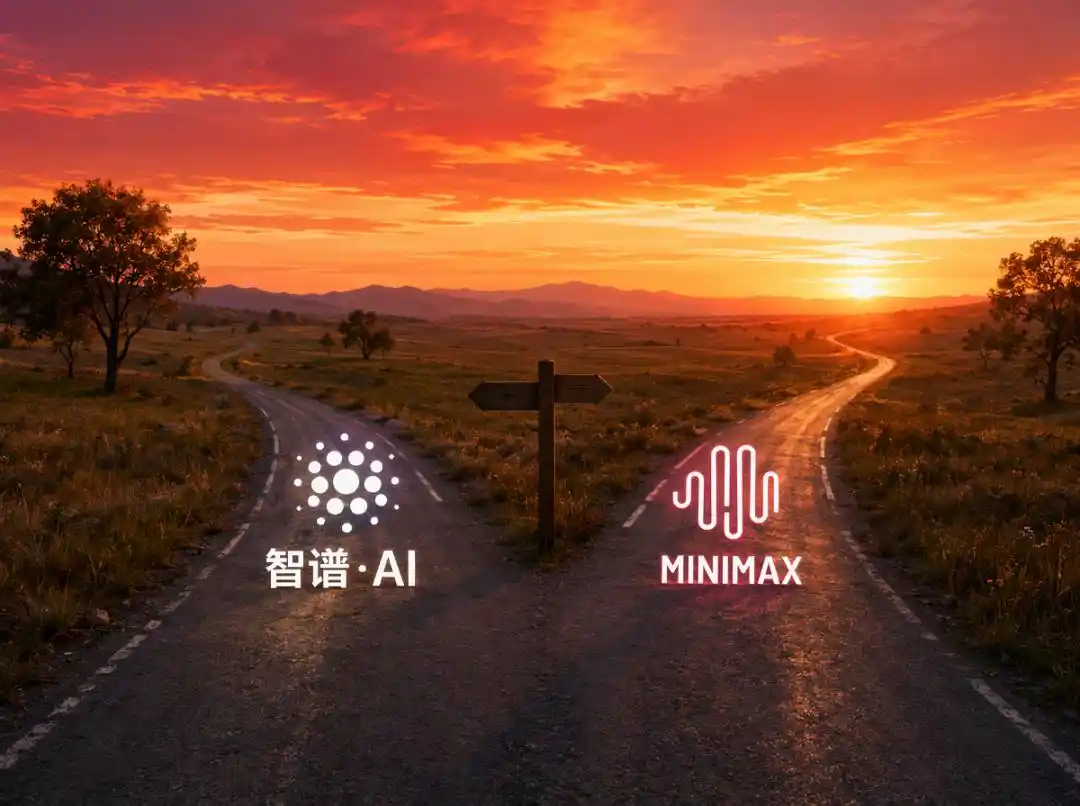
Standing in July 2026, the fork in the road for China's AI industry is clearer than ever.

The first path: The monetization path represented by MiniMax.

Package models into products, target the C-end, focus on subscriptions, prove commercial closure with revenue growth. The market looks at MAU, ARPU, renewal rates, gross margin. MiniMax's plunge proves one thing: when an AI company takes this path, capital will scrutinize it with the harshest mobile internet traffic metrics and financial leverage.

The second path: The infrastructure path represented by Zhipu.

Continue making models, platforms, infrastructure. Maintain valuation with technological breakthroughs rather than revenue growth. The benchmarks are OpenAI, Anthropic.

The two paths correspond to two sets of valuation rules, two types of investor expectations, and, of course, two paths to failure.

Take the first path, fail when user红利 peaks or commercialization growth falls short of expectations.

Take the second path, fail when technology R&D hits a plateau, and breakthroughs are迟迟无法兑现.

Tang Jie chose the second. He used a very heavy phrase in his letter: Failing to reach the summit is failure.

This is a military order he set for himself and also expectation management for investors: Don't measure me by revenue, measure me by AGI.

The most noteworthy aspect of Tang Jie's letter is not what he said, but when he said it.

Choosing to send an AGI faith manifesto in the time window right after lock-up expiration, when the stock price began to soften and MiniMax had just crashed—this timing itself is precise expectation management.

He is seizing the right of definition. Before the capital market has a chance to label Zhipu an AI product company, weld the AGI company label firmly onto itself.

But this letter also reveals a deeper issue: The valuation of AI companies is shifting from technological faith to commercial realization. This shift is irreversible. MiniMax was swept in first; Zhipu will inevitably face the same questioning sooner or later.

What Tang Jie's "touch high" might buy is perhaps only time.

The moment an AI company's revenue begins to be realized—is it the starting point of success or the beginning of another kind of crisis?

MiniMax has been forced to answer this question. Zhipu is trying to bypass it.

As for whether it can be bypassed depends on what "touch high" ultimately touches: the true technological ceiling or the ceiling of capital's patience.

This article is from the WeChat public account "Beyond the Layout," author: Hua Hua

Связанные с этим вопросы

QAccording to the article, what was the most unusual detail about Tang Jie's internal letter titled '巨浪已来' (The Giant Wave Has Arrived)?

AThe most unusual detail was that the letter almost completely avoided mentioning 'Coding,' which was the very factor that had directly propelled Zhipu's market value from hundreds of billions to a trillion Hong Kong dollars. The entire letter focused on concepts like Long Horizon Task, Autonomous Agent, Self-Evolving, and AGI.

QWhat fundamental shift in the capital market's valuation logic is Zhipu's founder, Tang Jie, most worried about, according to the analysis?

ATang Jie is most worried that the capital market will start valuing Zhipu using traditional internet SaaS or platform company financial metrics—focusing on metrics like ARR, growth rate, user retention, and customer acquisition cost payback periods—instead of the futuristic, potential-based valuation logic applied to AGI companies.

QWhy does the article argue that Zhipu is attempting a 'narrative switch' by emphasizing Agent and AGI concepts over Coding in its communication?

AThe article argues it is a 'narrative switch' for Zhipu's valuation model. As Coding becomes a successful, commercialized reality, the capital market may start viewing Zhipu as a stable software service company, which commands lower valuations. By emphasizing uncommercialized future concepts like Agent and AGI, Zhipu aims to maintain its valuation by aligning itself with companies like OpenAI and Anthropic, which are valued based on their potential to achieve AGI, not current revenue.

QWhat two divergent paths for Chinese large model companies does the article outline after the case of MiniMax?

AThe article outlines two divergent paths: 1) The monetization path, exemplified by MiniMax, where companies package models into products, target consumers, and are judged by internet-era metrics like MAU, ARPU, and growth rate. 2) The infrastructure path, exemplified by Zhipu, where companies focus on models, platforms, and fundamental research, maintaining valuation through technological breakthroughs and being benchmarked against AGI leaders like OpenAI.

QWhat is the core dilemma or 'deeper problem' that Tang Jie's letter reveals about AI company valuations, according to the article's conclusion?

AThe deeper problem revealed is that AI company valuations are irreversibly shifting from being based on 'technological faith' towards being based on 'commercial realization.' The moment an AI company's revenue begins to materialize, it risks being re-valued by the market using stricter, traditional financial metrics. Zhipu's 'Touch High' plan is an attempt to delay this reckoning by keeping the focus on future AGI potential, but the fundamental migration in valuation logic is inevitable.

Похожее

Почти сто игроков ворвались в индустрию данных для воплощенного интеллекта: Кто на самом деле может заработать на «продаже данных», если за год привлекли 4,47 млрд?

Более 90 игроков выходят на рынок данных для воплощенного интеллекта: за год привлечено 44,7 млрд юаней инвестиций, но кто действительно может заработать на «продаже данных»? Индустрия данных для воплощенного интеллекта (Embodied AI) формируется как самостоятельный сегмент, привлекая разнообразных участников: независимых поставщиков данных, государственные платформы, робототехнические компании и игроков из смежных отраслей. За последний год 15 независимых поставщиков услуг по обработке данных привлекли около 44,7 млрд юаней. Однако, по сравнению с общим объемом финансирования в области воплощенного интеллекта (438 млрд юаней за первое полугодие 2026 года), эта сумма невелика, что указывает на сохраняющуюся осторожность инвесторов. Основные методы сбора данных включают телеуправление реальными роботами, сбор данных без робота (с использованием захвата движений, перспективы от первого лица и т.д.), синтез в симуляциях и дистилляцию из интернет-видео. Наиболее распространены гибридные подходы. Текущая годовая производственная мощность отрасли оценивается в 1,6-1,8 млн часов данных + 70-80 млн отдельных единиц данных, но краткосрочная цель — увеличить это в 15-20 раз. Сбор данных ведется более чем в 20 провинциях Китая, при этом наибольшая концентрация — в регионе дельты Янцзы. Несмотря на бурный рост, отрасль остается на ранней стадии: более половины ключевых независимых компаний младше года, большинство находятся на ранних стадиях финансирования (A-раунд и ранее), и лишь одна компания заявляет о прибыльности. Капитал распределен широко, но ни один институциональный инвестор не сделал крупной ставки. Ключевой вопрос, который предстоит решить в ближайшие год-два, — сможет ли «чистая» продажа данных стать устойчивой и прибыльной бизнес-моделью в этой сфере.

marsbit16 мин. назад

Почти сто игроков ворвались в индустрию данных для воплощенного интеллекта: Кто на самом деле может заработать на «продаже данных», если за год привлекли 4,47 млрд?

marsbit16 мин. назад

Диалог с партнером Multicoin: Крипторынок достиг дна, в этом цикле ожидается рост трех криптовалют

Источник: интервью Tushar Jain, управляющего партнера Multicoin Capital, в подкасте «When Shift Happens». Ключевые тезисы: * **Рынок достиг дна:** По мнению Джейна, крипторынок пережил минимум. Сигналы: негативные новости больше не вызывают падений, а внедрение приложений растёт при отставании цены. * **Видение на текущий цикл:** Jain выделяет три основных актива: 1. **Solana (SOL):** Сохраняет уверенность как архитектура для интернет-рынков капитала, лидер в спотовой торговле и размещении токенизированных активов (RWA). Ценится за «доверенную нейтральность». 2. **Hyperliquid (HYPE):** Рассматривается как лидер в децентрализованных деривативах, предлагающий высокую производительность. Multicoin видит значительный потенциал роста. 3. **Zcash (ZEC):** Символизирует возврат к ценностям «киберпанка» и приватности. Рассматривается как актив для хранения стоимости с потенциалом войти в топ-5 по капитализации. Недавний инцидент с уязвимостью был расценён как нерациональная паника и возможность для увеличения позиции. * **Подход к инвестициям:** Multicoin избегает активной торговли и технического анализа. Стратегия включает концентрацию на наиболее убедительных идеях, метод «третей» для входа в позицию (немедленная покупка, усреднение и докупка на просадках) и продажу только при изменении тезиса, нахождении лучшей возможности или экстремальном завышении оценки. Биткоин используется в портфеле как инструмент хеджирования и «кэш». * **Об Ethereum:** Отмечается его ценовая устойчивость, несмотря на потерю доли рынка в спотовой торговле (Solana) и деривативах (Hyperliquid). Позиция Ethereum Foundation считается нечёткой.

marsbit41 мин. назад

Диалог с партнером Multicoin: Крипторынок достиг дна, в этом цикле ожидается рост трех криптовалют

marsbit41 мин. назад

Bitcoin приближается к минимуму цикла, несмотря на рекордные оттоки $8 млрд из спотовых ETF – Почему?

На момент публикации Bitcoin торговался на уровне $64 099,20, восстановившись после падения ниже $60 000, однако опасения сохраняются. По словам Джеймса Баттерфилла из CoinShares, на BTC оказывают давление три фактора: напряженность на Ближнем Востоке, опасения ФРС по поводу инфляции и сохраняющаяся высокая процентная ставка в США (3,50%-3,75%). Несмотря на рекордный отток средств из спотовых Bitcoin-ETF на $8 млрд за последние восемь недель, появились предварительные признаки возможного дна. Вливания за последние три торговые сессии указывают на снижение институционального давления продаж. Также крупная продажа 3 588 BTC в начале июля не обрушила рынок. Технический анализ показывает, что зона сопротивления теперь находится у отметки $77 000, а значительное сопротивление — в диапазоне $84 000–$85 000. При этом в диапазоне $60 000–$63 000 формируется новая зона поддержки. Общий вывод: рынок остается под давлением, но не сломлен, и есть признаки того, что цикл снижения может приближаться к завершению.

ambcrypto46 мин. назад

Bitcoin приближается к минимуму цикла, несмотря на рекордные оттоки $8 млрд из спотовых ETF – Почему?

ambcrypto46 мин. назад

Прогноз цены XRP: Стоят ли на паузе трейдеры, отказываясь гнаться за слабыми отскоками?

По данным Santiment, активность в сети XRP Ledger недавно упала до необычно низкого уровня: 9 и 10 июля было зафиксировано всего 25 350 и 24 887 ежедневно активных адресов соответственно. Эти показатели стали вторыми самыми низкими в 2026 году. Ежедневный рост сети также замедлился. Трейдеры, по-видимому, воздерживаются от покупок во время незначительных ценовых отскоков, ожидая более устойчивого движения. Тенденции спотового объема подтверждают эту осторожность: индикатор Spot CVD (Cumulative Volume Delta) находится в нейтральной зоне и снижается, указывая на ослабление покупательского давления с марта. Хотя чистый отток XRP с бирж продолжается, он менее интенсивен, чем в 2025 году. Аналитик Darkfost отмечает, что агрегированные funding rates остаются отрицательными на протяжении всего 2026 года, отражая устойчивый медвежий консенсус даже после коррекции более чем на 70% от пика июля 2025 года. Подобная ситуация наблюдалась в апреле 2025 года и предшествовала росту на 126%. Таким образом, текущий сильный пессимизм может служить сигналом к развороту на среднесрочной перспективе, однако для существенного роста необходимы значительные изменения в спотовых объемах. В настоящее время цена XRP движется в боковом диапазоне около уровня поддержки $1,10.

ambcrypto1 ч. назад

Прогноз цены XRP: Стоят ли на паузе трейдеры, отказываясь гнаться за слабыми отскоками?

ambcrypto1 ч. назад

В основе запуска Robinhood: токенизированные акции не дают прав собственности. Как долго продержится эта игра с упаковкой?

Робинхуд запустил собственный Layer 2 блокчейн (Robinhood Chain) и «токенизированные акции» (Stock Tokens). Однако эти токены не предоставляют реальных прав акционера, таких как право голоса. Вместо этого они представляют собой токенизированные долговые ценные бумаги, выпущенные дочерней компанией в Джерси, и обеспечивают лишь экономическое воздействие на базовые активы. Правовая структура сложна и регулируется, включая KYC, санкционные ограничения и зависимость от традиционных финансовых посредников. Стратегия Robinhood заключается в создании «супераппа» для глобальных финансов, объединяющего брокерские услуги, криптовалюты, кошелек и теперь собственный блокчейн. Цель — предложить простой интерфейс для пользователей, скрыв сложную юридическую и техническую инфраструктуру. Успех этой модели зависит от того, смогут ли пользователи и регуляторы принять это расхождение между простым представлением и сложной реальностью продукта. Хотя запуск блокчейна и токенизированных активов является стратегическим расширением, текущая основная выручка Robinhood по-прежнему поступает от традиционных брокерских операций. Новая инициатива — это попытка использовать существующую клиентскую базу и дистрибуцию для выхода на рынок программируемых финансов, не меняя радикально регулируемое ядро бизнеса в США.

marsbit1 ч. назад

В основе запуска Robinhood: токенизированные акции не дают прав собственности. Как долго продержится эта игра с упаковкой?

marsbit1 ч. назад

Торговля

Спот
活动图片