YC Partner Reveals: Building an AI-Native Company from Scratch

marsbitОпубликовано 2026-05-15Обновлено 2026-05-15

Введение

"YC Partner Reveals: Building an AI-Native Company from Scratch" YC partner Diana Hu argues that true AI-native companies operate 1000x faster than incumbents, not by using AI for mere efficiency, but by making it the company's core operating system. This requires a fundamental shift: companies must become "queryable" to AI, with all workflows and communications generating data for AI to learn from, creating a "closed-loop" system for continuous optimization. For example, an AI agent with access to tickets, code, meetings, and customer feedback can analyze past performance and autonomously plan future engineering cycles, dramatically increasing output. In product development, the new paradigm is the "AI software factory": humans write specifications and tests, while AI agents generate the code. This transparent, data-driven model renders traditional middle management obsolete. Future AI-native companies will consist of three roles: Independent Contributors (who build/operate with AI), Directly Responsible Individuals (who own outcomes), and the AI Founder who leads by example. The critical shift is maximizing token usage over headcount. A small, AI-augmented team can outperform large traditional teams. Startups have a key advantage: they can design their entire culture and systems around AI from day one, unburdened by legacy processes. The core takeaway: Founders must personally experience AI's transformative power. The future belongs to those who embed AI into their com...

Source: Y Combinator

In Silicon Valley, Y Combinator (YC) is widely recognized as the "philosopher's stone" for global startups.

As the world's premier startup incubator, since its founding in 2005, YC has incubated over 5,600 companies, giving birth to tech giants such as Airbnb, Stripe, Dropbox, Reddit, and Coinbase. Even OpenAI's CEO Sam Altman once served as YC's President.

It can be said that YC's perspective represents the cutting-edge trends in tech entrepreneurship. Recently, YC partner Diana Hu proposed a striking assertion in the podcast "How To Build A Company With AI From The Ground Up": The operating speed of an AI-native startup could be up to 1000 times faster than existing industry giants.
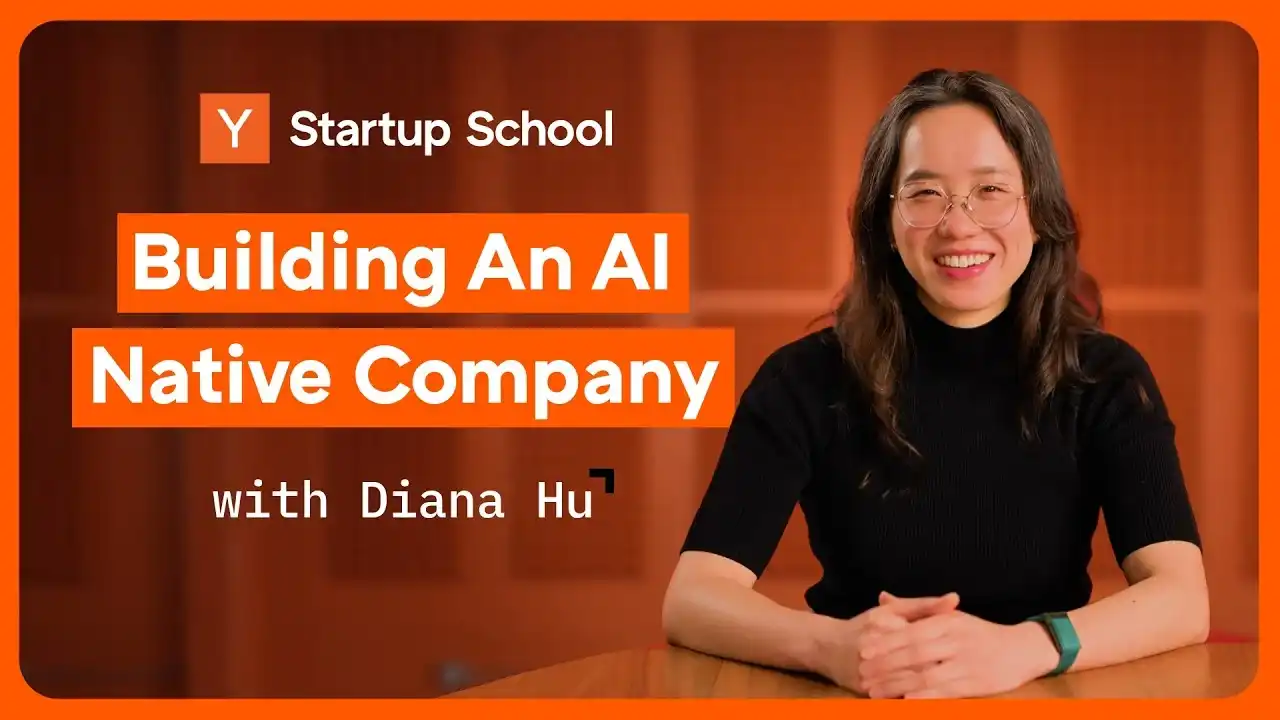
TinTinLand has compiled the key insights from the original video. Let's explore, from YC's perspective, how a truly AI-native company should operate.

Not "Using AI," but "Running on AI"

Currently, most discussions about AI still revolve around "increasing efficiency," such as "AI can make engineers more efficient" or "we need to add a Copilot to our existing workflow." This mindset is fundamentally misguided.

The true transformation is not about productivity gains, but the emergence of entirely new capabilities.

A true AI-native company should not merely treat AI as a tool, but rather see it as the company's operating system (OS). In this model, every workflow, every decision, and every process should be handled through an intelligent layer that continuously learns and improves.

With the support of AI tools, a single capable individual can now build features that previously required an entire team, or even things that were previously impossible.

Making the Entire Company AI-Queryable

Building a Closed-Loop System

Diana introduced the "Closed Loop" concept from control systems to describe the ideal AI company.

  • Open Loop System: This is how traditional companies operate. Management makes decisions, employees execute, but results often cannot be measured and fed back systematically, with significant information loss throughout the process.

  • Closed Loop System: The system continuously monitors outputs, captures information, and feeds it back to the AI, thereby constantly optimizing processes over time.

The Prerequisite for a Closed Loop: Queryability

To achieve such a closed loop, it is necessary to make the company completely transparent and queryable to AI.

This means that all actions within the company must produce "digital artifacts" that AI can learn from:

👉 Use AI assistants to record meetings throughout, reduce the use of private messages and emails, embed AI agents in all communication channels, and build a company-wide real-time dashboard covering revenue, sales, engineering, hiring, and operations.

Specific Case: Revolutionizing Engineering Management

Diana gave a concrete example from engineering management: Suppose you have an AI Agent with access to Linear tickets, Slack channels, GitHub repositories, Notion docs, customer feedback emails, and daily standup meeting recordings.

Then, this Agent can genuinely analyze what was actually delivered in the last sprint and how well it matched customer needs—rather than relying on the distorted information from multiple layers of reporting.

Building on this, the Agent can go a step further: automatically propose engineering plans for the next sprint, making them more predictable and accurate. Diana mentioned that she has seen teams adopting this approach halve their engineering timelines while accomplishing nearly ten times more work.

The core principle behind this is: To gain the full capabilities of AI, you need to provide the model with the same level of context as your employees.

Software Factory: Humans Define Specs, AI Writes Code

At the product development level, a new paradigm is emerging—the AI Software Factory. This is an evolution of Test-Driven Development (TDD):

  • Humans Define Success: Humans write requirement specifications (Specs) and test cases defining success criteria.

  • AI Handles Implementation: AI Agents generate the code implementation and iterate until all tests pass.

  • Shift in Human Role: Humans define what to build and judge the output; writing the code itself is the Agent's job.

Diana noted that some leading companies have already achieved codebases with no handwritten code at all, only Specs and test suites.

This is also how the "10x engineer" envisioned by software engineer Steve Yegge can be realized: surround a single engineer with a systematic cluster of Agents, enabling them to build things that would have been impossible to achieve alone before.

Flat 2.0: A New Organizational Structure

When a company becomes queryable and information flow becomes transparent and driven by an AI layer, the traditional pyramid management structure becomes obsolete.

Traditionally, we needed middle managers to convey information up and down the organization. But in the new world, the AI intelligent layer takes on this role. If your company is queryable and highly digitized, you should need almost no "human middleware."

Every layer of human routing you eliminate is a direct speed gain.

The Three Types of Employees in Future Companies

Diana referenced a point by Block (formerly Square) founder Jack Dorsey: If you keep your old organizational structure and management practices, you're completely missing out on this wave.

Future AI-native companies will consist of the following three types of employees:

  • Type 1: Independent Contributors (ICs). These are the people directly creating and operating things. In an AI-native company, this isn't limited to engineers—operations, support, sales—everyone brings a working prototype to meetings, not just a PowerPoint.

  • Type 2: Directly Responsible Individuals (DRIs), focusing on strategy and customer outcomes. This isn't a manager in the traditional sense, but someone with clear accountability for a specific result.

  • Type 3: AI Founders, at the forefront, leading by example to show the team the capability gains brought by AI, not delegating AI strategy to others.

Key Shift: Maximizing Token Usage

👉 The most critical shift for an AI-native company is not maximizing headcount, but maximizing Token usage.

  • Leaner Teams: A single employee working with AI tools can produce output equivalent to what previously required a large engineering team.

  • Restructured Budget: Founders should be willing to pay very high API bills. Because these bills replace extremely expensive and bloated personnel costs.

In this model, startups can generate enormous impact with a very small scale.

The "Dimensionality Reduction" Advantage for Startups

Why is now the best time for startups to surpass giants?

Diana pointed out that large incumbent companies face serious "path dependency." They must maintain existing businesses while undoing years of accumulated standard operating procedures (SOPs) and core assumptions. For them, changing core processes is extremely risky.

In contrast, AI-native startups hold a massive advantage:

You can design the entire system, workflow, and company culture around AI from day one. The result is that AI-native startups can operate potentially 1000 times faster than existing industry giants.

Conclusion: The Non-Outsourcable Belief

Finally, Diana offered a crucial admonition: Do not outsource your belief in the power of AI tools; you must experience it firsthand yourself.

You must personally sit at the computer and work with programming Agents until you witness with your own eyes how they shatter your perception of "what is possible."

For early-stage founders, this is the best of times: no legacy systems to bind you, no thousand-person team to retrain, no entrenched organizational structure. You have the freedom to build the company right from the start.

The future winners will be those who dare to embed AI into the soul of their company from day one.


Связанные с этим вопросы

QWhat is the core difference between an AI-native company and a traditional company using AI tools, according to the article?

AThe core difference is that a true AI-native company treats AI as the operating system (OS) of the entire company, integrating it into every workflow, decision, and process as a continuous learning intelligent layer. In contrast, traditional companies often treat AI merely as a tool for improving efficiency ('giving our process a Copilot').

QWhat does Diana Hu mean by a 'Closed Loop' system in an AI-native company?

AA 'Closed Loop' system is one that continuously monitors outputs, captures information, and feeds it back to the AI, allowing the processes to be optimized over time. This contrasts with an 'Open Loop' system typical of traditional companies, where decisions are made and executed but results are not systematically measured and fed back, leading to significant information loss.

QWhat key principle must be followed to achieve a full AI-powered closed-loop system within a company?

ATo achieve a full AI-powered closed-loop system, the company must be made completely transparent and queryable to the AI. This means all internal actions must produce 'digital artifacts' for the AI to learn from, and the AI must be provided with the same level of contextual information as human employees.

QHow does the article describe the concept of an 'AI Software Factory' and the changing role of engineers?

AThe 'AI Software Factory' is an evolution of Test-Driven Development (TDD). In this paradigm, humans define the specifications (Specs) and write test cases to define success criteria. AI Agents then generate the code to meet these specs and iterate until all tests pass. The engineer's role shifts from writing code to defining what to build and judging the output; the act of coding itself becomes the work of the AI Agent.

QAccording to the article, what is the fundamental budget and resource shift for an AI-native startup compared to a traditional one?

AThe fundamental shift is from maximizing headcount to maximizing token usage. Founders should be willing to pay very high API bills, as these costs replace the far more expensive and cumbersome costs of large human teams. A lean team empowered by AI tools can achieve output equivalent to a much larger traditional engineering team.

Похожее

I've Been a VC in Web3 for Nine Years: Asian Funds Are Experiencing "Hell Mode"

After nine years as a Web3 VC, the author observes a severe downturn in Asia's crypto venture capital scene, with many funds disappearing or pivoting away. The market has cooled dramatically since the 2021-2024 frenzy, leading to fewer deals and active investors. IOSG Ventures, a firm that has endured three market cycles, has adapted its strategy: shifting from 80-90% early-stage investments to a 50% early-stage, 30% post-TGE, and 20% OTC portfolio to find better value and liquidity. The current bear market is described as "hell mode" for Asian funds due to scarce LP capital, forcing extreme precision in targeting only top projects. The author argues the core industry problem has been the disconnect between tokens and real value, where tokens served as fundraising tools without granting holders rights to protocol revenue. A positive shift is emerging where projects like Uniswap and Morpho are programmatically binding token value to protocol profits. Investment focus has moved towards fundamentals: real-yield financial infrastructure (stablecoins, lending) and crypto-native AI infrastructure, while avoiding narrative-driven projects. The conclusion is that true, durable companies are born in pessimistic times when focus shifts to real user needs and sustainable business models. The industry's future will be shaped by those who remain after the泡沫 dissipates.

marsbit3 мин. назад

I've Been a VC in Web3 for Nine Years: Asian Funds Are Experiencing "Hell Mode"

marsbit3 мин. назад

Cango Releases Q1 Financial Report: Total Revenue of $102 Million, Business Expands into AI Computing Infrastructure

Cango Releases Q1 2026 Financial Results: Total Revenue of $102 Million, Business Expands into AI Compute Infrastructure Bitcoin mining company Cango reported unaudited financial results for Q1 2026. While bitcoin mining remains its core revenue driver, the company is strategically expanding into energy and AI compute infrastructure. **Key Financial & Operational Highlights:** * **Revenue & Performance:** Total revenue for the quarter was $102 million, with $98.4 million coming from bitcoin mining. However, the company reported a net loss of $261.1 million, primarily attributed to non-cash impacts like bitcoin price declines leading to miner impairments and fair value losses on its bitcoin holdings. Notably, long-term debt was significantly reduced to $30.6 million from $557.6 million at the end of 2025. * **Mining Operations:** Cango's total hash rate was 37.01 EH/s. It mined 1,266 bitcoin during the quarter and reduced its average cash cost per bitcoin by 9.0% quarter-over-quarter to $76,928, demonstrating improved operational efficiency. * **AI Business Expansion:** The company introduced EcoHash, a new commercial platform. This initiative leverages Cango's existing expertise in energy management and high-density computing to provide infrastructure for AI workloads, starting with GPU compute leasing. Management emphasized executing a disciplined strategy to strengthen the core mining business while advancing AI infrastructure through EcoHash. They highlighted progress in cost reduction, stable global operations, and a strengthened balance sheet through debt reduction.

marsbit3 мин. назад

Cango Releases Q1 Financial Report: Total Revenue of $102 Million, Business Expands into AI Computing Infrastructure

marsbit3 мин. назад

Another Corporate Bitcoin Treasury Strategy Ends: From High-Profile Entry to Liquidation at a Massive Loss in 11 Months

French semiconductor company Sequans Communications has sold off its bitcoin holdings and terminated its corporate bitcoin treasury strategy less than a year after launching it, sustaining heavy losses. Facing delisting from the New York Stock Exchange in mid-2025 due to low market capitalization, Sequans announced a plan to hold over 3,000 bitcoin as a long-term reserve asset. The strategy was executed with Swan Bitcoin and backed by a $384 million private financing round. At its peak in October 2025, the company held 3,234 bitcoin with an average cost of approximately $116,643 per coin. However, the plan quickly unraveled. With bitcoin's price falling, Sequans sold 970 bitcoin in late 2025 to repay debt, contradicting the core "hold" philosophy of such corporate strategies. The company has now sold more bitcoin to fully repay its convertible notes and announced the termination of its bitcoin reserve strategy. It plans to liquidate its remaining 658 bitcoin. The venture resulted in significant financial damage. The company reported an unrealized loss of $67.4 million on its bitcoin holdings in 2025, contributing to a total net loss of $109.3 million for the year. Sequans' stock (SQNS) has plummeted over 80% since the strategy's launch and is down 77% year-to-date. CEO Georges Karam, who previously championed bitcoin's long-term value, now states the company will refocus entirely on its core IoT semiconductor business. The failed experiment highlights the risks for companies adopting volatile digital assets as treasury reserves.

marsbit36 мин. назад

Another Corporate Bitcoin Treasury Strategy Ends: From High-Profile Entry to Liquidation at a Massive Loss in 11 Months

marsbit36 мин. назад

BIS Latest Research: The Future of Stablecoins and the Global Monetary Landscape

BIS Working Paper No. 170, released in May 2026, analyzes the impact of stablecoins on the global monetary system. The market has grown exponentially since 2014, with over 300 active stablecoins exceeding $300 billion in market capitalization. It is highly concentrated, dominated by USD-linked stablecoins (98% by market cap, mainly USDT and USDC), which function as new forms of private offshore dollar claims on blockchain. Currently, stablecoin use remains largely within crypto ecosystems for trading and DeFi collateral. Real-economy adoption, such as in cross-border payments, is nascent but growing in emerging markets and developing economies (EMDEs) facing high inflation and volatile currencies, where they facilitate capital flight and "digital dollarization." The paper assesses impacts using the Cohen-Kennen framework. For private-sector functions, stablecoins most directly affect value storage (as a dollar-denominated safe haven in EMDEs) and the medium of exchange (enhancing cross-border payment efficiency, further entrenching dollar use). Impacts on the unit of account and official-sector functions are currently limited but could indirectly constrain monetary policy autonomy and capital controls. The report outlines three potential future scenarios: 1) **Niche adoption**, where stablecoins remain crypto-centric with minimal systemic impact; 2) **Digital dollarization**, a high-risk scenario where USD stablecoins become de facto standards in EMDEs, eroding monetary sovereignty; and 3) **Local currency stablecoin integration**, an ideal but challenging scenario where regulated domestic stablecoins linked to CBDCs enhance efficiency without foreign currency substitution. Key policy recommendations emphasize global coordination: establishing uniform regulatory standards (e.g., for reserves and disclosure), strengthening cross-border supervisory cooperation, enhancing domestic defenses in EMDEs (via macroeconomic stability, improved payment systems, and CBDCs), and combating illicit activities. The paper concludes that stablecoins are a structural force reinforcing dollar dominance in the near term, posing significant risks to EMDEs' financial stability and policy autonomy. Their long-term trajectory depends on regulatory responses, adoption patterns, and the co-evolution with public digital currencies.

marsbit44 мин. назад

BIS Latest Research: The Future of Stablecoins and the Global Monetary Landscape

marsbit44 мин. назад

Торговля

Спот
Фьючерсы

Популярные статьи

Неделя обучения по популярным токенам (2): 2026 может стать годом приложений реального времени, сектор AI продолжает оставаться в тренде

2025 год — год институциональных инвесторов, в будущем он будет доминировать в приложениях реального времени.

1.8k просмотров всегоОпубликовано 2025.12.16Обновлено 2025.12.16

Неделя обучения по популярным токенам (2): 2026 может стать годом приложений реального времени, сектор AI продолжает оставаться в тренде

Обсуждения

Добро пожаловать в Сообщество HTX. Здесь вы сможете быть в курсе последних новостей о развитии платформы и получить доступ к профессиональной аналитической информации о рынке. Мнения пользователей о цене на AI (AI) представлены ниже.

活动图片