XRP Network Sees Steep Pullback In New User Activity From Its 2024 High

bitcoinistОпубликовано 2026-05-08Обновлено 2026-05-08

Введение

XRP's network activity has significantly cooled in May, with a sharp decline in new user adoption. According to Glassnode data, daily new wallet addresses have plummeted by over 85%, falling from a peak of 18,000 in December 2024 to around 2,700. This drop indicates waning retail investor interest, which previously fueled the network's growth. Concurrently, monthly active supply has also decreased, suggesting the speculative wave from late 2024 has largely unwound. While market sentiment has shifted, causing a broader pullback, XRP's price decline appears driven more by a lack of buyers than by strong selling pressure. Notably, significant long futures positions are being accumulated at current levels, potentially capping price upside despite emerging buying interest.

XRP’s waning price performance seems to have finally influenced the network’s activity, which has seen a notable cooldown in the month of May. Just a few days into May, the network is struggling to attract new wallet addresses. After over a year, new addresses have fallen to one of their lowest levels.

New XRP Addresses Drop Dramatically

The XRP network’s activity and its price are starting to move toward the same negative direction. While the recent momentum in price is slowly fading away, user growth across the network appears to have sharply cooled down.

The slowdown is a result of a significant drop in the number of new wallet addresses created on the network. According to the chart from Glassnode, a popular research and on-chain data analytics platform, the metric has fallen from its peak in late 2024. Currently, the tide of new user onboarding and involvement that formerly drove network growth has slowed in recent months.

Glassnode announced that new wallet addresses on the XRP network have collapsed from 18,000 XRP in a single day in December to about 2,700 XRP per day as of yesterday. This drop from the 2024 high to today’s levels represents a more than 85% decrease after over a year.

In the ever-evolving crypto market, new addresses are often linked to retail investors. Therefore, the declining new addresses’ activity points to a sign of weakening retail involvement, particularly during times of increased speculation and market excitement.
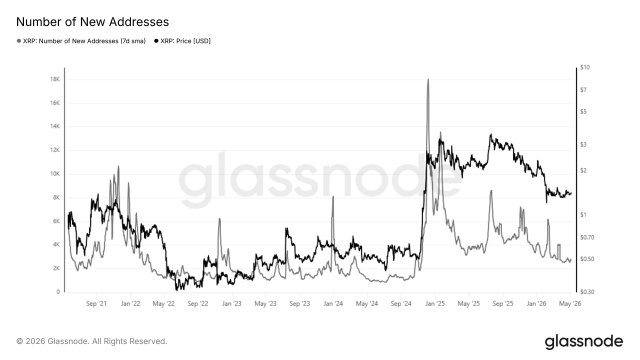
Source: Chart from Glassnode on X

Amid this fading, new wallet addresses created on the XRP network, its monthly active supply is telling a different story. As reported by Glassnode, the monthly active supply is exhibiting bearish activity, dropping from 7.4 billion XRP per day to around 2 billion per day over the same period.

Looking at the setup, the platform has highlighted that the speculative wave that pushed that altcoin’s surge in late 2024 has largely unwound at the network level. In the meantime, this development could either mark a temporary pause or a large change in the adoption trends of the altcoin.

A Continued Decline In Waning Downside Pressure

Market sentiment has heavily shifted, causing a wave of pullback across major crypto assets. XRP was impacted by this drawdown, which has now fallen further despite the absence of significant downside pressure. Such a trend is developing a disconnect in the market where buyers are stepping back, rather than sellers forcefully taking control.

During the period, CW, a verified author at the CryptoQuant platform, has revealed that a trader is net buying a massive volume of futures positions at the current price level. While strong upside pressure is starting to emerge, the price is not rising significantly. This may be linked to the persistent purchase of long positions by a trader, which is currently blocking the rise.

XRP trading at $1.38 on the 1D chart | Source: XRPUSDT on Tradingview.com

Связанные с этим вопросы

QAccording to the article, what has happened to the number of new wallet addresses on the XRP network in May?

AThe number of new wallet addresses on the XRP network has dropped dramatically, falling from a peak of around 18,000 per day in December 2024 to about 2,700 per day as of early May, representing a more than 85% decrease.

QWhat does the decline in new addresses typically indicate about market participants?

AThe decline in new addresses typically indicates weakening retail investor involvement, as new addresses are often linked to retail investors, especially during periods of high market speculation and excitement.

QBesides new addresses, what other key metric is showing bearish activity on the XRP network according to Glassnode?

AAccording to Glassnode, the monthly active supply on the XRP network is also showing bearish activity, dropping from 7.4 billion XRP per day to around 2 billion XRP per day over the same period.

QWhat possible reason does the article suggest for XRP's price not rising significantly despite emerging buying pressure?

AThe article suggests that a trader's persistent large-scale purchase of long futures positions at the current price level may be blocking a significant price rise, even as upside pressure starts to emerge.

QWhat does the article state about the speculative wave that drove XRP's surge in late 2024?

AThe article states that the speculative wave that pushed XRP's surge in late 2024 has largely unwound at the network level, signaling a significant cooldown.

Похожее

The Value Distribution of Stablecoins

**Summary: The Value Distribution of Stablecoins** The article argues that stablecoins are evolving from mere trading tools into broader channels for dollar access. It divides the stablecoin ecosystem into four layers to analyze how value is distributed: 1. **Issuance Layer:** Mints stablecoins, holds reserve assets, and captures the spread between reserve yield and user costs (e.g., Tether, Circle). This layer currently earns the largest profit margin. 2. **Infrastructure Layer:** Connects stablecoins to the traditional financial system, handling fiat on/off-ramps, banking integration, compliance (KYC/AML), and asset management (e.g., Bridge, BVNK). This is the "unglamorous" but critical work, building the essential bridges between crypto and real-world finance. 3. **Acquiring/Distribution Layer:** Integrates stablecoins into merchant systems, manages payment flows, and provides enterprise financial software (e.g., Stripe, Coinbase). They act as the access point for businesses. 4. **Application Layer:** The end-users and businesses that ultimately use stablecoins for payments, settlements, or as a store of value. They benefit from convenience but have little pricing power. The core thesis is that while the issuance layer currently dominates profits, the often-overlooked **infrastructure layer holds significant long-term potential**. The real challenge and barrier to mass adoption is not the on-chain transfer of stablecoins (which is simple), but the complex "last mile" integration into existing business workflows, banking systems, and regulatory frameworks across different countries. Companies in this layer are currently in a "land grab" phase, investing heavily to build networks, secure bank partnerships, and establish compliance pathways. While their position is currently pressured by the profitable issuers above and distribution platforms below, the article suggests that if stablecoins become a default financial rail for businesses, the infrastructure providers who have done the hard work of integration will ultimately gain strong pricing power and become entrenched, essential players.

marsbit7 мин. назад

The Value Distribution of Stablecoins

marsbit7 мин. назад

The Value Distribution of Stablecoins

The Value Distribution of Stablecoins The article argues that stablecoins are evolving from a mere trading tool into a broad "dollar channel." It analyzes the industry's value chain through four layers: 1. **Issuance Layer (e.g., Tether, Circle):** The top layer that mints stablecoins, holds reserve assets, and captures the thickest interest rate spread. 2. **Infrastructure Layer (e.g., Bridge, BVNK):** Connects stablecoins to the traditional financial system, handling critical but complex "dirty work" like fiat on/off-ramps, banking integration, compliance (KYC/AML), and cross-border settlement. 3. **Acquiring/Distribution Layer (e.g., Stripe, Coinbase):** Embeds stablecoins into merchant systems, manages payment flows, and integrates with enterprise software. 4. **Application Layer:** End-users and businesses that ultimately use stablecoins for payments, settlement, or storing value. The author posits that while the issuance layer currently captures the most profit, the most overlooked and potentially critical layer is infrastructure. The core challenge for stablecoin adoption isn't the on-chain transfer (which is simple), but bridging the gap between blockchain and the real-world financial system. This involves solving practical problems for businesses: fiat conversion, reconciliation, tax handling, and user onboarding. Infrastructure companies are currently in a difficult "land-grab" phase—building networks, securing banking relationships, and achieving compliance country-by-country. They face pressure from both the profitable issuance layer above and distribution platforms below. However, the author suggests this layer is building a crucial moat. Once stablecoins become a default business rail, the infrastructure players who have done the hard work of integration may gain significant, durable value and pricing power.

链捕手11 мин. назад

The Value Distribution of Stablecoins

链捕手11 мин. назад

Why Is Nvidia Borrowing $20 Billion When It's Not Short of Cash?

Nvidia's recent announcement to issue at least $20 billion in senior notes, despite holding a strong cash position with over $48.6 billion in free cash flow last quarter, is not a sign of financial need. Instead, it represents a strategic move to leverage its high credit rating (recently upgraded to AA by S&P) to secure low-cost, long-term debt. This capital will support long-term AI infrastructure investments, data centers, R&D, supply chain prepayments, and strategic investments, while allowing the company to continue aggressive shareholder returns through stock buybacks and dividends. The decision reflects a mature capital management strategy: using debt to finance long-term growth assets is more efficient and less dilutive to shareholders than equity financing. It signals that Nvidia, like other tech giants (Alphabet, Meta, Amazon), is entering a new phase of heavy AI capital expenditure, shifting from a pure growth story to a story about capital allocation, credit strength, and long-term ecosystem positioning. The key question for investors is whether Nvidia can maintain its high cash flow generation and ensure that returns from these AI investments justify the cost of capital over the long term. The bond issuance amplifies its expansion capabilities but also ties its valuation more closely to the broader AI investment cycle's sustainability and profitability.

marsbit46 мин. назад

Why Is Nvidia Borrowing $20 Billion When It's Not Short of Cash?

marsbit46 мин. назад

How to Do Research Well: Deliberately Practice the Real Skills That Matter

No one truly teaches you how to do research. You're often given a desk, a pre-selected problem, and vague instructions to "create something new." Consequently, many people reverse-engineer the job based on visible outputs—papers, posts, announcements—learning only how to *appear* like a researcher rather than how to *become* one. True research capability is built from stacking small, trainable skills, nearly all of which can be developed through deliberate practice. **Pick Your Own Problem:** Most researchers absorb problems from advisors or trends, lacking the underlying reasoning. Choosing a problem you genuinely care about, as John Schulman advises, leads to original work. Develop "taste" like a muscle: predict experiment outcomes, guess paper results from methods, and track which findings remain important over time. **Upgrade Your Inputs:** Relying on shared reading lists (arXiv hot lists, filtered group chats) leads to unoriginal conclusions. Undervalued old literature often holds crucial insights (e.g., MoE, LSTM, backpropagation). Richard Sutton's "The Bitter Lesson" or Claude Shannon's 1952 talk on creative thinking are more predictive than lengthy modern surveys. Breadth matters as much as depth: draw from neuroscience, mechanism design, hardware knowledge, and honest statistics. Read papers directly, especially appendices and limitations sections. **Write Everything Down:** As Paul Graham noted, writing exposes flaws in seemingly mature ideas. Writing is the cheapest defense against self-deception. Following Feynman's principle, Darwin programmatically wrote down facts contradicting his theory to combat memory bias. Maintain a detailed log of hypotheses, setups, predictions, results, and updated understandings. Reviewing past logs fosters essential humility.

marsbit2 ч. назад

How to Do Research Well: Deliberately Practice the Real Skills That Matter

marsbit2 ч. назад

Торговля

Спот
Фьючерсы

Популярные статьи

Что такое XRP 2.0

XRP 2.0: Новая грань в мире криптовалют Введение в XRP 2.0 В постоянно развивающейся сфере криптовалют появляются новые проекты, стремящиеся к вниманию и внедрению. Один из таких многообещающих проектов - это XRP 2.0, новая криптовалюта, созданная для использования передовых технологий блокчейна и надежных методов шифрования. Хотя название вызывает ассоциации с XRP от Ripple, важно отметить, что XRP 2.0 функционирует независимо, сосредоточив внимание на повышении безопасности сделок, конфиденциальности и масштабируемости. Поскольку цифровая финансовая среда все больше принимает децентрализованные решения, XRP 2.0 намерена внести значимый вклад в web3 и общее расширение криптопроектов. Что такое XRP 2.0? XRP 2.0 в своей основе - это проект криптовалюты, цель которого - создать безопасную и децентрализованную экосистему цифровой валюты. Его базовая технология интегрирует сложные принципы блокчейна с современными методами шифрования. Основная цель XRP 2.0 - утвердиться как надежная и эффективная платформа, позволяющая быстро осуществлять транзакции с приоритетом на улучшенную защиту конфиденциальности для своих пользователей. Проект рекламируется как решение многих недостатков, с которыми сталкиваются существующие криптовалюты, предлагая систему, способную обрабатывать более высокий объем транзакций с улучшенной скоростью и конфиденциальностью. Эта универсальность позиционирует XRP 2.0 как значимого конкурента на рынке, переполненном различными цифровыми валютами. Кто создатель XRP 2.0? Идентичность создателя XRP 2.0 была обозначена как «Уилбур». Однако исчерпывающие данные о Уилбуре или связанном с ним проекте остаются неясными. Анонимность многих создателей криптовалют не является редким явлением в этой отрасли и часто применяется для сохранения определенной степени конфиденциальности и безопасности. Кто инвесторы XRP 2.0? <pна данный момент конкретная информация о инвестиционных фондах или организациях, поддерживающих xrp 2.0, не доступна публично. в секторе криптовалют поддержка репутабельными инвесторами может существенно повлиять на кредитоспособность и успех проекта, однако прозрачность в отношении финансовых спонсоров 2.0 еще была установлена. Как работает XRP 2.0? XRP 2.0 выделяется использованием сочетания технологий блокчейна и продвинутых алгоритмов шифрования, что обеспечивает безопасные и децентрализованные транзакции. Его инновационная структура включает уникальные функции, разработанные для повышения вовлеченности пользователей и расширения функциональности за пределами традиционных транзакций с криптовалютами. Среди этих функций XRP 2.0 интегрирует возможности с искусственным интеллектом, такие как текст в изображение и текст в речь. Эти дополнения разработаны для улучшения интерактивной работы пользователей, способствуя более широкому применению в различных секторах. Соединяя технологические достижения с дизайном, ориентированным на пользователя, XRP 2.0 стремится привлечь внимание разнообразных индивидуумов и предприятий, стремящихся интегрировать решения с криптовалютой в свои бизнес-процессы. Хронология XRP 2.0 Для понимания XRP 2.0 необходимо рассмотреть ключевые события, которые определили его путь до сих пор: 23 июля 2023 года: XRP 2.0 представлен как новый проект криптовалюты, стремящийся революционизировать возможности безопасных и децентрализованных транзакций в области блокчейна. 8 сентября 2023 года: Запуск другого проекта, XRP20, который представляет собой токен ERC-20 на блокчейне Ethereum и не имеет отношения к XRP 2.0. 13 ноября 2023 года: XRP Ledger подвергается значительному обновлению с выпуском программного обеспечения серверов rippled версии 2.0.0. Важно отметить, что это развитие не связано с проектом криптовалюты XRP 2.0. Ключевые моменты о XRP 2.0 Чтобы выделить суть XRP 2.0, возникают несколько критически важных факторов: Уникальные особенности: Включение таких функций, как основанные на ИИ текст в изображение и текст в речь, дополнительно разнообразит потенциальные приложения XRP 2.0. Технология блокчейна: Структура использует современные механизмы блокчейна и протоколы шифрования, обеспечивая безопасную и децентрализованную среду для транзакций. Масштабируемость и конфиденциальность: XRP 2.0 придает приоритет повышенным мерам защиты конфиденциальности в процессах транзакций и масштабируемости, необходимой для привлечения растущей базы пользователей. Нет связи с Ripple: Важно отметить, что, несмотря на свое название, XRP 2.0 не имеет никаких отношений или сотрудничества с XRP от Ripple, что отличает его операционные рамки и цели в экосистеме криптовалют. Заключение XRP 2.0 представляет собой амбициозное начинание в сфере криптовалют, стремясь предложить сочетание безопасности, конфиденциальности и эффективности в цифровых транзакциях. Интегрируя сложные технологии и удобные функции, проект стремится расширить горизонты того, что может достичь криптовалюта в современной цифровой экономике. Хотя анонимность его создателя и отсутствие раскрытых инвесторов могут вызвать вопросы у некоторых, акцент XRP 2.0 на передовых функциональных возможностях и децентрализации увеличивает его привлекательность на фоне все более переполненного крипто-рынка. Поскольку мир криптовалют продолжает развиваться, XRP 2.0 может еще стать ключевым игроком в расширении безопасных и масштабируемых блокчейн-решений.

198 просмотров всегоОпубликовано 2024.04.05Обновлено 2024.12.03

Что такое XRP 2.0

Неделя обучения по популярным токенам 13: запуск основной сети HIP-4 ожидается в середине 2026 года на фоне смещения фокуса рынка к масштабируемому внедрению ключевых криптоактивов, включая XRP

HIP-4 представит децентрализованные рынки прогнозов без разрешений, бинарные (исходные) контракты и опционы 0DTE.

1.3k просмотров всегоОпубликовано 2026.04.22Обновлено 2026.04.22

Неделя обучения по популярным токенам 13: запуск основной сети HIP-4 ожидается в середине 2026 года на фоне смещения фокуса рынка к масштабируемому внедрению ключевых криптоактивов, включая XRP

Обсуждения

Добро пожаловать в Сообщество HTX. Здесь вы сможете быть в курсе последних новостей о развитии платформы и получить доступ к профессиональной аналитической информации о рынке. Мнения пользователей о цене на XRP (XRP) представлены ниже.

活动图片