XRP Gets A Wall Street Wrapper: Evernorth CEO Teases Q1 2026 Nasdaq IPO

bitcoinistОпубликовано 2026-01-16Обновлено 2026-01-16

Введение

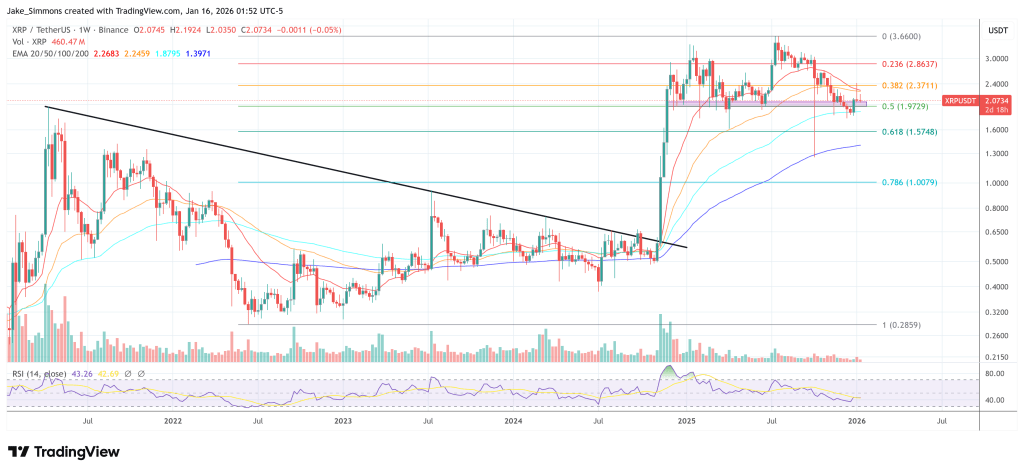
Evernorth CEO Ashish Birla announced the company is preparing for a Q1 2026 IPO on Nasdaq, positioning it as a simplified way for institutions to gain exposure to XRP without handling custody, compliance, or security directly. Birla cited favorable regulation and growing institutional demand as key reasons for the timing. The firm’s equity will serve as a proxy for XRP investment, allowing investors to buy public stock instead of holding the digital asset. Evernorth plans to actively manage its XRP treasury, generate yield, and support ecosystem development. At the time of reporting, XRP was trading at $2.07.

Evernorth CEO Ashish Birla said the firm is preparing for a Q1 2026 IPO on Nasdaq, pitching the listing as a simplified, public-markets route for institutions to gain exposure to XRP without building the custody, compliance, and security stack themselves.

Speaking on Nasdaq’s Live from MarketSite on Jan. 15 with host Kristina Ayanian, Birla framed the planned offering as a response to what he described as growing institutional readiness and a shifting regulatory backdrop. Ayanian said: “Evernorth is gearing up for a Q1 2026 IPO.”

Birla responded: “I’ve been waiting for this moment for a long time. I’ve been in blockchain since 2013,” Birla said. “The timing couldn’t be more perfect. We have the right kind of regulation. We have the right kind of administration and institutions are ready to adopt.”

XRP Gets A Wall Street Wrapper

At the center of Evernorth’s pitch is the XRP treasury strategy, which Birla described as “the digital asset underpinning Evernorth’s digital asset treasury.” In Birla’s telling, Evernorth’s equity is meant to function as an exposure vehicle for investors who prefer traditional market rails over direct token custody.

“Prior to Evernorth ... you would have to go in, you know, custody digital assets on your own. You would have to worry about compliance. You’d have to worry about security,” he said. “But a large lion’s share just wants to buy a public stock. So we made it as easy as buying a public stock. And we’ll figure that stuff out for you.”

Birla also suggested Evernorth intends to brand that exposure explicitly through its stock identity, referring to “XRPN as the Evernorth stock,” and repeating that the proposition is to “just buy the stock ... and we’ll take care of all that heavy lifting for you.” For investors, the value proposition is less about novel financial engineering than operational outsourcing: Evernorth claims it can package custody, compliance, and blockchain participation behind a public equity wrapper.

The executive tied the timing of Evernorth’s public-market push to what he described as rising demand for regulated exposure. Asked about “XRP ETFs ... making a big splash,” Birla said the category had seen “a record breaking last few weeks,” arguing that it signaled appetite from traditional investors. “That shows that there is the demand from the public markets to gain exposure to XRP,” he said, adding that Evernorth intends to go beyond simple spot exposure by supporting the broader ecosystem.

That “beyond” hinges on yield generation and active treasury management. Birla said Evernorth expects to “be generating yield as well on the XRP asset,” and that the proceeds would be recycled into the treasury: “We’ll use [it] to go and buy more of the digital asset for the treasury. So we’ll be actively out there.” He positioned the company as an active participant in product development on-chain, saying Evernorth will “help develop that XRP ecosystem, help bring financial products to the blockchain.”

Pressed on what separates durable “digital asset treasury” strategies from the rest, Birla emphasized scale and activity. “One, you have to have scale. And Evernorth as of today is by far the largest XRP digital asset treasury out there,” he said. The second criterion, he argued, is avoiding a purely passive posture. “They can’t be passive. They have to be active stewards of helping the ecosystem flourish and develop,” Birla said, adding that he plans to continue “helping the XRP ecosystem develop” and that Evernorth could “generate yield for the for the treasury as well.”

For prospective institutional buyers and public-market investors, the message was blunt: the company sees the last missing piece as capital access, and it is building a listed vehicle around it. “You’ve got regulation, you’ve got the products, and now you’ve got institutional capital,” Birla said. “I think timing is right to adopt blockchain for financial products.”

At press time, XRP traded at $2.07.

Bulls needs to reclaim the 0.382 Fib, 1-week chart | Source: XRPUSDT on TradingView.com

Связанные с этим вопросы

QWhat is the planned timeline for Evernorth's IPO on Nasdaq, and what is the core value proposition for investors?

AEvernorth is planning its IPO for Q1 2026. The core value proposition is to provide institutional investors with a simplified, public-markets route to gain exposure to XRP without having to manage the complexities of direct custody, compliance, and security themselves.

QAccording to CEO Ashish Birla, what are the two key factors that make the timing perfect for Evernorth's public-market push?

ABirla stated that the timing is perfect due to the 'right kind of regulation,' the 'right kind of administration,' and that 'institutions are ready to adopt' blockchain-based financial products.

QHow does Evernorth intend to go beyond simple spot exposure to XRP for its investors?

AEvernorth plans to go beyond simple spot exposure by actively generating yield on its XRP assets and recycling the proceeds to buy more for its treasury. The company also aims to be an active participant in developing the XRP ecosystem and bringing financial products to the blockchain.

QWhat two criteria did Birla emphasize as essential for a durable 'digital asset treasury' strategy?

ABirla emphasized that a durable strategy requires scale, noting Evernorth is the largest XRP treasury, and that the treasury cannot be passive; it must be an active steward that helps the ecosystem flourish and develop.

QWhat specific stock ticker did Birla refer to when describing Evernorth's equity as an exposure vehicle for XRP?

ABirla referred to the Evernorth stock as 'XRPN' and pitched it as a way for investors to gain exposure to XRP by simply buying the public stock.

Похожее

The Era Has Arrived Where Human Writers Must Prove They Are Not Machines

The article describes an era where AI-generated content is flooding the market, forcing human authors to prove they are not machines. It begins with the example of dozens of AI-written, error-ridden biographies of Henry Kissinger appearing on Amazon within hours of his death, a pattern repeated for other deceased celebrities and even living experts who find fraudulent books under their names. This spam content has exploded, with monthly new book releases on platforms like Amazon reaching 300,000 by late 2025. The issue spans genres, from suspiciously high proportions of AI-written teen romance and self-help books to dangerous, AI-generated foraging guides containing lethal advice. The platforms' automated review systems, designed to catch plagiarism and banned words, are ill-equipped to detect AI-generated text that avoids these pitfalls while being nonsensical or fraudulent. The problem has infiltrated traditional publishing. A major publisher, Hachette, had to recall a bestselling horror novel after AI detection tools suggested 78% of its content was machine-generated. An acclaimed European philosophy book was later revealed to be entirely written by AI under a fake author persona. In response, authors are fighting back. At the 2026 London Book Fair, 10,000 writers published a blank book titled "Don't Steal This Book" containing only their signatures—using emptiness as a protest weapon in an age of AI overproduction. Initiatives like the "Human Author Certification" program have emerged, ironically placing the burden on humans to prove their work is not machine-made. The article warns of a vicious cycle: AI-generated low-quality books pollute the data used to train future AI models, leading to "model collapse" and an ever-worsening flood of digital waste, eroding trust in publishing and devaluing human creativity.

marsbit9 мин. назад

The Era Has Arrived Where Human Writers Must Prove They Are Not Machines

marsbit9 мин. назад

The King of Blind Date Attire in Korea: How SK Hynix Made a Comeback Against Samsung?

In South Korea's dating scene, SK Hynix employees are now highly sought after, a status shift fueled by the company's astronomical profits and employee bonuses, projected to reach up to 6.1 million RMB per person by 2027. This marks a dramatic reversal for the long-time second-place player in memory semiconductors, which has now surpassed its rival Samsung in annual operating profit. The turnaround story began in 2008 when a struggling Hynix, emerging from bankruptcy restructuring, took a risky bet by agreeing to develop High Bandwidth Memory (HBM) with AMD. At the time, HBM had no clear market beyond high-end graphics cards and was a costly, complex technology. Major players like Samsung, pursuing its own HMC technology, declined. For Hynix, with only memory as its core business, it was a gamble born of necessity. The pivotal moment came in 2012 when SK Group Chairman Chey Tae-won acquired Hynix. Defying industry downturns, he invested heavily in R&D and fabrication, sustaining the HBM project through over a decade of commercial uncertainty and internal challenges. A key break occurred around 2016-2017 when Samsung faced production issues supplying HBM2 for Google's TPU, allowing SK Hynix to gain a crucial foothold in the data center market. The AI explosion post-ChatGPT in 2022 was the catalyst, turning HBM into a critical bottleneck for AI accelerators like NVIDIA's GPUs. By 2025, SK Hynix captured 62% of the global HBM market, leaving Samsung at 17%. For the first time, its annual operating profit exceeded Samsung's. Analysts point to the "innovator's dilemma" to explain Samsung's miss: its vast, successful business portfolio made it risk-averse, preventing an all-in bet on the initially niche HBM technology. In contrast, SK Hynix, as a challenger with its back against the wall, had no choice but to commit fully. The story highlights how Korea's chaebol system allows for ultra-long-term bets beyond quarterly pressures. However, SK Hynix's lead isn't guaranteed. Samsung is aggressively catching up on HBM4, and challenges like customer concentration (heavy reliance on NVIDIA) and technical hurdles in advanced packaging remain. The narrative underscores a market truth: the greatest alpha often comes from betting on uncertain, long-term directions others dismiss, much like HBM in 2008.

marsbit49 мин. назад

The King of Blind Date Attire in Korea: How SK Hynix Made a Comeback Against Samsung?

marsbit49 мин. назад

Торговля

Спот
Фьючерсы
活动图片