WSJ: Hyperliquid Is Becoming Wall Street's Crypto 'Convenience Store'

链捕手Опубликовано 2026-06-03Обновлено 2026-06-03

Введение

The Wall Street Journal reports that Hyperliquid, a decentralized crypto platform, is becoming a go-to "convenience store" for Wall Street traders, especially "weekend warriors" seeking to position themselves around global events outside traditional market hours. Founded by ex-HFT quant Jeff Yan after FTX's collapse, Hyperliquid emphasizes self-custody and operates 24/7. It has gained traction by offering perpetual futures on assets ranging from Bitcoin and the S&P 500 to oil and pre-IPO companies like SpaceX. A notable case involved a trader profiting 243% on oil positions after news of Middle East airstrikes. The platform, while currently blocking U.S. users, has seen significant growth, with its native HYPE token's market cap around $16B. Its community-driven culture, user-friendly interface, and developer ecosystem contribute to its appeal, despite concerns about the high risks of leveraged perpetuals. Hyperliquid aims to expand into prediction markets and options.

Author: Vicky Ge Huang

Compiled by: Jiahuan, ChainCatcher

One Saturday in February, when Vala Zeinali's phone lit up with the news that President Trump had announced airstrikes on Iran, the hedge fund commodity trader calmly opened Hyperliquid.

The decentralized crypto platform Hyperliquid is open 24/7. This year, the exchange has become the go-to place for Wall Street "weekend warriors" like Zeinali, who can build or dump large positions here hours or even days before the opening bell rings.

In early 2026, before Trump announced the airstrikes, Zeinali had already bet a four-figure sum on oil derivatives, anticipating conflict in the Middle East. When the news caused crude oil prices to surge, he logged into Hyperliquid and closed his position, locking in a massive profit of up to 243%.

Zeinali said: "I thought to myself, 'Great,' because usually such volatility in the crude market subsides before Sunday's opening. So I thought, 'Okay, I can actually close my position,' and that's what I did. I sold off most of my position."

An increasing number of traditional and crypto traders are flocking to the platform to place bets on almost any asset, from Bitcoin and the S&P 500 Index to crude oil and pre-IPO giants like SpaceX.

Their market of choice is perpetual futures – a type of derivative contract that never expires, allowing users to trade at any time and use huge leverage, amplifying their bets as the notional value of their position is magnified.

Hyperliquid was founded three years ago by Jeff Yan, a former quantitative trader at high-frequency trading firm Hudson River Trading. Yan has said his inspiration came from the disastrous collapse of Sam Bankman-Fried's FTX exchange. That event made him realize that the crypto market needed a high-performance trading platform where users, not the exchange, custody their own assets.

Yan said in an interview: "The main thing is, self-custody isn't just some academic concept; it's a basic feature that users will demand. I was surprised that users didn't demand it more strongly after FTX, but it's really as simple as controlling your own funds."

Hyperliquid Labs, the developer behind the exchange and blockchain, has 11 employees. According to Blockworks Research data, the blockchain and exchange, which share the Hyperliquid name, generated about $8 billion in total revenue last year.

CoinGecko data shows that the blockchain's native token "HYPE," launched at the end of 2024, has gained over 100% in the past year, with a market cap of around $16 billion.

Hyperliquid's rapid rise highlights the convergence of cryptocurrency and traditional finance. The platform's perpetual futures, especially those tied to traditional assets like stocks and commodities, are attracting Wall Street's attention.

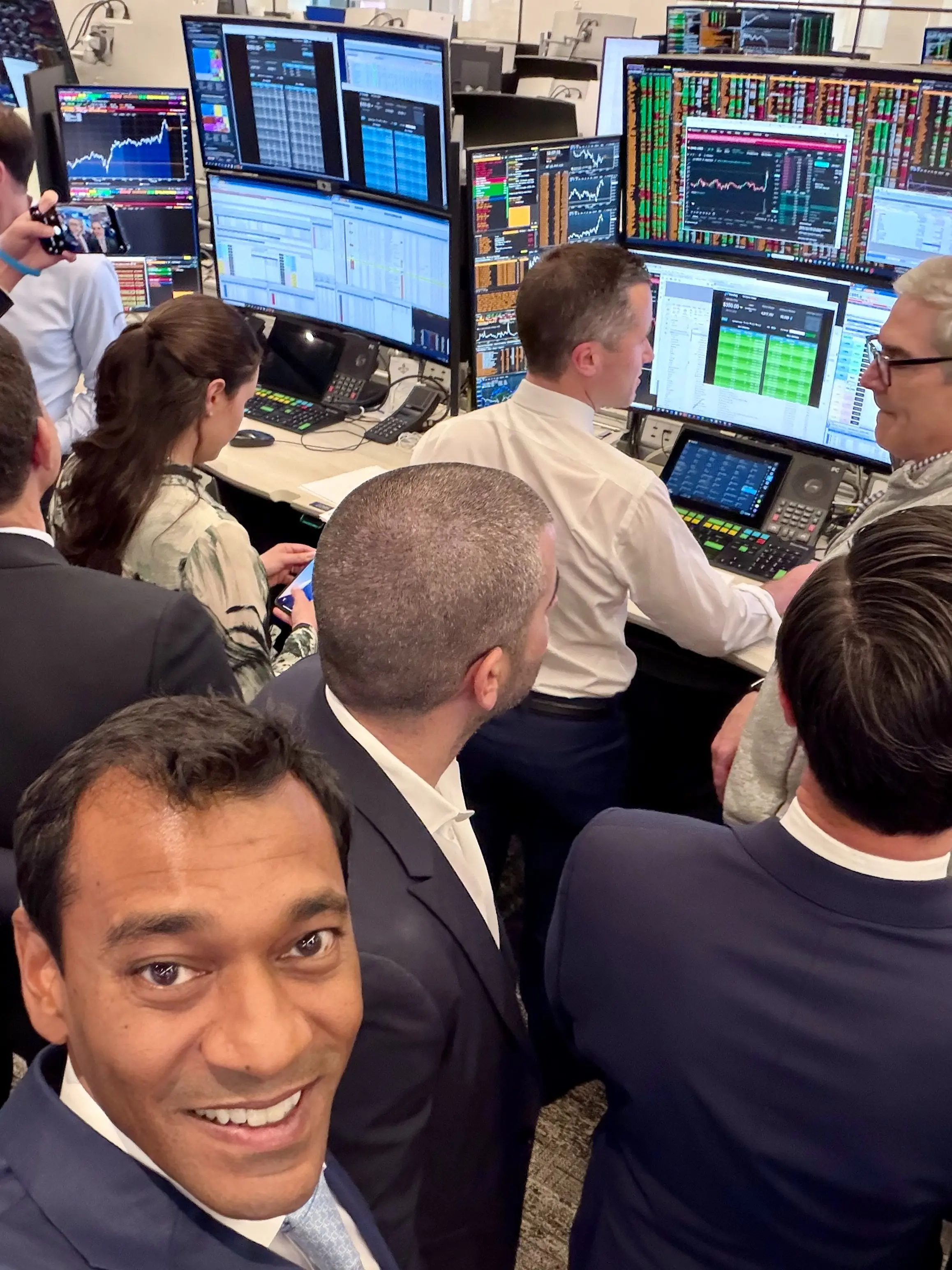
Recently, Benchmark venture capital firm's general partner Eric Vishria shared a photo on X: a banker, on the day AI chipmaker Cerebras landed on Nasdaq, intently watching the price of its linked perpetual futures.

Earlier this year, S&P Dow Jones Indices licensed the S&P 500 Index to Trade[XYZ], which created some of Hyperliquid's most popular perpetual futures contracts tied to traditional financial assets.

Some traders are drawn to Hyperliquid because it offers contracts for some of the most anticipated upcoming public listings. According to data from Hyperliquid analytics platform Hyperdash, the cumulative trading volume for perpetual futures linked to Elon Musk's rocket company SpaceX, which plans to go public later this year, has reached about $280 million on Hyperliquid.

Although US residents currently cannot use Hyperliquid, that may soon change.

Last Friday, the Commodity Futures Trading Commission (CFTC) outlined a framework for registered US platforms to offer perpetual futures. The agency also approved Kalshi to list Bitcoin perpetual futures contracts and allowed Coinbase's US customers to access its global perpetual futures through an affiliate.

Perpetual futures are also high-leverage, high-risk products that can greatly amplify traders' gains or expose them to devastating losses. For example, Trump's sudden announcement on October 10th of 100% tariffs on China triggered a sharp sell-off that wiped out over $19 billion in leveraged positions, with $10 billion of that on Hyperliquid.

Yan said the real scale of liquidations across the entire crypto space was far greater than $19 billion, and Hyperliquid was singled out mainly because its liquidation data is transparent and it remained online when many platforms were not fully accessible.

Benjamin Schiffrin, securities policy director at Better Markets, an organization pushing for tighter financial regulation, said: "Perpetual futures are a complex financial product that even experienced financial professionals struggle to fully understand, and I don't think the risks of perpetual futures have been adequately disclosed to retail investors. I think it's a very dangerous combination."

None of this has stopped traders in the US and other restricted regions from using virtual private networks (VPNs) to access the platform. Traders say they are drawn to Hyperliquid because it doesn't require identity verification or standard background checks, in stark contrast to the strict identity rules enforced by traditional brokers and stock exchanges.

Hyperliquid explicitly states in its terms of use that it blocks US traders and prohibits any actions to circumvent this restriction, including using VPNs.

What keeps traders hooked is also Hyperliquid's smooth and user-friendly interface, extensive selection of tradable assets, and a strong sense of community that closely connects its user base.

Trader Pascal Lin, based in Geneva, Switzerland, said he discovered Hyperliquid in late 2023 and quickly became a heavy user. Early on, he was impressed that he could easily join the platform's Discord channel and provide feedback directly to Yan and other members of the Hyperliquid team.

"It literally felt like I was building the product myself," said Lin, who is also the head of trading at his firm, ARES Capital Management.

On Hyperliquid, Lin primarily trades the Hyperliquid blockchain's native token HYPE, but also dabbles in perpetual futures tied to oil. It was there that he caught the wave as oil prices rose from around $67 per barrel to nearly $100.

Lin said he became so addicted to Hyperliquid that he set up real-time price alerts for the HYPE token on his Apple Watch, a habit he described as "toxic" and not recommended for other traders to emulate.

He said: "With just one click, I can access Hyperliquid. Whenever I wake up in the middle of the night, one click and I can check the HYPE price."

Lin is not the only trader fascinated by Hyperliquid and its token. A large part of Hyperliquid's appeal stems from the culture of its vast ecosystem, championed jointly by individual traders and developers building on the blockchain.

On X, regardless of the topic, Hyperliquid traders jokingly append the word "Hyperliquid" to almost every post.

Many also use the platform's mascot, a smiling cat in a green jacket named "Hypurr," as their social media profile picture. Beyond internet memes, developers are actively building trader-friendly tools and data trackers around the blockchain.

Hyperdash co-founder Lawrence Wu said: "I think the reason such a large community has formed is because it tries to fulfill cryptocurrency's original vision of establishing a meritocratic, permissionless system. It's very idealistic."

Yan said Hyperliquid's ultimate goal is to house the entire financial industry. The next steps on the roadmap are to venture into prediction markets and options trading. Its first outcome contracts tracking Bitcoin prices have already generated millions in derivative trading volume since their launch in early May.

Связанные с этим вопросы

QWhat is Hyperliquid, and why has it become popular among some Wall Street traders according to the WSJ article?

AHyperliquid is a decentralized cryptocurrency trading platform and its underlying blockchain, operating 24/7. It has become popular among Wall Street traders, especially 'weekend warriors,' because it allows them to build or liquidate large positions on various assets—from Bitcoin and the S&P 500 to oil and pre-IPO companies like SpaceX—outside traditional market hours using perpetual futures contracts with high leverage.

QWhat was the inspiration behind Jeff Yan's creation of Hyperliquid, and what key principle does it emphasize?

AJeff Yan, the founder of Hyperliquid, was inspired by the catastrophic collapse of Sam Bankman-Fried's FTX exchange. This event led him to realize the need for a high-performance trading platform where users, not the exchange, are the custodians of their assets. The key principle emphasized is self-custody as a fundamental, user-demanded feature.

QWhat type of financial product is the primary market on Hyperliquid, and what are the associated risks mentioned in the article?

AThe primary market on Hyperliquid is perpetual futures—derivative contracts that never expire, allowing users to trade at any time using significant leverage. The associated risks highlighted include high leverage magnifying both potential profits and devastating losses. For example, a sudden policy announcement led to liquidations wiping out over $10 billion in leveraged positions on Hyperliquid. Experts warn that these are complex products whose risks may not be fully disclosed to retail investors.

QHow does the article describe the community and cultural aspects surrounding the Hyperliquid platform?

AThe article describes a strong, dedicated community culture around Hyperliquid. Traders and developers are highly engaged, often ending social media posts with the platform's name and using its mascot, 'Hypurr' (a smiling cat in a green jacket), as their profile pictures. Developers actively build trader-friendly tools and data trackers. The community forms around Hyperliquid's pursuit of the crypto ideal of a meritocratic, permissionless system, fostering a sense of direct contribution and connection with the team.

QWhat regulatory constraints does Hyperliquid face regarding U.S. users, and how are some traders circumventing them?

AHyperliquid explicitly blocks U.S. users in its terms of service and prohibits actions to circumvent this, including using VPNs. Despite this, some traders from the U.S. and other restricted regions use Virtual Private Networks (VPNs) to access the platform, attracted by features like no identity verification or standard background checks, which contrasts with traditional financial institutions' strict KYC rules.

Похожее

After Marvell's 32% Surge, the Chinese Chip Family Behind It Emerges

The stock price of Marvell Technology surged 32.5% on June 2nd, driven by NVIDIA CEO Jensen Huang highlighting its custom ASICs and optical interconnects as core to AI data center architecture. This event brought attention to the Chinese semiconductor family behind Marvell: the Dai siblings. The story centers on three siblings, all UC Berkeley graduates, whose three-decade entrepreneurial journey aligns with major semiconductor industry shifts. In 1995, youngest sister Dai Wei Li co-founded Marvell with her husband Sehat Sutardja and his brother, focusing on storage controllers. Eldest brother Dai Wei Min founded EDA company Ultima, later sold to Cadence, and later founded VeriSilicon (芯原) in China, becoming a leading semiconductor IP provider. Second brother Dai Wei Jin co-founded EDA firm Silicon Perspective (sold to Cadence) and GPU IP company Vivante, later acquired by VeriSilicon. The combined "Dai-Sutardja" family network extends beyond Marvell. Their ventures and investments form a comprehensive ecosystem for the post-Moore's Law, chiplet era. Key holdings include: Dream Big Semiconductor (AI SuperNICs, acquired by Arm), Alphawave (high-speed SerDes IP, acquired by Qualcomm), and Silicon Box (a chiplet advanced packaging foundry). VeriSilicon itself thrives on the AI ASIC and IP boom in China. Collectively, the family's AI infrastructure-related portfolio is estimated at over $22 billion. Their strategy represents a distinct path: building critical components for open standards and key manufacturing capacity in the chiplet era, rather than pursuing standalone AI chip dominance. While this path may not create the next NVIDIA, it has enabled repeated successful exits and sustained influence within the global semiconductor industry.

marsbit49 мин. назад

After Marvell's 32% Surge, the Chinese Chip Family Behind It Emerges

marsbit49 мин. назад

Microsoft is Afraid of Being Marginalized by AI Giants

Microsoft, once the defining force of the PC era, now faces a familiar challenge in the AI age: the risk of being relegated to a profitable but invisible infrastructure provider. This anxiety was laid bare at Build 2026, where CEO Satya Nadella unveiled a major strategic pivot. The catalyst was a quiet April agreement that dissolved Microsoft's exclusive licensing and cloud-hosting deal with OpenAI, its once-vital partner. This erased Microsoft's key AI moat. With OpenAI and Anthropic defining AI applications and gaining enterprise traction—even within Microsoft's own ranks—Nadella had to answer: without exclusivity, what is Microsoft's role? The answer was a suite of seven in-house AI models, a developer-focused AI workstation (Surface RTX Spark Dev Box), and, most crucially, the Agent 365 platform for enterprise AI governance. The models, notably targeting Anthropic's strengths in coding and enterprise, signal a defensive move. However, the broader strategy is to make the models themselves less decisive. Financially, Microsoft's AI revenue is strong, driven largely by Azure running others' models. Yet its user-facing products like Copilot show weak penetration and engagement. Microsoft earns infrastructure money but lacks direct user mindshare. Nadella's core fear is being "hollowed out." As OpenAI and Anthropic prepare for IPOs and gain financial independence, they may build their own infrastructure, threatening Azure's lucrative AI revenue stream. Microsoft's window is to entrench itself deeper: not as the model creator, but as the indispensable platform for securely deploying, managing, and governing all AI models within the enterprise through Agent 365. Build 2026 revealed Microsoft's bet: in the AI era, the ultimate power lies not in any single model, but in the enterprise "operating system" that controls them. Nadella is determined to ensure Microsoft is the driver of this new era, not just a passenger.

marsbit1 ч. назад

Microsoft is Afraid of Being Marginalized by AI Giants

marsbit1 ч. назад

CPU, Quietly Returning to the Center of the AI Computing Power Stage

Over the past three years, AI computing power narratives have been dominated by GPUs. However, starting in 2026, this story began to shift. While training large models remains GPU-intensive, the rapid growth of inference and AI agent workloads, which require high levels of task orchestration, concurrency, and data flow management, has highlighted a renewed critical role for CPUs. These are tasks GPUs are not designed to handle. Intel's recent launch of the Xeon 6+ processor, built on its Intel 18A process and featuring up to 288 efficiency cores (E-cores), exemplifies this strategic pivot. It is positioned not as a mere companion to GPUs but as the essential "control plane" for AI infrastructure, optimized for high-density, energy-efficient, and high-throughput workloads characteristic of AI agents and inference. This "CPU resurgence" is not about CPUs outperforming GPUs in raw computation. It reflects a systemic bottleneck: as AI scales from training single models to deploying countless intelligent agents, the demand for coordination and data handling surges. Major cloud providers are also developing their own high-density ARM-based server CPUs for similar workloads. However, Intel's success with this strategy faces significant challenges. Competition includes NVIDIA's integrated CPU-GPU solutions, the expanding adoption of cloud vendors' in-house ARM CPUs, and the crucial market test of Intel's 18A manufacturing process against rivals like TSMC's N2. In conclusion, CPUs are indeed reclaiming a central, though redefined, role in AI compute—managing the complex orchestration that enables massive-scale AI deployment. While the trend is clear, which company will ultimately lead this CPU resurgence remains an open question to be decided in the data centers of 2027 and beyond.

marsbit1 ч. назад

CPU, Quietly Returning to the Center of the AI Computing Power Stage

marsbit1 ч. назад

Торговля

Спот
Фьючерсы

Популярные статьи

Как купить S

Добро пожаловать на HTX.com! Мы сделали приобретение Sonic (S) простым и удобным. Следуйте нашему пошаговому руководству и отправляйтесь в свое крипто-путешествие.Шаг 1: Создайте аккаунт на HTXИспользуйте свой адрес электронной почты или номер телефона, чтобы зарегистрироваться и бесплатно создать аккаунт на HTX. Пройдите удобную регистрацию и откройте для себя весь функционал.Создать аккаунтШаг 2: Перейдите в Купить криптовалюту и выберите свой способ оплатыКредитная/Дебетовая Карта: Используйте свою карту Visa или Mastercard для мгновенной покупки Sonic (S).Баланс: Используйте средства с баланса вашего аккаунта HTX для простой торговли.Третьи Лица: Мы добавили популярные способы оплаты, такие как Google Pay и Apple Pay, для повышения удобства.P2P: Торгуйте напрямую с другими пользователями на HTX.Внебиржевая Торговля (OTC): Мы предлагаем индивидуальные услуги и конкурентоспособные обменные курсы для трейдеров.Шаг 3: Хранение Sonic (S)После приобретения вами Sonic (S) храните их в своем аккаунте на HTX. В качестве альтернативы вы можете отправить их куда-либо с помощью перевода в блокчейне или использовать для торговли с другими криптовалютами.Шаг 4: Торговля Sonic (S)С легкостью торгуйте Sonic (S) на спотовом рынке HTX. Просто зайдите в свой аккаунт, выберите торговую пару, совершайте сделки и следите за ними в режиме реального времени. Мы предлагаем удобный интерфейс как для начинающих, так и для опытных трейдеров.

1.4k просмотров всегоОпубликовано 2025.01.15Обновлено 2026.06.02

Как купить S

Sonic: Обновления под руководством Андре Кронье – новая звезда Layer-1 на фоне спада рынка

Он решает проблемы масштабируемости, совместимости между блокчейнами и стимулов для разработчиков с помощью технологических инноваций.

2.3k просмотров всегоОпубликовано 2025.04.09Обновлено 2025.04.09

Sonic: Обновления под руководством Андре Кронье – новая звезда Layer-1 на фоне спада рынка

HTX Learn: Пройдите обучение по "Sonic" и разделите 1000 USDT

HTX Learn — ваш проводник в мир перспективных проектов, и мы запускаем специальное мероприятие "Учитесь и Зарабатывайте", посвящённое этим проектам. Наше новое направление .

1.8k просмотров всегоОпубликовано 2025.04.10Обновлено 2025.04.10

HTX Learn: Пройдите обучение по "Sonic" и разделите 1000 USDT

Обсуждения

Добро пожаловать в Сообщество HTX. Здесь вы сможете быть в курсе последних новостей о развитии платформы и получить доступ к профессиональной аналитической информации о рынке. Мнения пользователей о цене на S (S) представлены ниже.

活动图片