World's Largest Crypto ATM Operator Bitcoin Depot Files for Bankruptcy, All 9,700 Machines Shut Down

marsbitОпубликовано 2026-05-20Обновлено 2026-05-20

Введение

Bitcoin Depot, once the world's largest cryptocurrency ATM operator with roughly 9,700 machines, has filed for Chapter 11 bankruptcy and ceased operations. The company cited an unsustainable business model due to intensified regulatory pressure across multiple U.S. states. Crackdowns included new transaction limits, license suspensions, and direct bans, driven by concerns over the machines facilitating fraud. The FBI reported $389 million in consumer losses via crypto ATMs in 2025. Over the past six months, states like Connecticut, Missouri, Nevada, and Massachusetts took action against Bitcoin Depot, including lawsuits alleging it profited from scams. This regulatory assault caused the company's quarterly revenue to plunge nearly 50% year-over-year. Stricter anti-fraud measures, such as mandatory identity verification implemented in February, further reduced user activity. Additionally, the company faced mounting legal fees from multiple lawsuits and a nearly $19 million arbitration ruling related to a Canadian subsidiary dispute.

Author:Ben Dooley

Compiled by:Deep Chao TechFlow

Deep Chao Insight: Crypto ATMs, once ubiquitous in convenience stores across the United States, are now retreating en masse under regulatory pressure. The world's largest crypto ATM operator, Bitcoin Depot, filed for Chapter 11 bankruptcy protection on May 18th, with approximately 9,700 of its machines ceasing operations. The direct cause is a wave of state-level regulations, including transaction limits, license suspensions, and anti-fraud lawsuits—FBI data shows consumers lost $389 million through crypto ATM scams in 2025. This report from the ICIJ (International Consortium of Investigative Journalists) reviews the journey of this publicly traded company from expansion to collapse.

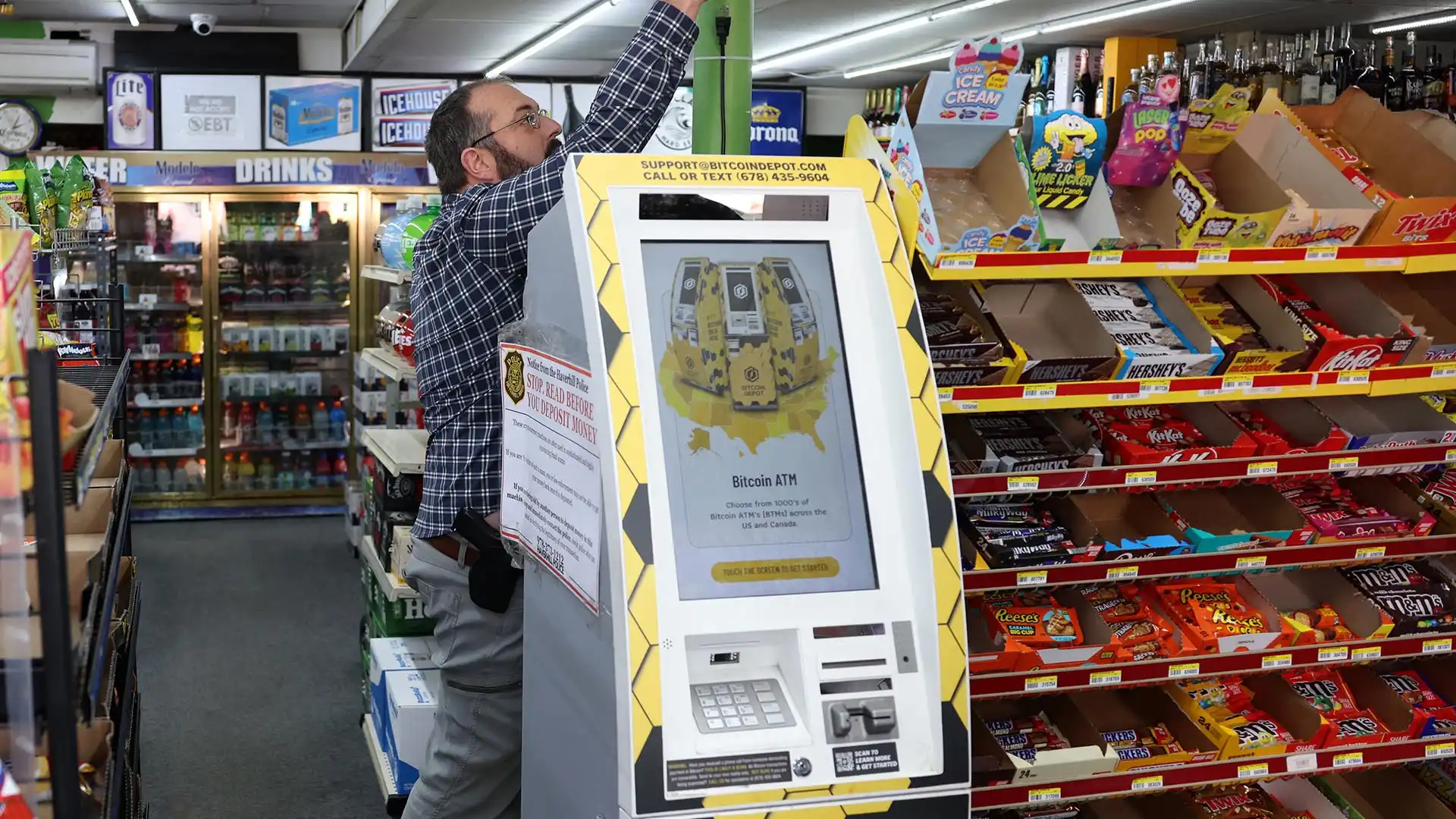
Caption: A police officer disconnecting the power to a Bitcoin Depot ATM inside a convenience store in Haverhill, Massachusetts, on April 6, 2026.

Image source: Jessica Rinaldi/The Boston Globe via Getty Images

Bitcoin Depot, once the world's largest cryptocurrency ATM operator, officially filed for bankruptcy protection on May 18th. This company, long accused of facilitating scams, delivered another blow to the industry.

CEO Alex Holmes stated in a declaration on the company's website that all approximately 9,700 crypto ATMs operated by the company have been taken offline and operations will cease.

Holmes attributed the failure to "increasingly stringent compliance requirements, including new transaction limits, and direct restrictions or bans on crypto ATMs in certain jurisdictions," which made the business model unsustainable.

Over the past year, local and state governments across the U.S. have significantly tightened regulations on crypto ATMs. These machines function similarly to bank ATMs but are used to exchange cash for cryptocurrency. Due to concerns that these machines are being used as tools for scams, regulators have launched investigations into operators.

FBI data shows that consumers lost $389 million through crypto ATM scams in 2025. Scammers use these machines to quickly transfer victims' funds overseas, beyond the reach of U.S. law enforcement.

Crackdown by Multiple States in Six Months, Quarterly Revenue Plunges Nearly 50%

As the largest crypto ATM operator, Bitcoin Depot became a prime target for regulators. How intensive was the crackdown in the past six months?

Connecticut revoked Bitcoin Depot's banking license for inadequate anti-money laundering controls; the Missouri Attorney General launched an investigation into the company and other crypto ATM businesses; Nevada and Maine reached enforcement settlements with the company, requiring fines and compliance with state rules. The Massachusetts Attorney General directly sued Bitcoin Depot, alleging that a significant portion of its revenue came from crypto scams. The Iowa Attorney General's office also filed a lawsuit.

The impact on financial reports is startling. A filing Bitcoin Depot submitted to the SEC earlier this month showed revenue for the quarter ending in March plummeted nearly 50% year-over-year. The primary reasons cited were "state and municipal regulations prohibiting or restricting crypto ATMs, capping fees, limiting transaction amounts," as well as the company's own, necessary implementation of "stricter" compliance and anti-fraud measures, such as enhanced KYC (Know Your Customer) processes.

In February of this year, the company announced that all transactions would require customer identity verification. This made it harder for scammers to use the machines but also drove away a large number of users.

Bogged Down in Lawsuits, Mounting Legal Fees

While revenue plummeted, Bitcoin Depot was also burdened with massive legal fees. Bankruptcy filings show the company faces multiple lawsuits all pointing to the same issue: failing to take sufficient measures to prevent scam transactions from occurring through its machines. Additionally, an arbitration ruling related to a business dispute with a Canadian subsidiary in late 2025 saddled the company with nearly $19 million in damages.

A joint investigation by ICIJ and CNN in 2025 found that at least $1.5 million in scam transactions were completed through hundreds of Bitcoin Depot machines installed inside Circle K convenience stores. Bitcoin Depot paid millions in leasing fees to Circle K while taking a cut from each transaction.

The investigation found that Circle K management was aware of the problem but continued its partnership with Bitcoin Depot.

Связанные с этим вопросы

QWhat was the primary reason cited by Bitcoin Depot's CEO for the company's decision to file for bankruptcy and cease operations?

AThe primary reason cited by CEO Alex Holmes was 'increasing compliance demands, including new transaction limits, and outright restrictions or bans on cryptocurrency ATMs in some jurisdictions,' which made the company's business model unsustainable.

QAccording to the article, how much money did consumers lose through scams via crypto ATMs in 2025 based on FBI data?

AAccording to FBI data, consumers lost $389 million through scams via cryptocurrency ATMs in 2025.

QWhat specific regulatory actions did various US states take against Bitcoin Depot in the six months leading to its bankruptcy?

AConnecticut revoked its banking license for weak anti-money laundering controls; Missouri's attorney general launched an investigation; Nevada and Maine reached enforcement settlements requiring fines and rule compliance; Massachusetts sued it, alleging most revenue came from crypto scams; and Iowa's attorney general also filed a lawsuit.

QWhat major operational change did Bitcoin Depot implement in February, and what was its impact?

AIn February, Bitcoin Depot announced it would require identity verification for all transactions. While this made it harder for scammers to use the machines, it also drove away a significant number of users.

QWhat did a 2025 investigation by ICIJ and CNN reveal about Bitcoin Depot's machines in Circle K stores?

AThe investigation revealed that at least $1.5 million in fraudulent transactions were conducted through hundreds of Bitcoin Depot machines installed in Circle K convenience stores, and that Circle K management was aware of the problem but continued the partnership.

Похожее

ByteDance Adopts Arm CPUs, Jensen Huang: So Sad I Didn't Buy Arm

**Summary:** At Computex 2026, Arm CEO Rene Haas announced that ByteDance and Oracle have adopted Arm's self-designed Arm AGI data center CPU. The company expects significant revenue growth from this product, projecting $20 billion in demand for the 2027/2028 fiscal years. Haas noted that restricting AI-capable CPUs from the US to China is nearly impossible due to their widespread applications. Arm's stock has surged dramatically this year, notably rising 16% after NVIDIA's Arm-based Vera CPU and RTX Spark announcements. A highlight was the informal, humorous on-stage conversation between Haas and NVIDIA CEO Jensen Huang. Huang joked about NVIDIA's failed attempt to acquire Arm and playfully lamented selling his Arm shares. Both executives showed a clear sense of camaraderie and shared regret over the missed merger. Key technical topics were discussed: 1. **AI PC Design:** Huang explained NVIDIA's RTX Spark superchip (with a 20-core Arm CPU) is designed for future AI agents that will autonomously run and use tools on PCs, blending local and cloud processing. 2. **Agent vs. OS:** Huang emphasized the operating system remains crucial, as AI agents rely on its APIs and tools to function. 3. **Growth Constraints:** He identified the shift to "useful AI" that generates profitable tokens as a primary driver for immense, almost limitless, computational demand. Haas outlined Arm's strategy across PC and data centers. For PCs, Arm collaborates with partners like NVIDIA and MediaTek, offering its compute subsystem (CSS) for custom SoCs. In data centers, its Arm AGI CPU (built on TSMC's 3nm process) has gained major partners including OpenAI, Meta, and now ByteDance and Oracle. Arm presented a multi-year roadmap for its in-house CPU line. The article concludes that while GPUs dominated the AI training race, the explosion of AI agents is shifting significant focus to CPUs for inference, state management, and tool orchestration. The industry is trending towards vertical integration, with companies like cloud providers designing chips and chip/IP firms offering full solutions, all competing to deliver more efficient computing per watt.

marsbit4 мин. назад

ByteDance Adopts Arm CPUs, Jensen Huang: So Sad I Didn't Buy Arm

marsbit4 мин. назад

New Wall Street Play: Yen Shorts Still Adding, But Japan Stocks Don't Rely on Carry Trade Unwinding

On June 3rd, USD/JPY hit 160.44, its highest level since July 2024, while the Nikkei 225 surged past 68,000 points. Contrary to popular narratives of an imminent "carry trade unwind" akin to August 2024, data reveals a more complex picture. Speculative net short positions in yen futures have actually increased, reaching -114,667 contracts by late May, suggesting traders are doubling down rather than retreating. Meanwhile, Japan's Finance Ministry conducted its largest-ever single-round FX intervention (11.73 trillion yen) in April-May but failed to hold the 160 yen line. The Nikkei's rally is not driven by carry trade dynamics. Foreign investors are aggressively buying Japanese stocks, with net purchases in 2026 running nearly 16 times higher than 2025 levels. This inflow is concentrated in AI and semiconductor-related stocks like SoftBank and Socionext, fueled by positive sector outlooks, rather than being a flight from unwinding yen shorts. Furthermore, the Nikkei has continued climbing despite the Bank of Japan's (BOJ) rate hikes to 0.75%. This disconnect exists because the current equity boom is fueled by AI-driven foreign investment, not reliant on cheap yen funding. However, this relationship remains fragile. Should the BOJ hike rates further (e.g., to 1.0%) while dollar weakness increases carry trade costs, the trajectories of the yen and Japanese stocks could reconverge, potentially triggering volatility.

marsbit9 мин. назад

New Wall Street Play: Yen Shorts Still Adding, But Japan Stocks Don't Rely on Carry Trade Unwinding

marsbit9 мин. назад

Broadcom's Q3 Guidance Misses Expectations by $12 Billion, After-Hours Trading Plummets Over 13%, AI Narrative "Cooling"?

On June 3, Broadcom released record Q2 FY26 results with revenue of $22.19B, up 48% YoY, and AI chip sales of $10.8B, up 143%. Adjusted EPS of $2.44 beat estimates. However, its Q3 AI semiconductor revenue guidance of $16B, while up over 200% YoY, fell roughly $1.2B (7%) short of analyst consensus expectations of $17.2B. This miss, coupled with slightly weaker-than-expected software revenue, triggered a severe market reaction. CEO Hock Tan maintained the FY26 AI revenue outlook of over $100B but did not raise it, disappointing investors who had priced in more robust growth. The stock plummeted over 13% in after-hours trading, erasing roughly $270B in market cap. The sell-off extended to peers like Marvell. A key concern for markets, particularly for Chinese optical module suppliers, was Tan's comment that the contribution of AI networking (e.g., Ethernet switches, optical interconnect chips) to AI revenue, currently near 40%, is expected to normalize to around 30% over time, signaling a potential peak in growth for that segment. Despite the guidance shortfall, Tan reiterated that AI demand remains "insatiable" and reaffirmed the long-term target of exceeding $100B in AI revenue by FY27. The reaction highlights the heightened sensitivity and premium valuation placed on AI-exposed stocks, where anything less than stellar guidance can prompt significant profit-taking. The broader question is whether this represents a cooling AI narrative or a correction in overstretched valuations.

marsbit9 мин. назад

Broadcom's Q3 Guidance Misses Expectations by $12 Billion, After-Hours Trading Plummets Over 13%, AI Narrative "Cooling"?

marsbit9 мин. назад

Торговля

Спот
Фьючерсы

Популярные статьи

Как купить S

Добро пожаловать на HTX.com! Мы сделали приобретение Sonic (S) простым и удобным. Следуйте нашему пошаговому руководству и отправляйтесь в свое крипто-путешествие.Шаг 1: Создайте аккаунт на HTXИспользуйте свой адрес электронной почты или номер телефона, чтобы зарегистрироваться и бесплатно создать аккаунт на HTX. Пройдите удобную регистрацию и откройте для себя весь функционал.Создать аккаунтШаг 2: Перейдите в Купить криптовалюту и выберите свой способ оплатыКредитная/Дебетовая Карта: Используйте свою карту Visa или Mastercard для мгновенной покупки Sonic (S).Баланс: Используйте средства с баланса вашего аккаунта HTX для простой торговли.Третьи Лица: Мы добавили популярные способы оплаты, такие как Google Pay и Apple Pay, для повышения удобства.P2P: Торгуйте напрямую с другими пользователями на HTX.Внебиржевая Торговля (OTC): Мы предлагаем индивидуальные услуги и конкурентоспособные обменные курсы для трейдеров.Шаг 3: Хранение Sonic (S)После приобретения вами Sonic (S) храните их в своем аккаунте на HTX. В качестве альтернативы вы можете отправить их куда-либо с помощью перевода в блокчейне или использовать для торговли с другими криптовалютами.Шаг 4: Торговля Sonic (S)С легкостью торгуйте Sonic (S) на спотовом рынке HTX. Просто зайдите в свой аккаунт, выберите торговую пару, совершайте сделки и следите за ними в режиме реального времени. Мы предлагаем удобный интерфейс как для начинающих, так и для опытных трейдеров.

1.4k просмотров всегоОпубликовано 2025.01.15Обновлено 2026.06.02

Как купить S

Sonic: Обновления под руководством Андре Кронье – новая звезда Layer-1 на фоне спада рынка

Он решает проблемы масштабируемости, совместимости между блокчейнами и стимулов для разработчиков с помощью технологических инноваций.

2.3k просмотров всегоОпубликовано 2025.04.09Обновлено 2025.04.09

Sonic: Обновления под руководством Андре Кронье – новая звезда Layer-1 на фоне спада рынка

HTX Learn: Пройдите обучение по "Sonic" и разделите 1000 USDT

HTX Learn — ваш проводник в мир перспективных проектов, и мы запускаем специальное мероприятие "Учитесь и Зарабатывайте", посвящённое этим проектам. Наше новое направление .

1.8k просмотров всегоОпубликовано 2025.04.10Обновлено 2025.04.10

HTX Learn: Пройдите обучение по "Sonic" и разделите 1000 USDT

Обсуждения

Добро пожаловать в Сообщество HTX. Здесь вы сможете быть в курсе последних новостей о развитии платформы и получить доступ к профессиональной аналитической информации о рынке. Мнения пользователей о цене на S (S) представлены ниже.

活动图片