Wisdom Tree + Glassnode: Reframing Blockchains as Economic Systems

insights.glassnodeОпубликовано 2026-03-17Обновлено 2026-03-17

Введение

The digital asset ecosystem is increasingly viewed as an emerging financial system with its own infrastructure and economic structure. This report, a collaboration between Wisdom Tree and Glassnode, reframes blockchain networks as multi-layered economic systems that mirror traditional markets in function and incentives. Key insights include the use of transaction fees as a direct measure of blockchain health, the economic models of security (energy-backed for Bitcoin, capital-backed for Ethereum), and the industrialization of mining. Systemically important crypto exchanges and custodians now link on-chain activity to traditional capital markets, facilitating institutional adoption. Stablecoins serve as the core settlement and liquidity layer, while DeFi and tokenization extend financial functions on-chain with growing integration into traditional finance. The full analysis provides a data-driven framework for evaluating digital assets beyond price, using observable on-chain metrics and macroeconomic benchmarks.

The digital asset ecosystem is increasingly being evaluated not as a collection of speculative assets, but as an emerging financial system with its own infrastructure, economic inputs, and market structure.

In our joint analysis with Wisdom Tree, we reframe blockchain networks and digital assets as a multi-layered economic system that increasingly mirrors traditional markets in structure, incentives, and economic function.

For financial professionals, this framing demonstrates how digital assets can be analyzed through observable data and compared against traditional macroeconomic benchmarks, offering a more robust foundation for valuation and risk assessment than a price-centric analysis alone.

Key Takeaways

  • Transaction fees provide a direct, price-independent measure of a blockchain's growth, health and maturity. The transparency of blockchain data allows analysts to quantify economic activity with a level of fidelity that is difficult to achieve in other financial systems.
  • In blockchain systems, transaction security and settlement finality are enforced through economic incentives built into the protocol. Bitcoin represents an energy-backed security model, while Ethereum is an example of a capital-backed security model.
  • Mining has evolved into an industrialized commodity business: Cost structures, margin dispersion, and consolidation dynamics increasingly resemble traditional energy and extractive industries.
  • Crypto exchanges and custodians have become systemically relevant: they function as the primary financial gateways, linking on-chain activity to traditional capital markets, and driving the transition from retail-dominated ownership to institutional participation through regulated channels.
  • Stablecoins underpin settlement and liquidity across the ecosystem. Acting as the primary unit of account, stablecoins enable real-time clearing and continuous capital mobility across global markets.
  • DeFi and tokenization extend financial functionality on-chain. Trading, lending, and capital deployment are increasingly executed via rules-based systems, with growing integration into traditional finance.

The full report is freely available for download in PDF format.

Download report PDF

Quantifying Network Demand

At the foundation of the blockchain economy is blockspace, a scarce digital resource consumed by every transaction, smart contract execution, and settlement event, and priced dynamically through transaction fees.

Transaction fees, in this context, are not incidental costs but market-based pricing for network usage, offering a direct lens into network demand. Unlike traditional economic data, this activity is observable in near real time, enabling a high-fidelity view of system utilization.

While fee levels remain cyclical and sensitive to market conditions, the longer-term trend in the data points toward sustained growth in infrastructure-level demand. This dynamic positions blockspace as a core economic primitive for evaluating the ecosystem.

Security as an Economic Input

Blockchain networks replace institutional trust with explicitly funded security models, where participants are economically incentivized to validate transactions and maintain system integrity.

In Bitcoin’s Proof-of-Work model, this relationship is observable through hashrate, or the total computational power securing the network, which reflects the aggregate energy and capital deployed to maintain transaction finality. As the economic value of the network grows, so too does the incentive to invest in this security layer.

In practice, this has given rise to increasingly industrialised operations (most notably in Bitcoin mining), where cost efficiency, scale, and capital access shape competitive positioning.
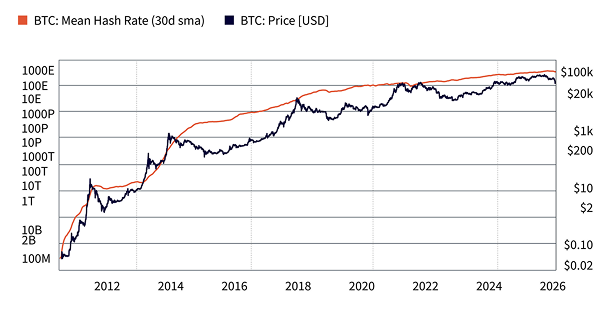
Bitcoin Hashrate vs. BTC Price

Financial Gateways and Institutional Integration

If blockchain networks form the economic substrate, then exchanges and custodians operate as the primary and systemically important financial gateways to traditional capital markets.

As infrastructure has matured, so too has the investor base. Ownership is increasingly shifting toward institutional and regulated capital, marking a transition from early adopters toward participants operating within formal mandates, governance frameworks, and risk constraints.
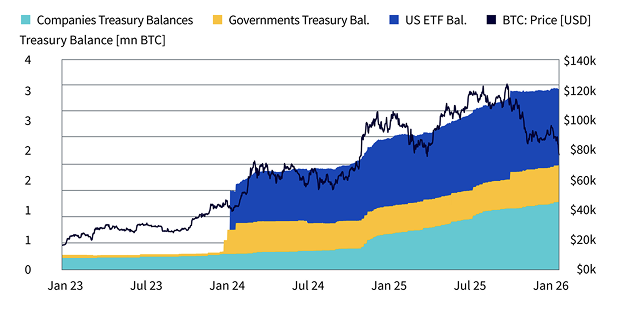
Institutional & Corporate Ownership of Bitcoin (Time Series)

The System’s Monetary Layer

Stablecoins have emerged as the core liquidity and settlement instrument within the blockchain economy. Functionally, they operate as the primary unit of account, medium of exchange, and collateral asset across both centralized and decentralized venues. Their ability to enable instant, final settlement makes them a growing rail for cross-border value transfer.

Growth in stablecoin supply reflects a broader structural shift: capital migrating from traditional banking infrastructure onto blockchain rails to support trading, settlement, and financial activity.
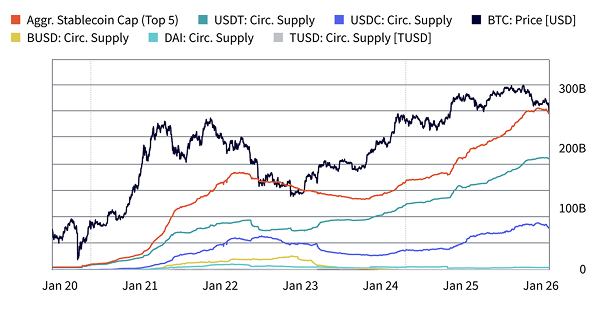
Stablecoin Supply Over Time

Extending Markets Beyond Traditional Rails

DeFi today represents an alternative financial system, where trading, lending, and capital deployment are executed through rules-based protocols rather than intermediaries.

This architecture enables continuous, transparent market activity, with mechanisms such as automated market making and on-chain credit replacing traditional structures.

At the same time, tokenization is extending this system outward: bringing traditional financial assets on-chain and deepening the integration between blockchain infrastructure and global capital markets.
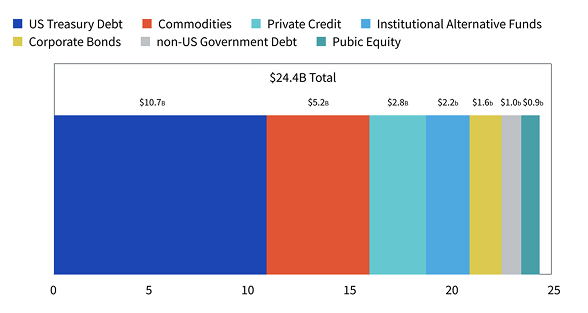
Tokenized Assets by Category

To read the full analysis, download the report in PDF format.

Download report PDF

Disclaimer: This report does not provide any investment advice. All data is provided for information and educational purposes only. No investment decision shall be based on the information provided here and you are solely responsible for your own investment decisions. We urge users to exercise caution and discretion when utilizing these metrics. Glassnode shall not be held responsible for any discrepancies or potential inaccuracies.


  • Follow us on X for timely market updates and analysis
  • Join our Telegram channel
  • For on-chain metrics, dashboards, and alerts, visit Glassnode Studio

Связанные с этим вопросы

QWhat is the primary measure of a blockchain's growth, health, and maturity that is independent of price?

ATransaction fees provide a direct, price-independent measure of a blockchain's growth, health, and maturity.

QHow do the security models of Bitcoin and Ethereum differ according to the report?

ABitcoin represents an energy-backed security model, while Ethereum is an example of a capital-backed security model.

QWhat role do stablecoins play in the blockchain ecosystem?

AStablecoins underpin settlement and liquidity across the ecosystem, acting as the primary unit of account and enabling real-time clearing and continuous capital mobility across global markets.

QWhat is the function of crypto exchanges and custodians in the blockchain economy?

ACrypto exchanges and custodians function as the primary financial gateways, linking on-chain activity to traditional capital markets and driving the transition from retail-dominated ownership to institutional participation.

QWhat is the core economic primitive for evaluating the blockchain ecosystem, as described in the 'Quantifying Network Demand' section?

ABlockspace is the core economic primitive for evaluating the ecosystem, as it is a scarce digital resource consumed by every transaction and priced dynamically through transaction fees.

Похожее

Прогноз цены Zcash: сможет ли обновление Ironwood поддержать 37% рост ZEC?

Цена Zcash (ZEC) выросла почти на 37% после развертывания на тестовой сети обновления Ironwood (NU6.3), которое знаменует собой важный переход для сети. Обновление, запланированное к активации в основной сети в конце июля, вводит новый защищенный пул и механизм «турникета» для повышения проверяемости предложения ZEC без ущерба для конфиденциальности. Оно также ознаменует начало вывода из эксплуатации устаревшего эталонного узла zcashd в пользу новой архитектуры на Rust. После роста цена ZEC консолидируется вокруг $546. Индекс RSI на дневном графике (~58) указывает на сохранение бычьих настроений. Ближайшее ключевое сопротивление находится на уровне $560, пробитие которого может открыть путь к $600. Основная поддержка сформирована в районе $500, и ее удержание важно для продолжения восходящего тренда.

ambcrypto6 мин. назад

Прогноз цены Zcash: сможет ли обновление Ironwood поддержать 37% рост ZEC?

ambcrypto6 мин. назад

BitMine добавляет 7 430 ETH и тратит $86 млн на выкуп акций – Почему?

Компания Bitmine на прошлой неделе значительно сократила закупки Ethereum (ETH), приобретя лишь 7430 ETH — это минимальный еженедельный объем с мая. Вместо наращивания криптовалютного резерва компания направила примерно 86 млн долларов на обратный выкуп 5,5 млн своих обыкновенных акций по средней цене 15,62 доллара, чтобы повысить акционерную стоимость. Несмотря на замедление темпов покупки, резерв Bitmine по-прежнему огромен и составляет 5 777 468 ETH (около 4,8% от общего объема эмиссии ETH). Компания близка к достижению своей долгосрочной цели — владению 5% всех ETH. Уже через 12 месяцев после запуска стратегии фонд почти достиг этого показателя. Кроме того, Bitmine разместила в стейкинге через свою платформу MAVAN около 4,92 млн ETH (85% своих активов). Это может приносить примерно 247 млн долларов годового дохода при текущей доходности в 2,67%, а после стейкинга всего резерва доход может вырасти до 290 млн долларов. Параллельно в статье отмечается, что пока Bitmine фокусируется на Ethereum, компания MicroStrategy Майкла Сэйлора продолжает агрессивно накапливать Bitcoin (BTC), несмотря на финансовое давление и недавние продажи части активов.

ambcrypto41 мин. назад

BitMine добавляет 7 430 ETH и тратит $86 млн на выкуп акций – Почему?

ambcrypto41 мин. назад

9,42 миллиона частных инвесторов бросились покупать акции Changxin Technology, кто же выиграл в лотерее?

Результаты размещения акций Changxin Technology привлекли огромное внимание инвесторов. Всего в онлайн-подписке для частных инвесторов участвовало около 9,4288 миллиона человек, было подано 816,92 миллиарда заявок на акции, сгенерировано примерно 7,7 миллиона выигрышных лотерейных номеров, а итоговая ставка онлайн-подписки составила около 0,4714%, что является рекордно высоким показателем для новых акций на рынке STAR. Из-за высокого спроса компания активировала механизм обратного перевода, увеличив количество акций, размещаемых онлайн, до 3,851 миллиарда. Среди институциональных инвесторов 285 организаций, управляющих 10907 счетами, подали заявки на сумму около 12,38 триллиона акций, получив в итоге 2,173 миллиарда акций при коэффициенте распределения около 0,1756%. Taikang Asset Management стал институциональным инвестором, получившим наибольшее распределение. Среди публичных фондов лидерами по объему размещения стали E Fund, Southern Fund и ICBC Credit Suisse. Основатель ведущей китайской компании в области больших моделей DeepSeek, Лян Вэньфэн, через свои хедж-фонды Ningbo幻方量化 и Zhejiang九章资产 получил самое большое распределение среди частных фондов — акций на общую сумму примерно 1,75 миллиарда юаней. Ожидается, что Changxin Technology официально выйдет на биржу 27 июля. По оценкам рынка, её стоимость после IPO может превысить 1 триллион юаней, а некоторые аналитики дают прогноз до 2-3 триллионов юаней. Однако недавняя коррекция на глобальном технологическом рынке может оказать определенное влияние на цену акций компании после листинга.

marsbit1 ч. назад

9,42 миллиона частных инвесторов бросились покупать акции Changxin Technology, кто же выиграл в лотерее?

marsbit1 ч. назад

Криптовалюта USCR стабилизируется на отметке $0,0022: Сможет ли мемкоин отыграть потери второго квартала?

Криптовалюта USCR, мемкоин, отслеживающий тему официальных крипторезервов США, пытается восстановиться после падения до двухмесячного минимума в $0.0022. В мае цена выросла на 65%, но в июне упала на 37%. Сейчас наблюдается потенциальный отскок, и если быкам удастся закрепиться выше ключевых скользящих средних, возможен рост до $0.0028 (уровень Фибоначчи) и далее до майского пика в $0.0036, что означает потенциал роста на 30-60%. Динамика USCR тесно связана с новостями о создании стратегического резерва биткойна в США. Майский рост совпал с увеличением вероятности этого события и внесением соответствующего законопроекта. Однако его рассмотрение застопорилось, а шансы на создание резерва к 2027 году, по данным Polymarket, упали до 18%, что давит на настроения. Несмотря на неопределённость, база держателей USCR остаётся значительной: 48 тысяч, сократившись лишь на 4 тысячи с начала 2026 года. Восстановление цены будет зависеть от позитивных новостей по законопроекту о биткойн-резерве.

ambcrypto1 ч. назад

Криптовалюта USCR стабилизируется на отметке $0,0022: Сможет ли мемкоин отыграть потери второго квартала?

ambcrypto1 ч. назад

«Богиня благотворительности» с 3 млн подписчиков целиком создана ИИ, поддельный детский дом, международный «фальшивый фонд» рухнул за одну ночь

**Шокирующий разоблачение: Астролябка «благотворительности» с 300 000 подписчиков оказалась масштабной аферой на основе ИИ** Австралийская инфлюенсерша Лили Джей, имевшая почти 3 миллиона подписчиков в Instagram, создала тщательно продуманную мошенническую схему под прикрытием своего «Фонда Лили Джей». Используя искусственный интеллект, она и ее команда генерировали фальшивые изображения и видео, изображающие строительство мечетей, раздачу хлеба в Газе и даже открытие детского дома в Уганде для привлечения пожертвований от преимущественно мусульманской аудитории. Расследование ABC News Verify выявило многочисленные подделки: видео с «открытием» детского дома полностью сгенерировано ИИ (включая детей, саму Лили и фонды), «награда» за гуманитарную деятельность оказалась фальшивкой с цифровым водяным знаком ИИ, а заявленные благотворительные проекты в Уганде и Газе не существуют. Фонд не зарегистрирован как официальная благотворительная организация, что позволяло избегать финансовой отчетности. После запросов ABC сайт фонда стал скрывать кнопки для пожертвований и предупреждения о своем неблаготворительном статусе для посетителей из Австралии, но оставил их для иностранных пользователей. Эксперты предупреждают, что эта афера — тревожный прецедент, демонстрирующий, как ИИ может эксплуатировать человеческое доверие и желание творить добро, создавая убедительные, но полностью вымышленные нарративы.

marsbit1 ч. назад

«Богиня благотворительности» с 3 млн подписчиков целиком создана ИИ, поддельный детский дом, международный «фальшивый фонд» рухнул за одну ночь

marsbit1 ч. назад

Торговля

Спот
活动图片