Wisdom Tree + Glassnode: Reframing Blockchains as Economic Systems

insights.glassnodeОпубликовано 2026-03-17Обновлено 2026-03-17

Введение

The digital asset ecosystem is increasingly viewed as an emerging financial system with its own infrastructure and economic structure. This report, a collaboration between Wisdom Tree and Glassnode, reframes blockchain networks as multi-layered economic systems that mirror traditional markets in function and incentives. Key insights include the use of transaction fees as a direct measure of blockchain health, the economic models of security (energy-backed for Bitcoin, capital-backed for Ethereum), and the industrialization of mining. Systemically important crypto exchanges and custodians now link on-chain activity to traditional capital markets, facilitating institutional adoption. Stablecoins serve as the core settlement and liquidity layer, while DeFi and tokenization extend financial functions on-chain with growing integration into traditional finance. The full analysis provides a data-driven framework for evaluating digital assets beyond price, using observable on-chain metrics and macroeconomic benchmarks.

The digital asset ecosystem is increasingly being evaluated not as a collection of speculative assets, but as an emerging financial system with its own infrastructure, economic inputs, and market structure.

In our joint analysis with Wisdom Tree, we reframe blockchain networks and digital assets as a multi-layered economic system that increasingly mirrors traditional markets in structure, incentives, and economic function.

For financial professionals, this framing demonstrates how digital assets can be analyzed through observable data and compared against traditional macroeconomic benchmarks, offering a more robust foundation for valuation and risk assessment than a price-centric analysis alone.

Key Takeaways

  • Transaction fees provide a direct, price-independent measure of a blockchain's growth, health and maturity. The transparency of blockchain data allows analysts to quantify economic activity with a level of fidelity that is difficult to achieve in other financial systems.
  • In blockchain systems, transaction security and settlement finality are enforced through economic incentives built into the protocol. Bitcoin represents an energy-backed security model, while Ethereum is an example of a capital-backed security model.
  • Mining has evolved into an industrialized commodity business: Cost structures, margin dispersion, and consolidation dynamics increasingly resemble traditional energy and extractive industries.
  • Crypto exchanges and custodians have become systemically relevant: they function as the primary financial gateways, linking on-chain activity to traditional capital markets, and driving the transition from retail-dominated ownership to institutional participation through regulated channels.
  • Stablecoins underpin settlement and liquidity across the ecosystem. Acting as the primary unit of account, stablecoins enable real-time clearing and continuous capital mobility across global markets.
  • DeFi and tokenization extend financial functionality on-chain. Trading, lending, and capital deployment are increasingly executed via rules-based systems, with growing integration into traditional finance.

The full report is freely available for download in PDF format.

Download report PDF

Quantifying Network Demand

At the foundation of the blockchain economy is blockspace, a scarce digital resource consumed by every transaction, smart contract execution, and settlement event, and priced dynamically through transaction fees.

Transaction fees, in this context, are not incidental costs but market-based pricing for network usage, offering a direct lens into network demand. Unlike traditional economic data, this activity is observable in near real time, enabling a high-fidelity view of system utilization.

While fee levels remain cyclical and sensitive to market conditions, the longer-term trend in the data points toward sustained growth in infrastructure-level demand. This dynamic positions blockspace as a core economic primitive for evaluating the ecosystem.

Security as an Economic Input

Blockchain networks replace institutional trust with explicitly funded security models, where participants are economically incentivized to validate transactions and maintain system integrity.

In Bitcoin’s Proof-of-Work model, this relationship is observable through hashrate, or the total computational power securing the network, which reflects the aggregate energy and capital deployed to maintain transaction finality. As the economic value of the network grows, so too does the incentive to invest in this security layer.

In practice, this has given rise to increasingly industrialised operations (most notably in Bitcoin mining), where cost efficiency, scale, and capital access shape competitive positioning.
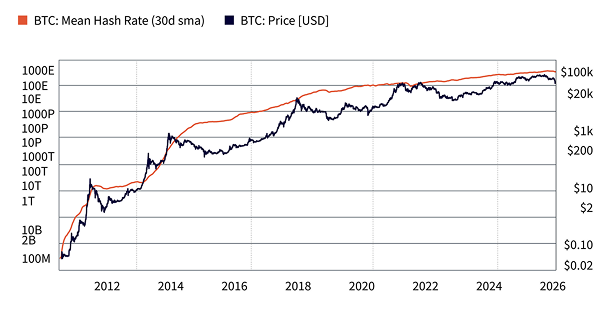
Bitcoin Hashrate vs. BTC Price

Financial Gateways and Institutional Integration

If blockchain networks form the economic substrate, then exchanges and custodians operate as the primary and systemically important financial gateways to traditional capital markets.

As infrastructure has matured, so too has the investor base. Ownership is increasingly shifting toward institutional and regulated capital, marking a transition from early adopters toward participants operating within formal mandates, governance frameworks, and risk constraints.
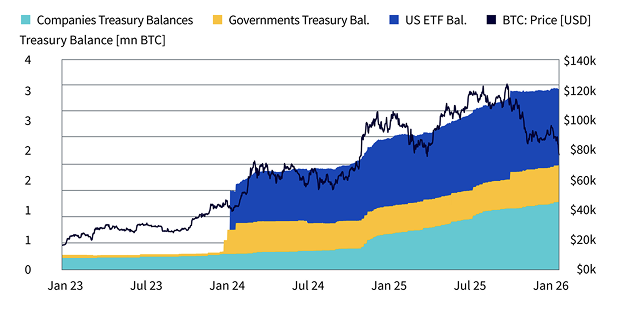
Institutional & Corporate Ownership of Bitcoin (Time Series)

The System’s Monetary Layer

Stablecoins have emerged as the core liquidity and settlement instrument within the blockchain economy. Functionally, they operate as the primary unit of account, medium of exchange, and collateral asset across both centralized and decentralized venues. Their ability to enable instant, final settlement makes them a growing rail for cross-border value transfer.

Growth in stablecoin supply reflects a broader structural shift: capital migrating from traditional banking infrastructure onto blockchain rails to support trading, settlement, and financial activity.
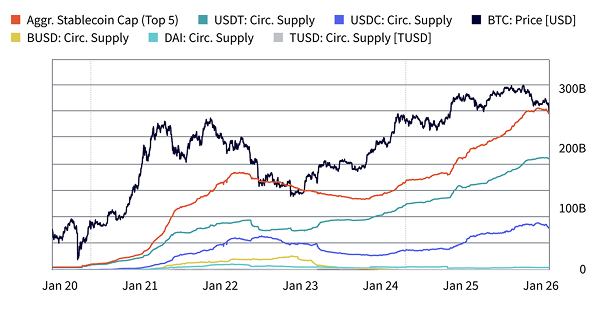
Stablecoin Supply Over Time

Extending Markets Beyond Traditional Rails

DeFi today represents an alternative financial system, where trading, lending, and capital deployment are executed through rules-based protocols rather than intermediaries.

This architecture enables continuous, transparent market activity, with mechanisms such as automated market making and on-chain credit replacing traditional structures.

At the same time, tokenization is extending this system outward: bringing traditional financial assets on-chain and deepening the integration between blockchain infrastructure and global capital markets.
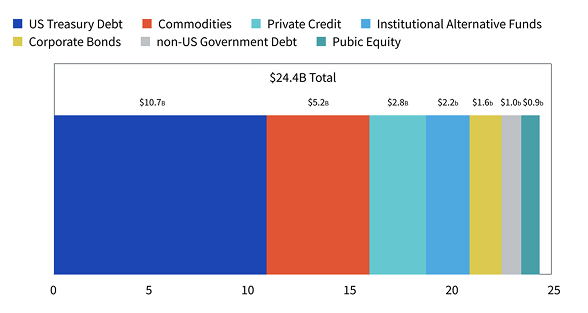
Tokenized Assets by Category

To read the full analysis, download the report in PDF format.

Download report PDF

Disclaimer: This report does not provide any investment advice. All data is provided for information and educational purposes only. No investment decision shall be based on the information provided here and you are solely responsible for your own investment decisions. We urge users to exercise caution and discretion when utilizing these metrics. Glassnode shall not be held responsible for any discrepancies or potential inaccuracies.


  • Follow us on X for timely market updates and analysis
  • Join our Telegram channel
  • For on-chain metrics, dashboards, and alerts, visit Glassnode Studio

Связанные с этим вопросы

QWhat is the primary measure of a blockchain's growth, health, and maturity that is independent of price?

ATransaction fees provide a direct, price-independent measure of a blockchain's growth, health, and maturity.

QHow do the security models of Bitcoin and Ethereum differ according to the report?

ABitcoin represents an energy-backed security model, while Ethereum is an example of a capital-backed security model.

QWhat role do stablecoins play in the blockchain ecosystem?

AStablecoins underpin settlement and liquidity across the ecosystem, acting as the primary unit of account and enabling real-time clearing and continuous capital mobility across global markets.

QWhat is the function of crypto exchanges and custodians in the blockchain economy?

ACrypto exchanges and custodians function as the primary financial gateways, linking on-chain activity to traditional capital markets and driving the transition from retail-dominated ownership to institutional participation.

QWhat is the core economic primitive for evaluating the blockchain ecosystem, as described in the 'Quantifying Network Demand' section?

ABlockspace is the core economic primitive for evaluating the ecosystem, as it is a scarce digital resource consumed by every transaction and priced dynamically through transaction fees.

Похожее

Диалог с Далио: Сейчас мы находимся в пузыре ИИ, 1% моего инвестиционного портфеля — это биткоин

Источник: интервью Рэя Далио, основателя Bridgewater Associates, для подкаста "The Diary Of A CEO". Далио, предсказавший кризис 2008 года, обсуждает "большой цикл" — концепцию, охватывающую долговые проблемы, растущее неравенство и геополитические сдвиги. Он указывает, что текущий ажиотаж вокруг ИИ демонстрирует классические признаки пузыря, который может лопнуть из-за высокой долговой нагрузки, роста процентных ставок и чрезмерной эмиссии акций, что способно привести к рецессии. Для защиты личного капитала в неопределенные времена Далио советует диверсификацию: вместо хранения наличных инвестировать в акции, золото, облигации. Сам он держит около 1% портфеля в биткоине, считая его "твердыми деньгами", но предпочитает физическое золото из-за его статуса резервного актива и независимости от технологических рисков. Говоря о влиянии ИИ, Далио отмечает, что технология заменяет не только физический труд, но и элементы мышления, что увеличит разрыв между капиталом и трудом. Ключевыми останутся человеческие качества — эмоции и интуиция, а успеха добьются те, кто научится работать в партнерстве с ИИ. На геополитической арене, по его мнению, мир движется к регионализации с центрами в виде США и Китая. Вовлечение США в конфликты, подобные иранскому, обнажает снижение их абсолютного влияния. Внутренние вызовы, такие как дебаты о налогах на богатство, риск капитального бегства и низкая производительность, также ставят под вопрос стабильность традиционных держав в текущей фазе цикла.

marsbit3 ч. назад

Диалог с Далио: Сейчас мы находимся в пузыре ИИ, 1% моего инвестиционного портфеля — это биткоин

marsbit3 ч. назад

7.2 трлн вон за один день: иностранные инвесторы установили рекорд чистых покупок в пятницу! Уолл-Стрит: встречный ветер в плане ликвидности на южнокорейском рынке уже утих

Капиталы возвращаются на южнокорейский рынок акций. 31 июля иностранные инвесторы осуществили чистые покупки акций KOSPI на рекордные 7,2 трлн вон за один день, что стало самым высоким показателем в истории. По данным Citigroup, эта цифра знаменует собой кардинальный разворот после месяцев масштабного оттока средств нерезидентов. В июле чистые продажи иностранными инвесторами значительно сократились до 9,8 трлн вон по сравнению с 48,4 трлн и 44,5 трлн вон в июне и мае соответственно. Одновременно внутренние пенсионные и инвестиционные фонды в июле вернулись к чистым покупкам на 1,0 трлн вон. Дополнительным фактором снижения волатильности стали новые правила Комиссии по финансовым услугам (FSC), ужесточившие с 31 июля доступ розничных инвесторов к ETF с плечом на отдельные акции. После введения норм торговый оборот таких инструментов упал примерно вдвое. Citigroup сохраняет целевую точку для KOSPI на уровне 10000 пунктов, отмечая ослабление давления со стороны движения капиталов. Аналитики видят поддержку рынку в устойчивости фундаментальных показателей сектора чипов памяти, низких оценках KOSPI, сильной экономике и благоприятной политике властей, включая возможные меры по поддержке ликвидности.

marsbit3 ч. назад

7.2 трлн вон за один день: иностранные инвесторы установили рекорд чистых покупок в пятницу! Уолл-Стрит: встречный ветер в плане ликвидности на южнокорейском рынке уже утих

marsbit3 ч. назад

Как стать человеком, которого искусственный интеллект никогда не сможет заменить

В статье рассматривается вопрос о том, как остаться незаменимым в эпоху искусственного интеллекта. Автор утверждает, что вместо страха перед ИИ следует сосредоточиться на развитии качеств, которые машины не смогут заменить. Он критикует «зарплатное рабство» — зависимость от работы, не приносящей удовлетворения, и предлагает путь к финансовой независимости через создание собственного дела. Ключ к успеху — развитие пяти элементов: самостоятельности (агентности), вкуса, умения убеждать, упорства и способности к итерациям. Главное — не просто создавать что-либо (сегодня это может каждый), а создавать что-то ценное, востребованное и уметь это продвигать. Автор считает, что наиболее важным навыком будущего является создание контента (медиа), а не просто написание кода, поскольку ценность контента субъективна и требует уникального человеческого вкуса и суждения. ИИ может помочь в производстве, но не заменит оригинальность мысли и связь с аудиторией. В качестве практического шага предлагается упражнение: за 15 минут ответить на вопросы, чтобы обнаружить свои уникальные знания, опыт и точку зрения, которые станут основой для личного бренда и дела жизни. Первый шаг — немедленно опубликовать свою основную идею, чтобы получить обратную связь от реального мира и начать процесс роста. Цель — стать «непригодным для найма», построив жизнь вокруг собственного творчества и экспертизы.

marsbit6 ч. назад

Как стать человеком, которого искусственный интеллект никогда не сможет заменить

marsbit6 ч. назад

Благодаря броскам кубиков ключи от биткоинов хранятся в автономном режиме, но не все будут этим заниматься

Статья посвящена практике генерации сид-фраз для биткоин-кошельков с помощью бросков кубиков в свете уязвимости, обнаруженной в аппаратных кошельках Coldcard. Подчеркивается, что физический бросок кубика (дающий около 2.6 бит энтропии за бросок) создает высококачественную случайность, поскольку предсказать результат практически невозможно из-за множества переменных. Для создания стандартной сид-фразы из 12 слов (128 бит энтропии) требуется около 50 бросков, а для повышенной безопасности рекомендуется 99 и более. В связи с инцидентом Coldcard, когда неисправный генератор случайных чисел в прошивке (2021-2026 гг.) мог создавать предсказуемые ключи, выяснилось, что сид-фразы, сгенерированные вручную через кубики, были защищены от этой уязвимости. Однако исследование показало, что другие функции устройства (создание бумажных кошельков, ключей для мультиподписи, паролей и т.д.) по-прежнему использовали скомпрометированный генератор, подвергая риску владельцев даже с безопасной основной сид-фразой. Автор отмечает, что, хотя метод с кубиками криптографически надежен, он непрактичен для массового использования из-за трудоемкости, высокой вероятности ошибок при вводе и необходимости строгой дисциплины для сохранения секретности процесса. Делается вывод, что будущее безопасности лежит в создании надежных аппаратных генераторов случайных чисел и понятных интерфейсов, а ручные методы остаются нишевым инструментом для опытных пользователей. Владельцам Coldcard рекомендуется обновить прошивку и проверить/заменить все ключи, сгенерированные уязвимыми функциями.

cryptonews.ru9 ч. назад

Благодаря броскам кубиков ключи от биткоинов хранятся в автономном режиме, но не все будут этим заниматься

cryptonews.ru9 ч. назад

Торговля

Спот
活动图片





