Why Should We Pay Attention to Japanese Government Bond Yields for Their Impact on Gold and Bitcoin?

marsbitОпубликовано 2026-01-23Обновлено 2026-01-23

Введение

This article explores the unusual divergence between gold and Bitcoin in response to rising Japanese Government Bond (JGB) yields. Typically, rising long-term yields suppress gold by increasing the opportunity cost of holding non-yielding assets. However, gold has recently moved in tandem with Japan’s 10-year yield, indicating a shift in market dynamics. This positive correlation suggests that markets are interpreting yield increases not as mere monetary tightening, but as a signal of credit risk and financial system stress—making gold a hedge against balance sheet vulnerabilities. In contrast, Bitcoin has maintained a negative correlation with JGB yields, underperforming as yields rise. This divergence highlights that Bitcoin is still reacting to yield increases as a tightening shock rather than a risk signal. Japan is a critical pressure point because its financial system is structurally exposed to rapid yield increases. Japanese banks hold significant long-duration JGBs, and a sharp, volatile rise in yields could strain the system, potentially triggering intervention by the Bank of Japan (BOJ). If the BOJ intervenes to stabilize yields, the article suggests gold may enter a consolidation phase as one of its key catalysts fades. Bitcoin, relieved of macro pressure, could see a rebound. The core insight is that JGB yields have become a barometer for global risk sentiment, with gold absorbing stress and Bitcoin reacting to it. Until Japanese yields stabilize, this divergen...

Editor's Note: The simultaneous rise in gold and Japan's 10-year yield contrasts sharply with the weakness in Bitcoin. This article points out that this divergence reflects a market shift from 'tightening trades' to 'risk pricing,' and every move by the Bank of Japan could become a key variable in breaking the current pattern.

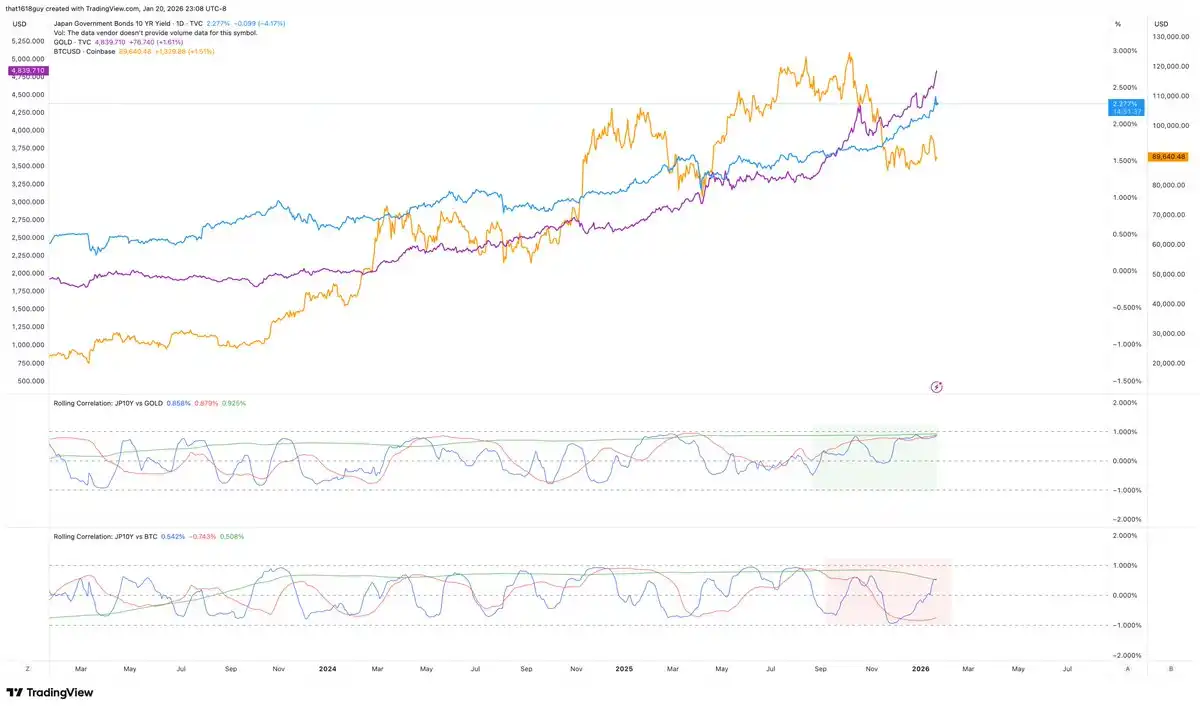
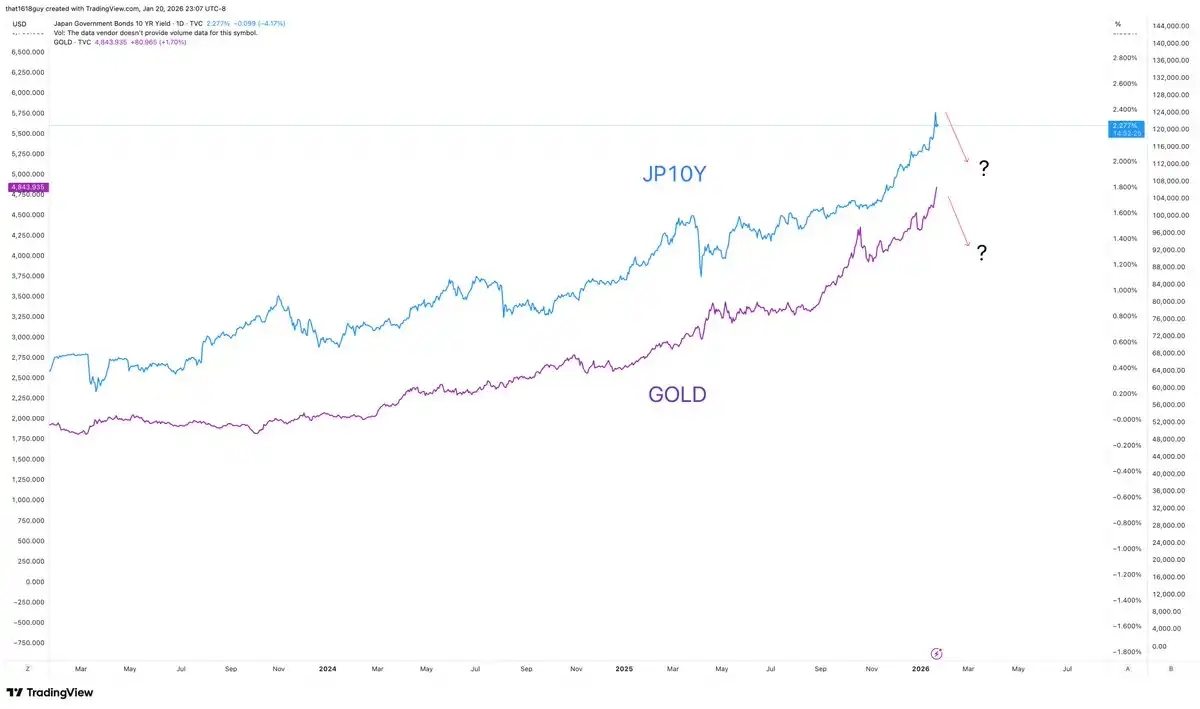
One of the most intriguing macro trends currently is the联动 relationship between gold and Japan's 10-year government bond yield. These two assets are moving in sync, which defies the norm in a typical monetary policy tightening cycle.

The following will analyze why gold is following the movement of Japanese yields, why Japan has become a key pressure point in the market, and the potential impact on Bitcoin if the Bank of Japan intervenes.

Gold and Japanese Bonds Climb Together... While Bitcoin Moves in the Opposite Direction

In a常规 environment, rising long-term yields suppress gold prices by increasing the opportunity cost of holding non-yielding assets. This negative correlation only breaks when yields deviate from the market's normal development and instead signal policy pressure. The current sharp surge in Japan's 10-year yield, with gold rising同步, precisely confirms the latter scenario.

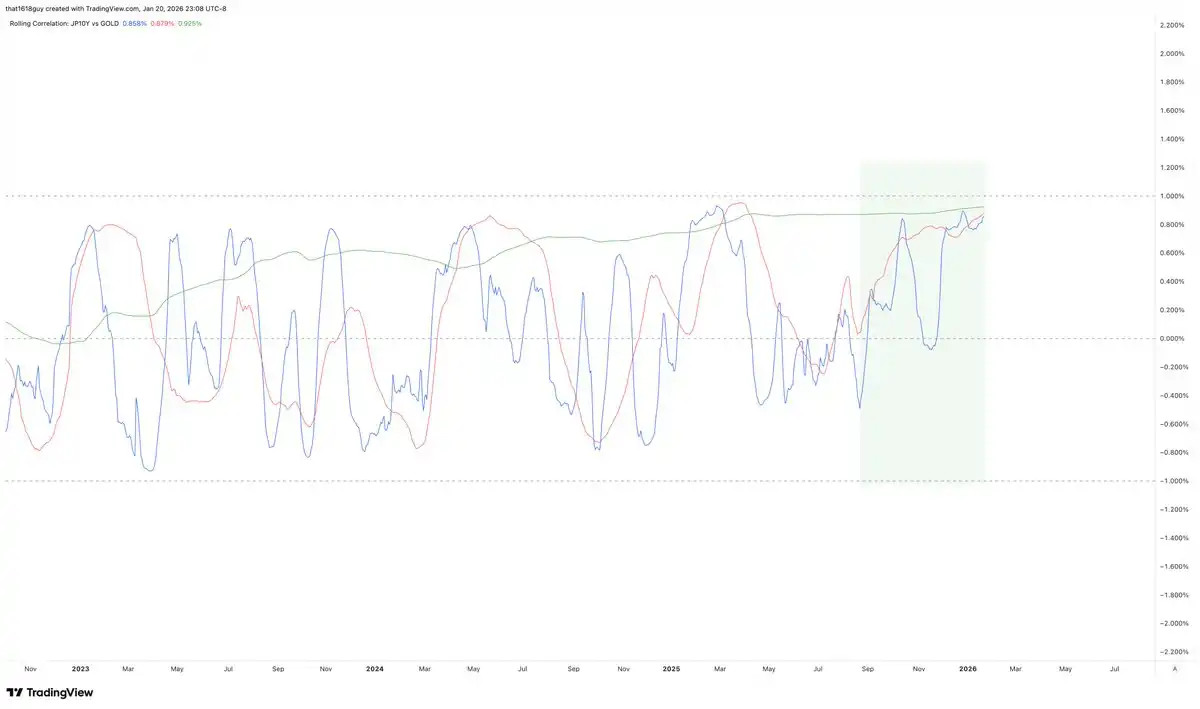
This correlation chart clearly reveals this shift.

The blue line in the chart shows the 30-day correlation between Japan's 10-year yield and gold. Although it still has fluctuations, the duration it stays in positive territory has significantly increased, rather than quickly falling into negative territory. This alone indicates that the traditional inverse relationship is weakening.

More importantly, the red line representing the 90-day correlation has followed suit and risen, indicating this is not short-term noise. Most convincing is the green line representing the 1-year correlation: it has steadily climbed and stabilized in positive territory.

When long-term correlations turn positive and remain high, it often signals a fundamental change in market logic. Rising Japanese bond yields no longer pose阻力 to gold but are instead interpreted by the market as a stress signal that gold is absorbing. This suggests the market views yield increases as a risk signal, not merely a tightening signal.

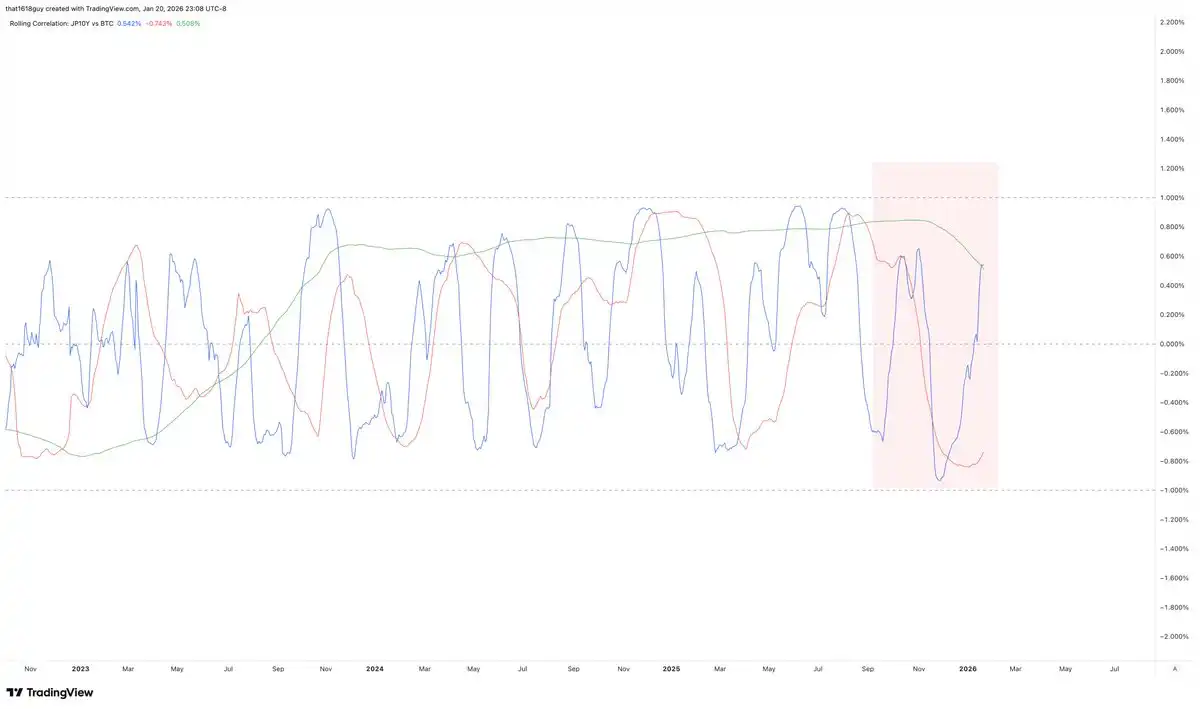
Even more interesting is that other markets haven't shown a similar phenomenon. During the same period, Bitcoin and Japan's 10-year yield have maintained a negative correlation.

A second correlation chart highlights this contrast.

The 30-day and 90-day correlations between Japan's 10-year yield and Bitcoin, while volatile as expected, primarily operate below the zero axis, reflecting Bitcoin's sensitivity to short-term macro pressures. Most crucially, the green 1-year correlation line has turned downward and remains negative, indicating that over a longer time horizon, Bitcoin consistently faces pressure when Japanese yields rise.

In other words, to see sustainable signs of a rebound, we need Japan's 10-year yield to start cooling down—theoretically, this would also be reflected in the gold price.

How to Interpret the Current Market Logic

When gold and sovereign bond yields rise together, the market is pricing not economic growth or enhanced monetary policy discipline, but credit risk and balance sheet fragility.

This pattern typically emerges under the following circumstances: hedging demand overpowers arbitrage logic, policy control capabilities are questioned, and rising yields expose duration mismatches rather than抑制 economic activity. In this environment, gold acts less like an inflation hedge and more like a balance sheet hedge.

The inverse relationship between Bitcoin and Japanese yields reinforces this interpretation. The market views rising Japanese yields as a tightening shock. Gold benefits from this while Bitcoin does not. This current divergence is a key signal.

Why Japan is the Key Pressure Point

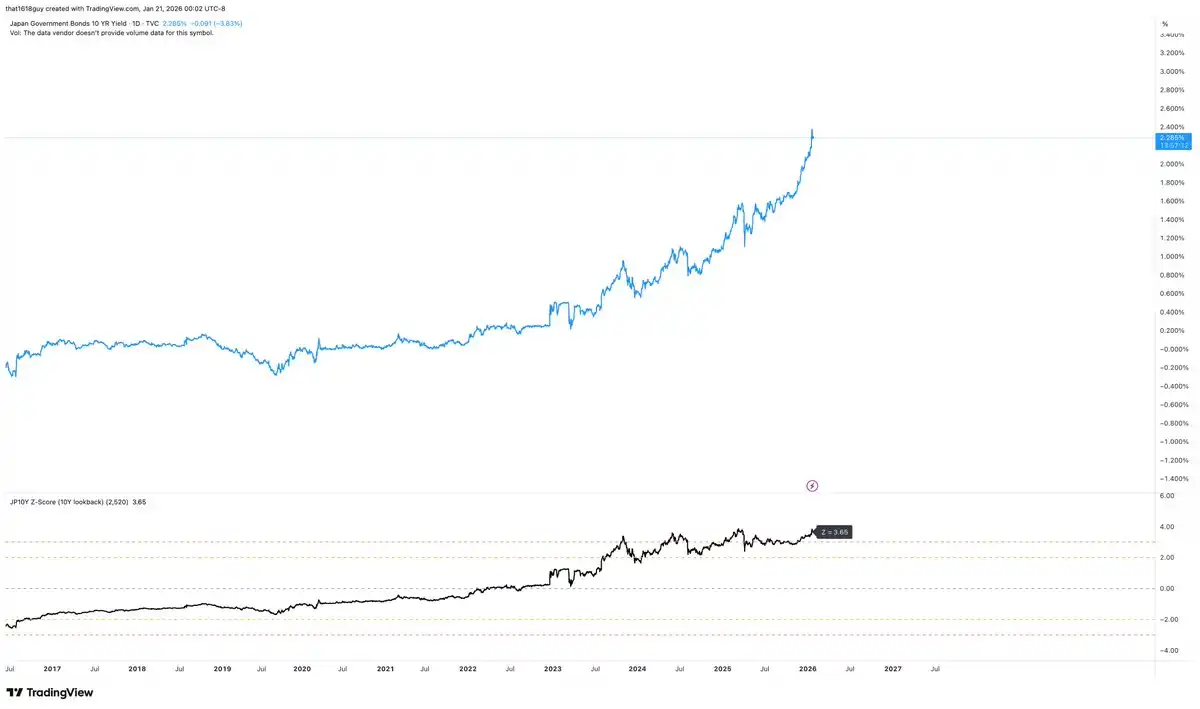
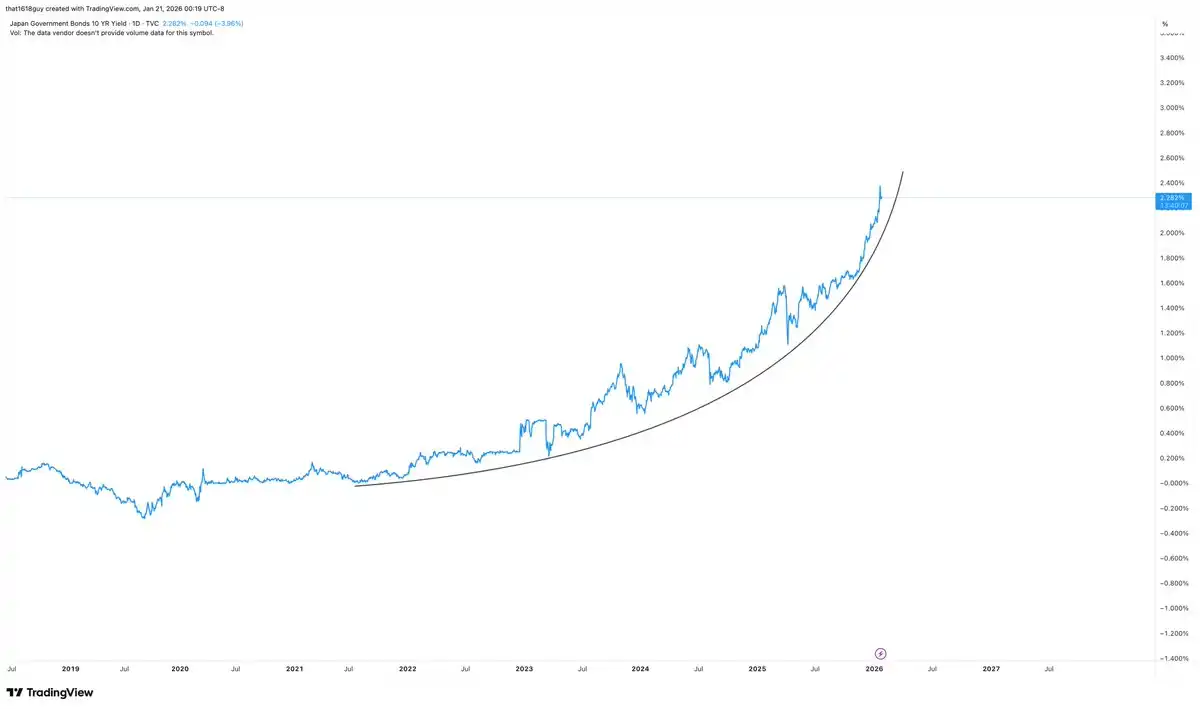
Japan has a unique sensitivity to this dynamic. The straight-line rise in Japan's 10-year government bond yield shown in the chart above is by no means a neutral event for its domestic financial system. The key is not just that yields are rising, but that the magnitude of the increase has reached statistically extreme values relative to Japan's own policy framework.

Calculated on a rolling 10-year window, the current Japan 10-year yield is about 3.65 standard deviations above its long-term average. This is equivalent to flipping a coin 13 times in a row and getting heads every time.

This is noteworthy in any market. But in Japan, where long-term yields have been strictly controlled for the past decade, a fluctuation of this magnitude clearly signals that the policy anchor is loosening. This is a classic特征 of the old order unraveling.

As important as the absolute level is the speed of the increase.

The steep slope of the recent yield surge has turned an interest rate move into a balance sheet event. Japan can gradually digest higher yields, but it struggles to cope calmly with a rapid duration repricing occurring abruptly within a financial system explicitly designed around yield suppression.

When yields shoot up vertically, the market is not just finding a new equilibrium; it is stress-testing all participants betting on the 'unchanged Japan model.'

Japanese banking institutions are structurally long duration and deeply hold JGBs as assets and collateral. This makes rapid yield increases inherently destabilizing, not merely restrictive. As yields spike sharply, bond portfolio market values shrink, collateral quality deteriorates, and financing conditions tighten within a system explicitly designed for yield suppression.

This is why the Bank of Japan has historically intervened when stress manifests in the data, not after the market has normalized. The BOJ doesn't need to wait for yields to hit an absolute threshold; accelerating moves of multiple standard deviations are often enough to trigger action.

Therefore, yield normalization in Japan is not a simple market adjustment but a balance sheet变动 that poses tangible transmission risks to the banking system, especially if market volatility is disorderly or one-way.

The current trajectory of Japan's 10-year government bonds significantly increases the motivation for the Bank of Japan to intervene. Such intervention does not necessarily require explicitly reinstating hard Yield Curve Control. Verbal guidance, targeted yield-smoothing operations, or more moderate control over the long-term bond market might be sufficient to slow the volatility in the yield curve and stabilize market conditions.

The Impact of BOJ Intervention on Gold

If the BOJ conducts credible intervention and regains control over long-end yields, this specific stress signal should weaken. This does not mean gold suddenly turns bearish, but it would likely remove a key catalyst for the current rally.

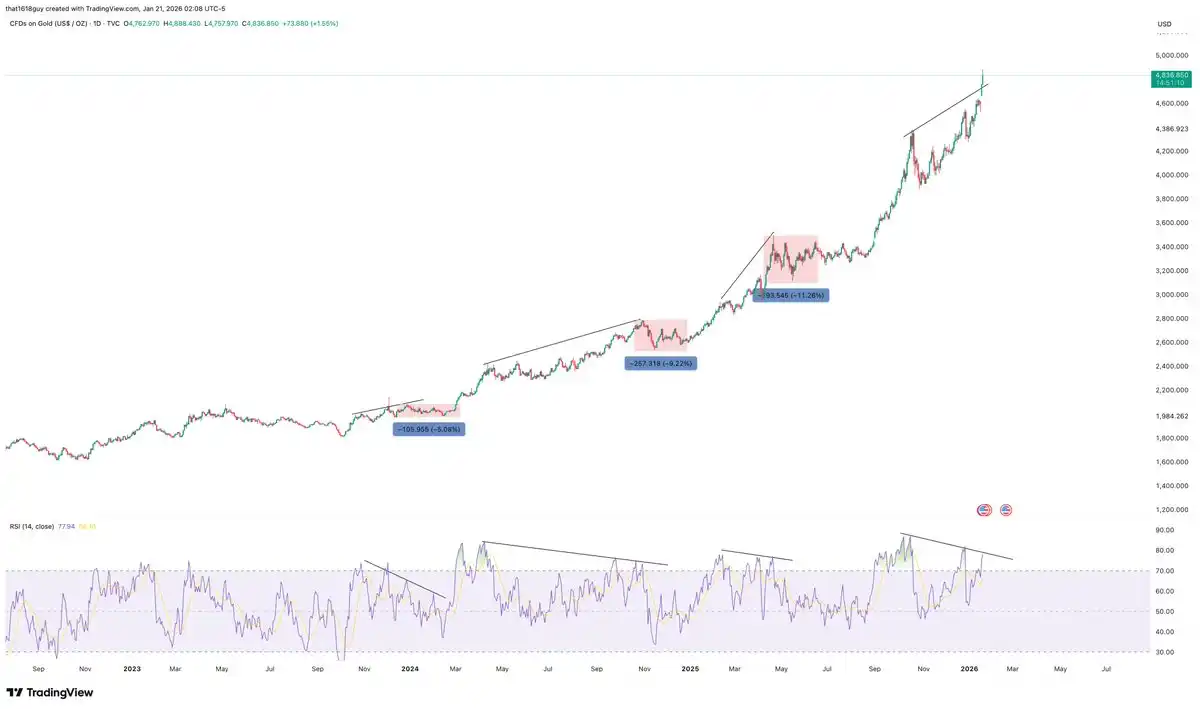
Combined with the analysis in the author's article 'Commodities Lead, Bitcoin Follows' published last week at Delphi Digital, the gold chart hints at this dynamic.

Although the overall uptrend remains intact, the upward momentum is no longer expanding at the same rate. The recent rally pushed the price to the upper edge of the rising channel but lacked the momentum confirmation seen in the early stages of the rise. Even as prices gradually move higher, the RSI indicator struggles to break previous highs, suggesting marginal buyers are becoming more cautious.

This aligns with a market that is structurally bullish but increasingly relies on policy stress rather than broad participation. Gold benefits from the vertical rise in Japan's 10-year yield, but this benefit manifests more in price persistence than acceleration. When the main catalyst is expected to be resolved, price action often shifts from impulsive to digestive.

Decisive intervention by the BOJ would likely break the link between gold and Japanese yields, reduce the pricing of policy stress, and perfectly match the signals already emitted by the chart——the market is forming a local top or entering a consolidation phase, not a trend reversal. Such an outcome would allow gold to work off excess momentum through time rather than price, cooling the pace of advance while preserving the larger trend.

Structurally, gold's support does not rely on Japanese stress, but marginally it clearly benefits from it. If that pressure is contained, the chart shows the market is prepared to pause the commodity trade.

The Impact of BOJ Intervention on Bitcoin

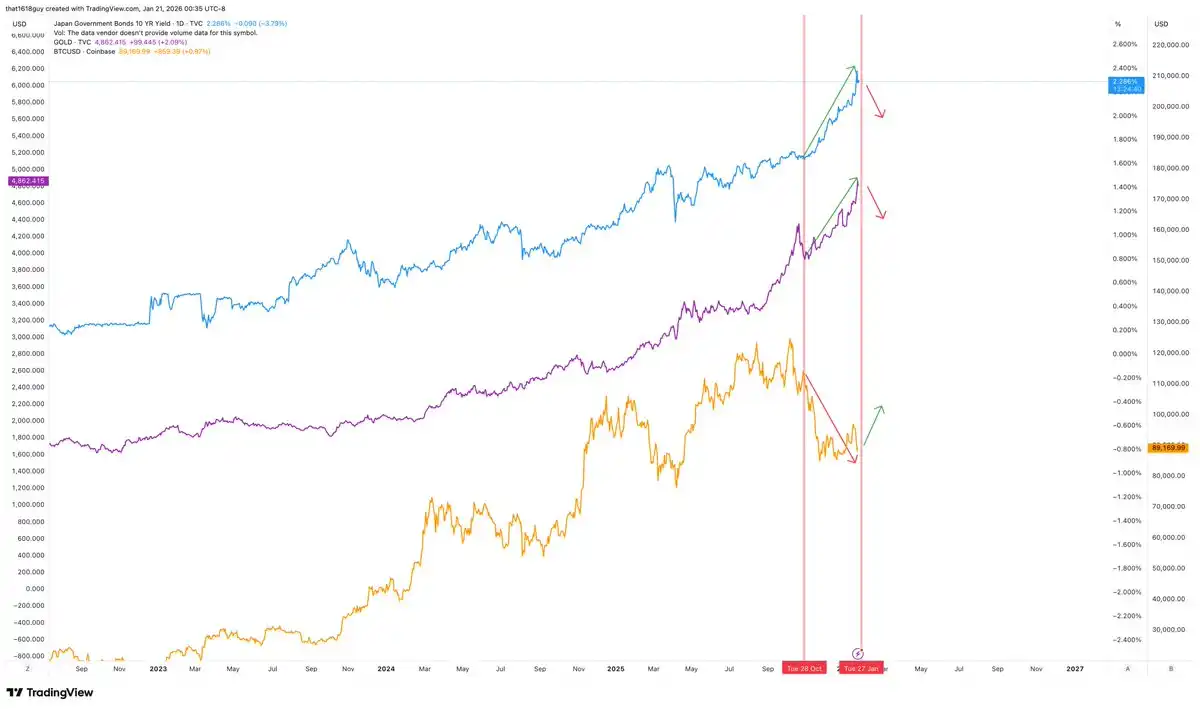
Given that Bitcoin's movement is inversely related to Japanese yields and gold, this relationship should also manifest when the BOJ finally decides to step in.

The chart already hints at this asymmetry: even as gold and Japanese yields continued to climb, Bitcoin, while weak, showed signs of stabilization rather than accelerated decline. This pattern fits an asset finding a bottom under macro pressure, remaining highly sensitive to any credible suppression measures.

If BOJ intervention materializes, Bitcoin's reaction is likely to differ from gold's. With global liquidity conditions stabilizing and the tightening shock from Japanese long-end yields easing, Bitcoin could experience a recovery rather than a pullback. In this sense, Bitcoin is not competing with gold in this mode; it's more like 'digital gold' waiting for the stress signal to be lifted.

Conclusion

The key insight is not that gold has peaked or that Japanese intervention is imminent, but that the market has already begun to treat Japanese yields as a global stress signal, and asset price behavior is adjusting accordingly.

Gold is absorbing this stress, while Bitcoin is reacting to it. The divergence between the two is revealing. As long as Japan's 10-year yield continues to rise unimpeded, gold's strength is logical. If the BOJ intervenes and regains control, the stress premium in gold should ease, and price action may shift from accelerating gains to choppy consolidation.

Regardless, the Japanese government bond market currently serves as the clearest window into how the market is pricing policy risk and balance sheet fragility. Until Japan's 10-year yield shows signs of softening, gold may continue its upward march, while Bitcoin's price performance may remain weak.

Связанные с этим вопросы

QWhy is the positive correlation between gold and Japanese 10-year bond yields significant in the current market?

AThe positive correlation is significant because it signals a fundamental shift in market logic. Instead of rising yields suppressing gold (as in a typical tightening cycle), the market now interprets the surge in Japanese yields as a risk signal, particularly concerning credit risk and balance sheet fragility. Gold is acting as a balance sheet hedge rather than just an inflation hedge.

QHow does the relationship between Bitcoin and Japanese 10-year yields differ from that of gold?

ABitcoin maintains a negative correlation with Japanese 10-year yields, meaning its price tends to fall as yields rise. This contrasts with gold's positive correlation. This divergence indicates that the market views rising Japanese yields as a tightening shock that pressures Bitcoin, while gold benefits from the same risk-off sentiment.

QWhat makes Japan a critical pressure point in the global financial system according to the article?

AJapan is a critical pressure point because its financial system is structurally long duration and heavily exposed to Japanese Government Bonds (JGBs). A rapid, multi-standard deviation rise in yields creates instability by causing bond portfolio markdowns, deteriorating collateral values, and tightening funding conditions in a system designed for yield suppression, posing a传导风险 (transmission risk) to the banking sector.

QWhat impact would credible intervention by the Bank of Japan (BOJ) have on the price of gold?

ACredible BOJ intervention to control long-term yields would likely remove a key catalyst for gold's recent strength by reducing the policy stress premium priced into the metal. This would cause gold's price action to shift from impulsive gains to a consolidation phase, cooling the pace of the rally without necessarily reversing the overall bullish trend.

QHow would the Bitcoin market likely react to intervention by the Bank of Japan?

ABitcoin would likely experience a recovery or rally if the BOJ intervenes. Since Bitcoin has been negatively correlated with and pressured by rising Japanese yields, a successful intervention that stabilizes global liquidity conditions and eases the tightening shock from Japan's long-end would remove this headwind, allowing Bitcoin's price to rebound.

Похожее

The Essence of AI Layoffs: Why More AI Adoption Leads to More Corporate Anxiety?

The author, awaiting potential inclusion on an 8000-person layoff list, analyzes the true nature of recent "AI-driven" layoffs. They argue that while AI use, particularly tools like Claude for code generation, has skyrocketed and boosted developer output (e.g., 2-5x more code commits), this has not translated into proportional business growth or revenue. The core issue is a misalignment between increased "Input" (code) and tangible "Outcomes" (user value, revenue). AI acts as a costly B2B SaaS, inflating operational expenses without guaranteed returns. Two key problems emerge: 1) The friction that once filtered out bad ideas is gone, as AI allows cheap pursuit of even weak concepts. 2) Organizational "alignment tax"—the difficulty of coordinating across teams—becomes crippling when development velocity outpaces consensus-building. Thus, layoffs serve two immediate purposes: 1) To offset ballooning AI costs (Token consumption) and maintain cash flow, as rising input costs without outcome growth destroys unit economics. 2) To reduce organizational bloat and alignment friction by simply removing teams, thereby speeding up execution in the short term. Therefore, these layoffs are fundamentally caused by AI, even if AI doesn't directly replace roles. They represent a painful correction until companies learn to convert AI-driven productivity into real business outcomes and streamline organizational coordination to match the new pace of work. The cycle will continue until this learning curve is mastered.

marsbit30 мин. назад

The Essence of AI Layoffs: Why More AI Adoption Leads to More Corporate Anxiety?

marsbit30 мин. назад

Can the Solana Foundation and Google's Collaboration on Pay.sh Bridge the Payment Link Between Web2 and Web3 in the Agent Economy?

Solana Foundation, in collaboration with Google Cloud, has launched Pay.sh, a payment gateway designed to bridge the gap between AI agents and enterprise-grade service infrastructure. The initiative aims to solve a key bottleneck in the "agent economy": existing payment systems are ill-suited for autonomous AI agents. Traditional methods like credit cards require human verification, while newer on-chain protocols like x402 and MPP create a separate, Web3-native system that raises barriers for service providers. Pay.sh functions as a universal payment layer. It allows users to fund a Solana wallet via credit card or stablecoin, which then acts as an identity and payment proxy for AI agents. When an agent needs to access a paid API service (e.g., Google Cloud, Alibaba Cloud), Pay.sh handles the transaction seamlessly. It leverages the HTTP 402 status code ("Payment Required") to initiate payments, intelligently choosing between one-time transfers (x402-style) or session-based authorizations (MPC-style) based on the service's billing model. This spares agents from manual account registration and API key management. A key feature for service providers is low integration effort. They can adopt Pay.sh by providing a declarative configuration file, enabling features like tiered pricing, free tiers, and automatic revenue splitting to multiple addresses (e.g., for royalties, cloud costs). Providers can also list their APIs in a central Pay Skill Registry for agent discovery. The collaboration with Google Cloud provides crucial infrastructure for API proxying, traffic routing, and compliance logging, aiming to keep agent activities within regulated boundaries. By connecting Web2 services with Web3 payment rails, Pay.sh positions the Solana wallet as a foundational identity and payment tool for AI agents, potentially driving more transaction volume to the Solana ecosystem. However, the report notes challenges. The service registry currently lacks robust vetting, risking exposure to unauthorized or malicious third-party APIs. Pay.sh also inherits security and compatibility risks from its underlying payment protocols (x402, MPC). Furthermore, adoption may be hindered by varying regional data privacy and payment compliance regulations among API providers. Despite these hurdles, Pay.sh represents a significant step towards integrating Web2 and Web3 for autonomous agent commerce.

marsbit36 мин. назад

Can the Solana Foundation and Google's Collaboration on Pay.sh Bridge the Payment Link Between Web2 and Web3 in the Agent Economy?

marsbit36 мин. назад

Bitcoin's Bull-Bear Cycle Indicator Turns Positive for the First Time in 7 Months: End of Bear Market or False Breakout?

Bitcoin's "Bull-Bear Market Cycle Indicator" from CryptoQuant has turned positive for the first time since October 2025. This gauge, based on the P&L Index relative to its 365-day moving average, suggests a potential shift from a bear market phase. Concurrently, the Bull Score Index rose to a neutral reading of 50 in late April. The indicator's move into positive territory follows a roughly 35% price rebound from a low near $60,000 in February to above $81,000. The recovery over approximately three months was faster than the 12-month period observed during the 2022 bear market. However, analysts caution against premature optimism, citing a historical precedent from March 2022. Back then, the Bull Score Index briefly hit 50, but it proved to be a false signal as Bitcoin's price subsequently plunged further. Structural differences exist in the current cycle, including consistent inflows into spot Bitcoin ETFs and an increase in large holder addresses. Yet, some models, referencing the four-year halving cycle, suggest a potential deeper bottom near $50,000 might still be possible around late 2026. In summary, while on-chain data shows marked improvement and the worst panic may be over, market participants remain cautious. A convincing trend reversal confirmation likely requires Bitcoin to sustainably break above key resistance, such as the 200-day moving average near $82,000.

marsbit44 мин. назад

Bitcoin's Bull-Bear Cycle Indicator Turns Positive for the First Time in 7 Months: End of Bear Market or False Breakout?

marsbit44 мин. назад

How to Automate Any Workflow with Claude Skills (Complete Tutorial)

This is a comprehensive guide to mastering Claude Skills, a feature for creating permanent, reusable instruction sets that automate specific workflows. Unlike simple saved prompts, Skills function like trained employees, delivering consistent, high-quality outputs by defining the entire task process, standards, error handling, and output format. The guide is structured in four phases: **Phase 1: Installation (5 minutes).** Skills are folders containing a `SKILL.md` file. The user is instructed to find a relevant Skill online, install it, test it on a real task, and compare its performance to one-off prompts. **Phase 2: Building Your First Custom Skill.** Start by rigorously defining the Skill's purpose, trigger phrases, and providing a concrete example of perfect output. The `SKILL.md` file has two parts: a YAML frontmatter with a specific name/description/triggers, and a detailed, step-by-step workflow written in natural language with examples and quality standards. **Phase 3: Testing & Optimization for Production.** Test the Skill in three scenarios: 1) a standard, common task; 2) edge cases with missing or conflicting data; and 3) a pressure test with maximum complexity. Any failure indicates a needed instruction. Implement a weekly optimization cycle to continuously refine the Skill based on real usage. **Phase 4: Building a Complete Skill Library.** The goal is to create a team of Skills for all repetitive tasks. Examples are given for industries like real estate, marketing, finance, consulting, and e-commerce. The user should list their tasks, prioritize them, and build one new Skill per week, maintaining a master document to track their library. The conclusion emphasizes the compounding time savings: ten Skills saving 30 minutes each per week reclaims over 260 hours (6.5 work weeks) per year, fundamentally transforming one's work system.

marsbit1 ч. назад

How to Automate Any Workflow with Claude Skills (Complete Tutorial)

marsbit1 ч. назад

Торговля

Спот
Фьючерсы

Популярные статьи

Тест по Bitcoin Биткоина

HTX Learn: Изучите Bitcoin halving и Заработаете Токены USDT

3.0k просмотров всегоОпубликовано 2024.04.16Обновлено 2024.04.16

Тест по Bitcoin  Биткоина

Что такое $BITCOIN

ЦИФРОВОЕ ЗОЛОТО ($BITCOIN): Комплексный анализ Введение в ЦИФРОВОЕ ЗОЛОТО ($BITCOIN) ЦИФРОВОЕ ЗОЛОТО ($BITCOIN) — это проект на основе блокчейна, работающий в сети Solana, который стремится объединить характеристики традиционных драгоценных металлов с инновациями децентрализованных технологий. Хотя он носит имя Биткойн, часто называемого “цифровым золотом” из-за его восприятия как средства хранения ценности, ЦИФРОВОЕ ЗОЛОТО является отдельным токеном, предназначенным для создания уникальной экосистемы в ландшафте Web3. Его цель — позиционировать себя как жизнеспособный альтернативный цифровой актив, хотя детали его применения и функциональности все еще развиваются. Что такое ЦИФРОВОЕ ЗОЛОТО ($BITCOIN)? ЦИФРОВОЕ ЗОЛОТО ($BITCOIN) — это токен криптовалюты, специально разработанный для использования в блокчейне Solana. В отличие от Биткойна, который выполняет широко признанную роль хранения ценности, этот токен, похоже, сосредоточен на более широких приложениях и характеристиках. Примечательные аспекты включают: Инфраструктура блокчейна: Токен построен на блокчейне Solana, известном своей способностью обрабатывать высокоскоростные и недорогие транзакции. Динамика предложения: ЦИФРОВОЕ ЗОЛОТО имеет максимальное предложение, ограниченное 100 квадриллионами токенов (100P $BITCOIN), хотя детали о его обращающемся предложении в настоящее время не раскрыты. Утилита: Хотя точные функциональные возможности не описаны, есть указания на то, что токен может быть использован для различных приложений, потенциально связанных с децентрализованными приложениями (dApps) или стратегиями токенизации активов. Кто создатель ЦИФРОВОГО ЗОЛОТА ($BITCOIN)? На данный момент личность создателей и команды разработчиков, стоящих за ЦИФРОВЫМ ЗОЛОТОМ ($BITCOIN), остается неизвестной. Эта ситуация типична для многих инновационных проектов в области блокчейна, особенно тех, которые связаны с децентрализованными финансами и феноменом мем-криптовалют. Хотя такая анонимность может способствовать культуре, ориентированной на сообщество, она усиливает опасения по поводу управления и ответственности. Кто инвесторы ЦИФРОВОГО ЗОЛОТА ($BITCOIN)? Доступная информация указывает на то, что у ЦИФРОВОГО ЗОЛОТА ($BITCOIN) нет известных институциональных спонсоров или значительных венчурных капиталовложений. Проект, похоже, функционирует по модели пирингового взаимодействия, сосредоточенной на поддержке и принятии сообществом, а не на традиционных путях финансирования. Его активность и ликвидность в основном сосредоточены на децентрализованных биржах (DEX), таких как PumpSwap, а не на устоявшихся централизованных торговых платформах, что еще больше подчеркивает его подход, ориентированный на grassroots. Как работает ЦИФРОВОЕ ЗОЛОТО ($BITCOIN) Операционные механизмы ЦИФРОВОГО ЗОЛОТА ($BITCOIN) можно подробно описать на основе его дизайна блокчейна и характеристик сети: Механизм консенсуса: Используя уникальный механизм доказательства истории (PoH) Solana в сочетании с моделью доказательства доли (PoS), проект обеспечивает эффективную валидацию транзакций, что способствует высокой производительности сети. Токеномика: Хотя конкретные дефляционные механизмы не были подробно описаны, большое максимальное предложение токенов подразумевает, что оно может быть предназначено для микротранзакций или нишевых случаев использования, которые еще предстоит определить. Интероперабельность: Существует потенциал для интеграции с более широкой экосистемой Solana, включая различные платформы децентрализованных финансов (DeFi). Однако детали относительно конкретных интеграций остаются неуточненными. Хронология ключевых событий Вот хронология, которая подчеркивает значимые вехи, касающиеся ЦИФРОВОГО ЗОЛОТА ($BITCOIN): 2023: Первоначальное развертывание токена происходит в блокчейне Solana, отмеченное его адресом контракта. 2024: ЦИФРОВОЕ ЗОЛОТО приобретает видимость, когда оно становится доступным для торговли на децентрализованных биржах, таких как PumpSwap, позволяя пользователям обменивать его на SOL. 2025: Проект наблюдает спорадическую торговую активность и потенциальный интерес к инициативам, возглавляемым сообществом, хотя на данный момент не зафиксировано никаких значительных партнерств или технических достижений. Критический анализ Сильные стороны Масштабируемость: Основная инфраструктура Solana поддерживает высокие объемы транзакций, что может повысить полезность $BITCOIN в различных сценариях транзакций. Доступность: Потенциально низкая цена торговли за токен может привлечь розничных инвесторов, способствуя более широкому участию благодаря возможностям дробного владения. Риски Отсутствие прозрачности: Отсутствие публично известных спонсоров, разработчиков или процесса аудита может вызвать скептицизм относительно устойчивости и надежности проекта. Волатильность рынка: Торговая активность сильно зависит от спекулятивного поведения, что может привести к значительной волатильности цен и неопределенности для инвесторов. Заключение ЦИФРОВОЕ ЗОЛОТО ($BITCOIN) является интригующим, но неоднозначным проектом в быстро развивающейся экосистеме Solana. Хотя он пытается использовать нарратив “цифрового золота”, его отход от установленной роли Биткойна как средства хранения ценности подчеркивает необходимость более четкого различения его предполагаемой утилиты и структуры управления. Будущее принятие и усвоение, вероятно, будут зависеть от решения текущей непрозрачности и более четкого определения его операционных и экономических стратегий. Примечание: Этот отчет охватывает синтезированную информацию, доступную на октябрь 2023 года, и с тех пор могут произойти события.

99 просмотров всегоОпубликовано 2025.05.13Обновлено 2025.05.13

Что такое $BITCOIN

Fractal Bitcoin: масштабирование Биткоина с помощью рекурсивной системы

Fractal Bitcoin — масштабное Layer-1-решнение, созданное на базе кода Биткоина, позволяющего достигать бесконечного масштабирования с помощью рекурсивного подхода.

2.2k просмотров всегоОпубликовано 2025.06.30Обновлено 2025.06.30

Fractal Bitcoin: масштабирование Биткоина с помощью рекурсивной системы

Обсуждения

Добро пожаловать в Сообщество HTX. Здесь вы сможете быть в курсе последних новостей о развитии платформы и получить доступ к профессиональной аналитической информации о рынке. Мнения пользователей о цене на BTC (BTC) представлены ниже.

活动图片