Why Is Solana No Longer Suitable for Hosting Conferences?

marsbitОпубликовано 2025-12-16Обновлено 2025-12-16

Введение

"Solana Breakpoint 2025 in Abu Dhabi marked a significant evolution from its early developer-focused roots into a global 'festival' for builders, rather than a traditional conference. Written by a long-time Solana ecosystem builder, this reflection argues that as Breakpoint has scaled—paralleling Solana’s growth in transactions, DEX volume, and application revenue—it has managed to maintain a builder-first culture despite increased institutional and capital interest. The event emphasized openness, anti-elitism, and shared momentum, where developers, founders, and creators coexisted without hierarchy. The author notes a mature, product-centric energy, with serious discussions on DeFi, infrastructure, and new experiments, though cautioning against insular 'Solana-only' mindsets. Ultimately, Breakpoint 2025 succeeded as a celebration of creation and cultural cohesion, showcasing Solana’s resilience and forward motion beyond mere price cycles and speculation."

Editor's Note: In December 2025, after Solana Breakpoint 2025 concluded in Abu Dhabi, Abhitej, a long-time entrepreneur deeply involved in the Solana ecosystem, wrote this article. As the co-founder of Filament Finance and a core builder at Bento.fun, he reflects on his firsthand experience attending multiple Breakpoint events, questioning whether builders are still truly at the center as the conference scales.

The title may seem sharp, but it is not a negation of the grand event. Rather, it is a reminder from within the ecosystem: as Breakpoint evolves from an early developer-led gathering into a global spectacle alongside events like the F1 Grand Prix and Bitcoin MENA, with institutions, capital, and grand narratives flooding in, are the true "heads-down coders" being diluted in the process?

Unlike macro-level judgments from an external perspective, Abhitej focuses on those hard-to-quantify yet ecosystem-defining factors—whether the culture remains open, whether the stage still belongs to builders, and whether participation remains low-barrier. The article does not attempt to provide a standard answer, but it reminds us: Solana's vitality has never been on the stage or in the narratives, but in the developers around the globe who are persistently, quietly, yet truly building products.

Below is the original text:

I attended the first Breakpoint in Lisbon, and four years later, I came to Abu Dhabi for the latest edition. In between, industry giants have fallen, SOL's price has completed roller-coaster rides more than once, and Memecoin mania has repeatedly tested the resilience of the entire ecosystem.

But as the Solana ecosystem began preparing for Breakpoint 2025, it had already established its position:

Leading in multiple core metrics such as transaction volume, application revenue, and DEX trading volume

Boasting the most culturally perceptive and user-close ecosystem atmosphere

Being the strongest, or at least one of the strongest, builder ecosystems

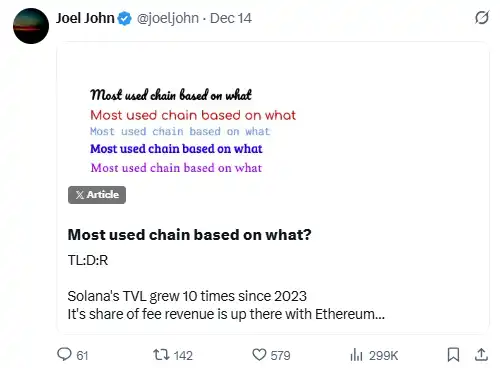
@joeljohn's article "Most used chain based on what?" also aptly highlights Solana's dominance across various dimensions recently.

All of this has happened against the backdrop of an extremely brutal cycle for retail investors. Arbitrageurs have squeezed value to near its limits, altcoins have underperformed the market overall, and net developer inflow has hit a low. What this industry truly lacks is a spark of optimism, something that reminds people: the crypto world itself is still beautiful.

I believe Breakpoint lit that very match.

When I walked into the Solana Breakpoint venue in Abu Dhabi, the first thing I felt was not excitement, but a movement in motion.
Not the kind of noisy, chaotic bustle. More like an undercurrent. A force in flow.

It didn't feel like entering a conference. There was no tension, no forced social pressure, no anxiety about "I must be in the right room at the right time." It felt more like a festival, a place where people weren't there to "extract value" from each other, but to genuinely celebrate "creation."

People were smiling, talking, moving around freely. Developers, creators, founders, institutions—everyone had their place, and the overall balance wasn't lost.

This sense of harmony was obvious from the start. No single group was overly amplified: institutions didn't dominate the narrative; creators weren't treated as mascots; founders weren't elevated to unreachable heights. Everyone seemed approachable.

And that, in itself, is very rare.

The longer I stayed at Breakpoint, the more I felt that this was not accidental, but deliberately designed.

The agenda wasn't like a top-down information dump: five-minute lightning talks, debates, product demos, conversations. Short, sharp, high information density. Letting more people be seen, rather than having a few repeatedly occupy the stage. You could clearly feel that this wasn't a one-time inspiration, but the result of long-term iteration.

Breakpoint wasn't achieved overnight; it gradually figured out "what really works" through years of practice.

A brief exchange with @paarugsethi from Superteam India was enough to realize how deeply the Solana ecosystem thinks about culture and the founder community.

Dissolving Elitism

But if there's one thing Solana does better than most ecosystems, it's this: it successfully dissolves elitism.

There's no invisible hierarchical structure where "only a few voices matter." As long as you've genuinely built something valuable, even if it's small, you get a platform to showcase it.

This openness changes everything: it reduces fear, invites more participation, and ultimately builds momentum. And momentum compounds.

After talking to more and more people, another characteristic became clear: within the Solana ecosystem, there is a shared sense of direction. Not a dogmatic consensus, but a state of "moving forward together." There are navigators, signal sources, and people seen as directional coordinates by others. Because of this, the ecosystem doesn't easily fragment.

In many ecosystems, people fight their own battles, narratives conflict, gaps keep widening, and everyone endlessly argues about "how it should be," while hesitating to accept "what is working."

Solana does it differently. If speculation works, it's accepted. If it aligns with the behavior of the new generation internet, it's studied, not shamed. There's no moral superiority, no whitewashing. Even memecoins, despite that phase being chaotic and predatory, were seen as an acceleration experiment, a stress test for internet capital markets.

The system crashed, some profited from it, and lessons were truly absorbed. Solana didn't pretend it never happened; instead, it distilled the insights as an "entire ecosystem." This acceptance, in turn, created space for innovation, rather than accumulating resentment.

The most prominent feeling this year was Breakpoint's extreme builder-first approach. The market has cooled, prices are no longer狂热, and the "100x overnight" crowd has noticeably thinned. But it's precisely at times like these that the real builders begin to shine.

DeFi appears more mature; infrastructure discussions return to reality: predictability of block space, latency optimization, how to make application execution cheaper and more reliable.

You can see this change in specific products: Kalshi choosing Solana as its tokenization infrastructure; Phantom powering consumer-facing interface experiences; Phoenix perpetual contracts, Prop AMM, new market designs; experiments in AI, bots, privacy; hackathons, Superteam projects, those still rough but real early ideas. People come to listen to shares to learn, not to ask "how to pump this token."

This energy shift is extremely important. It makes the entire conference feel solid, honest, and product-centric.

If there's one discomfort, it's this: there still exists some narrow-mindedness within the ecosystem—"if it's not Solana-only, it's not worth paying attention to."

This mindset isn't unique to Solana, but it shrinks the pie. The real opportunity isn't winning a public chain war, but reshaping the entire tech stack. And that can only be achieved through collaboration, not posturing.

The irony is: Solana doesn't need to proclaim loudly. Anyone walking into Breakpoint can feel it directly. This ecosystem doesn't need to mock others online. The products, the culture, the builders, the momentum—they are loud enough.

A "Festival"

This brings me back to the initial conclusion: Solana is no longer suitable for "hosting conferences." Conferences are one-way, static, and bounded. What Solana is doing aligns more with the native form of the new generation internet: a festival, a celebration that exists for builders. A space where culture, capital, experimental spirit, and belief collide.

And these "festivals" will only continue to grow: more vibrant, more immersive, more diverse. Every corner adds new flavor to this internet that is taking shape.

Breakpoint 2025 was one of the best conferences I've ever attended, and it clearly shows where Solana is heading.

P.S.: In my opinion, choosing Abu Dhabi as the host city was a key reason why Breakpoint 2025 could be so special.

Связанные с этим вопросы

QWhat is the main argument made in the article about Solana Breakpoint?

AThe article argues that Solana Breakpoint has evolved from a developer-focused conference into a large-scale global event, and questions whether it still effectively centers on the builders and maintains its open, low-barrier culture amidst the influx of institutions, capital, and grand narratives.

QAccording to the author, what positive cultural aspects of the Solana ecosystem were observed at Breakpoint 2025?

AThe author observed a culture of openness, a lack of elitism, shared direction among participants, and a builder-first atmosphere where people celebrated creation rather than just extracting value from each other.

QHow does the author describe the change in energy and focus at Breakpoint 2025 compared to previous periods?

AThe author notes that the energy shifted to be more focused on real builders, with discussions on mature DeFi, practical infrastructure, and product-centric innovation, rather than the previous '100x returns' hype and memecoin frenzy.

QWhat is one criticism or narrow-minded attitude the author says still exists within the Solana ecosystem?

AThe author points out that some in the ecosystem hold a narrow 'Solana-only' mindset, believing that projects not exclusively built on Solana are not worth attention, which can limit collaboration and growth.

QWhy does the author conclude that Solana is no longer suitable for holding a 'conference'?

AThe author believes that Solana's event has transcended a traditional conference, becoming more like a 'festival' or a celebration for builders—a dynamic, immersive, and diverse space where culture, capital, and experimentation collide, which is more aligned with the native form of the new internet.

Похожее

The Value Distribution of Stablecoins

**Summary: The Value Distribution of Stablecoins** The article argues that stablecoins are evolving from mere trading tools into broader channels for dollar access. It divides the stablecoin ecosystem into four layers to analyze how value is distributed: 1. **Issuance Layer:** Mints stablecoins, holds reserve assets, and captures the spread between reserve yield and user costs (e.g., Tether, Circle). This layer currently earns the largest profit margin. 2. **Infrastructure Layer:** Connects stablecoins to the traditional financial system, handling fiat on/off-ramps, banking integration, compliance (KYC/AML), and asset management (e.g., Bridge, BVNK). This is the "unglamorous" but critical work, building the essential bridges between crypto and real-world finance. 3. **Acquiring/Distribution Layer:** Integrates stablecoins into merchant systems, manages payment flows, and provides enterprise financial software (e.g., Stripe, Coinbase). They act as the access point for businesses. 4. **Application Layer:** The end-users and businesses that ultimately use stablecoins for payments, settlements, or as a store of value. They benefit from convenience but have little pricing power. The core thesis is that while the issuance layer currently dominates profits, the often-overlooked **infrastructure layer holds significant long-term potential**. The real challenge and barrier to mass adoption is not the on-chain transfer of stablecoins (which is simple), but the complex "last mile" integration into existing business workflows, banking systems, and regulatory frameworks across different countries. Companies in this layer are currently in a "land grab" phase, investing heavily to build networks, secure bank partnerships, and establish compliance pathways. While their position is currently pressured by the profitable issuers above and distribution platforms below, the article suggests that if stablecoins become a default financial rail for businesses, the infrastructure providers who have done the hard work of integration will ultimately gain strong pricing power and become entrenched, essential players.

marsbit1 ч. назад

The Value Distribution of Stablecoins

marsbit1 ч. назад

The Value Distribution of Stablecoins

The Value Distribution of Stablecoins The article argues that stablecoins are evolving from a mere trading tool into a broad "dollar channel." It analyzes the industry's value chain through four layers: 1. **Issuance Layer (e.g., Tether, Circle):** The top layer that mints stablecoins, holds reserve assets, and captures the thickest interest rate spread. 2. **Infrastructure Layer (e.g., Bridge, BVNK):** Connects stablecoins to the traditional financial system, handling critical but complex "dirty work" like fiat on/off-ramps, banking integration, compliance (KYC/AML), and cross-border settlement. 3. **Acquiring/Distribution Layer (e.g., Stripe, Coinbase):** Embeds stablecoins into merchant systems, manages payment flows, and integrates with enterprise software. 4. **Application Layer:** End-users and businesses that ultimately use stablecoins for payments, settlement, or storing value. The author posits that while the issuance layer currently captures the most profit, the most overlooked and potentially critical layer is infrastructure. The core challenge for stablecoin adoption isn't the on-chain transfer (which is simple), but bridging the gap between blockchain and the real-world financial system. This involves solving practical problems for businesses: fiat conversion, reconciliation, tax handling, and user onboarding. Infrastructure companies are currently in a difficult "land-grab" phase—building networks, securing banking relationships, and achieving compliance country-by-country. They face pressure from both the profitable issuance layer above and distribution platforms below. However, the author suggests this layer is building a crucial moat. Once stablecoins become a default business rail, the infrastructure players who have done the hard work of integration may gain significant, durable value and pricing power.

链捕手2 ч. назад

The Value Distribution of Stablecoins

链捕手2 ч. назад

How to Do Research Well: Deliberately Practice the Real Skills That Matter

No one truly teaches you how to do research. You're often given a desk, a pre-selected problem, and vague instructions to "create something new." Consequently, many people reverse-engineer the job based on visible outputs—papers, posts, announcements—learning only how to *appear* like a researcher rather than how to *become* one. True research capability is built from stacking small, trainable skills, nearly all of which can be developed through deliberate practice. **Pick Your Own Problem:** Most researchers absorb problems from advisors or trends, lacking the underlying reasoning. Choosing a problem you genuinely care about, as John Schulman advises, leads to original work. Develop "taste" like a muscle: predict experiment outcomes, guess paper results from methods, and track which findings remain important over time. **Upgrade Your Inputs:** Relying on shared reading lists (arXiv hot lists, filtered group chats) leads to unoriginal conclusions. Undervalued old literature often holds crucial insights (e.g., MoE, LSTM, backpropagation). Richard Sutton's "The Bitter Lesson" or Claude Shannon's 1952 talk on creative thinking are more predictive than lengthy modern surveys. Breadth matters as much as depth: draw from neuroscience, mechanism design, hardware knowledge, and honest statistics. Read papers directly, especially appendices and limitations sections. **Write Everything Down:** As Paul Graham noted, writing exposes flaws in seemingly mature ideas. Writing is the cheapest defense against self-deception. Following Feynman's principle, Darwin programmatically wrote down facts contradicting his theory to combat memory bias. Maintain a detailed log of hypotheses, setups, predictions, results, and updated understandings. Reviewing past logs fosters essential humility.

marsbit4 ч. назад

How to Do Research Well: Deliberately Practice the Real Skills That Matter

marsbit4 ч. назад

Торговля

Спот
Фьючерсы

Популярные статьи

Обсуждения

Добро пожаловать в Сообщество HTX. Здесь вы сможете быть в курсе последних новостей о развитии платформы и получить доступ к профессиональной аналитической информации о рынке. Мнения пользователей о цене на SOL (SOL) представлены ниже.

活动图片