Why Did It Take Prediction Markets Nearly 40 Years to Explode?

marsbitОпубликовано 2025-12-31Обновлено 2025-12-31

Введение

This article explores the explosive growth of prediction markets in 2025, which saw an estimated 400% increase in trading volume, reaching $40 billion, and a user base growing to 15 million. It examines why, despite existing since the 1980s (e.g., Iowa Electronic Markets), prediction markets only recently surged in popularity. Key factors for the 2025 boom include major regulatory progress. The CFTC approved platforms like Polymarket as designated contract markets, allowing them to operate legally in the US. This compliance enabled wider distribution, integration into major apps like Robinhood, and attracted institutional investment, with both Polymarket and Kalshi securing over $1 billion in new funding. Regulatory clarity also allowed for a diversification of event types, including sports and crypto, which now dominate trading volume. The article contrasts prediction markets with traditional gambling, noting the US government distinguishes them based on their "positive externalities." Unlike sportsbooks that set odds, prediction markets facilitate peer-to-peer betting, aggregating collective knowledge to improve information efficiency and decision-making, which regulators view as socially beneficial despite gambling-like elements. A provocative section discusses insider trading. Some argue that insiders using non-public information on anonymous, decentralized platforms like Polymarket can enhance market accuracy and serve as a form of information discovery. However, this...

As this year draws to a close, the rapid growth of prediction markets has attracted increasing attention from both crypto enthusiasts and those outside the circle. When discussing prediction markets with different friends, I often explain the difference between them and traditional gambling through 'differences in betting models' and 'the financialization of information.' As these conversations multiplied, I gradually realized that these two points are still not intuitive enough for friends who haven't been exposed to prediction markets. They even raised some very interesting and sharp questions, such as:

I can understand the difference between 'betting against the house' and 'P2P gambling among players,' but in essence, both models still involve real-money betting. Why does the U.S. government treat the two so differently?

If the lenient attitude towards prediction markets is because 'the financialization of information' has many benefits, then why hasn't this good thing become popular before? Why did it only explode in 2025?

There has been much discussion about the advantages and future prospects of prediction markets. Therefore, this article will explore prediction markets from more interesting angles.

Why Did Prediction Markets Only Explode in 2025?

Report data shows that the prediction market is expected to achieve an astonishing 400% growth rate in 2025, with total trading volume projected to grow from approximately $900 million in 2024 to $40 billion. The user base is also expected to increase 3-4 times, from about 4 million in 2024 to 15 million in 2025.

Retail players familiar with prediction markets should be well-acquainted with the hot topics over the past two years, such as the 2024 U.S. presidential election and the 2025 League of Legends World Championship. One might instinctively think that these hot topics drove the development of prediction markets.

But this is clearly not the only or core factor. Traditional gambling platforms also offer the same markets, and compared to the binary 'Yes/No' of prediction markets, traditional gambling markets have even more variety, such as 'point spreads.' Moreover, before the rise of Polymarket and Kalshi, there were precedents for prediction markets. The earliest available prediction market platform was the Iowa Electronic Markets (IEM), launched by the University of Iowa in 1988 for predicting the 1988 U.S. presidential election. Even prediction market platforms incorporating blockchain technology were not pioneered by Polymarket; Augur on Ethereum came in 2018.

Significant progress in regulation is an important factor, and the relaxation of regulations has contributed to the explosion of prediction markets on multiple levels.

First, the rollout of distribution channels. On November 25, the CFTC approved Polymarket's Amended Order of Designation, allowing it to re-enter the U.S. market as a Designated Contract Market (DCM). Kalshi also integrated directly into Robinhood and Coinbase this year. More importantly, after compliance, prediction markets have broader distribution channels in the U.S. than traditional gambling, covering all 50 states, while traditional gambling distribution channels only cover over 30 authorized states.

The more profound significance is that compliance clarifies the positioning of prediction markets as legitimate commodity derivatives rather than gambling, affirming the positive significance of prediction markets. This expands the distribution audience beyond traditional gambling enthusiasts to include investors and decision-makers. For ordinary people, seeing traditional media reports citing prediction market data or seeing internet search engines like Google directly indexing prediction market data creates a positive perception of 'legitimacy' that the cryptocurrency industry has sought for many years.

Second, policy friendliness has given institutional investors sufficient confidence, leading to rapid growth in the financing path for prediction markets. Both Polymarket and Kalshi completed a total of three new rounds of financing in 2025, with new financing amounts each exceeding $1 billion. This has given them better conditions to provide better products and liquidity.

Finally, the variety of event types in prediction markets has also been enriched. In 2024, Kalshi won a lawsuit against the CFTC, allowing it to list more types of event predictions, such as cryptocurrency-related events, and since January this year, it has expanded to sports events. The CFTC abandoned its appeal in May this year. Currently, sports event predictions account for about 90% of Kalshi's trading volume. A report by Eilers & Krejcik believes that, in the long run, sports event predictions will account for 44% of the total trading volume in prediction markets.

Of course, whether it's Kalshi, which has always strictly followed a compliant, off-chain path, or Polymarket, which took an offshore-then-compliant, on-chain path, the improvement of the prediction market products themselves, along with advancements in AI technology that have provided more complete related tools for the entire prediction market ecosystem, are all reasons why 2025 became the year of prediction markets. As mentioned earlier, the earliest on-chain prediction market, Augur, was previously criticized for its poor user experience and, after four years of silence, announced in March this year that it would be restarted by the Lituus Foundation. The popularity of anything requires waiting for the 'right time, place, and people.' The wheel of fortune turns, and prediction markets have finally borne fruit in 2025.

Why Does the U.S. Government Treat 'Gambling' Differently?

This is a very interesting question. Even I was initially confused—although prediction markets themselves do not act as the house, do not provide odds, and do not bet against users, we cannot say that peer-to-peer betting is not gambling. Otherwise, we could also say that playing poker is not gambling because the organizer does not play but only takes a rake, and the betting only occurs among the players.

At the same time, traditional gambling platforms, for their own benefit, have professional teams to analyze various event bets and try to provide reasonable odds. In the past, traditional media and institutional reports have cited odds from traditional gambling platforms for event reporting and analysis. Although prediction markets, compared to traditional gambling, can better reflect 'collective cognition' without the bias of a single team, and unlike traditional gambling platforms, they do not deliberately align odds with the public to increase overall betting volume and use the rake to offset losses caused by unreasonable odds settings, and indeed show higher real-time responsiveness and accuracy in some events, this does not seem to constitute an overwhelming advantage over traditional gambling platforms.

And whether for traditional gambling enthusiasts or ordinary retail investors in prediction markets, our grasp and analysis of events are, in most cases, certainly not as good as professionals, which means losses are common.

So, isn't the U.S. government worried about the harm caused by the gambling nature of prediction markets to the public? Of course it is, otherwise the compliance path for prediction markets would not have been so difficult for many years.

Internationally, some prediction markets operate directly under gambling licenses, such as the political prediction market on the UK's Betfair. Recently, U.S. District Court Judge Andrew Gordon in Nevada revoked an injunction protecting prediction market company Kalshi from state regulation and ruled that Kalshi's sports event predictions do not constitute transactions under the 'Commodity Exchange Act.' The judge believed that these prediction events are very similar to sports betting wagers and therefore fall under the regulatory purview of the Nevada Gaming Control Board and the Nevada Gaming Commission.

But the government's starting point is 'overall positive externality.' Just as the stock market allows the vast majority of retail investors to 'pay tuition' while greatly promoting overall social and economic operation, prediction markets, although essentially still gambling, also have key social benefits such as improving information efficiency and aiding decision-making. As long as the harms can be avoided as much as possible through sound regulation, we should not give up eating for fear of choking.

Of course, after reading this, you might still say that 'overall positive externality' is a pale rebuttal, and traditional gambling can still play a similar role. However, at least one point is undeniable: the mechanism of prediction markets themselves determines that the platform can only 'choose topics' and cannot 'rig the game.' Whether Polymarket or Kalshi, they can at most choose topics that people like to encourage betting and cannot manipulate odds.

Moreover, besides the U.S., governments in other countries and regions currently agree with your thinking. The U.S. is the only country in the world that distinguishes the positioning of prediction markets from traditional gambling and issues 'event contract' licenses for prediction markets. As the scale of prediction markets grows, controversies surrounding gambling will continue, and whether the U.S. government's attitude will change remains unknown.

Maybe, let the prediction markets predict it...?

A Paradise for Insider Traders?

This is a very interesting question. If asked whether insider trading in the stock market is good or bad, we would all say it's bad. But if the subject of this question is changed to prediction markets?

My colleague believes this is the value of prediction markets. The existence of insider information certainly creates unfairness in betting, but it also most accurately discloses information. Therefore, a true prediction market should be like Polymarket, built on-chain, anonymous without KYC.

Such views are actually not uncommon. For example, this tweet by @shafu0x received considerable recognition:
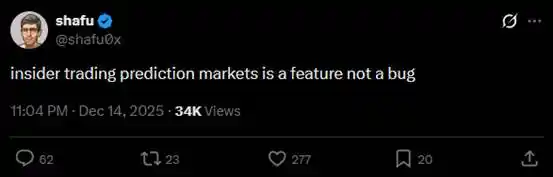
Players who hold this view believe that as long as the information leaked through insider trading has 'overall positive externality,' it is justified. They also believe that prediction markets cannot do without these insiders because without them, the accuracy of event predictions in prediction markets would drop significantly, leaving only those without accurate information to bet against each other.

This view has some merit, but I think prediction market platforms themselves would resist such positioning because, in the long run, it would harm retail trust. The entire market would essentially change from a platform encouraging individual research and insight, aggregating collective wisdom, into a one-sided 'slaughter' by insiders, which is not conducive to the development of liquidity. If prediction markets were like this, it would be better to rename them 'information bounty platforms.'
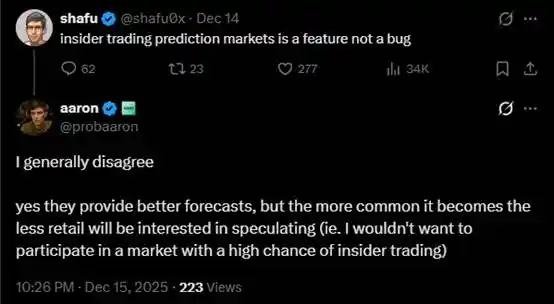
Overall, I believe that platforms like Polymarket, built on-chain, with transparent movements and anonymity, fulfill our expectations of decentralization—anyone can freely send signals through prediction markets without worrying about anything, only needing to be responsible for their own bets. The harsh reality is that there are too many wealth transfers caused by information asymmetry in the world, and those that occur in prediction markets or stock markets might be the ones we feel most keenly.

As for whether prediction markets themselves should maintain a relatively fairer environment for retail investors and whether they need to sustain a more acceptable positioning for the public for sustainable development, that is a question they should consider.

Conclusion

There are actually many interesting questions, such as whether there will be a prediction market in the future that can challenge Kalshi and Polymarket? If prediction market compliance continues to advance worldwide, will each country and region have its own leader (because these markets can do better localization and provide prediction events more friendly to users in their respective countries and regions), etc.

Prediction markets are not exactly new, but the compliance of prediction markets is a very new, very avant-garde bold attempt. I believe that over time, the various questions mentioned in this article will have interesting answers that we cannot anticipate.


Трендовые криптовалюты

Связанные с этим вопросы

QWhy did prediction markets take nearly 40 years to experience a major breakout in 2025?

APrediction markets saw explosive growth in 2025 due to key regulatory advancements, such as CFTC approvals allowing platforms like Polymarket and Kalshi to operate legally in the U.S., expanded distribution channels, increased institutional investment, richer event diversity including sports and crypto, and improved product experiences aided by AI tools.

QHow does the U.S. government distinguish prediction markets from traditional gambling?

AThe U.S. government treats prediction markets as legal commodity derivatives rather than gambling because of their 'positive externalities,' such as improving information efficiency and aiding decision-making. Unlike traditional gambling, prediction markets use peer-to-peer betting without a house setting odds, reducing manipulation risks, and they operate under specific regulatory frameworks like the Commodity Exchange Act.

QWhat role did regulatory changes play in the growth of prediction markets in 2025?

ARegulatory changes were crucial: the CFTC approved platforms like Polymarket as designated contract markets, allowing nationwide distribution in all 50 states. This legitimacy attracted institutional investors, facilitated major funding rounds, expanded event types like sports and crypto predictions, and enhanced public trust through media and tech integrations.

QAre prediction markets considered a haven for insider trading, and how is this viewed?

ASome argue that insider trading on prediction markets like Polymarket can be beneficial because it leads to more accurate information disclosure and positive externalities. However, platforms generally resist this perception, as it could undermine散户 trust and liquidity, turning the market into an 'information bounty' system rather than a fair collective intelligence platform.

QWhat are the main factors that contributed to the user and volume growth of prediction markets in 2025?

AKey factors include regulatory approvals expanding access, integration with major platforms like Robinhood and Coinbase, a wider range of预测事件 such as sports and elections, increased institutional funding improving liquidity and product quality, and AI-driven tools enhancing user experience and market efficiency.

Похожее

«Голос в пустыне» с Уолл-Стрит вновь прицелился в Nvidia

Новая сделка Майкла Берри, известного как «пророк биржевого апокалипсиса» после успешного шорта во время ипотечного кризиса, вновь привлекла внимание. Через свой Substack он объявил о шорте акций Nvidia (по цене входа $198.09), Tesla, Applied Materials, Caterpillar и ETF SOXX, а позднее добавил Micron Technology ($1051.87). 25 июля он увеличил позиции против Nvidia, Micron и SOXX. Его аргументы против Nvidia сосредоточены на проблемах в цепочке поставок ИИ: завышенные сроки амортизации оборудования (6 лет вместо реалистичных 2-3 лет) у таких клиентов, как Microsoft и Meta, что искусственно завышает их прибыль, и риски «внебалансового циклического финансирования», когда спрос на чипы может быть поддержан самой Nvidia через гарантии для покупателей. Третий аргумент о выкупе акций был оспорен компанией как основанный на ошибочных данных. Цена акций Nvidia колебалась после заявлений Берри, в целом оставаясь вблизи его цены входа, что привело к небольшому убытку по его более поздним позициям. История Берри после 2008 года неоднозначна: были как провалы (шорт Tesla в 2021), так и успехи (предупреждение о мемных акциях). Его методология, основанная на анализе свободного денежного потока и первичных документов, хорошо выявляет структурные риски, но плохо определяет время кризиса. Другие известные инвесторы разделяют осторожность, но действуют иначе. Стив Эйсман («Большой шорт») пока не шортит Nvidia, отмечая сильные текущие показатели, но сократил позиции. Джим Чанос согласен с тезисом об «учетном несоответствии», но шортит не чипмейкеров, а частные фонды, сочетающие ставки на ИИ и коммерческую недвижимость. Общий вывод: опытные инвесторы признают признаки перегрева в секторе ИИ, но их конкретные ставки и сроки сильно различаются. Для рядового инвестора ценным является не копирование их сделок, а понимание их методов анализа — куда смотреть, чтобы выявить скрытые риски и завышенные оценки, особенно когда рынок убежден, что «на этот раз все по-другому».

marsbit25 мин. назад

«Голос в пустыне» с Уолл-Стрит вновь прицелился в Nvidia

marsbit25 мин. назад

Когда рынок начинает сомневаться в капитальных затратах на ИИ: полный анализ квартальных отчетов пяти технологических гигантов

В конце июля 2026 года ведущие технологические гиганты — Alphabet (Google), Intel, Microsoft, Meta и Apple — представили квартальные отчёты. Все компании показали рост выручки и прибыли, превысив ожидания рынка, однако реакция инвесторов сильно различалась из-за расхождений в подходах к капитальным затратам (CAPEX) на ИИ и ожиданиях относительно свободного денежного потока. **Alphabet** продемонстрировал рекордный 12-й квартал двузначного роста выручки, а облачный бизнес вырос на 82%. Однако акции упали более чем на 7% после новостей о рекордных квартальных CAPEX в $44,9 млрд и первом в истории отрицательном свободном денежном потоке. Компания также повысила годовой прогноз по CAPEX. **Intel** сообщил о самом сильном росте выручки за 15 лет (25%), во многом благодаря бизнесу центров обработки данных и ИИ. Несмотря на это, акции испытали волатильность после увеличения годового прогноза CAPEX с $18 млрд до более чем $20 млрд, что усилило опасения по поводу денежного потока. **Microsoft** стала фаворитом рынка: выручка Azure впервые превысила $100 млрд в годовом исчислении. Ключевым положительным сигналом стало *снижение* прогноза по CAPEX на 2026 год с $190 млрд до $175 млрд и обещание положительного свободного денежного потока в 2027 финансовом году. Акции выросли, показав лучший однодневный результат за 18 лет. **Meta**, несмотря на рост выручки на 28%, столкнулась с самым резким падением акций (почти 10%). Причина — рост расходов на 55%, резкое сокращение свободного денежного потока на 90% и повышение годового прогноза по CAPEX. Это уже второй квартал подряд, когда Meta наказывают за рост затрат. **Apple** отчиталась о рекордной выручке и прибыли за июньский квартал, но её акции упали более чем на 8%, а рыночная капитализация сократилась на $300 млрд. Это произошло из-за консервативного прогноза на следующий квартал, который оказался ниже ожиданий Уолл-стрит, и опасений по поводу ограничений в цепочке поставок. **Общий вывод:** Рынок смещает фокус с абсолютных показателей выручки и прибыли на **доходность капитальных вложений**. Компании, демонстрирующие контроль над расходами и путь к положительному свободному денежному потоку (как Microsoft), вознаграждаются. Те, кто агрессивно наращивает CAPEX без четких краткосрочных перспектив возврата денежных средств (как Google и Meta), сталкиваются с продажами. В следующем отчётном сезоне объяснение стратегии CAPEX и его окупаемости будет критически важным для котировок акций.

Odaily星球日报39 мин. назад

Когда рынок начинает сомневаться в капитальных затратах на ИИ: полный анализ квартальных отчетов пяти технологических гигантов

Odaily星球日报39 мин. назад

a16z: От компании к DAO, DUNA может стать следующей организационной формой

Автор: a16z crypto Компиляция: Deep Tide TechFlow Основная задача бизнеса на протяжении веков остаётся неизменной: как организовать сотрудничество незнакомых людей с разными ролями, асимметричной информацией и интересами для достижения общей цели? История бизнеса — это история поиска новых организационных форм. Компания стала великим прорывом для индустриальной эпохи, но цифровые технологии и интернет-протоколы снижают потребность в традиционных иерархических структурах. Существующее законодательство не предназначено для нового мира децентрализованных сетей. DAO (децентрализованные автономные организации), хотя и являются перспективной формой, сталкиваются с правовыми проблемами: отсутствием юридического признания, что подвергает участников неограниченной ответственности, и неопределённостью в регулировании, особенно в свете теста Хоуи в США. В качестве решения предлагается DUNA (Децентрализованная Некорпоративная Некоммерческая Ассоциация) — новая правовая форма, уже принятая в нескольких штатах США. DUNA предоставляет группе людей юридическое лицо и ограниченную ответственность, позволяя децентрализованным сообществам легально владеть активами, заключать контракты и вести деятельность, не полагаясь на централизованное управление. Она заполняет правовой вакуум для интернет-нативных организаций, не решая всех проблем управления, но давая им законный статус. Эволюция организационных форм — от семейных предприятий и компаний до LLC и DUNA — расширяет инструменты для координации людей. DUNA представляет собой следующий шаг, позволяющий анонимным, географически разбросанным участникам блокчейн-сетей сотрудничать как единое юридическое лицо, минимизируя личные риски и открывая новую главу в организации коллективных действий.

marsbit1 ч. назад

a16z: От компании к DAO, DUNA может стать следующей организационной формой

marsbit1 ч. назад

Отчет о токенизированных активах реального мира (RWA) за середину 2026 года: рыночная капитализация токенизированных акций удвоилась за год, но 90% прав – пустышка

**Отчет о RWA на блокчейне за середину 2026 года: капитализация токенизированных акций удвоилась за год, но 90% прав — пустышка** В июле 2026 года стоимость распределенных токенизированных акций достигла $1,89 млрд, почти удвоившись с марта. Однако рост сконцентрирован вокруг немногих инструментов (SECZ, FGRS, STRCx дали ~49% прироста) и платформ (Ondo, xStocks, Securitize контролируют 85% рынка). Рынок расколот: офшорные продукты (Ondo, xStocks) обеспечивают ликвидность и доступность в DeFi, но предлагают слабые юридические права на базовый актив. Регулируемая инфраструктура США (например, через Nasdaq) обеспечивает юридическую определенность, но страдает от низкой ликвидности и ограниченного распределения. Ни один продукт не сочетает полноценные права собственности, широкое распределение, ликвидность и независимое ценовое образование. Общие данные по RWA ($36,8 млрд распределенных активов) требуют осторожной интерпретации из-за изменений в методологии учета. Рынок токенизированных акций расширяется технически, но остается фрагментированным в правовом поле, где разные токены, отслеживающие одну акцию, представляют собой отдельные юридические обязательства.

marsbit2 ч. назад

Отчет о токенизированных активах реального мира (RWA) за середину 2026 года: рыночная капитализация токенизированных акций удвоилась за год, но 90% прав – пустышка

marsbit2 ч. назад

Внимание, пользователи биткоина! Сегодняшний взлом может быть масштабнее, чем вы думали. Вот что нужно делать

Компания Coinkite, производитель аппаратных биткоин-кошельков Coldcard, обнаружила критическую уязвимость в процессе генерации сид-фраз на устройствах Coldcard Mk3 с прошивкой версий 4.0.1–5.0.3. Все биткоин-адреса, созданные из этих сид-фраз, потенциально скомпрометированы. Компания настоятельно рекомендует пользователям немедленно перевести средства на новый, безопасный кошелёк, создав новую сид-фразу. Просто сменить устройство недостаточно — старую сид-фразу использовать нельзя. Это предупреждение следует на фоне масштабной атаки 30 июля, в ходе которой автоматизированный инструмент за 41 минуту опустошил 1196 кошельков, похитив около 1082 BTC (на тот момент ~$70,2 млн). Исследователи связывают эту атаку с обнаруженной уязвимостью, так как она произошла за 30 часов до публичного раскрытия проблемы Coinkite. Украденные средства пока остаются на четырёх адресах без движения.

cryptonews.ru4 ч. назад

Внимание, пользователи биткоина! Сегодняшний взлом может быть масштабнее, чем вы думали. Вот что нужно делать

cryptonews.ru4 ч. назад

Торговля

Спот

Популярные статьи

Что такое ANSEM

I. Введение в проектЧёрный Бык ($ANSEM) — это прозрачная, управляемая сообществом мемкоин на Solana, основанная на одном кредо: двигаться вперёд, несмотря ни на что. Проект ориентирован на фронтенд и полностью поддаётся проверке — его веб-сайт отображает данные в реальном времени с блокчейна и рынка напрямую из Solana, включая цену, ликвидность, объём, рыночную капитализацию и распределение держателей, так что любой может проверить утверждения без входа в систему и без сбора пользовательских данных. Кроме токена, он предлагает Ansem-call Radar, некустодиальные пулы ликвидности сообщества на PumpSwap и браузерный мем-терминал. $ANSEM — это стандартный токен Pump.fun SPL (6 знаков после запятой), торгующийся против SOL и USDC.II. Информация о токенеСимвол токена: ANSEM (Чёрный Бык)III. Связанные ссылкиВебсайт:https://www.blackbullsol.com/X: https://x.com/blknoiz06Адрес контракта: https://solscan.io/token/9cRCn9rGT8V2imeM2BaKs13yhMEais3ruM3rPvTGpumpПримечание: Введение в проект основано на материалах, опубликованных или предоставленных официальной командой проекта, и предназначено только для справки и не является инвестиционной рекомендацией. HTX не несёт ответственности за любые прямые или косвенные убытки, возникшие в результате.

847 просмотров всегоОпубликовано 2026.07.01Обновлено 2026.07.01

Что такое ANSEM

Как купить ANSEM

Добро пожаловать на HTX.com! Мы сделали приобретение The Black Bull (ANSEM) простым и удобным. Следуйте нашему пошаговому руководству и отправляйтесь в свое крипто-путешествие.Шаг 1: Создайте аккаунт на HTXИспользуйте свой адрес электронной почты или номер телефона, чтобы зарегистрироваться и бесплатно создать аккаунт на HTX. Пройдите удобную регистрацию и откройте для себя весь функционал.Создать аккаунтШаг 2: Перейдите в Купить криптовалюту и выберите свой способ оплатыКредитная/Дебетовая Карта: Используйте свою карту Visa или Mastercard для мгновенной покупки The Black Bull (ANSEM).Баланс: Используйте средства с баланса вашего аккаунта HTX для простой торговли.Третьи Лица: Мы добавили популярные способы оплаты, такие как Google Pay и Apple Pay, для повышения удобства.P2P: Торгуйте напрямую с другими пользователями на HTX.Внебиржевая Торговля (OTC): Мы предлагаем индивидуальные услуги и конкурентоспособные обменные курсы для трейдеров.Шаг 3: Хранение The Black Bull (ANSEM)После приобретения вами The Black Bull (ANSEM) храните их в своем аккаунте на HTX. В качестве альтернативы вы можете отправить их куда-либо с помощью перевода в блокчейне или использовать для торговли с другими криптовалютами.Шаг 4: Торговля The Black Bull (ANSEM)С легкостью торгуйте The Black Bull (ANSEM) на спотовом рынке HTX. Просто зайдите в свой аккаунт, выберите торговую пару, совершайте сделки и следите за ними в режиме реального времени. Мы предлагаем удобный интерфейс как для начинающих, так и для опытных трейдеров.

384 просмотров всегоОпубликовано 2026.07.01Обновлено 2026.07.01

Как купить ANSEM

Обсуждения

Добро пожаловать в Сообщество HTX. Здесь вы сможете быть в курсе последних новостей о развитии платформы и получить доступ к профессиональной аналитической информации о рынке. Мнения пользователей о цене на A (A) представлены ниже.

活动图片