When "Vibe Coding" Enters the Gaming World, What Is Verse8 Changing?

Odaily星球日报Опубликовано 2026-03-04Обновлено 2026-03-04

Введение

"Vibe Coding" is reshaping game development, and platforms like Verse8 are at the forefront of this shift. The article begins with the author’s experience playing Mine8, a simple yet engaging game, highlighting how AI is lowering barriers in game creation. Unlike traditional tools, Verse8 allows users to generate playable games using natural language prompts, dramatically speeding up development—often to just hours. The platform functions like a "TikTok for games," enabling both play and creation. Its core engine, Agent8, handles complex backend tasks like asset generation, code debugging, and deployment, while the "Spin" feature lets users remix existing games easily. Integrated with Story Protocol, Verse8 also ensures on-chain IP ownership and rewards original creators as content evolves. With over 4,000 creators, 25,000 games, and 3.5 million daily active users, Verse8 is demonstrating real traction. Early metrics show significant growth in engagement and creation time. Though still in early stages—with no token launched yet—it offers reward mechanisms and collaborates with major IPs like Moonbirds and Azuki. Ultimately, Verse8 is transforming games from static entertainment into dynamic, creator-driven media—making game creation accessible and scalable within the Web3 economy.

Original | Odaily Planet Daily (@OdailyChina)

Author | DingDang (@XiaMiPP)

The Epiphany Starting from a "Simple" Mini-Game

After playing Mine8 for two days, I realized that I had been hooked on this extremely simple mini-game for so long. The gameplay isn't complicated: dig for treasures with a shovel within a limited time, where the shovel's damage and speed determine efficiency, but whether you actually find treasure depends more on luck. Occasionally opening a lucky box allows you to upgrade the shovel, adding a bit of anticipation for the next round. The mechanics aren't particularly novel, and the game interface isn't very polished, but it genuinely captured my attention.

However, what really made me stop and think wasn't the game itself, but the timing of its emergence.

"Vibe coding" is becoming one of the hottest keywords right now. Tools like Cursor and Lovable have already proven that anyone can build software just by describing their needs in natural language. Cursor achieved $100 million ARR (Annual Recurring Revenue) within 12 months, while Lovable became a unicorn in just 8 months.

While AI programming tools are spreading across general application fields, one massive sector remains relatively blank — gaming. It's complex, engineering-heavy, and has long development cycles, making it precisely the type of content form that is hardest to natural-language-ize.

Mine8, and the Verse8 behind it, are emerging in this very context.

Verse8: Not "More Mini-Games," but "More Creators"

If you only look at the surface, Verse8 can easily be misunderstood as a mini-game collection platform.

At first, you just click into a mini-game as usual. The rules aren't complicated, it's easy to get started, you finish a round and close it — it seems no different from any casual game.

But at some point, you suddenly realize one thing: this game isn't "finished"; it's "something that can be continued to be written."

On Verse8's page, creators don't need to face a traditional development backend. The Prompt itself is the entry point.

A single description can generate a playable game; an existing work can also be directly copied, modified, and republished. This means that "making a game" no longer requires full engineering preparation for the first time. You're not standing at the starting point of a project, but on top of content that is already running. A game can be generated in just a few hours, or even less.

Therefore, Verse8 serves not just players. What it truly attracts are those who originally lacked game development capabilities but possess the desire to express and create. Here, everyone is both a player and a potential developer at any moment — the barrier to creation is drastically lowered, and the speed at which ideas materialize is infinitely amplified.

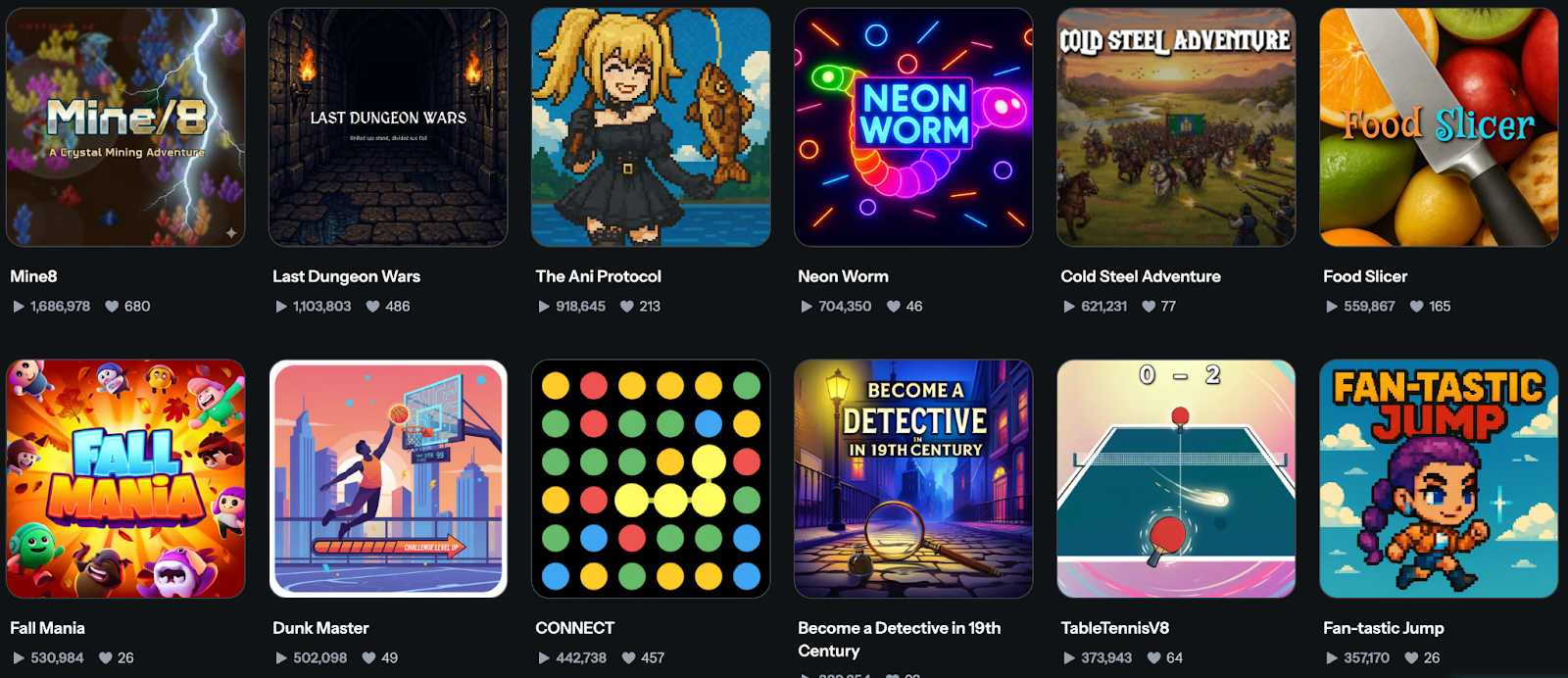
If an analogy must be drawn, Verse8 can be understood as the "TikTok for games". It allows anyone to create and publish a large number of AI-generated mini-games, with diverse themes, gameplay, and styles. The aforementioned Mine8 is currently the most popular mini-game on the platform. Likes, shares, and dissemination — the games themselves begin to take on a content-based, socialized form.

From "Play" to "Spin": An Infrastructure Serving the Creator Economy

On Verse8, the creation experience appears exceptionally lightweight. You just describe your idea in natural language, and out comes a runnable, interactive game that others can play. But this "lightness" isn't because things have actually become simpler; it's because the complexity is systematically hidden.

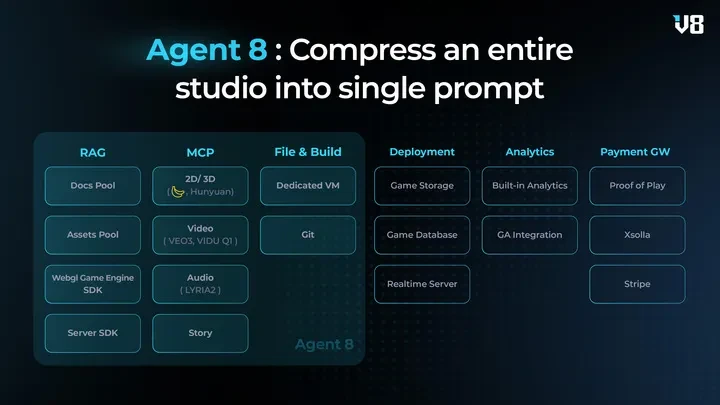
However, to achieve true Prompt-to-Play, Verse8 needs to simultaneously complete multiple high-complexity tasks in the backend. Text, images, audio, video, and code must be generated together. The generated results need to run instantly, be tested, have errors found and automatically fixed, and finally be deployed and distributed. In traditional game development, these processes often require multi-person collaboration and repeated debugging. In Verse8, they must be completed in a single generation process.

Bearing this "invisible engineering" is Verse8's core creation layer: Agent8.

It's not just a simple generation tool; it's more like compressing an entire production team into a prompt. Agent8 has built-in templates for various mature game genres, including RPG, platformer, idle, FPS, etc., and directly integrates a WebGL engine, allowing generated content to be published and run in real-time without building or setting up servers.

At the same time, the asset production pipeline is highly automated. 2D assets are automatically adapted and optimized for the target platform; 3D models undergo rigging, format processing, and web optimization. Art, animation, and audio — the most time-consuming and experience-dependent parts — are compressed into the system's default internal processes. Creators see a "ready-to-go" result, not the engineering details behind it.

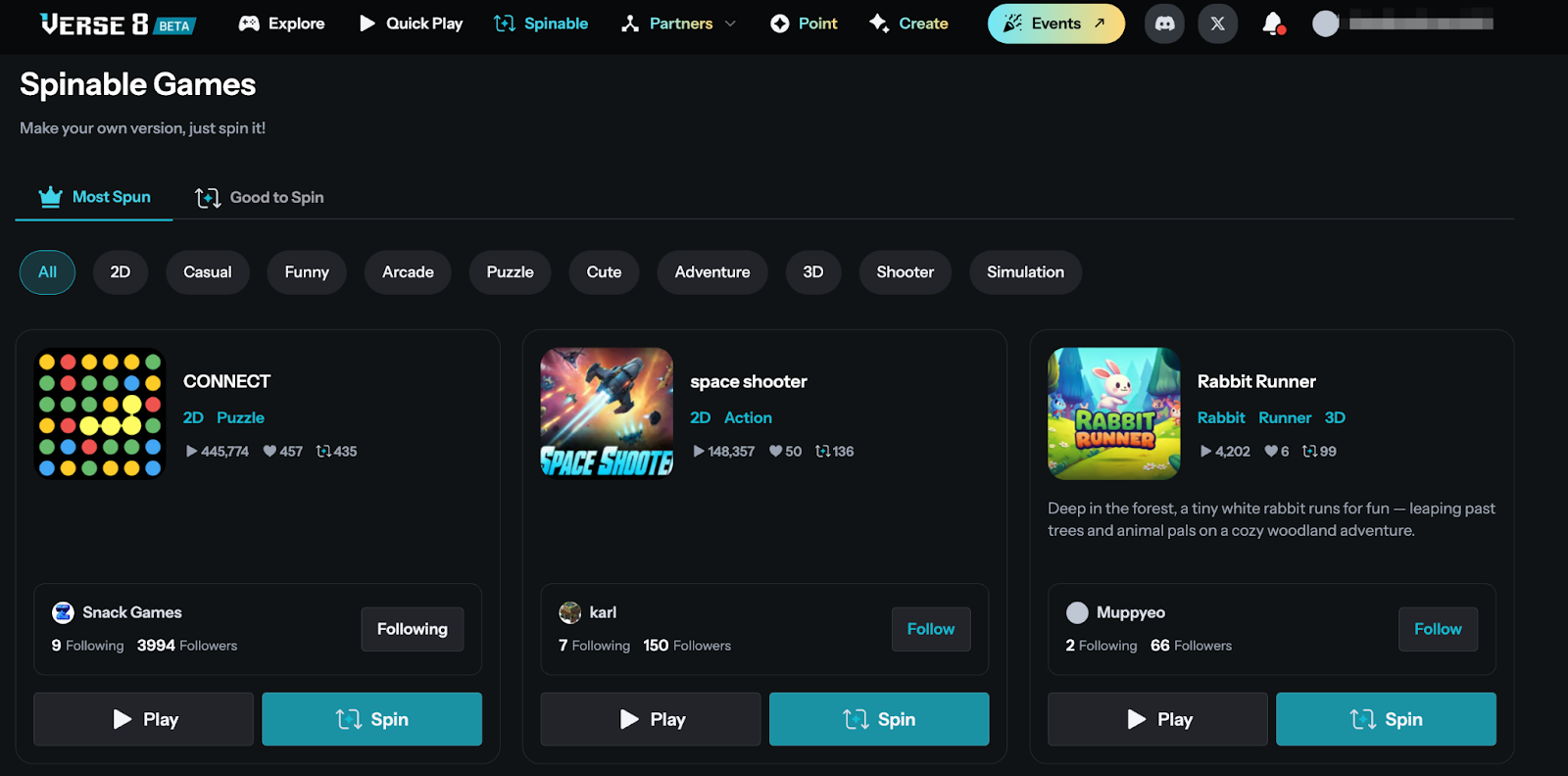
Think that's all? No. What truly gives creation scale is its Spin mechanism. Any published work can be copied with one click; the creator just needs to modify elements like the prompt, character settings, background, music, gameplay parameters, etc., and the AI will automatically regenerate a modified version that belongs to you. After modification, it can be directly published and shared.

On this foundation, Verse8 introduces Story Protocol as the on-chain IP and ownership layer. Every game, asset, and derivative content is automatically registered and its ownership established. The more a work is adapted, the higher the回报 (return) for the original creator. Creation is no longer just a one-time output but begins to have the potential for continuous reuse and amplification.

In the past, building a game with integrated assets often required weeks of manual debugging; now, Verse8 creators can complete it within two days, or even compress the production time to a few hours. What it truly solves is not whether the gameplay is novel enough, but whether creation can be scaled, replicated, and evolved.

When Games Shift from Entertainment to a New Battleground for Web3 Creator Economy

Games have always been an important part of the attention economy, but unlike text, images, video, or music, they never truly entered the creator economy system. The high development barriers and complex production processes long made "making games" the exclusive capability of a few professional teams. Even if ordinary creators had ideas, it was difficult to turn them into runnable, shareable works.

Verse8 is changing this structure. When the Prompt becomes the creation entry point, when games can be directly copied, rewritten, and quickly published, games begin to transform from a high-threshold entertainment product into a means of production that creators can directly use. They are no longer just objects to be chosen and experienced, but a medium that can be repeatedly processed and redistributed.

Under this change, the real competition between platforms is no longer just about vying for attention, but about who can host more creators, who can amplify creative efficiency, and who can enable content to continuously evolve and generate compound interest. Games, a relatively closed entertainment category, are beginning to shift towards an open content form.

What Verse8 promotes is not "more fun mini-games," but a role shift. When games transform from consumed content into a medium that can be continuously produced and rewritten, the battleground of the creator economy truly lands on games for the first time.

From "Usable" to "Actually Being Used"

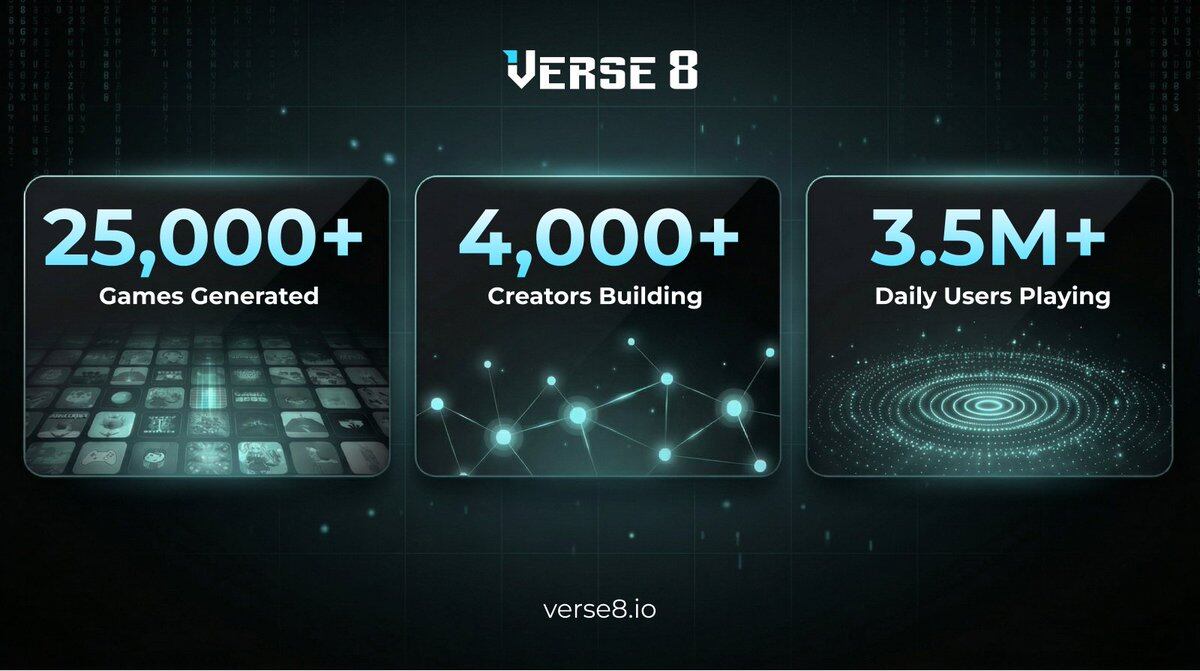
While the creation experience continues to be optimized, Verse8 has also formed a preliminary scaled user and creator base. Currently, the platform has attracted over 4,000 creators, launched more than 25,000 mini-games, and reached 3.5 million daily active users. For a platform still in its early stages, this data at least indicates one thing: this method of creation is not just conceptual.

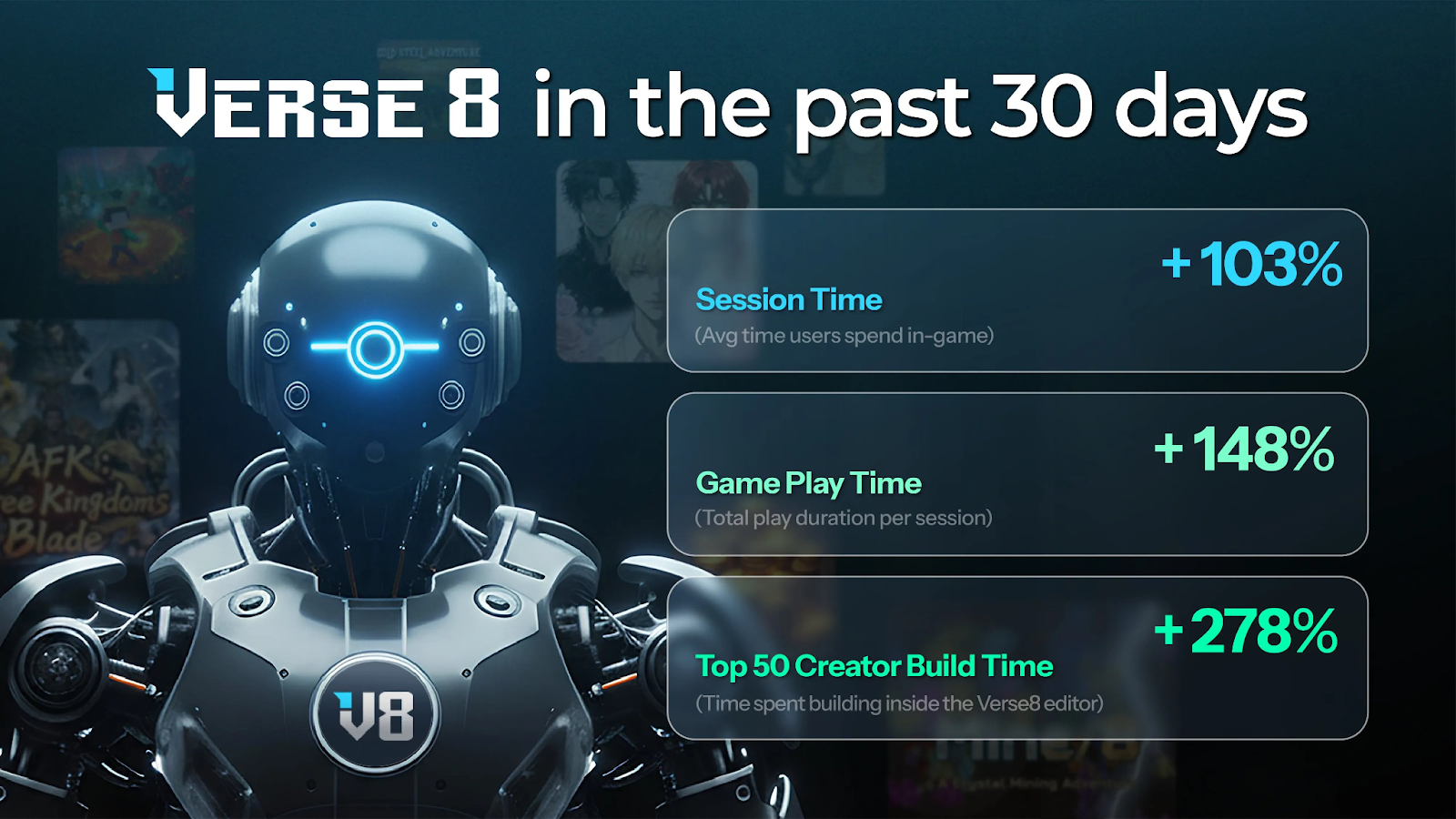
Over the past month, Verse8 has achieved significant quality improvements in creator-related metrics: session duration increased by 103%; game immersion time increased by 148%; creation build time increased by 278%.

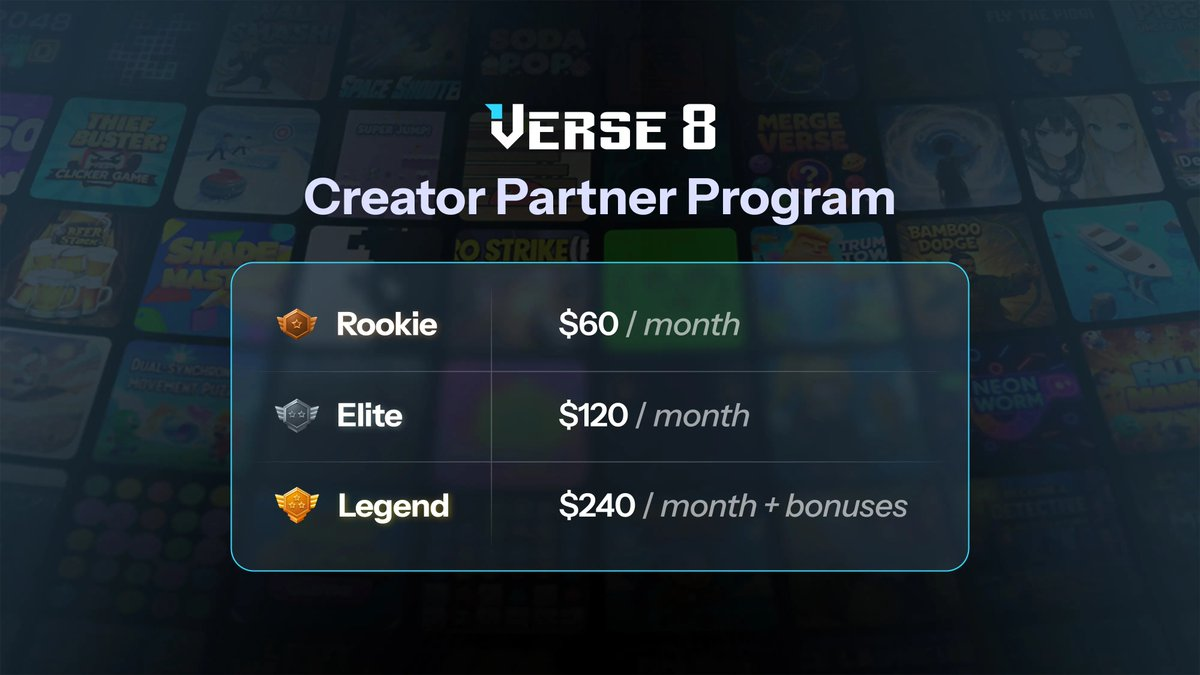
As a creative platform, Verse8 also collaborates with popular IPs like Moonbirds and Azuki, enabling creators to use these blue-chip IPs for AI Vibe Coding game creation with zero barriers and compliance, continuously attracting creators and driving the production of high-quality content. Meanwhile, the platform is advancing a Creator Partner Program, providing tiered incentives and resource support to help high-potential creators expand their influence. Participants also have the opportunity to receive incentives from a $10,000 reward pool.

It's important to emphasize that Verse8 is still in a very early stage and has not yet issued a token. But it has already provided a clear participation path for crypto users — earning points by completing tasks. In the near future, these points may be converted into actual economic incentives.

Conclusion

Attention is temporary, but creativity can last long.

In the Web3 era, Verse8 makes games no longer just content to be consumed, but a medium that can be produced, rewritten, and owned. When the barrier to expression is lowered, when the speed of creation is amplified, games are finally becoming a real territory within the creator economy.

Since inspiration strikes, why not open verse8.io and try vibe coding something. Your first game could be the starting point of the creator economy.

Связанные с этим вопросы

QWhat is the core concept of 'Vibe Coding' as described in the article, and how does it relate to Verse8?

AThe core concept of 'Vibe Coding' is using natural language prompts to generate software, making development accessible to non-coders. Verse8 applies this concept specifically to the game development sector, allowing users to create and modify games through simple text descriptions, thus drastically lowering the barrier to entry for game creation.

QHow does Verse8's 'Spin mechanism' function, and what purpose does it serve for creators?

AVerse8's 'Spin mechanism' allows any published game to be copied with a single click. Creators can then modify elements like the prompt, character settings, background, music, or gameplay parameters. The AI will automatically regenerate a new, customized version of the game. This enables rapid iteration, remixing, and scaling of content, turning creation into a collaborative and evolutionary process.

QWhat role does Agent8 play in the Verse8 platform's infrastructure?

AAgent8 is Verse8's core AI-powered creation layer. It functions like a compressed development team, handling the complex backend work required for prompt-to-play generation. This includes generating and integrating code, 2D/3D assets, and audio; running and testing the game; fixing errors; and deploying it—all automatically and instantly, hiding the underlying engineering complexity from the user.

QWhat key metrics mentioned in the article indicate Verse8's early adoption and user engagement?

AKey metrics indicating Verse8's early adoption include: over 4,000 creators, more than 25,000 small games published, and 3.5 million daily active users. The platform has also seen significant quality improvements with a 103% increase in session duration, a 148% increase in game immersion time, and a 278% increase in creation build time over the past month.

QHow does Verse8 integrate with Web3 and creator economics according to the article?

AVerse8 integrates with Web3 by using Story Protocol as an on-chain IP and ownership layer. This automatically registers every game, asset, and derivative work, establishing clear ownership. The more a work is adapted by others, the higher the rewards for the original creator. The platform also has a points system for completing tasks, which may convert to economic incentives in the future, and runs a creator partner program with a financial reward pool.

Похожее

Silicon Valley 'Startup Guru' Steve Hoffman: Web3 + AI Could Be a Trap

Silicon Valley investor and "Godfather of Startups" Steve Hoffman warns that combining Web3 with AI is likely a trap, not a promising venture. In an interview, Hoffman argues that while AI is a foundational technology touching all industries, Web3 adds complexity, friction, and regulatory risk without solving mainstream consumer or business needs. He advises founders to focus on deep, specialized applications where startups can out-iterate giants, rather than on generic features easily replicated by large tech companies. Hoffman observes that Silicon Valley will lead foundational AI research, while China excels at rapid, large-scale application and commercialization, particularly in robotics. He stresses that AI-driven autonomous agents capable of collaborative, multi-step tasks are 2-4 years away, which will cause significant job displacement. The solution is not to slow AI but to redesign business models around human-AI collaboration and reform social systems like education and retraining. For startups, Hoffman recommends focusing on vertical, expertise-heavy domains to build defensibility. He sees major opportunities in AI fraud detection and cybersecurity. Key founder mindsets include systemic thinking over feature-focus, relentless customer centricity, building adaptive teams, and deeply understanding AI's capabilities and limits. Hoffman is also leading a non-profit initiative to establish university centers aimed at training future leaders in responsible, human-value-aligned AI innovation.

marsbit1 ч. назад

Silicon Valley 'Startup Guru' Steve Hoffman: Web3 + AI Could Be a Trap

marsbit1 ч. назад

Token Inefficient, Economy Tokenless

The article "Tokens Aren't Economical, Economics Aren't Tokenized" analyzes a pivotal shift in the AI industry from a technology-driven narrative to one dominated by capital efficiency. It highlights two concurrent trends: a severe capital shortage due to the exorbitant and recurring costs of compute (e.g., OpenAI's high burn rate) and a wave of corporate spin-offs where major tech companies are separating their AI units (like Kuaishou's Kling and Baidu's Kunlunxin). The core argument is that AI's "anti-internet" business model, where user growth increases costs rather than profits, has created a disconnect between high valuations and actual cash flow. Spin-offs address this by allowing AI assets to be valued independently. Within a parent company, they are seen as cost centers, but as standalone entities, they are priced based on their growth potential and scarcity in the primary market, leading to massive valuation premiums (e.g., Kling's estimated value tripling post-spin-off). The industry is at an inflection point, moving from "model worship" to "value realization." The competition is evolving from a pure compute (GPU) race to a broader focus on systemic efficiency and full-stack engineering (involving CPUs and orchestration) to achieve viable commercialization. The year 2026 is framed as a critical moment where the industry must definitively answer how to economically translate AI capability into tangible business value, reshaping the sector's future power structure.

marsbit1 ч. назад

Token Inefficient, Economy Tokenless

marsbit1 ч. назад

Crossing the 'Memory Wall': The Wafer-Level Revolution and Computing Power Routes in the AI Inference Era

In 2026, a historic shift occurred in AI as major cloud providers' inference spending surpassed training spending for the first time, signaling a move from "building large models" to "using large models." This shifts the core challenge from computing power to the "memory wall"—the bottleneck of data movement (model weights, activations, KV Cache) between external DRAM and processors, where energy and latency from data transfer far exceed computation itself. Companies like Nvidia face GPU idle time due to bandwidth limits. In contrast, Cerebras Systems adopts a radical "wafer-scale" approach with its Wafer-Scale Engine (WSE). Instead of cutting a silicon wafer into many chips, Cerebras uses almost the entire wafer as one massive chip (WSE-3). This design provides 44GB of on-chip SRAM, delivering memory bandwidth thousands of times higher than traditional HBM (e.g., 21 PB/s vs. Nvidia B200). For LLM inference, weights are streamed layer-by-layer from external MemoryX storage to the chip, avoiding HBM bottlenecks. This results in token generation speeds 1.5–5 times faster than Nvidia's B200 in some models and significant advantages in first-token latency and long-context tasks. Additionally, Cerebras's architecture offers much lower interconnect power consumption (0.15 pJ/bit vs. GPU's ~10 pJ/bit). However, Cerebras faces challenges: SRAM scaling has slowed with advanced nodes, limiting future capacity gains; the chip requires specialized liquid cooling and custom software stacks; and its external I/O bandwidth (150 GB/s) is low compared to NVLink, hindering multi-system scaling for very large models. Competition is intensifying. Major players are pursuing three paths: 1) Developing proprietary inference ASICs (e.g., Google TPU, Microsoft Maia), 2) Leveraging advanced packaging (e.g., TSMC's SoW) to democratize wafer-scale-like integration, potentially eroding Cerebras's process advantage within a few years, and 3) Exploring optical interconnects for ultimate bandwidth. Commercially, Cerebras is transitioning from a hardware vendor to a service provider, facing the immense challenge of building high-power, specialized data centers to meet large contracts (e.g., 250MW/year from 2026–2028). In conclusion, the AI inference era presents a fundamental architectural trade-off. Cerebras opts for extreme physical optimization for low-latency, single-task performance, while Nvidia prioritizes versatility and massive cluster throughput. The path forward remains uncertain, with technology and business models still evolving in the race toward advanced AI.

marsbit1 ч. назад

Crossing the 'Memory Wall': The Wafer-Level Revolution and Computing Power Routes in the AI Inference Era

marsbit1 ч. назад

Has Bitcoin's 'Rebound Ended', Officially Entering the Late Bear Market Phase?

**Title: Has Bitcoin's Rebound Ended, Entering the Late Bear Market Phase?** **Summary:** Bitcoin's price has declined by 13% this week, signaling a potential return to late-stage bear market conditions. The price fell to around $67k, positioned between the Realized Price and Realized Cap Weighted Average. For the first time since early 2022, the Short-Term Holder cost basis has dropped below this key average, confirming a hallmark of late-cycle bear markets. Profitability metrics have collapsed sharply. The 7-day average of the Realized Profit/Loss ratio plummeted from a local high of 3.16 to 0.29, mirroring the February panic sell-off. Critically, the 90-day average never breached the threshold of 2, indicating the recent rally to $82k was a bear market bounce, not a structural shift. Realized losses surged to $1.35 billion daily, with $770 million coming from Long-Term Holders selling at a loss. This accelerating redistribution of supply from weak to strong hands is a necessary but ongoing process for a market bottom. The rally stalled almost precisely at the aggregate cost basis (~$83k) of US spot Bitcoin ETF investors, turning that level into strong resistance and leaving the average ETF holder underwater again. Spot market flows have turned decisively negative, showing sellers are dominating order books despite the price drop. While a significant futures long liquidation event cleared over $400 million in leverage, providing a potential reset, sustained spot demand is yet to materialize. Options markets continue to price in higher future volatility (Implied Volatility) than recent price action (Realized Volatility) has shown, with a persistent skew towards put options, indicating ongoing demand for downside protection. In conclusion, multiple metrics point to a fragile market structure. Resistance at the ETF cost basis, accelerating realized losses, dominant spot selling, and cautious options pricing all suggest the bear market trend persists. A sustainable recovery likely requires a resurgence of spot demand, ETF holders returning to profit, and a clear reduction in selling pressure.

marsbit1 ч. назад

Has Bitcoin's 'Rebound Ended', Officially Entering the Late Bear Market Phase?

marsbit1 ч. назад

Торговля

Спот
Фьючерсы
活动图片