When On-Chain Lending Systems Converge

marsbitОпубликовано 2026-02-10Обновлено 2026-02-10

Введение

Credit is the time machine of the economy, enabling businesses to bring future cash flows into today's decisions. The global credit gap for SMEs in emerging markets is estimated at $5.7 trillion. Recent developments in on-chain lending, such as Kraken's DeFi Earn and Bitwise's vault strategies on Morpho, signal a maturation beyond the speculative cycles of 2022. The ecosystem now integrates vaults for self-custody and transparency, automated risk management by firms like Chaos Labs, and AI-driven optimization engines. Total value locked in lending protocols has grown 150% in two years, with active loans exceeding $40 billion—double the 2022 peak. This evolution reduces operational inefficiencies, lowers credit costs via stablecoins and smart contracts, and enhances accessibility, potentially helping bridge the global credit gap. However, risks like liquidity constraints and curator discretion remain.

Author: Prathik Desai

Compiled by: Block unicorn

Credit is the time machine of the economy. It allows businesses to bring future cash flows into today's decision-making.

I believe this is one of the most underrated aspects of the financial world.

People rarely notice credit at work, but it manifests in how businesses operate. An effective credit system enables businesses to restock shelves before they are empty, allows factories to upgrade equipment before it becomes obsolete, and lets founders to hire new employees before a human resource redundancy crisis erupts.

The gap between a good idea and its execution often stems from limited access to credit. And banks promise to bridge this gap.

Banks accept deposits from customers through bank accounts and provide credit to those who need loans. They pay a lower interest rate to depositors and charge a higher interest rate to borrowers, with the difference being their profit. However, bank credit also faces many challenges. The mismatch between credit supply and demand is one of the most significant among them.

Private credit fills the areas that bank credit cannot cover, but the gap remains. This gap reflects investors' current unwillingness to lend in the credit market.

In March 2025, a joint report by the International Finance Corporation and the World Bank, "Financing the Micro, Small, and Medium Enterprise (MSME) Gap," estimated the financing gap in 119 emerging markets and developing economies (EMDEs) to be approximately $5.7 trillion, accounting for about 19% of their combined GDP.

In this context, I find last week's developments in the on-chain credit space exciting. On-chain lending is not new. We experienced a crazy cycle in 2022, and people are still discussing it for various reasons today. But the current cycle feels different.

In this article, I will delve into all the changes happening in the on-chain credit market and explain why I believe it could revolutionize the credit industry.

Let's begin.

Money markets have existed on Ethereum for years. Over-collateralized lending, liquidation bots, interest rate curves, and occasional cascading liquidations are not new. Therefore, what truly caught my attention with last week's credit-related announcements was not the money markets themselves, but the players involved and how they are repackaging credit.

What excites me is that these sporadic partnership announcements collectively signal a broader trend of convergence. The fragmented DeFi landscape of summer 2022 is converging into a powerful force. Features like vault infrastructure, non-custodial wrapping, professional risk management, and automated yield optimization are being integrated and promoted.

Kraken launched DeFi Earn, a platform for retail users that can channel lenders' deposits into vaults (in this case, Veda). The vaults would then direct the funds to lending protocols like Aave. Chaos Labs would act as the risk manager, monitoring the entire engine. Kraken promises lenders an annual percentage yield (APY) of up to 8%.

What do vaults change? They offer lenders self-custody and fund visibility. Unlike traditional credit markets where you hand over funds to a fund manager and wait for monthly disclosures, vaults integrate smart contracts that mint claims on the funds and show the fund deployment in real-time on the blockchain.

Around the same time, Bitwise, the world's largest crypto fund manager, launched a non-custodial vault strategy on the on-chain lending platform Morpho.

This is not the first time on-chain lending has received institutional endorsement. In 2025, Coinbase launched its USDC lending service, enabling smart contract wallets to connect and route deposits via on-chain vaults to the Morpho platform. Steakhouse Financial used the platform for cross-market fund allocation to optimize yields.

This coincides with the on-chain lending market being on the verge of explosive growth, and the data confirms this.
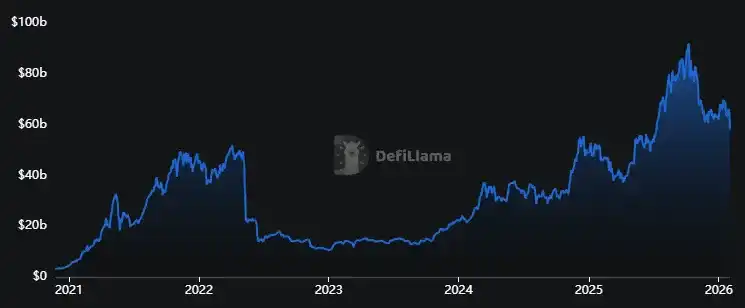
The total value locked (TVL) in lending protocols reached $58 billion, a 150% increase in two years. However, this figure is only 10% higher than the peak in 2022.

Here, the outstanding loan balance dashboard provides a more accurate picture of the actual situation.
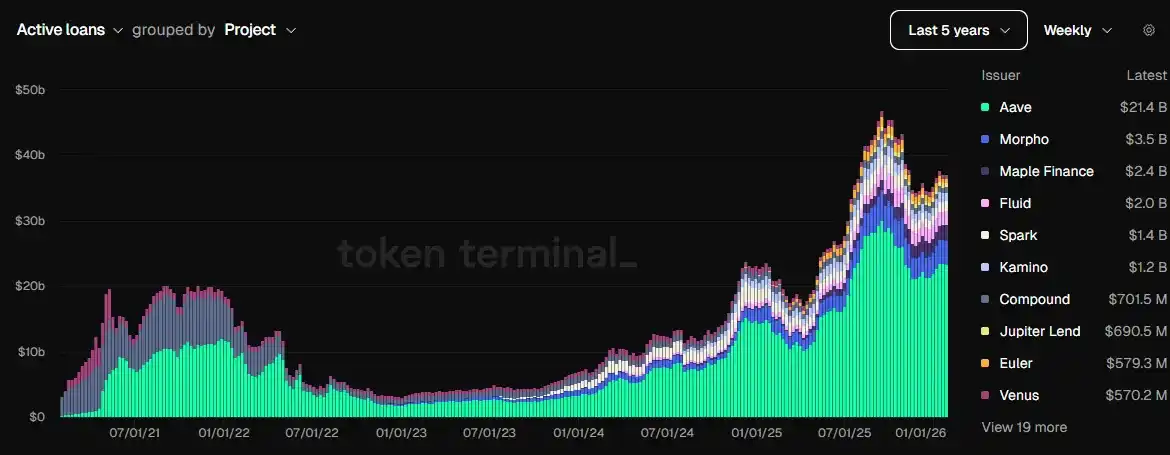
This dashboard shows that the foundation laid by leading protocols like Aave and Morpho is very solid, with active loans exceeding $40 billion in recent months, more than double the peak in 2022.

The dashboard shows that existing institutions, including Aave and Morpho, have laid a solid foundation, with active loans exceeding $40 billion in the past few months, more than double the peak level in 2022.

Today, both Aave and Morpho's revenues are six times what they were two years ago.

While these charts show investor confidence in lending protocols, I find the growth of vault deposits over time even more convincing.

In October 2025, total vault deposits surpassed the $6 billion mark for the first time. Today, deposits stand at $5.7 billion, more than double the amount from the same period last year ($2.34 billion).
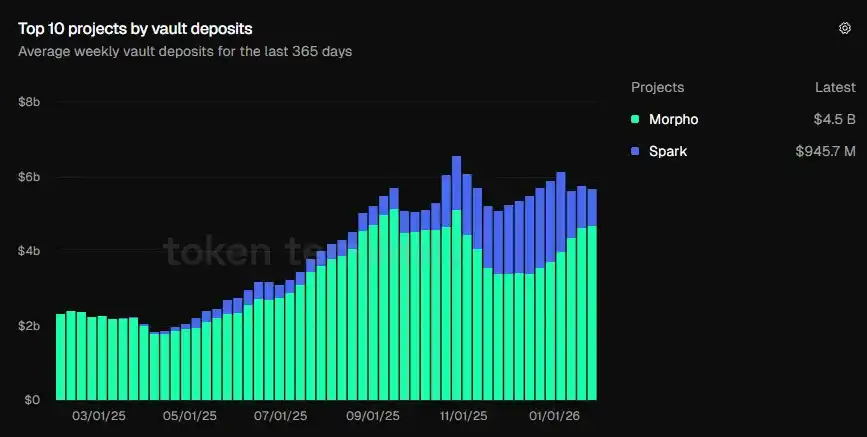
These charts indicate that users are opting for products that offer a comprehensive ecosystem, including vaults, yield optimization strategies, risk configuration, and professional management.

This is the evolution I am optimistic about, completely different from what we observed during the DeFi summer.

Back then, the lending market seemed like a closed loop. Users leveraged this loop by depositing collateral, borrowing funds, using the proceeds to buy more collateral, and depositing again to earn higher yields. Even if collateral prices fell, these users could at least earn rewards from the platform for using its lending protocol. But when those rewards themselves disappeared, the loop broke.

Even the current cycle is built on the same basic elements—over-collateralized lending—but on a fundamentally different and much more solid foundation. Today's vaults have evolved into wrappers that turn protocols into automated asset management tools. Risk managers play a central role, setting up safety measures.

This shift changes the appeal of on-chain lending for both investors and lenders.

During the DeFi summer, lending protocols were just another way to make quick money. This model worked until the incentives failed. Users registered Aave accounts, deposited funds, borrowed against collateral, and so on, until the incentives ran out. We saw this with Aave's Avalanche deployment: incentives attracted deposits and kept the cycle running initially. But when the subsidies waned, the cycle collapsed. As a result, Avalanche's outstanding debt decreased by 73% quarter-on-quarter in Q3 2022.

Today, the lending business has evolved into a mature ecosystem with specialized players responsible for risk management, yield optimization, and liquidity management.

Here's how I assemble the entire stack.

The bottom layer is settlement funds, existing in the form of stablecoins. They can be transferred instantly, stored anywhere, deployed at any time, and crucially, are easy to account for.

On top of this are the familiar money markets, such as Aave, where lending and borrowing are enforced by software code and collateral.

Next is the world of wrappers and routers that aggregate funds and route them from lenders to borrowers. Vaults act as wrappers, packaging the entire lending product in a way that is easy for retail investors to understand. For example, it can be presented as "Deposit $X to earn up to Y% yield," as Veda wallet does on Kraken's Earn platform.

Custodians sit above these protocols, deciding which collateral to allow, liquidation thresholds, exposure concentration, and when to close positions if collateral value declines. Think of how Steakhouse Financial operates on the Morpho platform, or how asset managers like Bitwise embed their judgment directly into the vault rules.

In the background, AI systems run 24/7, managing on-chain credit risk and acting as the nervous system of the lending ecosystem when humans are not around. Manual risk management is difficult to scale. Limited risk management increases credit risk during market volatility. The best outcome is substandard returns, the worst is liquidation.

AI optimization engines track borrowing demand, oracle deviations, and liquidity depth to trigger timely withdrawals. It alerts when vault exposure exceeds preset thresholds. Furthermore, it advises on risk mitigation measures and assists risk teams in decision-making.

It is this round-the-clock optimization, de-risking, audited vaults, carefully curated strategies, institutional backing, and professional risk management that make the current market feel safer and less risky.

But none of these measures can completely eliminate risk. Among them, liquidity risk is one of the most easily overlooked.

Although vaults offer better liquidity than isolated protocols, they still operate within the same markets as these protocols. In markets with thin trading volume, vaults increase the cost of closing positions, making it difficult to exit funds.

Furthermore, there is the risk of curator discretion.

When users deposit funds into a vault, they are essentially trusting certain institutions to make investment decisions based on market conditions, choose suitable collateral, and set corresponding redemption thresholds. Credit works in myriad ways, but lenders should understand that non-custodial does not necessarily mean zero risk.

Despite these challenges, on-chain lending is also changing the cryptocurrency landscape and, consequently, the economic landscape.

The cost of running a credit market depends on time and operational costs.

Heavy investment in verification, monitoring, reporting, settlement, and execution of transactions makes traditional credit expensive. A significant portion of the interest they charge borrowers is avoidable and not necessarily related to the "time value of money."

On-chain credit saves both time and operational costs.

Stablecoins minimize settlement time, smart contracts reduce execution time, transparent ledgers reduce audit and reporting time, and vaults simplify complexity for users. These cost savings will be even more significant when addressing the SME credit gap.

On-chain credit will not fill the credit gap overnight, but lower credit costs will make verification more convenient and credit access more inclusive. And this could reshape the economic landscape.


Трендовые криптовалюты

Связанные с этим вопросы

QWhat is the estimated financing gap for micro, small, and medium enterprises (MSMEs) in emerging markets and developing economies (EMDEs) according to the IFC and World Bank report from March 2025?

AThe estimated financing gap for MSMEs in 119 emerging markets and developing economies is approximately $5.7 trillion, which is about 19% of their combined GDP.

QHow does the current cycle of on-chain lending differ from the DeFi summer of 2022?

AThe current cycle is built on a more robust foundation with vaults acting as wrappers that turn protocols into automated asset management tools, professional risk managers setting safeguards, and AI systems managing credit risk. Unlike the 2022 cycle, which relied heavily on incentives that eventually failed, the current ecosystem includes dedicated players for risk management, yield optimization, and liquidity management.

QWhat role do vaults play in the on-chain lending ecosystem?

AVaults provide self-custody and transparency for lenders by integrating smart contracts that mint claims on funds and show real-time deployment on the blockchain. They package lending products in a user-friendly way for retail investors, such as offering fixed yield rates, and route funds to lending protocols like Aave.

QWhat are some risks associated with on-chain lending, even with the improvements in the current cycle?

ARisks include liquidity risk, where exiting positions can be costly in low-volume markets, and curator discretion risk, where users trust institutions to make investment decisions, choose collateral, and set redemption thresholds. Non-custodial vaults do not mean zero risk.

QHow does on-chain credit potentially lower the cost of credit and benefit the economy?

AOn-chain credit reduces time and operational costs by using stablecoins for faster settlement, smart contracts for execution, transparent ledgers for auditing, and vaults to simplify user complexity. Lower credit costs can make verification easier and credit access more inclusive, helping to bridge the financing gap for SMEs and reshape the economy.

Похожее

Свет слабеет: что происходит с криптовалютными венчурными фондами?

**Крипто-венчурные фонды на перепутье: от нишевых игроков к интеграции** Когда-то узкоспециализированные крипто-фонды, такие как Paradigm, были первопроходцами, обладавшими уникальными знаниями и готовыми брать на себя высокие риски нового рынка. Однако сегодня, как показывает пример Paradigm, собравшего 1,2 млрд долларов для инвестиций в ИИ и робототехнику, эти границы размываются. История повторяется по модели Карлоты Перес: по мере взросления технологии (крипто переходит от «фазы установления» к «фазе внедрения») исчезает информационное преимущество специалистов. Традиционные финансовые гиганты, такие как BlackRock или Visa, теперь понимают блокчейн и приходят в отрасль, но им нужны не технические детали, а регуляторные и банковские связи. Это привело к «эффекту гантели» на рынке венчурного капитала. Гигантские универсальные фонды (a16z, Sequoia) и небольшие нишевые игроки выживают, в то время как фонды среднего размера, составляющие большинство крипто-специалистов, оказываются в «зоне смерти». Их размера недостаточно для конкуренции за крупные раунды с гигантами, а доходности только от крипто-стартапов может не хватить для выполнения обязательств перед инвесторами (LP). Поэтому они вынуждены диверсифицироваться, как Framework Ventures, или полностью менять фокус. Даже оставшиеся «чистыми» крипто-фонды, такие как Dragonfly или a16z, сужают свою стратегию до блокчейн-инфраструктуры для финансов (стейблкоины, рынки предсказаний), области, которая также интересует крупные универсальные фонды. Это создает проблемы для крипто-стартапов: им приходится конкурировать за внимание инвесторов с модными ИИ-проектами, а также они теряют поддержку в финансировании важной, но неприбыльной на ранних этапах инфраструктуры, которую раньше строили специализированные фонды. В будущем термин «крипто-инвестор» может устареть, как когда-то «интернет-инвестор». Крипто станет базовой инфраструктурой, а не отдельным классом активов. Рынок будет разделен: крупные универсальные фонды будут финансировать зрелые проекты, а небольшие специализированные фонды — поддерживать нишевые инновации. При этом появляется новая тенденция: такие проекты, как Hyperliquid, успешно запускаются вообще без венчурного капитала, через сообщество. Эра, когда крипто зависело от специализированных VC, подходит к концу, открывая путь новой, более интегрированной и самостоятельной модели роста.

Foresight News15 мин. назад

Свет слабеет: что происходит с криптовалютными венчурными фондами?

Foresight News15 мин. назад

Когда консенсус формируется всё быстрее, во что ставят молодые инвесторы?

Статья «Когда консенсус ускоряется, на что делают ставки молодые инвесторы?» (издание Huxiu) анализирует новые тенденции в технологических инвестициях на фоне быстрого развития ИИ, робототехники, коммерческой космонавтики и квантовых вычислений. Молодые инвесторы смещают фокус от простого преследования технологических трендов к пониманию реальных путей интеграции технологий в промышленность. Выделяются четыре ключевых направления: 1. **ИИ переходит в физический мир:** Инвестиции смещаются от облачных моделей к периферийным устройствам, роботам (включая воплощённый интеллект) и интеллектуальному оборудованию. Акцент делается не на демонстрационных возможностях, а на надёжности, стоимости развёртывания и реальной окупаемости. 2. **Конкурентное преимущество смещается к «интеллектуальной маховичной модели»:** Вместо вопроса «чей ИИ-модель мощнее» важен вопрос, какая компания может встроить возможности модели в рабочие процессы, создав цикл обратной связи «данные — обучение — улучшение продукта». Это создаёт долгосрочный барьер, как показывают примеры компаний Zhipu AI и Kling AI. 3. **Новые базовые технологии для преодоления дефицита данных:** По мере исчерпания общедоступных данных качественного обучения растёт интерес к таким подходам, как обучение с подкреплением и самоиграющие модели. Научные базовые модели (например, для биологии, химии) рассматриваются как перспективное, но сложное направление для генерации новых высококачественных данных. 4. **Терпеливый капитал для глубоких технологий:** В таких сферах, как коммерческая космонавтика и квантовые вычисления, где циклы разработки и валидации длительны, инвесторы должны рано оценивать фундаментальный потенциал, инженерные компетенции команд и готовность сопровождать проекты в долгосрочной перспективе, даже при неопределённости технических путей. Общий вывод: современный технологический инвестор должен глубже понимать язык технологий, оценивать не только финансовые модели, но и инженерные, и коммерческие траектории, и делать выбор в условиях, когда консенсус ещё не сформирован.

marsbit43 мин. назад

Когда консенсус формируется всё быстрее, во что ставят молодые инвесторы?

marsbit43 мин. назад

Высвобождение ликвидности на $100 млн? Новая политика Pump.fun тестирует «технику пампов» за 5 минут

**Pump.fun запускает режим BOOST: использует "мертвую ликвидность" для 5-минутного "фейерверка"** 21 июля платформа для запуска мем-токенов Pump.fun представила режим BOOST, ставший новым стандартом для эмиссии. Его цель — решить проблему "мертвой ликвидности". Раньше при переходе токена с bonding curve в пул ликвидности около 20% средств навсегда блокировались в LP, даже если токен обесценивался. По оценкам платформы, это приводило к ежегодным потерям ликвидности свыше $100 млн. Суть BOOST: вместо блокировки эти 20% средств (примерно 17.6 SOL или $2516 USDC) используются для скупки самого токена в течение первых 5 минут после его миграции на PumpSwap. Покупка осуществляется по методу TWAP (средневзвешенная по времени цена), а все выкупленные токены немедленно сжигаются. Это создает кратковременный покупательский спрос и сокращает предложение. Новый режим не меняет процесс торговли на bonding curve или порог миграции. Он активируется автоматически для всех токенов, мигрирующих после указанной даты. Ранее выпущенные токены и токены, запущенные через Mayhem, не подпадают под его действие. Логика Pump.fun, вероятно, в следующем: если новые мем-токены после запуска покажут кратковременный всплеск ("фейерверк"), это повысит вовлеченность трейдеров и объемы торгов на платформе. Устойчивый доход от комиссий — основа для будущего выкупа и поддержки собственного токена PUMP. Однако некоторые трейдеры выражают опасения: искусственный спрос в первые 5 минут может облегчить запуск низкокачественных проектов, а после окончания скупки токен может столкнуться с резкими продажами и высоким проскальзыванием, что усилит волатильность.

Foresight News53 мин. назад

Высвобождение ликвидности на $100 млн? Новая политика Pump.fun тестирует «технику пампов» за 5 минут

Foresight News53 мин. назад

Япония хочет купить рост с помощью ИИ. Поверит ли ей рынок облигаций?

Японское правительство представило новый курс экономической и фискальной политики («Основные принципы 2026»), сместив акцент с достижения профицита первичного баланса на стабилизацию и снижение соотношения госдолга к ВВП. Ключевым элементом стратегии стали масштабные инвестиции в стратегические области, такие как ИИ, полупроводники, оборона и энергетика, с целью стимулирования долгосрочного роста и повышения производительности. Однако рынок облигаций отреагировал на эти планы с осторожностью. Инвесторы опасаются, что ослабление прежнего фискального правила (первичный баланс) без четких новых механизмов контроля может привести к фискальной экспансии. Это вызвало рост доходности 10-летних японских гособлигаций и волатильность йены. Успех новой стратегии зависит от способности Японии обеспечить, чтобы номинальный экономический рост устойчиво превышал долгосрочные процентные ставки. Рынки будут оценивать не сам факт инвестиций в ИИ, а их реальную отдачу в виде роста производительности, налоговых поступлений и соблюдения дисциплины при выпуске новых облигаций.

marsbit1 ч. назад

Япония хочет купить рост с помощью ИИ. Поверит ли ей рынок облигаций?

marsbit1 ч. назад

Неправомерно пострадавшие A-акции: Устойчивость, ожидания и основание

В июле глобальные технологические акции столкнулись с коррекцией, начавшейся с распродаж в Южной Корее и затронувшей рынки США, Японии и Китая (A-shares). Однако китайский рынок продемонстрировал устойчивость благодаря нескольким факторам. Во-первых, базовые показатели технологического сектора Китая остаются прочными. Такие подотрасли, как оптические модули и оптическое волокно, показывают высокий рост прибыли (например, New Eastsoft, Changfei Optical Fiber). В отличие от южнокорейского рынка, сильно зависящего от полупроводников памяти, китайский технологический сектор диверсифицирован (компьютеры, связь, электроника) и опирается как на глобальные цепочки поставок (например, для NVIDIA), так и на политику импортозамещения. Во-вторых, государственные институты («команда страны») активно поддерживают рынок, выделив сотни миллиардов юаней на выкуп акций и ETF через такие компании, как China Reform Holdings и China Chengtong. Этот шаг направлен на стабилизацию ликвидности и формирование позитивных ожиданий, сигнализируя о возможном достижении локального дна. В-третьих, другие ключевые секторы A-shares демонстрируют внутренний потенциал для восстановления: * **Потребительский сектор:** CPI стабильно превышает 1%, указывая на улучшение маржи. Ключевые игроки, такие как Kweichow Moutai, повышают цены, а розничные продажи алкоголя растут. * **Сырьевой сектор (например, алюминий):** Высокая рентабельность, сохраняющийся дефицит предложения и низкие оценки создают потенциал для роста. * **Финансовый сектор:** Банки предлагают высокие дивиденды, а брокеры и страховщики выигрывают от оживления на рынке капитала. Таким образом, текущая коррекция в основном вызвана внешними факторами, а не ухудшением фундаментальных показателей. При поддержке государства и наличии внутренних драйверов роста в нескольких секторах рынок A-shares обладает значительной устойчивостью для возвращения к стабильности.

marsbit1 ч. назад

Неправомерно пострадавшие A-акции: Устойчивость, ожидания и основание

marsbit1 ч. назад

Торговля

Спот

Популярные статьи

Как купить T

Добро пожаловать на HTX.com! Мы сделали приобретение Threshold Network Token (T) простым и удобным. Следуйте нашему пошаговому руководству и отправляйтесь в свое крипто-путешествие.Шаг 1: Создайте аккаунт на HTXИспользуйте свой адрес электронной почты или номер телефона, чтобы зарегистрироваться и бесплатно создать аккаунт на HTX. Пройдите удобную регистрацию и откройте для себя весь функционал.Создать аккаунтШаг 2: Перейдите в Купить криптовалюту и выберите свой способ оплатыКредитная/Дебетовая Карта: Используйте свою карту Visa или Mastercard для мгновенной покупки Threshold Network Token (T).Баланс: Используйте средства с баланса вашего аккаунта HTX для простой торговли.Третьи Лица: Мы добавили популярные способы оплаты, такие как Google Pay и Apple Pay, для повышения удобства.P2P: Торгуйте напрямую с другими пользователями на HTX.Внебиржевая Торговля (OTC): Мы предлагаем индивидуальные услуги и конкурентоспособные обменные курсы для трейдеров.Шаг 3: Хранение Threshold Network Token (T)После приобретения вами Threshold Network Token (T) храните их в своем аккаунте на HTX. В качестве альтернативы вы можете отправить их куда-либо с помощью перевода в блокчейне или использовать для торговли с другими криптовалютами.Шаг 4: Торговля Threshold Network Token (T)С легкостью торгуйте Threshold Network Token (T) на спотовом рынке HTX. Просто зайдите в свой аккаунт, выберите торговую пару, совершайте сделки и следите за ними в режиме реального времени. Мы предлагаем удобный интерфейс как для начинающих, так и для опытных трейдеров.

950 просмотров всегоОпубликовано 2024.03.29Обновлено 2026.06.02

Как купить T

Обсуждения

Добро пожаловать в Сообщество HTX. Здесь вы сможете быть в курсе последних новостей о развитии платформы и получить доступ к профессиональной аналитической информации о рынке. Мнения пользователей о цене на T (T) представлены ниже.

活动图片












