When Hyperliquid Steals Solana's 'Internet Capital Market' Script

marsbitОпубликовано 2026-05-19Обновлено 2026-05-19

Введение

The article "When Hyperliquid Steals Solana's 'Internet Capital Markets' Playbook" discusses Solana's struggles to maintain its "internet capital markets" narrative by 2026. Despite its initial success as a high-performance "Ethereum killer," SOL's price has underperformed, dropping significantly compared to other major cryptocurrencies. Solana's vision of a global, on-chain trading network for all assets is being challenged not primarily by Ethereum, but by Hyperliquid. Hyperliquid, evolving from a perpetual contracts platform into a dedicated financial infrastructure Layer 1, has become a major beneficiary of the shift of derivatives trading from centralized exchanges to on-chain. The article argues that for high-frequency financial trading, a specialized, performance-focused chain like Hyperliquid may be more suitable than a general-purpose ecosystem like Solana. Further compounding Solana's issues was a major $200+ million exploit on its key perpetual protocol, Drift, in April, which damaged market confidence. In response, Solana founder Anatoly Yakovenko heavily promoted the protocol Phoenix as a replacement, boosting its visibility but not its trading volume, which remains far behind leading platforms. Solana supporters have launched a public critique of Hyperliquid's decentralization, pointing to its limited validators and closed-source code. Critics, however, note Solana's own declining validator count and centralization metrics. This strategy has also caused inter...

Author: Hu Tao

In the cyclical shifts of the cryptocurrency market, Solana once returned to its peak with the narrative of an 'Ethereum killer' and extreme performance. However, as of 2026, this once high-performance 'computer' running at full throttle is facing unprecedented pressure to slow down, first reflected in its price.

Over the past year, the maximum price drop of SOL from its high point reached 73.5%, the largest decline among all mainstream cryptocurrencies. In the recent month of market correction, SOL's rally has also been notably weak, significantly underperforming other mainstream cryptocurrencies like BTC and ETH.

Furthermore, Solana's core 'Internet Capital Markets' vision has suffered a heavy blow amidst internal and external troubles, forcing the Solana Foundation's senior team to frequently speak out recently, creating momentum for its ecosystem in the court of public opinion.

Solana's Core Narrative Suffers Setbacks

Over the past few years, Solana has consistently attempted to tell a story far grander than just a 'high-performance public chain.'

In the definition of the Solana Foundation, Solana's endgame has transformed into 'Internet Capital Markets'—a global trading network that brings stocks, commodities, futures, perpetual contracts, and even all real-world assets on-chain.

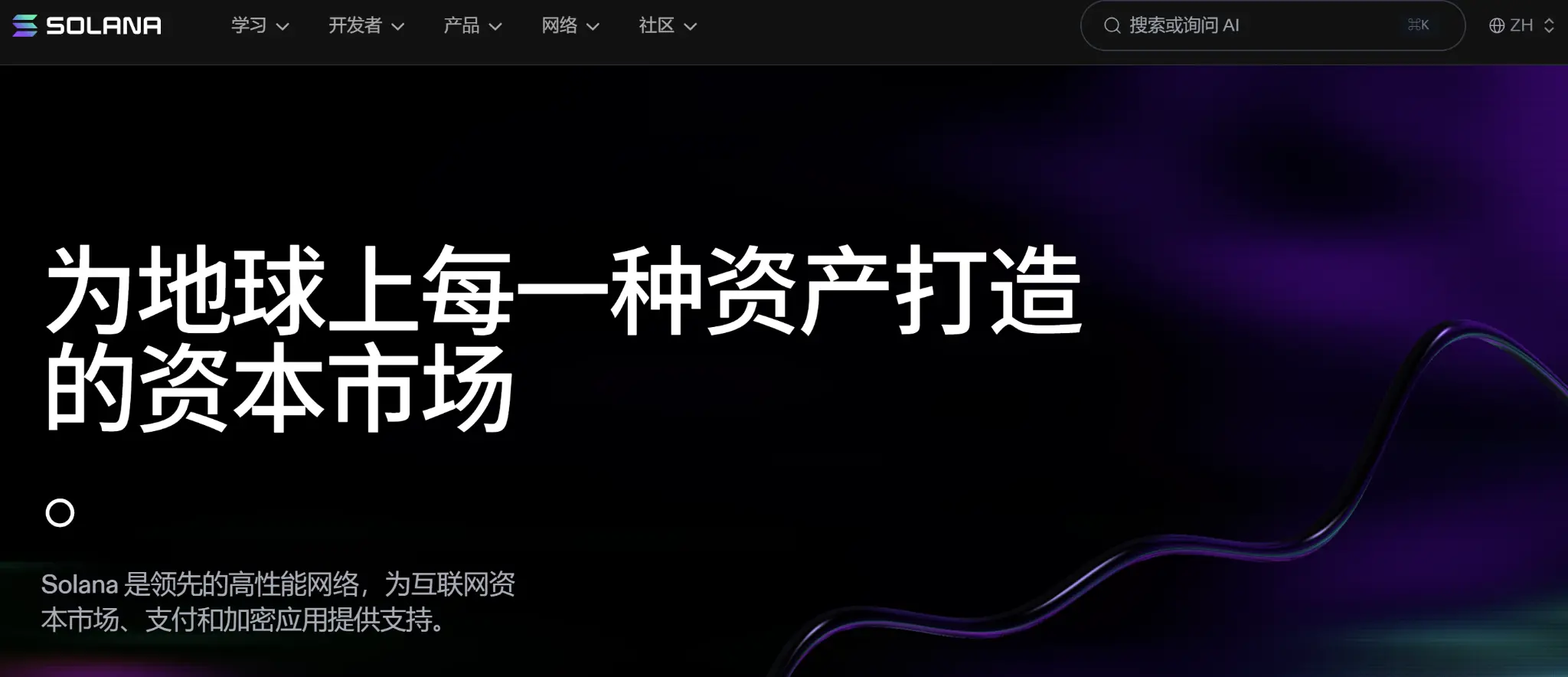
If you open the Solana official homepage today, the most prominent slogan that immediately catches your eye is still: 'Capital markets for every asset on Earth.'

It means that Solana not only aims to challenge Ethereum but also attempts to replace traditional exchanges, brokers, and clearing systems, becoming the on-chain version of Nasdaq. High speed, low fees, high throughput, relatively mature user experience, and the strong endorsement of Wall Street capital once positioned Solana as the public chain closest to achieving this goal.

The problem, however, is that when the 'Internet Capital Markets' truly began to take shape, the market discovered that Solana might not necessarily occupy the core position.

The Unexpected Impact of Hyperliquid

One of the biggest structural changes in the crypto industry over the past year is the migration of the perpetual contracts market away from traditional CEXs to on-chain platforms.

And the biggest beneficiary of this trend is not Solana, nor Ethereum, Sui, or other networks, but Hyperliquid.

Initially, Hyperliquid was just an on-chain perpetual contracts trading platform. However, with the advancement of its Layer1 strategy, it has gradually evolved into a complete financial infrastructure network. Compared to Solana's broad and abstract 'capital markets' vision, Hyperliquid has chosen a more focused, transaction-driven path.

For a long time, although the Solana ecosystem has hosted numerous DeFi projects, its core liquidity has always leaned more towards spot trading, Meme Coins, and on-chain speculation. Infrastructure truly capable of supporting institutional-grade trading depth, risk management, and high-frequency trading needs has never been mature.

More critically, Hyperliquid has gradually proven something many previously overlooked: the 'Internet Capital Markets' might not necessarily require a general-purpose ecosystem.

For high-frequency financial trading, the importance of performance, matching, liquidity, and trading experience far outweighs 'richness of on-chain applications.' This implies that a vertical Layer1 specifically designed for financial trading might be more suitable as the core of on-chain capital markets than a general-purpose public chain like Solana.

This is also why an increasing amount of capital, traders, and attention are converging towards Hyperliquid.

After the Drift Incident, Solana Forced to Adjust Its Perpetual Contracts Market Strategy

If Hyperliquid is squeezing Solana's 'capital markets' strategic space from the outside, then the attack on Drift Protocol tore open a significant gap from within.

In early April this year, the Solana DeFi protocol Drift suffered a governance and oracle attack, resulting in losses exceeding $200 million.

As one of the most important perpetual contracts protocols on Solana, Drift had always played a core liquidity role in Solana DeFi. After the hacker attack, the protocol's functions were directly paralyzed. A large number of assets, vaults, and associated protocols within the Solana ecosystem were affected, and market confidence rapidly deteriorated.

Perpetual contracts are a fiercely contested territory in the DeFi field. Facing the market vacuum left by Drift and Solana's strategic gap in on-chain derivatives, the Solana team had to heavily promote new alternatives to capture users and market share in the front lines of the 'Internet Capital Markets' strategy.

At this point, the choices before the Solana team included a series of products like Pacifica, Phoenix, Jupiter, GMTrade, Bullet, and Blink. However, Solana founder Anatoly Yakovenko firmly chose Phoenix.

Over the past five days, Toly (Anatoly) has posted at least twenty tweets or retweets related to Phoenix, either sharing other industry professionals' testing experiences with Phoenix, directly recommending its use, or discussing his views on Phoenix.

Regarding this 'favoritism,' Toly has also explained multiple times that Pacifica does not execute trades on the Solana chain—its compatibility with Solana is as good as Hyperliquid's—and that Jupiter is already mature, so he is focusing more on early-stage teams from 0 to 1. Meanwhile, Phoenix is decentralized and can atomically combine with all other applications on Solana.

Driven by Toly, Phoenix's popularity has remained in the top three of RootData's trending projects list for several consecutive days, reaching a historical peak in its heat index.

However, in terms of trading volume, Phoenix still lags far behind other established perpetual contracts platforms. According to DeFillama data, Phoenix's daily trading volume previously remained under $4 million for a long time. Recently, riding the market hype, its daily trading volume surpassed $80 million for the first time, but it still ranks outside the top 20 among all perpetual contracts platforms, with a gap of more than 20 times compared to platforms in the top 5 (minimum $1.6 billion).

Solana's Public Opinion Offensive and Internal Rifts

Faced with Hyperliquid's strong rise and the trauma within its own ecosystem, Solana supporters have chosen a seemingly 'using their own spear against their own shield' path—using decentralization as a weapon to launch a public opinion attack on Hyperliquid.

Solana Foundation member @harkl_ tweeted that Hyperliquid markets itself as a decentralized exchange platform, but the reality is 24 validator nodes, closed-source node code, a single bridge handling tens of billions of dollars in funds, and a record of forced settlements during market volatility.

'Can you participate in any part of the protocol stack with your own resources, without approval from a trusted third party? If not, it's not permissionless. No matter what you do, you cannot run a Hyperliquid sequencer,' Toly further stated.

This argument sparked intense debate in the crypto community. Supporters believe Toly hit Hyperliquid's core weakness—if there are less than 30 validator nodes, the node code is not public, and the bridge is highly centralized, then what is the essential difference between the so-called 'on-chain capital market' and the custodial model of a CEX?

Opponents pointed out that Solana's own number of validators has sharply dropped from 2560 to about 756, its Nakamoto Coefficient has fallen from 31 to 20, and the top twenty validators control over one-third of the staked share. Against this backdrop, discussing 'decentralization' carries a hint of 'the pot calling the kettle black.'

A more thorny issue comes from within the Solana ecosystem. The consistent 'favoritism' shown by many Solana Foundation executives has caused dissatisfaction among developers of other protocols.

'They will promote what they think is most beneficial for themselves. Just because a team meets a certain standard and pushing others away is turning friends into enemies,' said kdotcrypto, co-founder of Bulk.

The comment from Pacifica founder Constance was more restrained but equally impactful: 'We chose Solana in 2025, haven't taken any funding from the Foundation, haven't raised from investors, just wanted to build the product first and let the market decide.' Behind the phrase 'let the market decide' lies a subtle protest against the Solana Foundation's role as both 'referee and player.'

The most brutal truth in the crypto market is this: users don't care about grand narratives; they only care about depth, liquidity, and security. The rise of Hyperliquid is not just a technical victory but also a dimensional reduction attack on the 'general-purpose public chain' narrative—it proves that building the core of capital markets may not require a vast, complex ecosystem but rather an ultimate matching engine.

Now, Solana is mired in a quagmire of comparing 'decentralization metrics' with its competitors, and the Phoenix platform it heavily promotes still has a 20-fold trading volume gap compared to mainstream derivatives platforms.

In this battle for the endgame of 'Internet Capital Markets,' if Solana cannot regain its dominance in the derivatives field in the second half of 2026, it may remain an excellent Meme playground, but it will only drift further away from that dream of 'carrying global assets.'

Связанные с этим вопросы

QAccording to the article, what is the core vision that Solana has been promoting in recent years?

ASolana has been promoting a vision far grander than just being a 'high-performance public chain.' Its ultimate goal, as defined by the Solana Foundation, is to become the 'Internet Capital Markets'—a global trading network that brings stocks, commodities, futures, perpetual contracts, and all real-world assets on-chain. The slogan on its official homepage reads: 'Capital markets for every asset on earth.'

QWhich project is presented in the article as a major challenger to Solana's 'Internet Capital Markets' vision, and why?

AHyperliquid is presented as a major challenger. It started as an on-chain perpetual contract trading platform but has evolved into a full financial infrastructure network. The article argues that for high-frequency financial transactions, a specialized, vertical Layer 1 designed for trading (like Hyperliquid) may be more suitable than a general-purpose public chain like Solana, as performance, matching, liquidity, and trading experience are more critical than a wide variety of on-chain applications.

QWhat internal event significantly weakened Solana's position in the on-chain derivatives market, according to the article?

AThe attack on the Solana DeFi protocol Drift in early April significantly weakened Solana's position. The governance and oracle attack caused over $200 million in losses, paralyzing the protocol's functions. As one of the most important perpetual contract protocols on Solana, its failure impacted a large number of assets, vaults, and associated protocols within the ecosystem, rapidly deteriorating market confidence.

QWhich protocol did Solana founder Anatoly Yakovenko (Toly) strongly endorse to fill the gap left by Drift, and what was his stated reasoning?

AAnatoly Yakovenko strongly endorsed the protocol Phoenix. His stated reasoning was that Pacifica does not execute trades on the Solana chain (its compatibility with Solana is similar to Hyperliquid's), Jupiter is already mature, and he prefers to focus on early-stage teams building from scratch. He emphasized that Phoenix is decentralized and can be atomically composed with all other applications on Solana.

QWhat criticism did Solana supporters level against Hyperliquid, and what counter-criticism was mentioned in the article regarding Solana itself?

ASolana supporters, including founder Toly, criticized Hyperliquid for its lack of true decentralization, pointing to its 24 validator nodes, closed-source node code, a single bridge handling tens of billions in funds, and a record of forced settlements during market volatility. The counter-criticism mentioned is that Solana's own validator count has sharply decreased from 2,560 to about 756, its Nakamoto coefficient has dropped from 31 to 20, and the top 20 validators control over one-third of the staked SOL, making Solana's focus on 'decentralization' seem hypocritical or like 'the pot calling the kettle black.'

Похожее

Warsh's First Day in Office, Markets Deliver a 'Wake-up Call': Rate Hike Expected This Year

On his first day in office, newly inaugurated Federal Reserve Chairman Warsh received a stark market warning, with expectations now fully pricing in a 25-basis-point interest rate hike this year. The shift was triggered by hawkish remarks from Fed Governor Waller, who stated that inflation is now the key policy "driver" and that the odds of a hike or cut are evenly split. This sent short-term Treasury yields higher. Waller signaled a significant pivot in his stance, citing disappointing inflation and labor data. He suggested removing "easing bias" language from Fed statements and did not rule out future rate increases if inflation fails to recede, though he noted immediate action isn't warranted without signs of unanchored inflation expectations. Chairman Warsh faces immediate pressure at his first FOMC meeting in June. With the preferred inflation gauge at a three-year high, analysts warn that failing to hike could be interpreted as an implicit easing of policy. The geopolitical situation in the Middle East is adding to existing price pressures. The market's expectation for a hike contrasts sharply with earlier forecasts for multiple cuts. While long-term Treasury yields have been contained by lower energy prices recently, analysts note they remain under structural upward pressure. Warsh's swearing-in at the White House highlights political scrutiny over Fed independence. However, the market has made it clear that inflation is the most urgent challenge, leaving the new chairman little time to settle in.

marsbit4 ч. назад

Warsh's First Day in Office, Markets Deliver a 'Wake-up Call': Rate Hike Expected This Year

marsbit4 ч. назад

Has Microsoft Lost Its Way in the AI Race, and Can Copilot Bring It Back on Track?

Microsoft, once seen as an early AI frontrunner due to its investment in OpenAI, is navigating a strategic shift amid increased competition. Its initial reliance on OpenAI’s GPT models has been complicated by OpenAI’s growing ambitions as a direct competitor, rapid advancements from rivals like Claude and Gemini, and the disruptive rise of AI agents, which challenge its traditional SaaS business model. These factors contributed to stock declines and slower-than-expected adoption of its flagship Copilot products. In response, CEO Satya Nadella has taken a hands-on role in product development, signaling the urgency of change. Microsoft is pivoting from a model-centric strategy to a "model-agnostic" enterprise platform approach. It aims to become the foundational layer connecting various AI models—from OpenAI, Anthropic, or its own new "Superintelligence" team—with enterprise workflows, data, security, and cloud services. Recent organizational changes merged consumer and enterprise Copilot teams to accelerate innovation, exemplified by new products like Copilot Tasks and Copilot Cowork. However, this transformation comes at a high cost. Microsoft faces massive capital expenditures, potentially reaching ~$190 billion by 2026, to support AI infrastructure. While its platform strategy shows early signs of traction with growing Azure AI revenue, it must balance startup-like agility with the reliability expected by enterprise clients. The core challenge is no longer being the sole AI winner but defending its position as the essential enterprise software entry point amidst rapid technological commoditization and the shift towards always-on AI agents.

marsbit5 ч. назад

Has Microsoft Lost Its Way in the AI Race, and Can Copilot Bring It Back on Track?

marsbit5 ч. назад

Why Haven't Forex Stablecoins Taken Off?

Why FX Stablecoins Never Took Off: A Path Forward via Synthetic FX Despite the explosive growth of stablecoin-powered digital banking, which has seen ~$6B in VC investment and a 24x surge in crypto card spending in under a year, a major limitation persists: these banks are essentially dollar-only accounts. This leaves 95-99% of global accounts, which are denominated in non-USD currencies, underserved. Attempts to create native foreign currency (FX) stablecoins (like EURC) have largely failed, with total FX stablecoin TVL at ~$600M compared to $400B for USD stablecoins—a 700x gap. These FX tokens face critical challenges: fragile pegs due to low liquidity, limited exchange/FinTech acceptance, poor on/off-ramps, complex regional compliance, and a chicken-and-egg adoption problem. The article argues that the solution lies not in competing with entrenched USD stablecoin networks (USDT/USDC), but in adopting a synthetic FX model inspired by traditional finance. Specifically, it advocates for Mark-to-Market Non-Deliverable Forwards (NDFs)—cash-settled FX derivatives that allow users to maintain underlying USD stablecoin holdings while having their account balance and P&L denominated in a foreign currency. This approach offers key advantages: strong oracle-based pegs, retention of deep USD stablecoin liquidity and yield, superior on/off-ramps, scalability to any currency with a reliable feed, and capital efficiency. It mirrors how modern institutional FX markets operate. Primary use cases for on-chain NDFs include: 1. **Digital Banks/Wallets:** Enabling multi-currency accounts for international users without leaving the USD stablecoin ecosystem, boosting deposits and retention. 2. **FX Carry Trade Vaults:** Offering access to sovereign interest rate differentials (e.g., earning yield on BRL) in a more stable and scalable format than crypto-native products like Ethena. 3. **Global Enterprise Payments:** Allowing merchants to receive payments in local currency equivalents while settling in USD stablecoins, similar to services offered by Stripe for fiat. The conclusion is that synthetic FX, not native FX stablecoins, is the viable path to integrating foreign exchange into the growing stablecoin digital banking landscape, potentially unlocking the next phase of institutional DeFi and multi-trillion-dollar global adoption.

链捕手6 ч. назад

Why Haven't Forex Stablecoins Taken Off?

链捕手6 ч. назад

Торговля

Спот
Фьючерсы
活动图片