What Impact Does Interest-Bearing Digital Yuan Have on Hong Kong's Digital Finance?

marsbitОпубликовано 2026-01-01Обновлено 2026-01-01

Введение

China's digital yuan (e-CNY) has entered a new phase with the introduction of interest-bearing wallets starting January 2026, transitioning from a "digital cash" to a "digital deposit currency" model. This makes it the world’s first CBDC to pay interest to general users, fundamentally changing its legal nature from a central bank liability to a commercial bank liability, while still backed by sovereign credit. This innovation addresses a core challenge faced by global CBDC initiatives: avoiding financial disintermediation while promoting adoption. By allowing commercial banks to manage and profit from e-CNY deposits, China has turned a potential competitor into a integrated part of the banking system, creating sustainable incentives for adoption and enabling new monetary policy tools. For Hong Kong, interest-bearing e-CNY is transformative development. It enhances the city’s role as an offshore RMB hub by encouraging longer-term retention of digital yuan within its financial system, especially through platforms like mBridge. It also strengthens Hong Kong’s digital asset ecosystem by providing a high-credit settlement option for tokenized assets, enables new fintech innovations around programmable money, and complements—rather than competes with—Hong Kong’s own wholesale-focused digital Hong Kong dollar strategy. Together, these advances support Hong Kong’s ambition to become an international digital asset center.

Jason Jiang|Web3.01

By the end of 2025, the introduction of the People's Bank of China's "Action Plan on Further Strengthening the Digital Yuan Management Service System and Related Financial Infrastructure Construction" marked the official transition of the digital yuan from "Digital Cash 1.0" to the era of "Digital Deposit Currency 2.0".

The core change is that, starting from January 1, 2026, digital yuan wallet balances will begin to accrue interest, and its legal attribute has shifted from a direct liability of the central bank to a legal tender with the attributes of commercial bank liabilities.

Common Dilemmas of Global CBDCs and the Digital Yuan's Breakthrough

Over 130 monetary authorities worldwide exploring CBDC practices are generally caught in a difficult paradox: how to introduce a digital currency while preventing it from shaking the foundations of the traditional banking system? The root cause lies in the vigilance against financial disintermediation—the concern that the central bank directly providing the public with a safe and convenient digital legal tender could trigger a drain on commercial bank deposits and impact credit creation functions.

Therefore, whether it's the European Central Bank's discussions on setting holding limits for the digital euro or the clear warnings from the Bank of Japan, the underlying logic is defensive. They strictly define retail CBDC as non-interest-bearing digital cash (M0), reducing its appeal to bank deposits to ensure financial stability. However, this often leads to CBDCs struggling to gain traction due to a lack of incentives for both users and banks, falling into a dilemma where functionality and goals diverge.

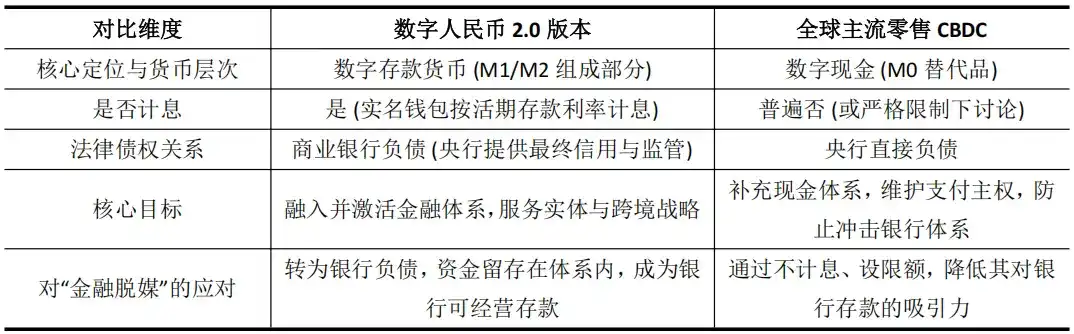
Building on this, the digital yuan will become the world's first CBDC to pay interest on ordinary user wallet balances. Digital Yuan 2.0 attempts to resolve risks and create new momentum within the banking system through institutional innovation that reconstructs monetary creditor-debtor relationships. Its difference from other global retail CBDCs lies in:

This model transforms the digital yuan from a tool that could potentially impact banks through "external circulation" into "internal blood" deeply integrated into the banks' balance sheets.

Commercial banks have management rights and profit rights over digital yuan deposits, shifting their promotion motivation from "passive duty fulfillment" to "active operation," forming a sustainable market-driven promotion mechanism. Simultaneously, clear deposit insurance guarantees eliminate credit concerns on the user side.

This not only solves the incentive problem but also means the digital yuan is formally incorporated into the traditional monetary creation and regulation framework, providing the central bank with a new, directly actionable policy variable (digital yuan interest rate). Its transaction traceability also creates conditions for implementing precise structural monetary policies.

Defining a New Form: The "Hybrid" of CBDC and Tokenized Deposits

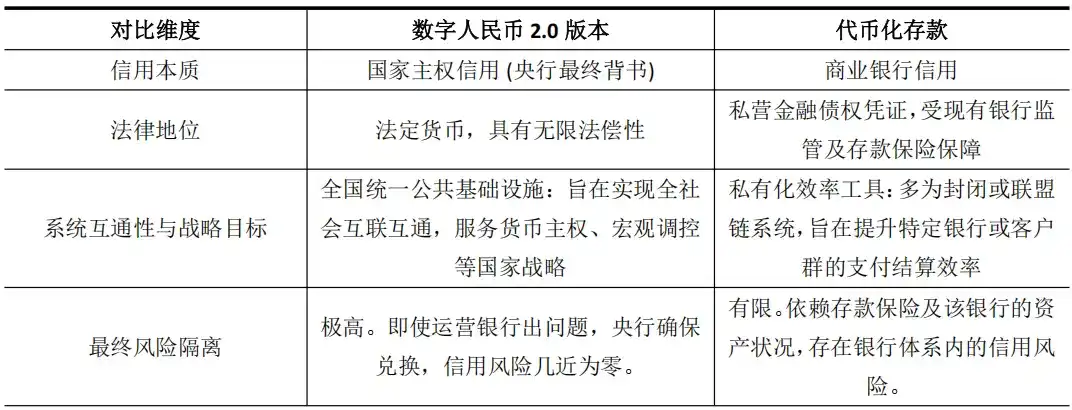
Digital Yuan 2.0, due to its interest-bearing and bank-operated characteristics, bears some resemblance to tokenized deposits promoted by commercial banks. The latter are digital representations of bank deposits on the blockchain (e.g., JPMorgan's JPM Coin), aimed at improving inter-institutional settlement efficiency. However, this similarity is superficial; they are fundamentally different in their credit foundation and strategic level.

Digital Yuan 2.0 actually creates a new hybrid form: it adopts the efficiency appearance of tokenized deposits, but its core is the complete credit of a sovereign national currency.

This distinction is crucial. The credit of a tokenized deposit is deeply tied to the balance sheet of its issuing bank; its essence is an efficiency tool optimizing existing financial intermediation. In contrast, the credit cornerstone of Digital Yuan 2.0 remains national sovereignty, with the goal of building foundational financial infrastructure to support the future digital economy.

A report from the Tsinghua University PBC School of Finance also pointed out that this type of programmable digital currency, backed by national credit, provides a core pivot for constructing a dual-platform model of "blockchain + digital assets."

Therefore, the upgrade of Digital Yuan 2.0 is far more than the evolution of a payment tool; it is pre-laying a "settlement track" with the highest credit rating for the upcoming era of large-scale asset tokenization.

Empowering Hong Kong's Digital Finance Ecosystem with Interest-Bearing Digital Yuan

The strategic elevation of the digital yuan has the most direct and profound impact on Hong Kong, given its unique geopolitical and institutional position.

The key variable of interest-bearing fundamentally changes the nature of the digital yuan in cross-border and financial scenarios, transforming it from a "payment channel" into a "strategic asset," thereby providing substantive empowerment for Hong Kong's construction of an "International Digital Asset Center" on multiple levels.

First, interest-bearing solves the motivation problem for cross-border funds to remain, directly strengthening Hong Kong's function as an offshore RMB funding pool.

In cross-border payment networks based on the multi-CBDC bridge (mBridge), non-interest-bearing digital currency is merely a circulation medium, and companies are motivated to settle quickly to reduce capital occupancy costs. After becoming interest-bearing, the digital yuan gains attributes competitive with Hong Kong's offshore RMB deposits. Multinational corporate treasury centers can use it as an interest-bearing liquidity management tool, staying within Hong Kong's compliance system for longer periods.

Currently, the digital yuan accounts for over 95% of mBridge transactions. The interest-bearing policy is expected to transform this flow advantage into a stock advantage, helping to expand and deepen Hong Kong's offshore RMB funding pool and consolidate its hub status.

Second, interest-bearing enhances the credit appeal of the digital yuan as a currency for issuing and settling tokenized assets in Hong Kong.

Hong Kong is actively promoting the tokenization of assets like bonds. In such Delivery versus Payment (DvP) settlements, the credit rating of the settlement currency directly affects the product's risk pricing and market acceptance. The interest-bearing digital yuan, backed by national credit, has a credit rating far exceeding that of any single bank's tokenized deposit.

The Hong Kong Monetary Authority's Ensemble project has explored the interoperability of tokenized deposits, and Digital Yuan 2.0 could be接入 (access) this ecosystem as a higher-level settlement asset. Utilizing the programmability of the digital yuan, processes like bond coupon payments or trade finance conditions can be automated, greatly improving efficiency and reducing operational risks.

This provides a potential, superior underlying financial infrastructure option for Hong Kong to issue high-end products like tokenized government green bonds.

Third, interest-bearing activates the space for financial service innovation围绕 (surrounding) the digital yuan, bringing synergistic opportunities for Hong Kong's fintech sector.

When the digital yuan becomes a bank-manageable, interest-bearing liability, services围绕 it—such as deposits, wealth management, financing, and smart contract management—will emerge.

Hong Kong, with its common law system aligned with international standards and active financial market, is an ideal "sandbox" for testing such innovative services. For example, compliant gateways connecting digital yuan wallets with virtual asset platforms could be developed, or structured wealth management products based on its interest-bearing特性 (characteristics) could be designed.

This innovative synergistic effect will allow Hong Kong to gain a first-mover advantage in the product design and rule-making of digital finance.

Fourth, interest-bearing deepens the differentiated协同 (synergy) strategy between the digital yuan and Hong Kong's "e-HKD".

Hong Kong has clearly prioritized developing the wholesale-type "e-HKD", focusing on large-value transactions between financial institutions and capital market applications. The interest-bearing Digital Yuan 2.0 can focus on serving cross-border retail payments, trade settlement, and related derivative financial services closely connected to the Mainland's real economy.

The two are not substitutes but form a clear complementary pattern: the e-HKD optimizes local wholesale financial efficiency, while the digital yuan deepens cross-border economic ties. This synergy enables Hong Kong to simultaneously strengthen its local financial infrastructure and its function as a cross-border bridge.

Связанные с этим вопросы

QWhat is the core change in the Digital Yuan 2.0 that distinguishes it from its previous version?

AThe core change is that starting from January 1, 2026, Digital Yuan wallet balances will accrue interest, and its legal attribute has shifted from being a direct liability of the central bank to a legal currency with the attributes of a commercial bank liability.

QHow does the interest-bearing feature of the Digital Yuan help solve the common dilemma faced by global CBDC initiatives?

AIt addresses the 'financial disintermediation' dilemma by transforming the Digital Yuan from a potential tool that could impact banks into a 'blood within the body' deeply integrated into bank balance sheets. This gives commercial banks management rights and profit rights over Digital Yuan deposits, turning their promotion motive from passive compliance to active operation, thus creating a sustainable market-driven promotion mechanism.

QWhat new hybrid form does the Digital Yuan 2.0 create, and how does it differ from tokenized deposits like JPM Coin?

AThe Digital Yuan 2.0 creates a hybrid form that adopts the efficiency appearance of tokenized deposits but is backed by the full credit of the national sovereign currency. The key difference lies in their credit foundation: tokenized deposits are tied to the issuing bank's balance sheet and are efficiency tools, whereas the Digital Yuan 2.0 is built on national sovereign credit and aims to be a foundational financial infrastructure for the future digital economy.

QWhat are the key impacts of the interest-bearing Digital Yuan on Hong Kong's digital financial ecosystem?

AThe key impacts are: 1) It strengthens Hong Kong's offshore RMB fund pool by providing an incentive for cross-border funds to remain. 2) It enhances the Digital Yuan's credit appeal as a settlement currency for tokenized assets in Hong Kong. 3) It activates financial service innovation space around the Digital Yuan, creating synergistic opportunities for Hong Kong's fintech sector. 4) It deepens the differentiated synergy strategy between the Digital Yuan and Hong Kong's proposed 'digital Hong Kong dollar' (wHKD).

QHow does the interest-bearing feature of the Digital Yuan specifically benefit the mBridge cross-border payment network?

AThe interest-bearing feature changes the Digital Yuan from merely a flow medium into an interest-bearing asset. This gives multinational corporate treasury centers an incentive to hold it as a liquidity management tool for longer periods within Hong Kong's compliant system. As the Digital Yuan already constitutes over 95% of mBridge transactions, this interest policy is expected to transform this flow advantage into a stock advantage, helping to expand and deepen Hong Kong's offshore RMB fund pool and consolidate its hub status.

Похожее

How Many Tokens Away Is Yang Zhilin from the 'Moon Chasing the Light'?

The article explores the intense competition between two leading Chinese AI companies, DeepSeek and Kimi (Moon Dark Side), and the mounting pressure on Yang Zhilin, the founder of Kimi. While DeepSeek re-emerged after 15 months of silence with its powerful V4 model—boasting 1.6 trillion parameters and low-cost, long-context capabilities—Kimi has been focusing on long-context processing and multi-agent systems with its K2.6 model. Yang faces a threefold challenge: technological rivalry, commercialization pressure, and investor expectations. Despite Kimi’s high valuation (reaching $18 billion), its revenue heavily relies on a single product with low paid conversion rates, while DeepSeek’s strategic silence and open-source influence have strengthened its market position and valuation prospects, now targeting over $20 billion. Both companies reflect broader trends in China’s AI ecosystem: Kimi aims for global influence through open-source contributions and agent-based advancements, while DeepSeek prioritizes foundational innovation and hardware independence, notably shifting to Huawei’s chips. Their competition is seen as vital for China’s AI progress, with the gap between top Chinese and U.S. models narrowing to just 2.7% on the Elo rating scale. Ultimately, the article argues that this rivalry, though anxiety-inducing for leaders like Zhilin, is essential for driving innovation and solidifying China’s role in the global AI landscape.

marsbit4 ч. назад

How Many Tokens Away Is Yang Zhilin from the 'Moon Chasing the Light'?

marsbit4 ч. назад

TechFlow Intelligence Bureau: ChatGPT Helps Amateur Mathematician Crack 60-Year-Old Problem, CFTC Sues New York Regulator Over Coinbase and Gemini

An amateur mathematician, with the assistance of ChatGPT, has solved a combinatorial mathematics puzzle originally proposed by Hungarian mathematician Paul Erdős in the 1960s. This marks another milestone in AI-aided mathematical research, demonstrating the evolving capabilities of large language models in formal reasoning. In other AI developments, OpenAI introduced a new privacy filter tool for enterprise API usage, automatically screening sensitive data. Meanwhile, the Qwen3.6-27B model achieved 100 tokens per second on a single RTX 5090 GPU using quantization, significantly lowering the cost barrier for local AI deployment. In crypto and Web3, the U.S. CFTC sued New York’s financial regulator, challenging its oversight of Coinbase and Gemini—a first-of-its-kind federal-state regulatory clash. Following a vulnerability, KelpDAO and major DeFi protocols established a recovery fund. Tether froze $344 million in assets linked to Iran’s central bank upon U.S. Treasury request, highlighting the centralized control risks in stablecoins. Separately, Litecoin underwent a 3-hour chain reorganization to undo a privacy-layer exploit. In the U.S., former President Trump invoked the Defense Production Act to address power grid bottlenecks affecting AI data centers and dismissed the entire National Science Board, raising concerns over research independence. A retail trader gained 250% on a $600k Intel options bet amid AI-related speculation. Xiaomi announced its first performance electric vehicle, targeting rivals like Tesla. Meanwhile, iPhone users reported devices automatically reinstalling a hidden app daily, suspected to be MDM-related. A Chinese securities report noted that A-share institutional crowding has reached its second-longest streak since 2007, signaling high valuations and potential style rotation. The day’s developments reflect a dual narrative: AI is enabling unprecedented individual breakthroughs, while centralized power structures—whether governmental or corporate—are becoming more assertive, underscoring that decentralization is as much a political-economic challenge as a technical one.

marsbit4 ч. назад

TechFlow Intelligence Bureau: ChatGPT Helps Amateur Mathematician Crack 60-Year-Old Problem, CFTC Sues New York Regulator Over Coinbase and Gemini

marsbit4 ч. назад

Торговля

Спот
Фьючерсы

Популярные статьи

Как купить S

Добро пожаловать на HTX.com! Мы сделали приобретение Sonic (S) простым и удобным. Следуйте нашему пошаговому руководству и отправляйтесь в свое крипто-путешествие.Шаг 1: Создайте аккаунт на HTXИспользуйте свой адрес электронной почты или номер телефона, чтобы зарегистрироваться и бесплатно создать аккаунт на HTX. Пройдите удобную регистрацию и откройте для себя весь функционал.Создать аккаунтШаг 2: Перейдите в Купить криптовалюту и выберите свой способ оплатыКредитная/Дебетовая Карта: Используйте свою карту Visa или Mastercard для мгновенной покупки Sonic (S).Баланс: Используйте средства с баланса вашего аккаунта HTX для простой торговли.Третьи Лица: Мы добавили популярные способы оплаты, такие как Google Pay и Apple Pay, для повышения удобства.P2P: Торгуйте напрямую с другими пользователями на HTX.Внебиржевая Торговля (OTC): Мы предлагаем индивидуальные услуги и конкурентоспособные обменные курсы для трейдеров.Шаг 3: Хранение Sonic (S)После приобретения вами Sonic (S) храните их в своем аккаунте на HTX. В качестве альтернативы вы можете отправить их куда-либо с помощью перевода в блокчейне или использовать для торговли с другими криптовалютами.Шаг 4: Торговля Sonic (S)С легкостью торгуйте Sonic (S) на спотовом рынке HTX. Просто зайдите в свой аккаунт, выберите торговую пару, совершайте сделки и следите за ними в режиме реального времени. Мы предлагаем удобный интерфейс как для начинающих, так и для опытных трейдеров.

1.2k просмотров всегоОпубликовано 2025.01.15Обновлено 2025.03.21

Как купить S

Sonic: Обновления под руководством Андре Кронье – новая звезда Layer-1 на фоне спада рынка

Он решает проблемы масштабируемости, совместимости между блокчейнами и стимулов для разработчиков с помощью технологических инноваций.

2.2k просмотров всегоОпубликовано 2025.04.09Обновлено 2025.04.09

Sonic: Обновления под руководством Андре Кронье – новая звезда Layer-1 на фоне спада рынка

HTX Learn: Пройдите обучение по "Sonic" и разделите 1000 USDT

HTX Learn — ваш проводник в мир перспективных проектов, и мы запускаем специальное мероприятие "Учитесь и Зарабатывайте", посвящённое этим проектам. Наше новое направление .

1.8k просмотров всегоОпубликовано 2025.04.10Обновлено 2025.04.10

HTX Learn: Пройдите обучение по "Sonic" и разделите 1000 USDT

Обсуждения

Добро пожаловать в Сообщество HTX. Здесь вы сможете быть в курсе последних новостей о развитии платформы и получить доступ к профессиональной аналитической информации о рынке. Мнения пользователей о цене на S (S) представлены ниже.

活动图片