What Are Crypto Users Most Concerned About in 2025? 10 AI Models Give Different Answers

marsbitОпубликовано 2025-12-24Обновлено 2025-12-24

Введение

The article explores what cryptocurrency users might be most concerned about in 2025 by querying 10 major AI models with the same prompt. Each model was asked to list the top three questions crypto users would frequently ask in 2025, with instructions to avoid real-time searches and rely on their understanding of long-term discussion patterns. The models provided varied responses, reflecting their unique focuses and contextual training. For instance, ChatGPT emphasized market cycles and alpha opportunities, while Grok focused on narratives like Bitcoin halving and ETF inflows. Perplexity prioritized price trends and scams, and Claude highlighted risk management for beginners. Gemini leaned toward real-world assets and technical roadmaps like L2 and AI integration. Chinese models like Douban and Wenxin were more aligned with regulatory impacts and market cycles, whereas Kimi delved into practical on-chain issues like wallet security and MEV. Overall, the questions centered on three core themes: market cycle positioning, profit opportunities, and risk management. The diversity in responses suggests differences in model design, data training, and intended use cases, with more advanced models often providing more structured and specific questions. The findings reflect the crypto community’s persistent focus on volatility, narrative-driven markets, and the balance between seeking returns and avoiding risks.

Author: WuBlockchain

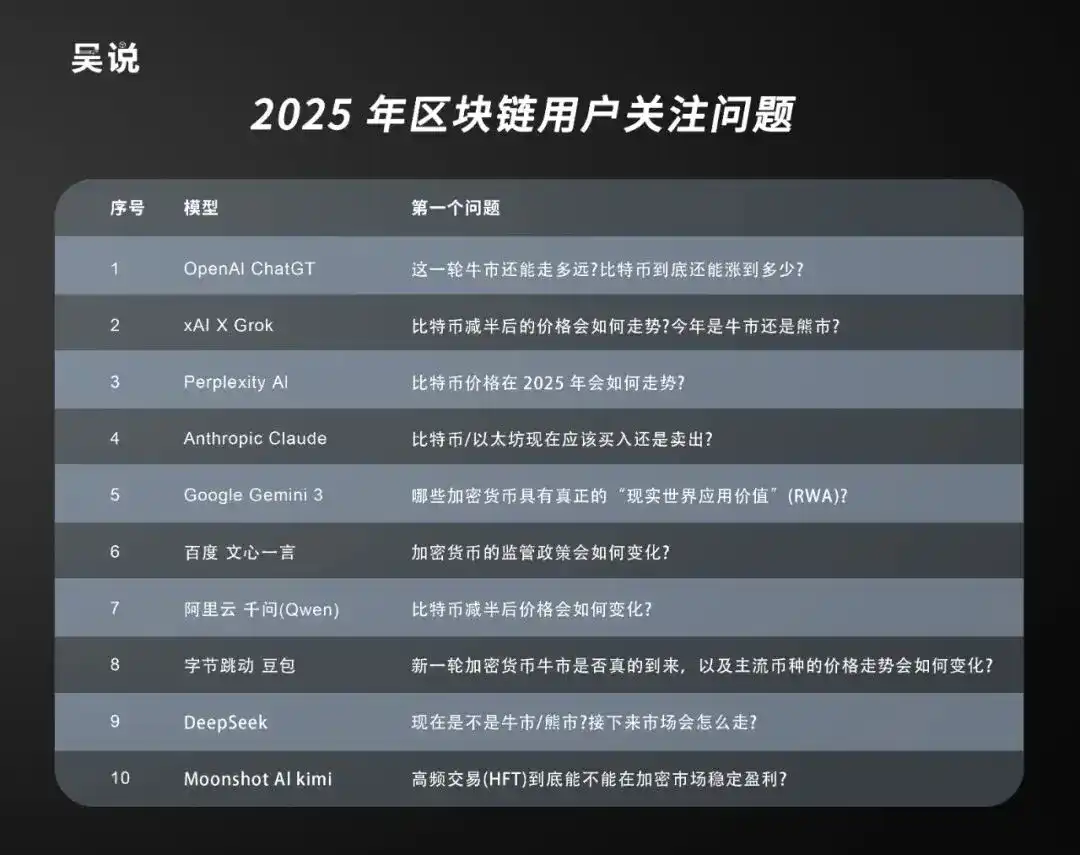
What are crypto users most concerned about in 2025? We conducted a user survey using AI large models by asking different models the same question: "What are the three most frequently asked questions about cryptocurrencies in 2025?"

To minimize homogenized answers due to real-time retrieval and considering that large models generally cannot—and are not allowed to—statistically verify or disclose their training data, we added a note to the question: "Please do not perform real-time searches or cite specific articles; answer based solely on your understanding of long-term discussion patterns."

ChatGPT

1. How much further can this bull run go? Has Bitcoin already peaked?

2. Is there still genuine Alpha in this market cycle, and how can average users make money?

3. Do current hot projects or sectors have long-term viability, or are they structurally exploitative?

X Grok

1. Is the market in a bull or bear phase after the Bitcoin halving?

2. What are the most promising crypto assets or sectors to invest in for 2025?

3. How are Ethereum spot ETFs performing, and what is the inflow of institutional capital?

Perplexity AI

1. How might Bitcoin's price evolve in 2025?

2. How to identify and avoid cryptocurrency-related scams?

3. How will ETF and regulatory developments impact the crypto market?

Claude

1. Is now the right time to buy or sell Bitcoin or Ethereum?

2. Is a particular crypto project a scam, and is it trustworthy?

3. How should new users start investing in cryptocurrencies while managing risks?

Gemini 3

1. Which crypto projects have real-world application value (RWA)?

2. How will current and future regulatory policies affect personal asset security?

3. Among Ethereum L2, Solana, and AI+Crypto, which technological path is likely to emerge as the ultimate winner?

DeepSeek

1. Is the current market in a bull or bear phase?

2. Which crypto sectors or assets show the most potential in 2025?

3. How will changes in regulatory policies impact asset security and investment decisions?

Douban

1. Has a new cryptocurrency bull market arrived?

2. How will changes in regulatory policies across countries affect ordinary investors?

3. What does the Bitcoin halving trend mean for retail investment strategies?

Qianwen

1. How will Bitcoin's price trend evolve after the halving?

2. Have Ethereum and major public chains achieved substantive breakthroughs in practical applications?

3. How will regulatory policies in various countries affect the legitimate use of cryptocurrencies?

Wenxin Yiyan

1. How will global cryptocurrency regulatory policies change?

2. Do Bitcoin and mainstream crypto assets have long-term investment value?

3. Can real-world application scenarios for cryptocurrencies truly be realized?

Kimi

1. Can retail investors achieve stable profits through high-frequency trading in the crypto market?

2. What is the safest way to store private keys and wallet assets?

3. How should slippage be set in on-chain transactions to avoid MEV loss?

Summary

The reason these models provide slightly different "top three questions" may relate to their respective positioning and context. ChatGPT seems to adopt a trader's perspective, framing the discussion as a structured chain of anxiety: "How long will the cycle last — Is Alpha still available — Is there structural exploitation?" Grok aligns more with social media hotspots, focusing on narratives like halving, bull/bear markets, and ETF capital flows. Perplexity's style resembles a retrieval-based summary, concentrating on price trends, scam prevention, and ETF/regulatory progress. Claude is more cautious, emphasizing timing for buying/selling, project trustworthiness, and risk management for beginners. Gemini leans toward industry and technology, focusing on RWA, regulatory impacts on asset security, and the "final choice" among L2/Solana/AI. Chinese models overall focus more on cycles, halving, and regulation—these "most hardcore deterministic variables"—while Kimi is an exception, diving into on-chain execution details (wallet security, slippage/MEV, HFT), resembling real friction points for high-frequency on-chain users.

Another secondary but noteworthy possibility is that model capability differences also affect the "sharpness" of outputs. More capable models tend to frame the same topic more specifically and systematically; conversely, weaker models更容易 fall back on "price/regulation/scams"这类最大公约数式表达, making answers appear more similar with less informational增量. This factor may not be the main cause, but in macro open-ended questions, it could amplify the perception of homogeneity.

Overall, these questions highly concentrate on three core themes: cycle positioning, profit paths, and risk boundaries. The crypto market's notable features—high volatility and strong narrative drive—mean that "where are we in the bull/bear cycle" almost determines all subsequent user actions (holding, selling, swapping, leveraging, or exiting). As the market matures and becomes more crowded, users quickly shift from "is there an opportunity" to "where is the opportunity, and can I still capture it," making Alpha, sector selection, and institutional capital (ETFs) natural high-frequency topics. Meanwhile, scams, project credibility, asset security, and regulatory compliance reflect that crypto users长期 operate in a "high-reward/high-uncertainty" environment: chasing returns while fearing pitfalls, ultimately forming a typical behavioral structure—first assess the trend, then seek opportunities, finally control risks.

Связанные с этим вопросы

QWhat are the three main themes that cryptocurrency users are most concerned about in 2025, based on the AI model responses?

AThe three main themes are market cycle position (bull or bear market), profit-making opportunities (alpha, investment strategies, and institutional inflows), and risk management (scams, asset security, and regulatory impacts).

QHow do the concerns of Chinese-language models (like Douban and Qwen) differ from others in the survey?

AChinese-language models focus more on cyclical trends, halving events, and regulatory policies, which are seen as 'core deterministic variables,' while models like Kimi address more granular, on-chain execution details such as wallet security and MEV.

QWhich AI model emphasized technical and industry-focused questions, such as real-world asset (RWA) applications and layer-2 solutions?

AGemini 3 emphasized technical and industry-focused questions, including queries about real-world asset (RWA) value, regulatory impacts on asset security, and comparisons between Ethereum L2, Solana, and AI+Crypto technologies.

QWhat methodological constraint was added to the AI models' responses to avoid homogenized answers?

AThe models were instructed not to perform real-time searches or cite specific articles, relying solely on their understanding of long-term discussion patterns to generate responses.

QAccording to the summary, what behavioral structure do cryptocurrency users typically exhibit in high-uncertainty environments?

AUsers typically follow a behavioral structure: first assessing market trends, then seeking profit opportunities, and finally focusing on risk control to navigate the high-reward but high-uncertainty environment.

Похожее

When AI Begins to Audit the World: From Claude Discovering the ZEC Vulnerability, Watching the Encryption Industry Enter the 'Recursive Security Era'

**When AI Audits the World: From Claude's Discovery of a ZEC Vulnerability, Viewing the Crypto Industry Entering a "Recursive Security Era"** This article examines a pivotal shift in the blockchain security landscape, triggered by the convergence of two events: Anthropic's research on AI's "Recursive Self-Improvement" and Claude Opus 4.8's discovery of a critical vulnerability in Zcash's code. Traditionally, crypto security has relied on human experts and automated tools for periodic audits. However, the article argues AI is transitioning from a mere tool to an active participant in understanding and analyzing complex systems. Claude's ability to identify a subtle flaw in Zcash's zero-knowledge proof system demonstrates AI's potential to dramatically lower the cost and time required for risk discovery. This goes beyond finding a single bug; it signals a change in the very mechanism of how vulnerabilities are found. The core thesis introduces the concept of "Recursive Security," drawing a parallel to Anthropic's "Recursive Self-Improvement." Just as AI can accelerate its own development through feedback loops, security systems are evolving towards a continuous cycle of analysis, risk identification, remediation, and re-analysis. Security is becoming a persistent, evolving capability integrated into a system's lifecycle, rather than a one-time pre-launch audit. This shift is particularly urgent for the crypto industry, where system complexity from Layer-2 networks, modular architectures, and ZK-proofs is growing faster than human analysis capacity. AI excels at the pattern recognition and contextual understanding needed to navigate this complexity. Importantly, the article cautions that AI augments both defenders and potential attackers, accelerating the entire threat landscape. The future competitive advantage may not lie in having zero vulnerabilities, but in having the fastest risk discovery, validation, and response capabilities. The Claude-Zcash incident is thus an early signal of an era where AI-driven, recursive security systems become essential for managing risk in an increasingly complex digital world.

marsbit9 мин. назад

When AI Begins to Audit the World: From Claude Discovering the ZEC Vulnerability, Watching the Encryption Industry Enter the 'Recursive Security Era'

marsbit9 мин. назад

From MSTR to STRC+: Where Is the Limit of the Strategy Universe?

From MSTR to STRC+: The Evolution and Limits of the Strategy Universe This article examines the transformation of Strategy (formerly MicroStrategy) from a simple "Bitcoin treasury" company into a complex financial engineering firm building a BTC-backed credit system. **Core Thesis:** Strategy's true significance lies not just in its massive BTC holdings (~844k BTC), but in its attempt to transform this static reserve into a multi-layered credit curve within traditional capital markets and, subsequently, into on-chain yield infrastructure. **The MSTR Flywheel:** The initial model was a reflexive loop: BTC price rises → MSTR stock rises → company raises capital (debt/equity) at a premium → buys more BTC → increases per-share BTC exposure → MSTR premium grows. This "amplified Bitcoin" equity (MSTR) thrives on bullish momentum but is vulnerable to tightening premiums and rising funding costs. **Building the Credit Curve:** Strategy's innovation is slicing its single BTC balance sheet into different risk/return profiles via specialized securities: * **MSTR:** High-volatility equity layer absorbing full BTC upside/downside. * **STRC:** Key product. A perpetual preferred stock designed as "short duration high yield credit," offering ~11.5% floating monthly dividends. It attracts fixed-income investors seeking yield without direct BTC exposure, funding Strategy's operations. * **STRD/STRK/STRF:** Other preferred/share classes with varying durations, conversion rights, and fixed dividends. **Risks of the STRC Model:** STRC's high yield is not risk-free. Its stability depends on: 1) Sufficient BTC asset coverage, 2) Strategy's continued ability to pay dividends, and 3) Market faith in the MSTR/STRC funding flywheel. Stress points include deep BTC price declines eroding the asset buffer, rising dividend costs if STRC trades below par, and a broken flywheel if MSTR's premium (mNAV) falls persistently. **On-Chain Expansion: STRC+:** Projects like **Saturn** and **Apyx** aim to package STRC's (and other DAT preferred stock) cash flows into on-chain stablecoin yield (e.g., sUSDat, apyUSD). They offer DeFi a new yield source distinct from trading fees or incentives—cash dividends from traditional securities. However, this introduces compounded risks: off-chain custody, issuer credit risk, BTC volatility, and protocol execution risk. **Conclusion: The Ultimate Boundary** Strategy's endgame is not infinite BTC accumulation. It is the market's long-term acceptance of a new credit system where BTC serves as collateral for tradable securities whose cash flows can power on-chain financial applications. Its "universe" expands if this BTC-native credit curve gains legitimacy, but contracts if these instruments are repriced purely as high-risk, yield-bearing credit assets without stablecoin mythology.

marsbit28 мин. назад

From MSTR to STRC+: Where Is the Limit of the Strategy Universe?

marsbit28 мин. назад

Founder of Baixing.com: My Fourteen Claude Code Usage Experiences

Founder of Baixing.com Shares 14 Personal Tips for Using Claude Code The author outlines his personal, non-universal strategies for maximizing Claude Code. Key points include: focusing deeply on one primary tool (Claude Code) rather than constant comparison; mastering essential shortcuts for the editor and command line; utilizing voice input like HoldSpeak; starting projects with a structured PROJECT.md file; defaulting to Claude agents for most tasks; and leveraging integrations with GitHub and Cloudflare for build, deployment, and infrastructure. He emphasizes a clear separation between human and machine work: manually maintain a core CLAUDE.md file, and understand AI-generated content by asking the AI, not reading its raw code. Efficient communication involves dragging files (screenshots, audio, documents) directly into the interface. For knowledge management, he recommends a centralized, Git-synced memory system based on ~/.claude/CLAUDE.md to ensure permanence and avoid scattered project memories. Other practices include writing and continuously refining "Skills," using the expensive but reliable ultracode for complex dynamic workflows, and employing Git documentation as handoff points between agents. The overarching philosophy is to treat Claude Code like a horse (or a person) with its own pathfinding abilities—setting goals and boundaries rather than micromanaging every turn.

链捕手36 мин. назад

Founder of Baixing.com: My Fourteen Claude Code Usage Experiences

链捕手36 мин. назад

Торговля

Спот
Фьючерсы

Популярные статьи

Неделя обучения по популярным токенам (2): 2026 может стать годом приложений реального времени, сектор AI продолжает оставаться в тренде

2025 год — год институциональных инвесторов, в будущем он будет доминировать в приложениях реального времени.

1.8k просмотров всегоОпубликовано 2025.12.16Обновлено 2025.12.16

Неделя обучения по популярным токенам (2): 2026 может стать годом приложений реального времени, сектор AI продолжает оставаться в тренде

Обсуждения

Добро пожаловать в Сообщество HTX. Здесь вы сможете быть в курсе последних новостей о развитии платформы и получить доступ к профессиональной аналитической информации о рынке. Мнения пользователей о цене на AI (AI) представлены ниже.

活动图片