Vitalik Buterin Says Ethereum Solved The Blockchain Trilemma

bitcoinistОпубликовано 2026-01-05Обновлено 2026-01-05

Введение

Vitalik Buterin claims Ethereum has effectively solved the blockchain trilemma—decentralization, consensus, and high bandwidth—through two key technical developments now in production. PeerDAS, which enables decentralized data availability sampling, is live on the mainnet. ZK-EVMs, though still in an alpha stage, offer production-level performance with safety improvements underway. Buterin argues these innovations shift Ethereum into a new category of decentralized network, combining robust consensus with high throughput. He outlines a multi-year rollout, expecting significant scalability improvements by 2026–2030, with ZK-EVMs eventually becoming the primary validation method. Distributed block building is noted as a longer-term goal to enhance fairness and reduce centralization risks.

Ethereum co-founder Vitalik Buterin said the network has effectively “solved” the blockchain trilemma: decentralization, consensus, and high bandwidth, arguing that the missing ingredients are now live on mainnet or within reach as zero-knowledge Ethereum virtual machines (ZK-EVMs) move toward production use.

In a Jan. 3 post on X, Buterin framed the moment around two technical developments: PeerDAS, which he said is now live on Ethereum mainnet, and ZK-EVMs, which he described as being at an “alpha stage” with “production-quality performance” while “remaining work is safety.”

“These are not minor improvements; they are shifting Ethereum into being a fundamentally new and more powerful kind of decentralized network,” Buterin wrote. “To see why, let’s look at the two major types of p2p network so far.”

Buterin drew a contrast between early peer-to-peer systems that could scale throughput but lacked agreement on shared state, and blockchains that achieved robust consensus but paid for it with constrained bandwidth. He pointed to BitTorrent as a model of decentralized distribution without consensus, and to Bitcoin as a model of decentralization and consensus that keeps bandwidth low because “it’s not ‘distributed’ in the sense of work being split up, it’s replicated.”

Ethereum Will Solve The Blockchain Trilemma

The claim, in Buterin’s telling, is that Ethereum is entering a third category. “Now, Ethereum with PeerDAS (2025) and ZK-EVMs (expect small portions of the network using it in 2026), we get: decentralized, consensus and high bandwidth,” he said. “The trilemma has been solved — not on paper, but with live running code, of which one half (data availability sampling) is on mainnet today, and the other half (ZK-EVMs) is production-quality on performance today — safety is what remains.”

Buterin cast this as the culmination of a multi-year roadmap rather than a sudden breakthrough. He described it as a “10-year journey,” pointing back to early data availability sampling research and noting that ZK-EVM efforts began around 2020. The arc of his argument is that data availability sampling changes what a decentralized network can safely publish and verify at scale, while ZK-EVMs change how nodes can validate execution, shifting validation toward proof-based verification as the technology matures.

Looking ahead, Buterin laid out an approximate timeline for how he expects the vision to roll out over the next four years. In 2026, he expects “large non-ZKEVM-dependent gas limit increases” tied to BALs and ePBS, alongside what he described as the first opportunities to run a ZK-EVM node.

From 2026 through 2028, he anticipates a sequence of changes, gas repricings, adjustments to state structure, moving execution payloads into blobs, and other steps, aimed at making higher gas limits safe. Between 2027 and 2030, he expects “large further gas limit increases,” with ZK-EVMs becoming “the primary way to validate blocks on the network.”

He also flagged what he called a “third piece” of the puzzle: distributed block building. The long-term goal, he wrote, is a world where “the full block is never constituted in one single place,” though he stressed it “will not be necessary for a long time.” The nearer-term focus is distributing “meaningful authority in block building,” either through in-protocol mechanisms—he floated expanding FOCIL as a primary transaction channel—or through out-of-protocol systems such as distributed builder marketplaces.

For Buterin, distributing block building is not just an engineering preference but a risk and fairness question: he argued it would reduce the chance of “centralized interference with real-time transaction inclusion,” while creating “a better environment for geographical fairness.”

At press time, ETH traded at $3,164.
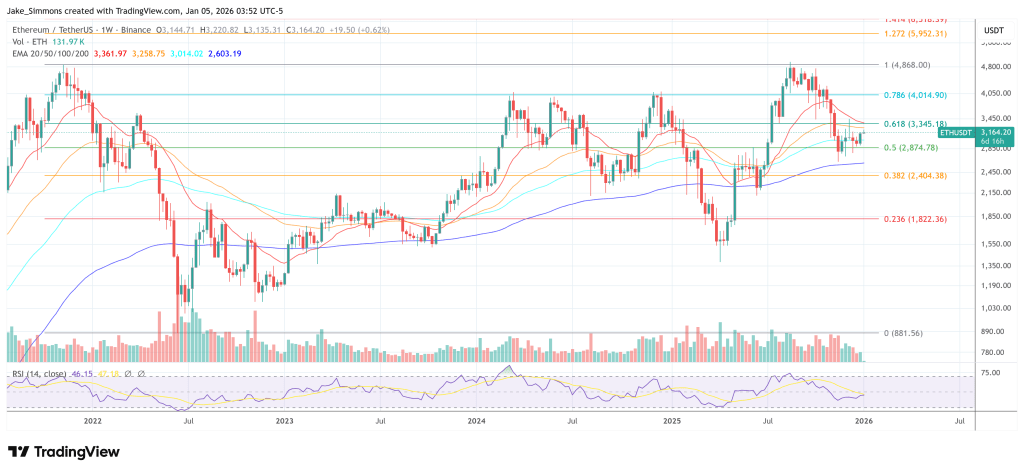
ETH faces the 50-week EMA, 1-week chart | Source: ETHUSDT on TradingView.com

Связанные с этим вопросы

QWhat are the two key technical developments that Vitalik Buterin claims have solved the blockchain trilemma for Ethereum?

AThe two key technical developments are PeerDAS, which is now live on the Ethereum mainnet, and ZK-EVMs, which are at an 'alpha stage' with production-quality performance.

QAccording to Buterin, what are the three components of the blockchain trilemma that Ethereum has now addressed?

AThe three components of the blockchain trilemma are decentralization, consensus, and high bandwidth.

QWhat is the long-term goal for distributed block building that Buterin describes?

AThe long-term goal is a world where 'the full block is never constituted in one single place' to reduce the risk of centralized interference and improve geographical fairness.

QWhat approximate timeline did Buterin provide for when ZK-EVMs are expected to become the primary way to validate blocks on the Ethereum network?

AButerin expects ZK-EVMs to become the primary way to validate blocks between 2027 and 2030.

QHow did Buterin contrast early peer-to-peer systems like BitTorrent with blockchains like Bitcoin?

AHe contrasted them by stating that early P2P systems like BitTorrent could scale throughput but lacked agreement on a shared state, while blockchains like Bitcoin achieved robust consensus but paid for it with constrained bandwidth, as the work is replicated rather than distributed.

Похожее

Insider Trading in War: 5 People Involved, the Highest Earner Was Arrested

On April 24, the U.S. Department of Justice arrested U.S. Army Special Forces Staff Sergeant Gannon Ken Van Dyke for insider trading related to the capture of Venezuelan President Nicolás Maduro on January 3. Van Dyke allegedly profited over $400,000 by placing bets on a prediction market, Polymarket, using insider knowledge of the covert operation. According to the indictment, Van Dyke registered an account (0x31a5) on December 26 and made a series of bets predicting Maduro’s capture and U.S. military involvement in Venezuela. He withdrew most of his funds on the day of the operation and attempted to obscure his tracks by transferring assets through crypto and brokerage accounts. This case marks the first time the DOJ has prosecuted insider trading on Polymarket. PolyBeats had previously identified five suspicious accounts, including Van Dyke’s—the highest earner—in January. The other accounts, with profits ranging from $34,000 to $145,000, remain under unofficial scrutiny but have not been charged. Their lower profits, indirect access to information, and unclear legal boundaries may complicate prosecution. Polymarket has since strengthened its market integrity rules, explicitly prohibiting trading based on confidential or insider information. Van Dyke’s arrest, nearly four months after his trades, signals increased regulatory attention and the persistent traceability of blockchain-based transactions.

marsbit3 мин. назад

Insider Trading in War: 5 People Involved, the Highest Earner Was Arrested

marsbit3 мин. назад

Bitwise: Bullish on Bitcoin's Performance in the Second Half of the Year, AI and Regulation Will Spark a New Altcoin Season

Bitwise CIO Matt Hougan and Research Lead Ryan Rasmussen express strong bullish sentiment on Bitcoin's long-term prospects, suggesting that its $1 million price target may be too conservative. They argue Bitcoin serves a dual role: as digital gold and a potential global settlement asset, especially amid declining trust in traditional monetary systems. Despite a weak Q1 2026 where nearly all crypto assets and prices saw double-digit declines, the analysts remain optimistic due to strong forward-looking catalysts, including institutional adoption via Bitcoin ETFs from major firms like Morgan Stanley and Goldman Sachs. Geopolitical instability, such as Iran’s mention of using Bitcoin for international payments, increases the value of Bitcoin’s “out-of-the-money call option” as a non-political, global settlement currency. This enhances its appeal beyond a mere store of value. . Additionally, Hougan highlights that a clearer regulatory token framework under current SEC leadership, combined with AI efficiency gains and high-performance blockchains, could fuel a new “altseason” by late 2026. This may lead to a wave of legitimate, value-capturing token projects, unlike the earlier ICO boom. . Bitwise also announced an Avalanche ETF, citing its unique architecture and rapid growth in real-world asset (RWA) tokenization, which has surged 10x to nearly $30 billion in two years. The firm believes Layer 1 blockchains are still early in their growth cycle, with significant potential ahead.

marsbit49 мин. назад

Bitwise: Bullish on Bitcoin's Performance in the Second Half of the Year, AI and Regulation Will Spark a New Altcoin Season

marsbit49 мин. назад

Торговля

Спот
Фьючерсы

Популярные статьи

Manyu: восходящая мем-звезда на Ethereum, готовая открыть новую эру культуры Shiba

Manyu - это мемтокен на Ethereum, который приносит децентрализованную культурную и развлекательную ценность через вирусное влияние в соцсетях и вовлечённость сообщества.

1.9k просмотров всегоОпубликовано 2025.11.27Обновлено 2025.11.27

Manyu: восходящая мем-звезда на Ethereum, готовая открыть новую эру культуры Shiba

Обсуждения

Добро пожаловать в Сообщество HTX. Здесь вы сможете быть в курсе последних новостей о развитии платформы и получить доступ к профессиональной аналитической информации о рынке. Мнения пользователей о цене на ETH (ETH) представлены ниже.

活动图片