Verse8 Completes $5 Million Seed Funding Round to Accelerate AI-Driven Game Creation

marsbitОпубликовано 2026-03-26Обновлено 2026-03-26

Введение

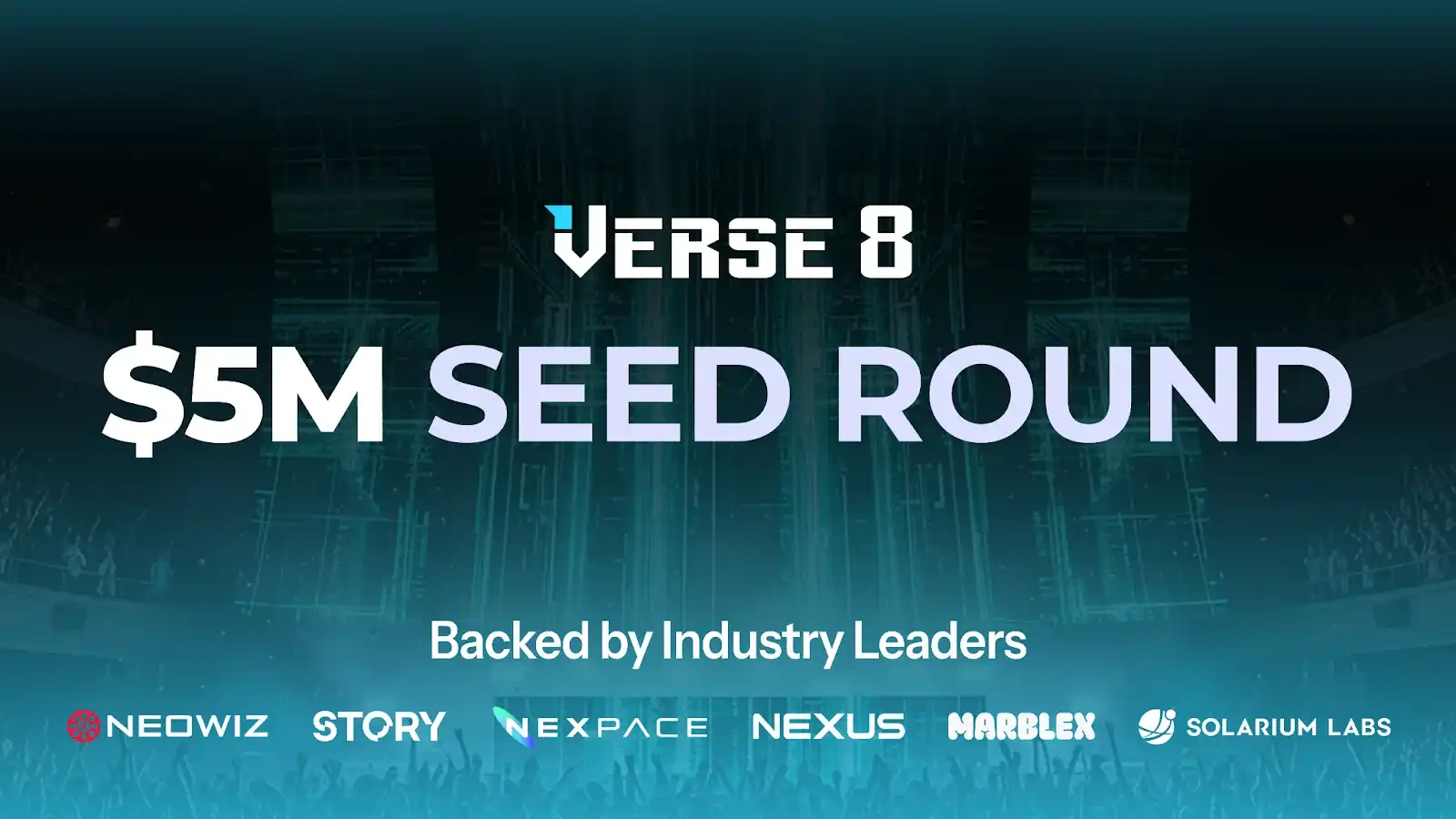
Verse8, an AI-native platform that enables creators to instantly turn ideas into playable games, has raised $5 million in seed funding. The round was co-led by Story Foundation, NEXPACE (Nexon’s Web3 arm), Neowiz, MARBLEX (Netmarble’s Web3 arm), Solarium Labs, and NEXUS, with participation from other investors in gaming, media, and tech. The funds will accelerate development of Verse8’s core AI systems, expand creator onboarding and incentive programs, and enhance its publishing and distribution infrastructure. Since its launch in July 2024, the platform has attracted over 3.5 million monthly active users and more than 5,000 active creators who have generated 25,000 games. Using natural language prompts, users can create fully playable multiplayer games within minutes, eliminating the need for coding, game engines, or large teams. Co-founded by JC Kim and Kevin Lee, Verse8 aims to democratize interactive content creation. The platform automates art, code, design, and QA, while integrating with Story for on-chain ownership, licensing, and distribution, allowing creators to retain attribution and monetize their work. Advised by Jake Song, co-founder of Nexon, Verse8 is positioned at the forefront of a new AI-native, creator-led era in interactive media.

Verse8, an AI-native platform that enables creators to instantly turn ideas into playable games, today announced the completion of a $5 million seed funding round. This round was co-led by Story Foundation, NEXPACE (Nexon's Web3 division), Neowiz, MARBLEX (Netmarble's Web3 division), Solarium Labs, and NEXUS, with participation from multiple investors in the gaming, media, and technology sectors.

The new funds will be used to advance Verse8's core AI systems, expand creator onboarding and incentive programs, and enhance its publishing and distribution infrastructure.

This funding round comes at a critical inflection point for interactive media development. Generative AI is significantly reducing the cost and complexity of content creation; however, the creation of interactive experiences remains constrained by lengthy development cycles, large teams, and centralized studios. While billions of people worldwide create videos, music, and images, only a tiny fraction possess the skills and tools to make games. Verse8 was built to meet this inflection point, aiming to enable anyone to create real-time, multiplayer games.

Verse8 allows creators to use natural language prompts to generate fully playable multiplayer games within minutes, with no need for coding, installing engines, or assembling large production teams. A simple idea can become a real-time interactive experience, instantly deployed and accessible to players globally.

Since its launch in July 2024, the platform has attracted over 3.5 million monthly active users for game creation and play, with more than 5,000 active creators who have generated 25,000 games.

Verse8 was co-founded by JC Kim and Kevin Lee, seasoned entrepreneurs with deep experience in blockchain gaming, platform building, and strategic investment. Their backgrounds include pioneering blockchain business at LINE, successfully founding and exiting startups, and deploying over $200 million in game investments, which has positioned Verse8 to focus on speed, accessibility, and creative iteration from the outset.

Jake Song, renowned creator of Korea's iconic "Lineage" series and co-founder of Nexon, will serve as a core advisor, providing strategic guidance for Verse8's AI-driven gaming platform.

Reimagining the Creation of Interactive Media

Today's game development is capital- and labor-intensive. Production often requires lengthy cycles, multidisciplinary teams, and budgets reaching tens of millions of dollars, concentrating creative and economic power in the hands of a few studios. Verse8 dramatically lowers these barriers by enabling creators to turn text prompts into real-time, shared game worlds within minutes, facilitating large-scale experimentation and creativity.

"Globally, only about 3 million creators are making interactive content, with the top 20 studios controlling 70% of the output," said Kevin Lee, CEO of Verse8. "Verse8 is changing this landscape. By compressing the tools of a full game studio into a single prompt, we empower all creators to engage in interactive creation. This funding allows us to deepen our technology and expand an ecosystem where creativity builds cumulatively rather than starting from scratch."

S.Y. Lee, Co-founder and CEO of Story, stated: "AI is reducing the cost of creation for all media formats, but games have been the final frontier. Verse8 is tackling the hardest part of this problem—compressing months of development and millions of dollars in funding into minutes of natural language prompts, and doing so from day one in a way that coordinates creators, IP holders, and distribution channels. We believe this marks the beginning of a new creative stack for interactive media, with Verse8 at its center."

Verse8 automates art, code, design, and quality assurance while supporting continuous iteration and deployment. Through integration with Story, it provides on-chain ownership, licensing, and distribution, enabling creators to retain attribution, earn revenue, and safely remix existing IP.

Verse8 believes this approach lays the foundation for a new category of creator-led, AI-native interactive media, with games representing the first scalable application in a broader shift in how digital content is created, owned, and distributed.

About Verse8

Verse8 is an AI-native creation and publishing platform that allows anyone to turn ideas into interactive games and stories. By combining generative AI, integrated game engines, and on-chain ownership, Verse8 lowers the barrier to interactive creation and supports a new generation of creator-led digital worlds. The platform was developed by Planetarium Labs in collaboration with Jake Song, leveraging deep gaming expertise and strategic partnerships to deliver high-fidelity interactive experiences at scale.

Связанные с этим вопросы

QWhat is Verse8 and what recent milestone did it achieve?

AVerse8 is an AI-native platform that enables creators to instantly turn ideas into playable games. It recently announced the completion of a $5 million seed funding round.

QWhich companies co-led the seed funding round for Verse8?

AThe seed funding round was co-led by Story Foundation, NEXPACE (Nexon's Web3 division), Neowiz, MARBLEX (Netmarble's Web3 division), Solarium Labs, and NEXUS.

QHow does Verse8's platform work for creators?

AVerse8 allows creators to use natural language prompts to generate fully playable multiplayer games in minutes, with no need for coding, installing engines, or large production teams.

QWhat are some key user metrics for Verse8 since its launch in July 2024?

ASince its launch in July 2024, the platform has over 3.5 million monthly active users for game creation and play, more than 5,000 active creators, and has generated 25,000 games.

QWho is a key advisor to Verse8 and what is his background?

AJake Song, the creator of Nexon's iconic 'Lineage' series and a co-founder of Nexon, is a core advisor providing strategic guidance for Verse8's AI-driven game platform.

Похожее

From Madison Square Garden to Kalshi: Prediction Markets Break into the NBA Finals

From Madison Square Garden to Kalshi: Prediction Markets Break into the NBA Finals Prediction markets are playing a significant role in the 2026 NBA Finals, particularly around the New York Knicks' unexpected 2-0 series lead. Platforms like Kalshi and Polymarket have seen massive trading volumes, exceeding hundreds of millions of dollars on championship and related markets. Their influence extends beyond online trading. Kalshi's official partnership with Madison Square Garden has given it prominent physical branding at the arena. Furthermore, local businesses like The Jeffrey bar are using prediction market contracts to hedge the risk of game-result-based promotions, turning potential losses into manageable costs—a concept similar to the famous "Mattress Mack" strategy from traditional sports betting. These markets differentiate themselves by offering a wider, more entertainment-focused range of "event contracts" beyond typical game outcomes, such as predicting celebrity attendance. They also have broader accessibility across the U.S. compared to age- and location-restricted traditional sportsbooks. However, their rapid integration into sports raises regulatory and ethical questions. The NBA is cautiously engaging, discussing integrity frameworks with regulators like the CFTC. While the league permits minor investments like Giannis Antetokounmpo's stake in Kalshi, it advocates for strict rules to prevent insider trading. Many fans express concern on platforms like Reddit, fearing that the close ties between prediction markets, the league, and players could compromise the game's integrity. The NBA Finals has thus become a high-stakes testing ground, showcasing prediction markets' commercial potential while challenging traditional boundaries between financial trading, entertainment, and gambling.

marsbit2 ч. назад

From Madison Square Garden to Kalshi: Prediction Markets Break into the NBA Finals

marsbit2 ч. назад

Recursive Self-Improvement AI Gains Traction, Google Pours Cold Water, While DeepSeek and Others Approach the Fringes

The term "recursive self-improvement" (RSI), where AI improves itself autonomously, is gaining momentum in the AI industry. Startups like Recursive Superintelligence and projects such as Andrej Karpathy's Auto-Research aim to create systems where AI designs, implements, and validates its own research, moving toward superintelligence. While Google CEO Sundar Pichai cautions that such exponential acceleration is not yet a reality, progress is evident. For instance, Anthropic reported its Claude Code writes nearly 100% of the team's code, though it still lacks true self-direction. Analysts frame RSI development in stages: "adequacy" (systems functioning without humans), "parity" (matching human research quality), and "supremacy" (exceeding human-AI collaboration). Reaching parity could trigger rapid, unpredictable advancement due to AI's continuous operation. In China, companies like DeepSeek and Baidu incorporate self-optimization techniques without explicitly branding them as RSI, focusing on algorithmic efficiency and reinforcement learning. However, challenges remain, including "model collapse" from training on AI-generated data and the immense computational and open-collaboration requirements. Ultimately, RSI represents a trend of increasing automation in AI development, potentially reducing human oversight in the creation process itself.

marsbit2 ч. назад

Recursive Self-Improvement AI Gains Traction, Google Pours Cold Water, While DeepSeek and Others Approach the Fringes

marsbit2 ч. назад

Торговля

Спот
Фьючерсы

Популярные статьи

Неделя обучения по популярным токенам (2): 2026 может стать годом приложений реального времени, сектор AI продолжает оставаться в тренде

2025 год — год институциональных инвесторов, в будущем он будет доминировать в приложениях реального времени.

1.8k просмотров всегоОпубликовано 2025.12.16Обновлено 2025.12.16

Неделя обучения по популярным токенам (2): 2026 может стать годом приложений реального времени, сектор AI продолжает оставаться в тренде

Обсуждения

Добро пожаловать в Сообщество HTX. Здесь вы сможете быть в курсе последних новостей о развитии платформы и получить доступ к профессиональной аналитической информации о рынке. Мнения пользователей о цене на AI (AI) представлены ниже.

活动图片