US Prosecutors Reject Tornado Cash Founder’s Defense Amid Push For October Retrial

bitcoinistОпубликовано 2026-04-08Обновлено 2026-04-08

Введение

US prosecutors have rejected Tornado Cash co-founder Roman Storm's defense, claiming his arguments for dismissal are not applicable. They refuted his comparison to a Supreme Court case involving an internet service provider, arguing Storm intentionally implemented weak measures to counter criminal use of the crypto mixer. Prosecutors are pushing for a retrial in October 2026 on two deadlocked charges from his initial trial, where he was found guilty of operating an unlicensed money-transmitting business. A key hearing on Storm's motion for acquittal is scheduled for April 9.

US Southern District of New York (SDNY) prosecutors have pushed back on the Tornado Cash co-founder’s defense, claiming that his arguments for dismissal lack applicability ahead of a crucial hearing later this week.

DOJ Says Tornado Cash Founder’s Defense Is ‘Not Applicable’

On Tuesday, US Attorney for the Southern District of New York Jay Clayton sent a letter to Judge Katherine Failla rejecting Tornado Cash co-founder Roman Storm’s recent letter in support of his motion for a judgment of acquittal.

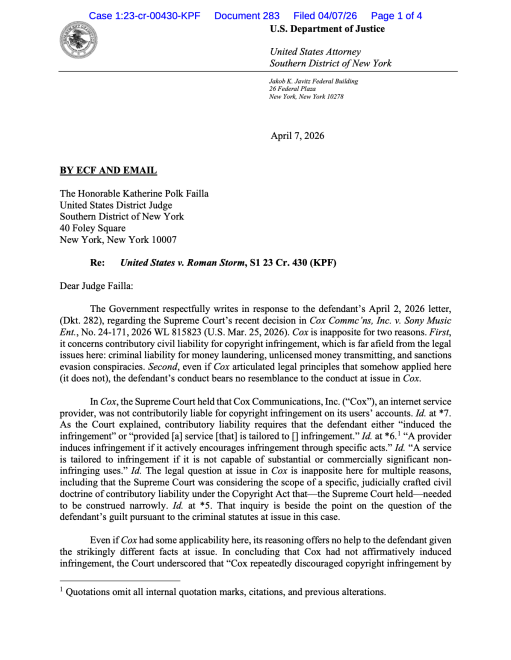
Clayton’s response addressed an April 2 motion filed by Storm’s defense, which claimed that a 2026 Supreme Court case, Cox Communications, Inc. v. Sony Music Entertainment, supported his pending Rule 29 motion.

The Cox case involved a civil liability of an internet service provider for its subscribers engaging in copyright infringement. The Supreme Court found that Cox was not contributorily liable for copyright infringement on its users’ accounts, as it did not induce its users’ infringement nor provide a service tailored to infringement.

In the Tuesday filing, the US attorney argued that “The defendant and the Tornado Cash service are a far cry from Cox,” affirming that “Even if Cox had some applicability here, its reasoning offers no help to the defendant given the strikingly different facts at issue.”

Prosecutors file letter pushing back on Storm's defense. Source: Inner City Press on X

“As set forth in detail in the Government’s response to the defendant’s Rule 29 motion— and in contrast to Cox’s robust system for responding to infringement—the defendant intentionally implemented mere half-measures that he said were ‘easy to bypass’ to counter criminal use of the Tornado Cash service, and his purpose in doing so was to distract law enforcement,” the document read.

Clayton added that Storm’s use of the crypto mixer “was window dressing at best and outright misdirection at worst,” as there was no evidence that the Tornado Cash founders put in place effective anti-money-laundering (AML) measures.

It’s worth noting that the US Department of the Treasury’s Office of Foreign Assets Control (OFAC) sanctioned Tornado Cash in August 2022 for failing to impose effective controls to prevent malicious actors from laundering funds through the protocol, including $455 million by the North Korea-linked hacking group, Lazarus Group.

However, the sanctions were overturned in March 2025 after the Court of Appeals ruled in November 2024 that OFAC had overstepped its authority by sanctioning immutable, decentralized smart contracts rather than a legal entity.

US Prosecutors Seek Roman Storm Retrial

The prosecutors’ latest move follows his March letter seeking a retrial of the Tornado Cash co-founder on the two counts where jurors were deadlocked last August. In the letter, Clayton asked Judge Failla to schedule a retrial for Roman Storm, pushing for trial dates between October 5 and 12, 2026.

For context, Storm was detained and indicted following the Tornado Cash sanctions and charged with conspiracy to commit money laundering, conspiracy to commit sanctions violations, and conspiracy to operate an unlicensed money-transmitting business.

The jury found Storm guilty of one count of conspiracy to operate an unlicensed money transmitting business, but was unable to come to a unanimous decision regarding the two other charges. Nonetheless, a hung jury does not constitute an acquittal, which opened the door to a potential retrial on those charges.

In September, Storm filed a motion for acquittal, which asks the trial judge to throw out charges or a verdict because the prosecution’s evidence is legally insufficient. The Tornado Cash founder’s lawyers argued that the government never proved he meant to help bad actors launder money through the platform, which would invalidate the grounds for his conviction based on negligent inaction.

Now, prosecutors and Storm’s defense attorneys are scheduled to meet on April 9 for an oral argument on the pending Rule 29 motion, which could shape the course of this key legal battle.

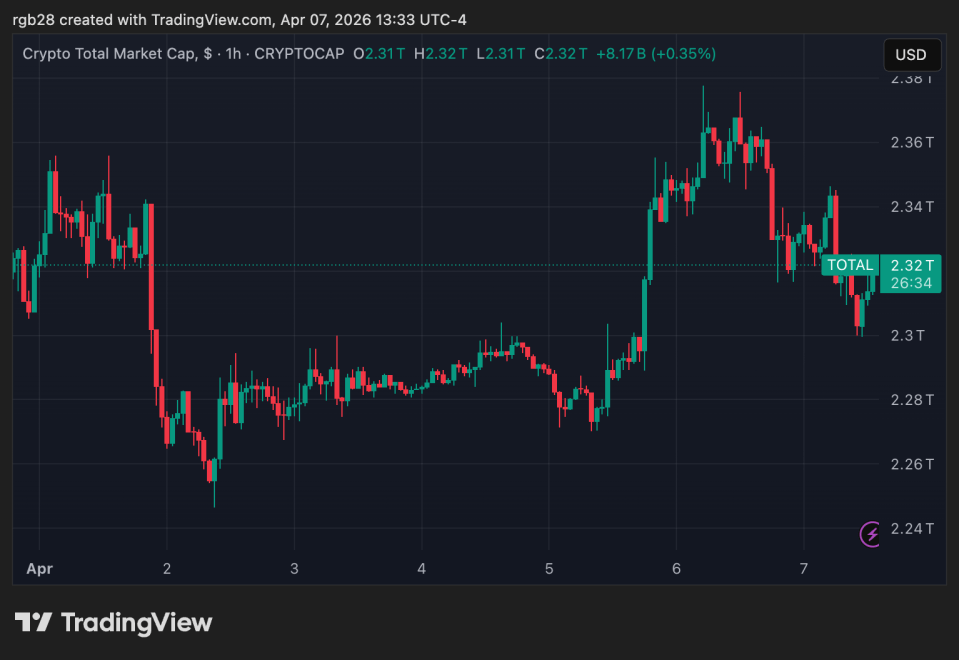
The total crypto market capitalization sits at $2.32 trillion on the one-week chart. Source: TOTAL on TradingView

Связанные с этим вопросы

QWhat is the core argument made by US prosecutors against Roman Storm's defense based on the Cox Communications case?

AProsecutors argued that the Cox Communications case is 'not applicable' because Tornado Cash and its founders are fundamentally different from an internet service provider like Cox. They claimed Storm implemented intentionally weak, bypassable measures as 'window dressing' to distract law enforcement, unlike Cox which had a robust system to respond to infringement.

QWhat was the outcome of Roman Storm's initial trial in August, and what charges is he currently facing a retrial for?

AThe jury found Storm guilty of one count of conspiracy to operate an unlicensed money transmitting business. However, the jury was deadlocked and could not reach a unanimous verdict on the two other charges: conspiracy to commit money laundering and conspiracy to commit sanctions violations. The prosecution is seeking a retrial specifically on these two deadlocked counts.

QWhy was Tornado Cash sanctioned by OFAC in 2022, and what was the eventual outcome of those sanctions?

AThe US Treasury's OFAC sanctioned Tornado Cash in August 2022 for failing to impose effective controls to prevent malicious actors from laundering funds, including $455 million by the North Korea-linked Lazarus Group. However, the sanctions were overturned in March 2025 after a Court of Appeals ruled that OFAC had overstepped its authority by sanctioning immutable, decentralized smart contracts instead of a legal entity.

QWhat is the purpose of the upcoming April 9 hearing between prosecutors and Storm's defense attorneys?

AThe hearing on April 9 is for an oral argument on Storm's pending Rule 29 motion for a judgment of acquittal. This motion asks the judge to throw out the charges or verdict based on the argument that the prosecution's evidence was legally insufficient to prove his intent to help bad actors launder money.

QWhat specific time frame have prosecutors proposed for Roman Storm's retrial?

AIn a letter to Judge Katherine Failla, US Attorney Jay Clayton pushed for the retrial to be scheduled for dates between October 5 and 12, 2026.

Похожее

Apple Also Has to Pay Rent Now

Apple Pays Rent Too: The Two-Way Flow of "Traffic Tax" and "AI Capability Rent" Between Tech Giants For over two decades, Google has paid Apple an estimated $20 billion annually to remain the default search engine on Safari, a "traffic tax" for a critical user entry point. However, in 2026, the direction of this cash flow partially reversed. Apple agreed to pay Google roughly $1 billion per year to license its Gemini AI models, as Apple's own models reportedly struggled with complex tasks. This creates a unique dynamic: Apple acts as the "landlord" in the established search ecosystem, collecting rent from Google for access. Simultaneously, in the emerging AI arena, Apple becomes the "tenant," paying Google for access to cutting-edge AI capabilities it cannot currently match internally. While Apple claims its new models are "distilled" from Gemini outputs and contain "not a drop" of Google's original code, core dependencies remain. Its knowledge base is refined using Gemini's outputs, and its most powerful cloud model runs on Google's infrastructure. Apple has structured the deal as non-exclusive, allowing it to theoretically switch AI suppliers—a hedge against over-reliance. The future hinges on whether advanced AI models become a commodity (cheap and abundant) or remain a concentrated, scarce resource (expensive and controlled by few). Apple is betting on the former, leveraging its massive device ecosystem to be a powerful, choosy customer. If the latter proves true, its bargaining power could erode. This power dynamic is extending to developers. Apple, Google, and WeChat are all pushing for apps to expose their core functions as standardized "actions" or "intents" that their respective AI assistants (Siri, Gemini, WeChat AI) can directly call. The new scarce resource is no longer just app store visibility, but "being selected by the AI." The currency of "rent" has changed from a 30% revenue share to ceding control over how users interact with an app's functions.

marsbit29 мин. назад

Apple Also Has to Pay Rent Now

marsbit29 мин. назад

Missed the SpaceX IPO? WEEX's "First Trade Protection" Lets You Experience US Stock Trading Risk-Free.

With the excitement around SpaceX's recent public listing reigniting interest in the US stock market, Chinese investors face significant challenges accessing compliant and convenient trading channels following regulatory actions against major online brokers. This article explores the available options, highlighting their risks and limitations. Traditional paths for US stock investments remain problematic. Qualified Domestic Institutional Investor (QDII) and Listed Open-Ended Fund (LOF) products, while compliant, suffer from high fees, significant purchase premiums, and a very limited selection of assets. Small, unregulated offshore brokers pose substantial risks, including potential insolvency. While secure, VIP accounts at banks in Hong Kong or Singapore require high minimum deposits (often 1-2 million RMB) and in-person visits, placing them out of reach for most retail investors. The article positions cryptocurrency exchanges, specifically their TradFi (traditional finance on-chain) offerings, as a compelling alternative. Platforms like WEEX are noted for providing access to a wide range of US stocks and ETFs, including SpaceX (SPCXON), through tokenized assets. This method offers advantages such as a single account for both crypto and traditional assets, USDT-based settlement avoiding fiat complexities, flexible leverage, and robust risk management. To attract users, WEEX is promoting a "First Trade Guarantee" campaign. Running from June 15 to July 8 (UTC+8), it features a $30,000 prize pool. Users who trade $500 worth of US stock contracts can qualify for a guarantee on their first eligible trade: 100% loss coverage up to $30 or a 20% bonus on profits up to $30. The campaign is presented as a low-risk opportunity for both crypto natives and traditional investors to experience US stock trading.

marsbit31 мин. назад

Missed the SpaceX IPO? WEEX's "First Trade Protection" Lets You Experience US Stock Trading Risk-Free.

marsbit31 мин. назад

How Difficult is Chip Making? A Division Error Costs 475 Million Dollars

How Hard Is It to Make a Chip? A Division Error Cost $475 Million Chip expert Shi Kan, a researcher at the Chinese Academy of Sciences and a popular tech creator, explains the immense challenges of chip development. Chips are foundational to modern technology, but their creation is extraordinarily difficult. The journey from sand to a functional chip involves complex design and manufacturing, but a critical bottleneck is verification—ensuring the design works flawlessly before costly production. A single, undetected bug can have catastrophic consequences, as illustrated by the infamous 1994 Intel Pentium FDIV bug. A flaw in the floating-point division unit forced a recall costing $475 million. Unlike software, chips cannot be easily patched after manufacture, making "first-time success" paramount. However, industry surveys show only 24% of chip projects achieve this; over three-quarters require at least one costly re-spin due to design flaws. Verification has thus become the dominant phase, consuming up to 70% of the design cycle. The core challenge is a "verification impossible triangle" between high performance, good debuggability, and low cost. Exhaustively verifying a modern CPU core could take 15,000 years with software simulation, or 30 years with advanced hardware emulation—timeframes utterly impractical for development. Despite being essential, verification is often seen as unglamorous "dirty work," receiving less academic attention than fields like AI. Shi and his team are tackling this by developing an agile verification research framework called ENCORE, based on FPGA technology, to improve verification efficiency and debug capability. Beyond research, Shi engages in public science communication through long-form video content, aiming to demystify chip technology, AI, and computer science. He argues for the value of pursuing "hard and long-term" endeavors, whether in the meticulous world of chip verification or in creating substantive educational content, believing such sustained effort is likely the right path forward.

marsbit41 мин. назад

How Difficult is Chip Making? A Division Error Costs 475 Million Dollars

marsbit41 мин. назад

Claude to Mandate "Face-Scan ID Verification", No ID No Service Starting July?

Anthropic, the creator of Claude AI, has sent privacy policy update emails to users, signaling a significant shift. The key change, effective July 8, is the potential requirement for consumer-level users (Free, Pro, Max plans) to verify their age or identity. This verification would be conducted through the third-party service Persona, involving uploading a government-issued photo ID and taking a live selfie for comparison. Anthropic states this data is for security purposes only, will not be used for model training, and is processed by Persona, not stored on its own servers. The update also clarifies data handling for Claude's new capabilities: when performing multi-step tasks or connecting to third-party apps, user data may flow between Anthropic and those external services. Additionally, more information may be collected from users who participate in Anthropic research. This move is seen as a major step towards establishing accountability as AI agents become more powerful and autonomous, capable of executing complex, real-world tasks. It follows previous enforcement actions, like the banning of the "Fable 5" account, and indicates a broader industry trend toward stricter user identification and safety measures. The verification is expected to apply in specific scenarios, particularly as users engage Claude in more complex agentic workflows.

链捕手53 мин. назад

Claude to Mandate "Face-Scan ID Verification", No ID No Service Starting July?

链捕手53 мин. назад

Blockchain Has Finally Started to Sail into the Mainstream After 18 Years

Blockchain Finds Its True Path After 18 Years: Becoming the Financial Backbone for AI Agents and Autonomy This analysis explores a pivotal shift in the blockchain and crypto investment landscape, driven by the dominance of AI. Major venture capital firms, including Variant, Paradigm, Haun Ventures, and YZi Labs, are moving beyond pure "crypto" investment theses. They are expanding their focus to AI, robotics, and frontier tech, signaling that blockchain is no longer seen as a standalone sector but as an underlying infrastructure layer. The core argument is that blockchain's killer application may not be user-facing apps, but rather providing the economic rails for the coming wave of AI agents, autonomous robots, and automated systems. Key capabilities like self-custody wallets, programmable stablecoins for micropayments, on-chain identity, and verifiable smart contracts are positioned as essential for a future where machines conduct economic activity. The recent $1.4 billion investment by Tether (via its venture arm) in German robotics company NEURA Robotics exemplifies this, aiming to embed Tether's wallet tools directly into robots for autonomous transactions. While many "AI + Crypto" projects remain superficial, the article concludes that true value lies where crypto is a necessary component—enabling machine-to-machine payments, agent autonomy, verifiable data provenance, and open financial settlement for the AI era. For crypto venture capital, this convergence with AI represents both an adaptation to shifting capital flows and a potential path to unlocking the large-scale, non-speculative utility the industry has long sought.

marsbit1 ч. назад

Blockchain Has Finally Started to Sail into the Mainstream After 18 Years

marsbit1 ч. назад

Торговля

Спот
Фьючерсы

Популярные статьи

Как купить S

Добро пожаловать на HTX.com! Мы сделали приобретение Sonic (S) простым и удобным. Следуйте нашему пошаговому руководству и отправляйтесь в свое крипто-путешествие.Шаг 1: Создайте аккаунт на HTXИспользуйте свой адрес электронной почты или номер телефона, чтобы зарегистрироваться и бесплатно создать аккаунт на HTX. Пройдите удобную регистрацию и откройте для себя весь функционал.Создать аккаунтШаг 2: Перейдите в Купить криптовалюту и выберите свой способ оплатыКредитная/Дебетовая Карта: Используйте свою карту Visa или Mastercard для мгновенной покупки Sonic (S).Баланс: Используйте средства с баланса вашего аккаунта HTX для простой торговли.Третьи Лица: Мы добавили популярные способы оплаты, такие как Google Pay и Apple Pay, для повышения удобства.P2P: Торгуйте напрямую с другими пользователями на HTX.Внебиржевая Торговля (OTC): Мы предлагаем индивидуальные услуги и конкурентоспособные обменные курсы для трейдеров.Шаг 3: Хранение Sonic (S)После приобретения вами Sonic (S) храните их в своем аккаунте на HTX. В качестве альтернативы вы можете отправить их куда-либо с помощью перевода в блокчейне или использовать для торговли с другими криптовалютами.Шаг 4: Торговля Sonic (S)С легкостью торгуйте Sonic (S) на спотовом рынке HTX. Просто зайдите в свой аккаунт, выберите торговую пару, совершайте сделки и следите за ними в режиме реального времени. Мы предлагаем удобный интерфейс как для начинающих, так и для опытных трейдеров.

1.5k просмотров всегоОпубликовано 2025.01.15Обновлено 2026.06.02

Как купить S

Sonic: Обновления под руководством Андре Кронье – новая звезда Layer-1 на фоне спада рынка

Он решает проблемы масштабируемости, совместимости между блокчейнами и стимулов для разработчиков с помощью технологических инноваций.

2.3k просмотров всегоОпубликовано 2025.04.09Обновлено 2025.04.09

Sonic: Обновления под руководством Андре Кронье – новая звезда Layer-1 на фоне спада рынка

HTX Learn: Пройдите обучение по "Sonic" и разделите 1000 USDT

HTX Learn — ваш проводник в мир перспективных проектов, и мы запускаем специальное мероприятие "Учитесь и Зарабатывайте", посвящённое этим проектам. Наше новое направление .

1.8k просмотров всегоОпубликовано 2025.04.10Обновлено 2025.04.10

HTX Learn: Пройдите обучение по "Sonic" и разделите 1000 USDT

Обсуждения

Добро пожаловать в Сообщество HTX. Здесь вы сможете быть в курсе последних новостей о развитии платформы и получить доступ к профессиональной аналитической информации о рынке. Мнения пользователей о цене на S (S) представлены ниже.

活动图片