Trump's Post Leaked in Advance? Polymarket Abnormal Betting Points to US-Iran Ceasefire Before Next Week

marsbitОпубликовано 2026-03-24Обновлено 2026-03-24

Введение

Former US President Donald Trump announced on Truth Social that "very good and productive discussions" were taking place to resolve the Middle East conflict. Prior to this public statement, several accounts on the prediction market platform Polymarket placed large bets, totaling approximately $160,000, that a ceasefire between the US would occur by March 31 or April 15. These bets, which would yield over $1 million if successful, were made by 10 newly created accounts and had already generated over $300,000 in floating profits after Trump's post. The timing and success of these wagers, particularly from an account with a history of profitable bets on geopolitical events, have raised suspicions of insider trading. In response, Polymarket announced new rules explicitly prohibiting trading on stolen confidential information, illegal insider knowledge, or by users who can influence event outcomes. Concurrently, unusual trading activity was detected in S&P 500 e-mini futures and WTI crude oil futures just minutes before Trump's post. A significant, isolated spike in volume occurred in these typically illiquid pre-market sessions. Shortly after the post, S&P futures surged over 2.5% while oil prices fell nearly 6%, suggesting that some entities may have traded on advance knowledge of the announcement. The SEC and CME Group declined to comment.

Author: Jinshi Data

On Monday morning local time, US President Trump posted on Truth Social, stating that the US and Iran had "very good and productive discussions" regarding resolving the Middle East war.

However, before Trump publicly disclosed this news, several accounts on the prediction market platform Polymarket had already placed large bets that the war would end within this week.

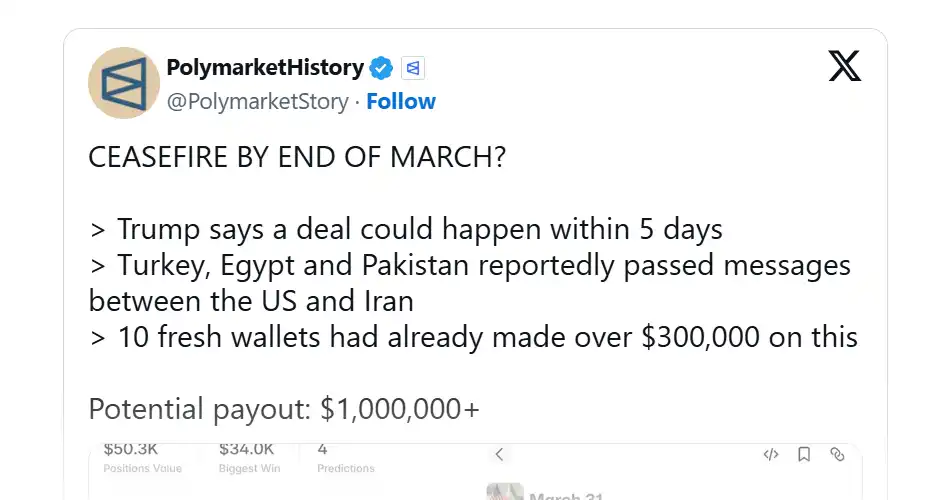
Ten recently opened accounts invested thousands of dollars in Polymarket's "US-Iran Ceasefire" market, betting on a ceasefire being reached by March 31 or April 15; these accounts collectively wagered approximately $160,000, and if a ceasefire is achieved before the end of the month, they stand to profit over $1 million.

These accounts were identified by X platform user Lirrato on Sunday and were subsequently shared and spread by the PolymarketHistory account. After Trump's post on Monday, the unrealized gains of these 10 accounts have already exceeded $300,000.

One account named "NOTHINGEVERFRICKINGHAPPENS" was particularly noteworthy. This account was registered in late February. Its first two trades were betting $7,600 on a US strike against Iran before February 28 and betting $11,283 on a strike before March 1; these two bets yielded profits totaling over $85,000. Now, the account has bet $8,005 on a US-Iran ceasefire before March 31 and another $15,614 on a ceasefire before April 15; these two bets have already generated unrealized gains of over $30,000.

The scale, timing, and past performance of these bets have led to external speculation about whether these Polymarket accounts belong to insiders—individuals connected to US or Iranian political circles who possess non-public information about diplomatic progress.

Prediction markets have previously been mired in insider trading scandals. A recent example involves a Polymarket trader who bet on the US taking military action against Venezuela, profiting over $400,000; a few days later, the US announced the capture of Venezuelan strongman Nicolás Maduro. Its competitor, Kalshi, recently also banned two users for insider trading, marking the platform's first public investigation into such activities.

On Monday, Polymarket announced an upgrade to its insider trading rules, explicitly prohibiting three types of behavior: trading using stolen confidential information, trading using illegal insider information, and trading when a user has the ability to influence the outcome of an event.

Polymarket's Chief Legal Officer, Neal Kumar, stated in a declaration: "Market prosperity relies on clear rules. The new regulations provide clarity for all participants and also demonstrate the compliance system we have built."

This rule adjustment may indicate that Polymarket will follow Kalshi's lead and initiate insider trading investigations. Although it is not yet certain whether the accounts betting on a US-Iran ceasefire are insiders, a platform investigation is expected to uncover the truth.

Abnormal Volume Spikes in S&P and Crude Futures Before Trump's Post

Furthermore, several minutes before Trump posted his market-moving social media update, abnormal trading volume spikes were also observed in S&P 500 futures and crude oil futures.

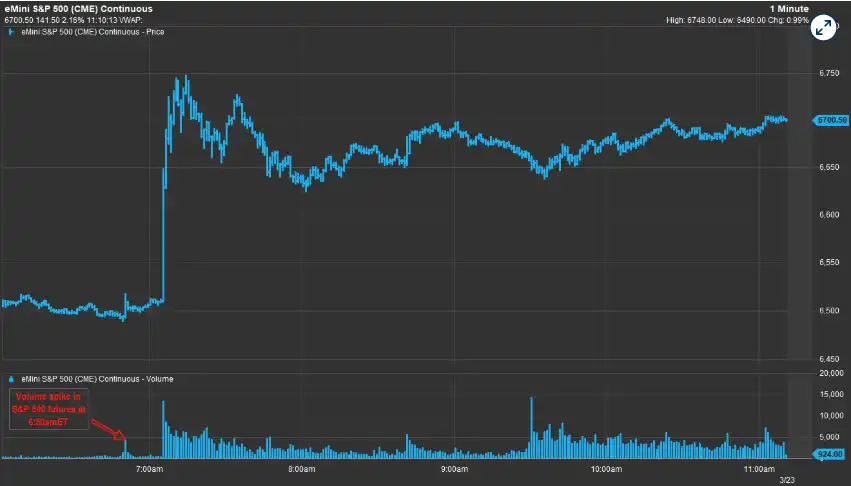
Around 6:50 AM New York time on Monday, the trading volume of S&P 500 e-mini futures traded on the Chicago Mercantile Exchange (CME) experienced a sharp and isolated surge, breaking the typically quiet pre-market backdrop. The early session is usually characterized by thin liquidity, making this sudden volume spike one of the largest moments of on-screen volume for that session up to that point.

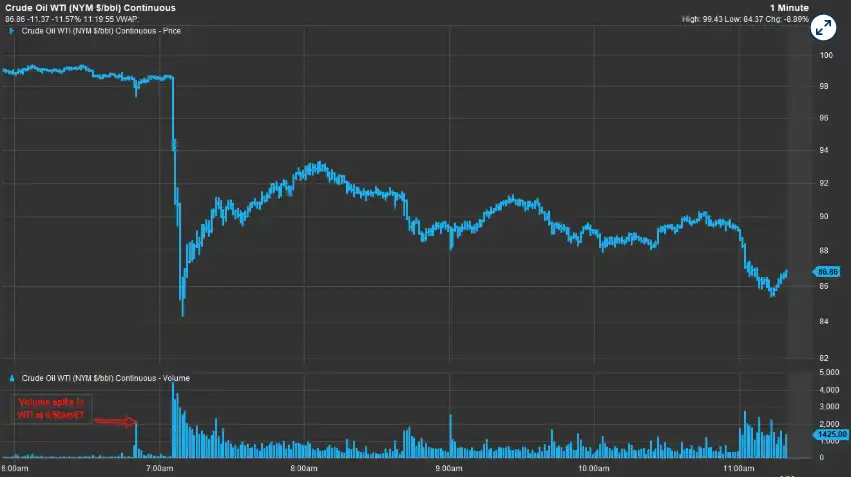
A similar pattern emerged in the crude oil market. WTI crude oil futures also showed a noticeable uptick in trading activity around the same time, with a significant volume spike disrupting the previously calm market conditions.

Approximately 15 minutes later, at 7:05 AM, Trump's statement about delaying strikes on Iranian power plants immediately triggered a rally in risk assets. S&P 500 futures surged over 2.5% before the open, while West Texas Intermediate (WTI) crude futures fell nearly 6% following the announcement.

The timing of the synchronized volume spikes in the stock and oil markets during the early session caught traders' attention—especially since there was no apparent catalyst driving the movement at the time of the spikes.

Pre-market futures trading typically has lower liquidity, making brief bursts of buying and selling more conspicuous than during regular trading hours. Nonetheless, these trades were still notable because anyone who bought stock futures in large quantities while simultaneously selling or shorting crude oil futures at that moment would have made huge profits just minutes later.

The US Securities and Exchange Commission (SEC) and the CME Group both declined to comment.

Algorithmic trading strategies and macro-driven strategies could also trigger rapid cross-asset capital flows during pre-market trading, even in the absence of a single identifiable catalyst.

Связанные с этим вопросы

QWhat did President Trump post on Truth Social regarding US-Iran relations?

APresident Trump posted on Truth Social that there had been 'very good and productive conversations' regarding resolving the Middle East war.

QWhat suspicious activity was observed on the Polymarket prediction platform before Trump's announcement?

ATen recently created accounts placed large bets, totaling approximately $160,000, predicting a ceasefire between the US and Iran would be reached by March 31st or April 15th.

QWhat is the name of one notable account that made profitable bets on these events, and what were its wagers?

AOne notable account was named 'NOTHINGEVERFRICKINGHAPPENS'. It previously profited over $85,000 from bets on US strikes on Iran and had new bets on a ceasefire that were already up over $30,000 in profit.

QWhat other financial markets showed unusual activity just before Trump's post?

AS&P 500 e-mini futures and WTI crude oil futures showed isolated, sharp spikes in trading volume approximately 15 minutes before Trump's post, in an otherwise quiet pre-market session.

QHow did Polymarket respond to concerns about potential insider trading on its platform?

APolymarket announced upgraded insider trading rules, explicitly prohibiting trading on stolen confidential information, illegal insider information, and trading by users with the ability to influence event outcomes.

Похожее

How Many Tokens Away Is Yang Zhilin from the 'Moon Chasing the Light'?

The article explores the intense competition between two leading Chinese AI companies, DeepSeek and Kimi (Moon Dark Side), and the mounting pressure on Yang Zhilin, the founder of Kimi. While DeepSeek re-emerged after 15 months of silence with its powerful V4 model—boasting 1.6 trillion parameters and low-cost, long-context capabilities—Kimi has been focusing on long-context processing and multi-agent systems with its K2.6 model. Yang faces a threefold challenge: technological rivalry, commercialization pressure, and investor expectations. Despite Kimi’s high valuation (reaching $18 billion), its revenue heavily relies on a single product with low paid conversion rates, while DeepSeek’s strategic silence and open-source influence have strengthened its market position and valuation prospects, now targeting over $20 billion. Both companies reflect broader trends in China’s AI ecosystem: Kimi aims for global influence through open-source contributions and agent-based advancements, while DeepSeek prioritizes foundational innovation and hardware independence, notably shifting to Huawei’s chips. Their competition is seen as vital for China’s AI progress, with the gap between top Chinese and U.S. models narrowing to just 2.7% on the Elo rating scale. Ultimately, the article argues that this rivalry, though anxiety-inducing for leaders like Zhilin, is essential for driving innovation and solidifying China’s role in the global AI landscape.

marsbit4 ч. назад

How Many Tokens Away Is Yang Zhilin from the 'Moon Chasing the Light'?

marsbit4 ч. назад

TechFlow Intelligence Bureau: ChatGPT Helps Amateur Mathematician Crack 60-Year-Old Problem, CFTC Sues New York Regulator Over Coinbase and Gemini

An amateur mathematician, with the assistance of ChatGPT, has solved a combinatorial mathematics puzzle originally proposed by Hungarian mathematician Paul Erdős in the 1960s. This marks another milestone in AI-aided mathematical research, demonstrating the evolving capabilities of large language models in formal reasoning. In other AI developments, OpenAI introduced a new privacy filter tool for enterprise API usage, automatically screening sensitive data. Meanwhile, the Qwen3.6-27B model achieved 100 tokens per second on a single RTX 5090 GPU using quantization, significantly lowering the cost barrier for local AI deployment. In crypto and Web3, the U.S. CFTC sued New York’s financial regulator, challenging its oversight of Coinbase and Gemini—a first-of-its-kind federal-state regulatory clash. Following a vulnerability, KelpDAO and major DeFi protocols established a recovery fund. Tether froze $344 million in assets linked to Iran’s central bank upon U.S. Treasury request, highlighting the centralized control risks in stablecoins. Separately, Litecoin underwent a 3-hour chain reorganization to undo a privacy-layer exploit. In the U.S., former President Trump invoked the Defense Production Act to address power grid bottlenecks affecting AI data centers and dismissed the entire National Science Board, raising concerns over research independence. A retail trader gained 250% on a $600k Intel options bet amid AI-related speculation. Xiaomi announced its first performance electric vehicle, targeting rivals like Tesla. Meanwhile, iPhone users reported devices automatically reinstalling a hidden app daily, suspected to be MDM-related. A Chinese securities report noted that A-share institutional crowding has reached its second-longest streak since 2007, signaling high valuations and potential style rotation. The day’s developments reflect a dual narrative: AI is enabling unprecedented individual breakthroughs, while centralized power structures—whether governmental or corporate—are becoming more assertive, underscoring that decentralization is as much a political-economic challenge as a technical one.

marsbit5 ч. назад

TechFlow Intelligence Bureau: ChatGPT Helps Amateur Mathematician Crack 60-Year-Old Problem, CFTC Sues New York Regulator Over Coinbase and Gemini

marsbit5 ч. назад

Торговля

Спот
Фьючерсы
活动图片