Trump, the World's Largest Oil Trader

marsbitОпубликовано 2026-03-24Обновлено 2026-03-24

Введение

Donald Trump, described as the world's largest oil trader, used a post on Truth Social to claim "very good, productive" talks with Iran and announce a five-day pause in strikes on Iranian energy facilities. Minutes after the March 23 post, S&P 500 futures surged 2.7%, and Brent crude plummeted 13% to below $100, boosting U.S. stock market value by an estimated $1.7 trillion. Iran denied any talks, suggesting Trump manipulates oil prices weekly. Suspicious trading spikes occurred 15 minutes before the post, raising insider trading concerns, though regulators declined to comment. This mirrors a pattern: in 2020, Trump brokered OPEC+ cuts to raise prices, benefiting oil executives who funded his campaigns. Academic research confirms his social media moves oil markets. Now, his sons profit from military contracts: Donald Jr. invested in drone firms like Unusual Machines, which secured Army deals after his father’s election. With the Iran war boosting drone demand, the family benefits whether oil rises (more contracts) or falls (political wins). Trump’s power over oil—using policy, not money—makes him a unique market force.

Author: David, Deep Tide TechFlow

How much is a single post really worth?

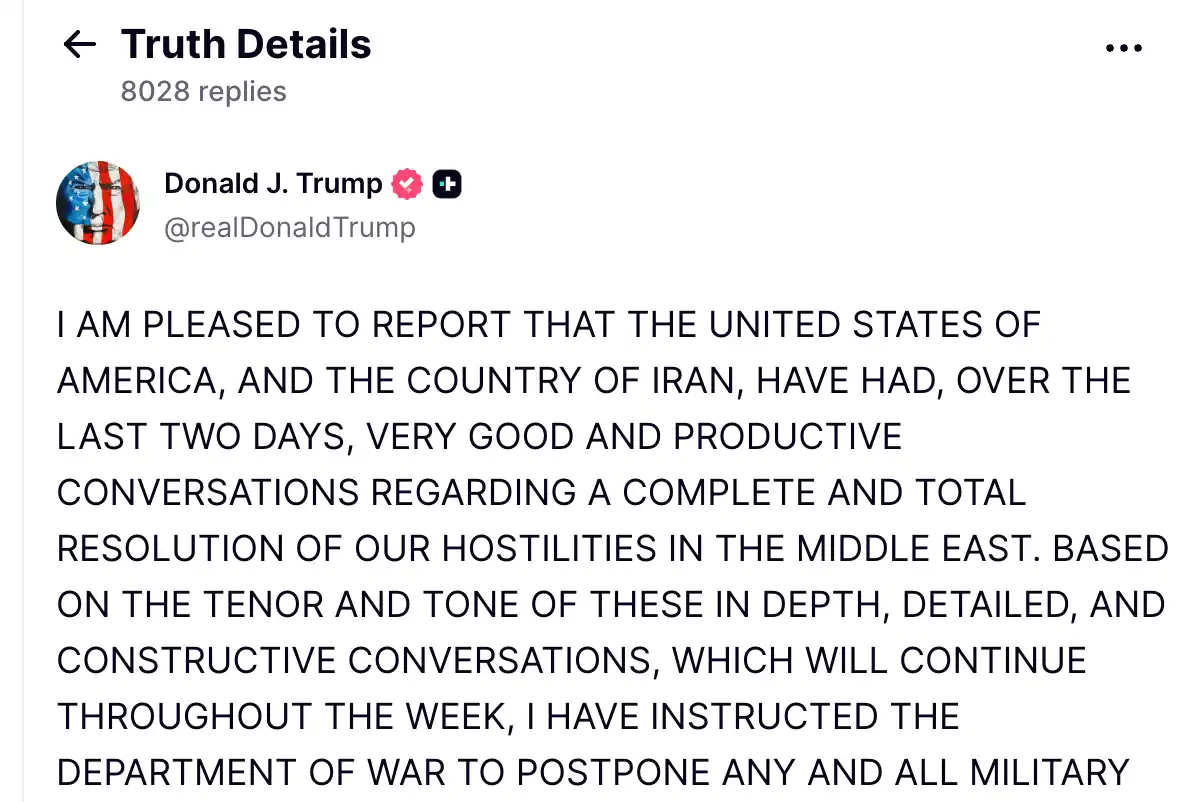
At 7:05 AM EST on March 23, Trump posted a message in all caps on Truth Social. The gist of it was: The US and Iran had "very good, productive conversations" over the past two days, and he had ordered a pause on strikes against Iranian power plants and energy facilities for five days.

This post was made before the US stock market opened. But the futures market is real-time.

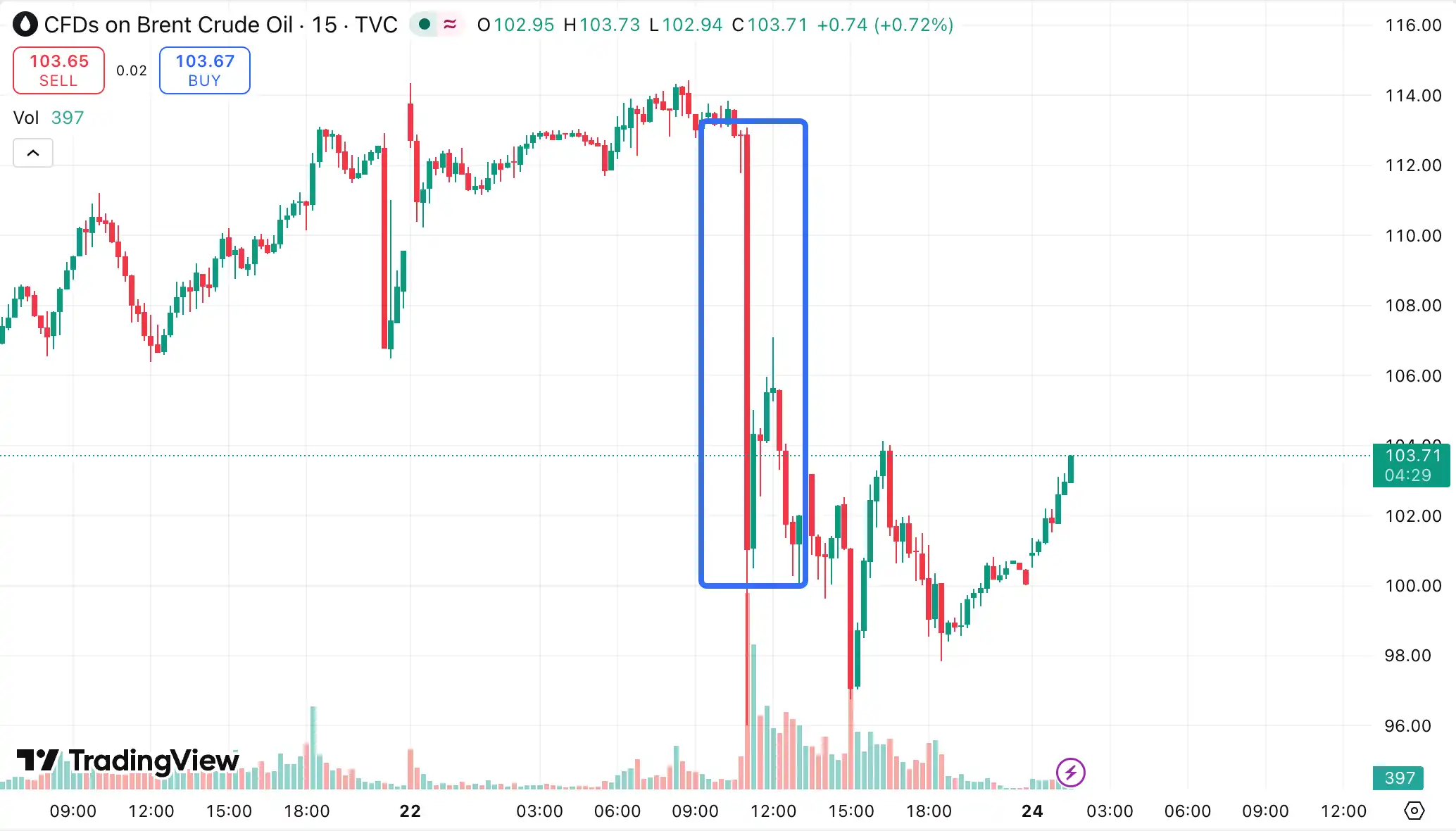
Within minutes, Dow Jones futures surged over 1000 points, and S&P 500 futures rose 2.7%. Brent crude plummeted from $113 per barrel straight down to $98, a drop of over 13%.

A reporter from the renowned foreign magazine Fortune later calculated that from the time the post was made until the market digested the news, the total market capitalization of US stocks increased by approximately $1.7 trillion.

If you were an ordinary trader and posted a message on social media about oil supply, causing global oil prices to crash by 13%, regulators would likely be at your door within 24 hours.

But if you are the President of the United States, this is called diplomacy.

Then Iran said: We haven't spoken to him.

Iran's state news agency quoted a security official stating there had been no direct or indirect dialogue between Tehran and Washington. Iranian scholar Seyed Mohammad Marandi wrote more bluntly on X:

"Every week when the market opens, Trump posts these kinds of statements to drive down oil prices. This time he even precisely set the five-day deadline to coincide with the close of the energy market trading week."

The news traveled back to the US, and the market gains were nearly halved. But by the close, the Dow was up 631 points, and Brent crude settled at $99.94, the first time it had fallen below $100 since March 11. This means the market chose to believe Trump's version, at least half of it.

One post, one hour, trillions of dollars swinging back and forth.

This is less the President making a diplomatic statement and more the world's largest oil trader placing an order.

And the tools in his hands aren't futures contracts; they are the US military and Truth Social. Other traders use money to go long or short; he uses the switch for war.

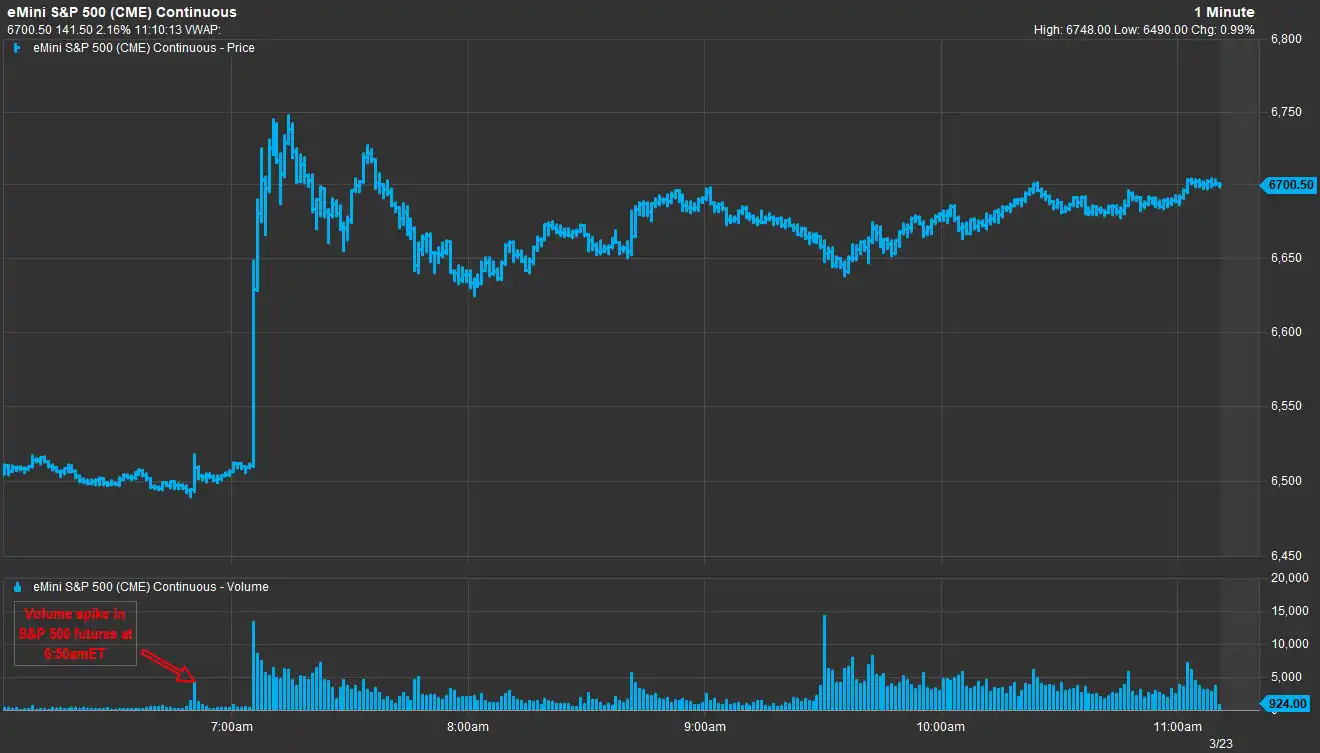
According to CNBC, about 15 minutes before the post was made, around 6:50 AM New York time, there was a simultaneous abnormal surge in trading volume for both S&P 500 futures and crude oil futures.

In the thin liquidity of the pre-market session, this sudden, isolated spike in volume was very conspicuous.

Fifteen minutes later, the post was made, oil prices crashed, and stock indices soared. This means that whoever acted at 6:50 made money after 7:05. In the commodities market, building a position precisely ahead of major news is one of the most classic forms of insider trading.

Image source: CNBC, S&P 500 pre-market trading volume spike

In April of last year, when Trump's反复变卦 (repeated flip-flopping) on tariff policy caused severe market volatility, Congressman Adam Schiff publicly questioned: Who knew what the President was going to say before he posted? No answer was given that time.

This time, CNBC contacted the SEC and the Chicago Mercantile Exchange. The response from both institutions was identical: No comment.

And this isn't the first time. Looking back, Trump moving oil prices with his mouth has been going on for nearly a decade.

The Mouth Business

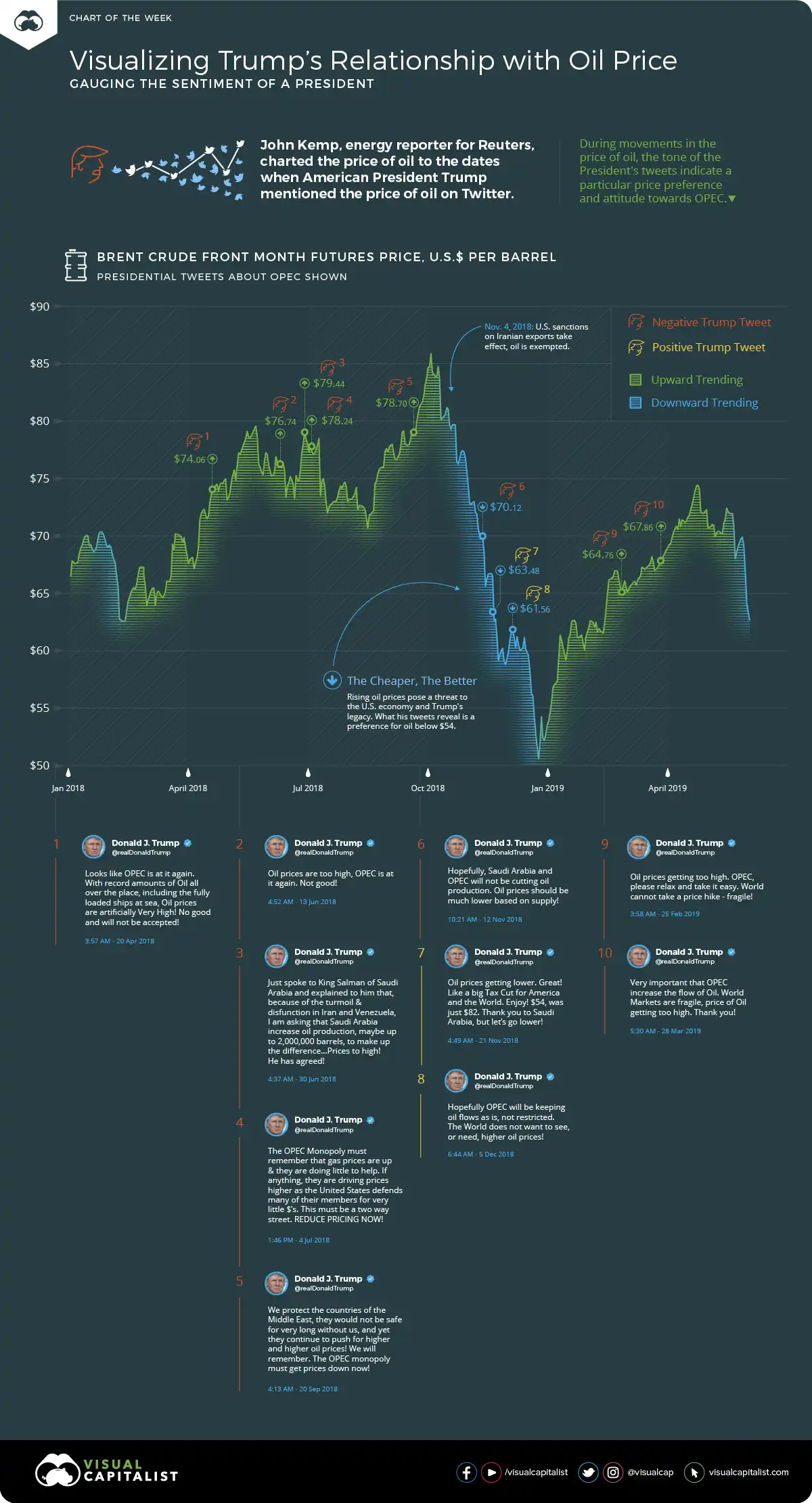
Trump started talking about oil prices on social media as early as 2011, back when he wasn't president. Railing against OPEC for manipulating the market was a regular part of his content. But complaining is one thing; a real estate developer grumbling on Twitter is different from manipulating oil prices.

What truly turned him from a "commentator" into a "trader" was a deal in 2020.

Early that year, the COVID-19 pandemic erupted, the global economy ground to a halt, and oil demand fell off a cliff. Making matters worse, Saudi Arabia and Russia started a price war, increasing production to snatch market share from each other. Oil prices plunged to around $20 per barrel. US shale companies were collapsing in droves; the entire industry was in mourning.

By normal logic, low oil prices are good for consumers—gas is cheaper. A president who cares about his constituents should be happy about it.

But Trump did the opposite.

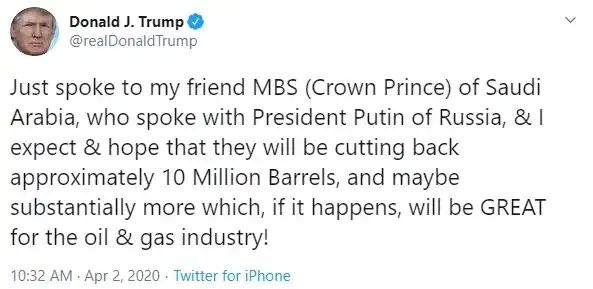
He invited a room full of oil company CEOs to the White House for a meeting. Then he personally called Saudi Crown Prince Mohammed bin Salman and Russian President Vladimir Putin, persuading them to join OPEC in massive production cuts. The goal was singular:

To push oil prices back up.

Subsequently, he posted a tweet hinting that a production cut agreement was imminent. That day, WTI crude surged 25%, marking the largest single-day gain in history.

Why save oil prices? Because those shale company owners on the verge of bankruptcy were his biggest political donors.

According to public reports, oil tycoon Harold Hamm saw his personal fortune evaporate by $3 billion in a few days during the price crash and immediately lobbied Trump to intervene. NBC's headline at the time was blunt: "Trump wanted lower oil prices, now he's consulting with oil execs on how to raise them."

The essence of this deal was: Global consumers paid for higher oil prices, the profits flowed to his political donors, and he himself harvested the next round of campaign funds.

If it had ended there, it could have been categorized as "political利益交换 (quid pro quo)". But Trump did something no politician would do—he publicly admitted it.

At subsequent campaign rallies, he said more than once to his supporters:

"We got oil prices too low, had to go save the oil companies. I called OPEC, I called Russia, I called Saudi Arabia, told them the price has to come up."

The audience erupted in applause.

Image source: Visual Capitalist

In 2023, the academic journal "Energy Policy" published a paper reviewing all of Trump's social media posts related to oil from his announcement of candidacy in 2015 to his account suspension in 2021.

The conclusion: His tweets did have a quantifiable impact on WTI crude futures prices and significantly amplified speculative behavior in the market.

In other words, academia used data to confirm something all traders already knew: This man's mouth could move global oil prices. And the 2020 story proved that he not only could, he was willing, and his motive wasn't national interest, but his own network of interests.

From his first term to now, Trump's oil trading tools have upgraded. Twitter became Truth Social,骂OPEC (cursing OPEC) became pausing bombing Iran...

But the logic has never changed: Use the information advantage and policy power unique to the presidency to create price fluctuations in the world's largest commodity market.

From Mouth to Hand

For the past decade, Trump has earned "influence" money in the oil market.

With a word, others profit, others lose, and he himself reaps political capital. But in 2026, the nature of this business began to change.

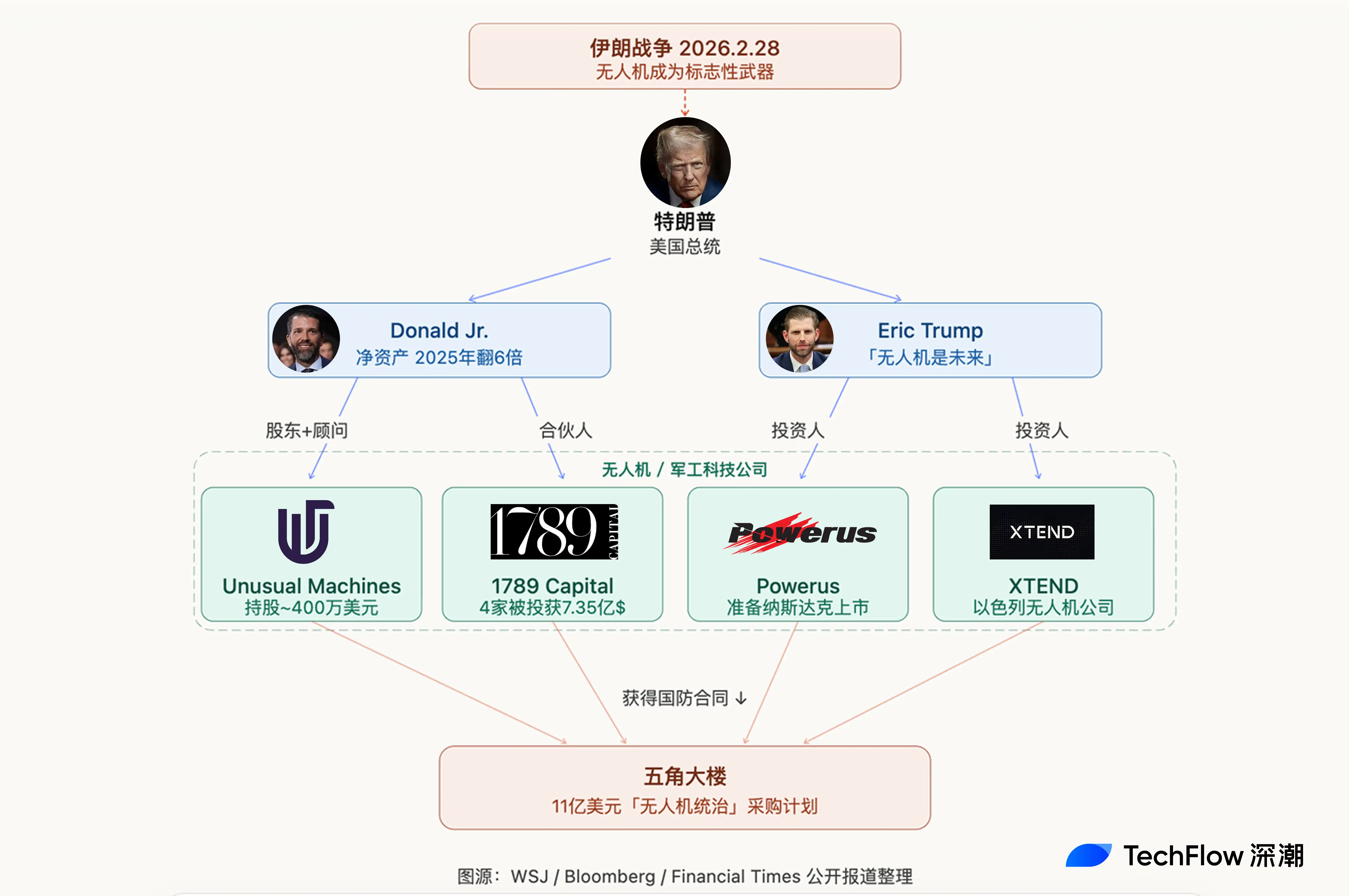
In early March this year, the Wall Street Journal and Bloomberg reported the same piece of news: Trump's two sons, Donald Jr. and Eric Trump, are investing in a military drone company called Powerus.

Donald Jr. is also a shareholder and member of the advisory board of drone component company Unusual Machines, holding approximately 330,000 shares worth about $4 million.

He joined this company in November 2024, just weeks after his father won the election. He had no prior experience in the drone or defense industry.

Unusual Machines subsequently secured a contract with the US Army to produce 3,500 drone motors, with the military indicating an additional 20,000 components would be ordered in 2026.

Donald Jr. is also a partner at venture capital firm 1789 Capital. According to Financial Times statistics, in 2025 alone, at least four portfolio companies of this VC received defense contracts from the Trump administration, totaling over $735 million.

Forbes estimated Donald Jr.'s personal net worth was around $50 million before his father's inauguration in January 2025; by the end of the year, it had sextupled.

Then, his father launched a war against Iran on February 28, 2026.

Drones are the signature weapon of this war. According to the New York Times, both sides are using drones extensively, with a unit cost only a fraction of traditional missiles. The Pentagon is advancing an $11 billion procurement plan aiming to deploy over 200,000 US-made attack drones by 2027.

A few days after the war started, his son Eric Trump posted on X: "Drones are the future."

The conflict of interest is obvious. A president's son enters the defense industry after his father takes office, invests in companies that get contracts from his father's administration, and his father is fighting a war that heavily uses the products of these companies.

It's not just oil anymore; the Trump family's business has expanded to the war itself. Oil is the money he makes with his mouth; drones are the money his son makes with his hands.

Today is the first day of the pause in strikes. In five days, either negotiations yield results, the Strait of Hormuz reopens to traffic, and oil prices continue to fall; or nothing is achieved, Iran continues to blockade the strait, and everything reverts to the way it was.

The world's largest oil trader has issued the market a five-day option. The strike price is war or peace; no one knows.

But one thing is certain: If oil prices rise, his son's drone company gets more orders; if oil prices fall, he wins again on Truth Social.

No matter the outcome, he won't lose money.

Связанные с этим вопросы

QWhat was the immediate market reaction to Trump's March 23rd post on Truth Social about pausing strikes on Iran?

AWithin minutes, the Dow Jones futures rose over 1000 points, S&P 500 futures gained 2.7%, and Brent crude oil plummeted from $113 to $98 per barrel, a drop of over 13%.

QAccording to the article, what classic form of market manipulation was suggested by unusual trading activity 15 minutes before Trump's post?

AThe article suggests it was a classic form of insider trading, as there was an isolated surge in trading volume for S&P 500 and crude oil futures 15 minutes before the post, allowing those traders to profit from the subsequent market move.

QWhat was the primary motivation cited for Trump administration's intervention to raise oil prices in 2020, contrary to the benefit of consumers?

AThe primary motivation was to benefit his political donors, specifically oil company executives whose businesses were failing due to low prices, in exchange for future campaign funding.

QHow has the nature of the Trump family's financial interest in geopolitical events evolved, as described in the article?

AIt has evolved from leveraging presidential influence to move oil markets for political capital ('influence money') to direct financial investments, specifically his sons' stakes in military drone companies that subsequently received government contracts amid a war that increased demand for their products.

QWhat does the article imply is the ultimate outcome for Trump regardless of whether the price of oil rises or falls after his 5-day ultimatum?

AThe article implies he will not lose money; if oil prices fall, he claims a victory on Truth Social, and if oil prices rise, his son's drone companies benefit from increased military contracts.

Похожее

Borrowing Money from a Hundred Years Later, Building Incomprehensible AI

Tech giants like Alphabet, Amazon, Meta, and Microsoft are undergoing a radical financial transformation due to AI. Their traditional "light-asset, high-free-cash-flow" model is being dismantled by staggering capital expenditures on AI infrastructure—data centers, GPUs, and power. Combined 2026 guidance exceeds $700 billion, a 4.5x increase from 2022, causing free cash flow to plummet (e.g., Amazon's fell 95%). To fund this, they are borrowing unprecedented sums through long-dated, multi-currency bonds (e.g., Alphabet's 100-year bond). The world's most conservative capital—pensions, insurers—is now funding Silicon Valley's most speculative bet. This shift makes these companies resemble heavy-asset industrials (railroads, utilities) rather than software firms, threatening their premium valuations. Historically, such infrastructure booms (railroads, fiber optics) followed a pattern: genuine technology, overbuilding fueled by competitive frenzy, aggressive debt financing, and a crash triggered by financial conditions—not technology failure. The infrastructure remained, but many original builders and financiers did not survive. The core gamble is a "time arbitrage": using cheap debt today to build scale and lock in customers before AI capabilities commoditize. They are betting that AI revenue will materialize before debt comes due. Their positions vary: Amazon is under immediate cash pressure; Meta's path to monetization is unclear; Alphabet has a robust core business buffer; Microsoft has the shortest path from infrastructure to revenue. The contract is set: the most risk-averse global capital has lent its time to Silicon Valley, awaiting a future that is promised but uncertain.

marsbit25 мин. назад

Borrowing Money from a Hundred Years Later, Building Incomprehensible AI

marsbit25 мин. назад

The 'VVV' Concept Soars 9x in Half a Year, The New AI Narrative on Base Chain

"The article explores the 'VVV' concept as the new AI-focused narrative within the Base ecosystem, centered around the token $VVV of the privacy-focused, uncensored generative AI platform Venice, led by crypto veteran Erik Voorhees. Venice has seen significant growth in 2026, with its API users surging, partly attributed to exposure from OpenClaw. The platform now boasts over 2 million total users and 55,000 paid subscribers. Correspondingly, the $VVV token price has risen over 9x this year. Key to its performance are tokenomics designed for value accrual: reduced annual emissions, subscription revenue used for buyback-and-burn, and a unique staking mechanism. Staking $VVV yields $sVVV, which can be used to mint $DIEM tokens. Each staked $DIEM provides a daily $1 credit for using Venice's API services, creating tangible utility. The article also highlights other tokens associated with the 'VVV' narrative. $POD, the token of distributed AI network Dolphin (which co-developed Venice's default AI model), saw a massive price surge. $cyb3rwr3n, a project for a Venice credit auction market, gained attention due to perceived connections to Venice's team despite official denials. Finally, $SR of robotics platform STRIKEROBOT.AI rose after announcing a partnership with Venice for robot vision-language model development. Overall, the 'VVV' ecosystem combines AI platform growth, deflationary tokenomics, and innovative utility mechanisms, driving significant investor interest and price action in related tokens."

marsbit34 мин. назад

The 'VVV' Concept Soars 9x in Half a Year, The New AI Narrative on Base Chain

marsbit34 мин. назад

Anthropic and OpenAI Have Single-Handedly Severed the Logic of Pre-IPO Stock Tokenization

The pre-IPO stock token market is experiencing significant turmoil following strong statements from AI giants Anthropic and OpenAI. Both companies have updated their official policies, declaring that any transfer of their company shares—including sales, transfers, or assignments of share interests—without prior board approval is "invalid" and will not be recognized in their corporate records. This means buyers in such unauthorized transactions would not be recognized as shareholders and would have no shareholder rights. A major point of contention is the use of Special Purpose Vehicles (SPVs), which are legal entities commonly used by pre-IPO token platforms to pool investor funds and indirectly acquire shares from employees or early investors. The companies explicitly state they do not permit SPVs to acquire their shares, and any such transfer violates their restrictions. They warn that third parties selling shares through SPVs, direct sales, forward contracts, or stock tokens are likely engaged in fraud or are offering worthless investments due to these transfer limits. This stance directly threatens the core model of many pre-IPO token platforms, which rely on SPV structures. The announcement revealed additional risks within this model, such as complex "SPV-within-SPV" layering that obscures legal transparency, increases management fees, and creates a chain reaction risk of invalidation. Following the news, tokens like ANTHROPIC and OPENAI on platforms like PreStocks fell sharply (over 20%). The market reaction highlights a divergence: while asset-backed pre-IPO tokens plummeted, purely speculative pre-IPO futures contracts, which are bilateral bets on future IPO prices with no claim to actual shares, remained relatively stable as they are unaffected by the transfer restrictions. The industry is split on the implications. Some believe the fundamental logic of pre-IPO token trading is broken if leading companies reject SPV-held shares, potentially causing a domino effect. Others, like Rivet founder Nick Abouzeid, argue that buyers of such unofficial tokens always knowingly accepted the risk of non-recognition by the company. The statements serve as a stark risk warning and a corrective measure for a market where valuations for some AI-related pre-IPO tokens had soared to irrational levels, far exceeding recent funding round valuations.

marsbit1 ч. назад

Anthropic and OpenAI Have Single-Handedly Severed the Logic of Pre-IPO Stock Tokenization

marsbit1 ч. назад

Anthropic and OpenAI Personally Sever the Logic of Pre-IPO Crypto-Stocks

The pre-IPO token market has been rocked by strong statements from Anthropic and OpenAI. Both AI giants have updated official warnings, declaring that any sale or transfer of their company shares without explicit board approval is "invalid" and will not be recognized on their corporate records. This directly targets Special Purpose Vehicles (SPVs), the common legal structure used by pre-IPO token platforms. These platforms typically use an SPV to acquire shares from employees or early investors, then issue blockchain-based tokens representing a claim on the SPV's economic benefits. Anthropic and OpenAI's position means that if an SPV's share purchase lacked authorization, the underlying asset could be deemed worthless, nullifying the token's value. Anthropic explicitly warned that any third party selling its shares—via direct sales, forwards, or tokens—is likely fraudulent or offering a valueless investment. The crackdown highlights risks in the popular SPV model, including complex multi-layered "Russian doll" SPV structures that obscure legal ownership, add fees, and concentrate risk. If one layer is invalidated, the entire chain could collapse. Following the announcements, tokens like ANTHROPIC and OPENAI on platforms like PreStocks fell sharply (over 20%). In contrast, purely speculative pre-IPO prediction contracts remained stable, as they involve no actual share ownership. The move is seen as a corrective measure amid a market frenzy where some pre-IPO token valuations (e.g., Anthropic's token hitting a $1.4 trillion implied valuation) far exceeded recent official funding rounds. Opinions are split: some believe this undermines the core logic of pre-IPO token trading if top companies reject SPVs, while others argue buyers always assumed this legal risk when accessing unofficial channels. The statements serve as a stark warning and a potential catalyst for market de-leveraging and clearer boundaries.

Odaily星球日报1 ч. назад

Anthropic and OpenAI Personally Sever the Logic of Pre-IPO Crypto-Stocks

Odaily星球日报1 ч. назад

The Waged Worker Driven to Poverty by AI Subscriptions

"AI Membership: The Hidden Cost Pushing Workers Toward 'Poverty'" The widespread corporate push for AI adoption is creating a hidden financial burden for employees. Companies, from giants like Alibaba to small firms, are mandating AI use, often tying token consumption to KPIs, but frequently refuse to cover the costs. Workers are forced to pay for subscriptions out of pocket to stay competitive and avoid being replaced. Front-end developer Long Shen spends up to 2000 RMB monthly on tools like Cursor and ChatGPT Plus, seeing it as a necessary 3% salary investment to handle 90% of his coding tasks. While it boosted his performance and led to promotions, he now faces idle time at work, pretending to be busy. Designer Peng Peng navigates strict company firewalls by using personal devices and accounts for AI image generation tools like Midjourney, spending hundreds monthly without reimbursement, while her boss demands faster, more numerous revisions. The pressure creates workplace anxiety and suspicion. Programmer Li Huahua, after a friend's experience of raised KPIs following AI success, fears being branded a "traitor" for using it yet worries about falling behind if she doesn't. The dynamic allows management to demand results without understanding the tools or covering expenses, treating employees like AI "agents." While some, like entrepreneur Jin Tu, find high value in paid AI, building entire systems and winning competitions, for most, it's a trap. Free tools like Kimi and Doubao are introducing fees, closing off alternatives. The initial efficiency gains individual advantage, but as AI becomes ubiquitous, the personal edge disappears, workloads increase, and a cycle of dependency begins. Workers like Long Shen realize they cannot maintain AI-generated code without AI, making stopping harder than continuing to pay. The tool promising liberation is instead becoming a compulsory, costly chain in the modern workplace.

marsbit2 ч. назад

The Waged Worker Driven to Poverty by AI Subscriptions

marsbit2 ч. назад

Торговля

Спот
Фьючерсы

Популярные статьи

Как купить S

Добро пожаловать на HTX.com! Мы сделали приобретение Sonic (S) простым и удобным. Следуйте нашему пошаговому руководству и отправляйтесь в свое крипто-путешествие.Шаг 1: Создайте аккаунт на HTXИспользуйте свой адрес электронной почты или номер телефона, чтобы зарегистрироваться и бесплатно создать аккаунт на HTX. Пройдите удобную регистрацию и откройте для себя весь функционал.Создать аккаунтШаг 2: Перейдите в Купить криптовалюту и выберите свой способ оплатыКредитная/Дебетовая Карта: Используйте свою карту Visa или Mastercard для мгновенной покупки Sonic (S).Баланс: Используйте средства с баланса вашего аккаунта HTX для простой торговли.Третьи Лица: Мы добавили популярные способы оплаты, такие как Google Pay и Apple Pay, для повышения удобства.P2P: Торгуйте напрямую с другими пользователями на HTX.Внебиржевая Торговля (OTC): Мы предлагаем индивидуальные услуги и конкурентоспособные обменные курсы для трейдеров.Шаг 3: Хранение Sonic (S)После приобретения вами Sonic (S) храните их в своем аккаунте на HTX. В качестве альтернативы вы можете отправить их куда-либо с помощью перевода в блокчейне или использовать для торговли с другими криптовалютами.Шаг 4: Торговля Sonic (S)С легкостью торгуйте Sonic (S) на спотовом рынке HTX. Просто зайдите в свой аккаунт, выберите торговую пару, совершайте сделки и следите за ними в режиме реального времени. Мы предлагаем удобный интерфейс как для начинающих, так и для опытных трейдеров.

1.3k просмотров всегоОпубликовано 2025.01.15Обновлено 2025.03.21

Как купить S

Sonic: Обновления под руководством Андре Кронье – новая звезда Layer-1 на фоне спада рынка

Он решает проблемы масштабируемости, совместимости между блокчейнами и стимулов для разработчиков с помощью технологических инноваций.

2.2k просмотров всегоОпубликовано 2025.04.09Обновлено 2025.04.09

Sonic: Обновления под руководством Андре Кронье – новая звезда Layer-1 на фоне спада рынка

HTX Learn: Пройдите обучение по "Sonic" и разделите 1000 USDT

HTX Learn — ваш проводник в мир перспективных проектов, и мы запускаем специальное мероприятие "Учитесь и Зарабатывайте", посвящённое этим проектам. Наше новое направление .

1.8k просмотров всегоОпубликовано 2025.04.10Обновлено 2025.04.10

HTX Learn: Пройдите обучение по "Sonic" и разделите 1000 USDT

Обсуждения

Добро пожаловать в Сообщество HTX. Здесь вы сможете быть в курсе последних новостей о развитии платформы и получить доступ к профессиональной аналитической информации о рынке. Мнения пользователей о цене на S (S) представлены ниже.

活动图片