Trend Research quietly becomes one of Ethereum’s largest whales with 46K ETH buy

cointelegraphОпубликовано 2025-12-24Обновлено 2025-12-24

Введение

Trend Research, associated with LD Capital founder Jack Yi, has become one of the largest Ethereum whales after purchasing 46,379 ETH, bringing its total holdings to around 580,000 ETH. This accumulation surpasses most public companies except SharpLink Gaming and BitMine Immersion Technologies, which hold larger amounts. Yi announced plans to invest another $1 billion in ETH, urging traders not to short. Meanwhile, BitMine aims to control 5% of ETH's supply, staking much of its holdings to earn yield and dominate Ethereum's consensus. In contrast, some firms like ETHZilla and FG Nexus are selling ETH to manage debt or fund stock buybacks, creating what analysts call a "transfer of wealth" to strategic accumulators.

Trend Research purchased 46,379 Ether (ETH) on Wednesday to raise its holdings to about 580,000 ETH, making it larger than most public Ethereum treasuries tracked by CoinGecko.

Only two listed companies, SharpLink Gaming and BitMine Immersion Technologies, currently report bigger ETH balances, with 859,853 ETH and 4,066,062 ETH, respectively.

Trend Research is not a publicly listed company and therefore does not appear in most Ethereum treasury rankings. Still, it has drawn industry attention for its rapid ETH accumulation.

Trend Research is a secondary investment institution associated with LD Capital founder Jack Yi, who has been behind a series of large ETH purchases that began in October, blockchain records show.

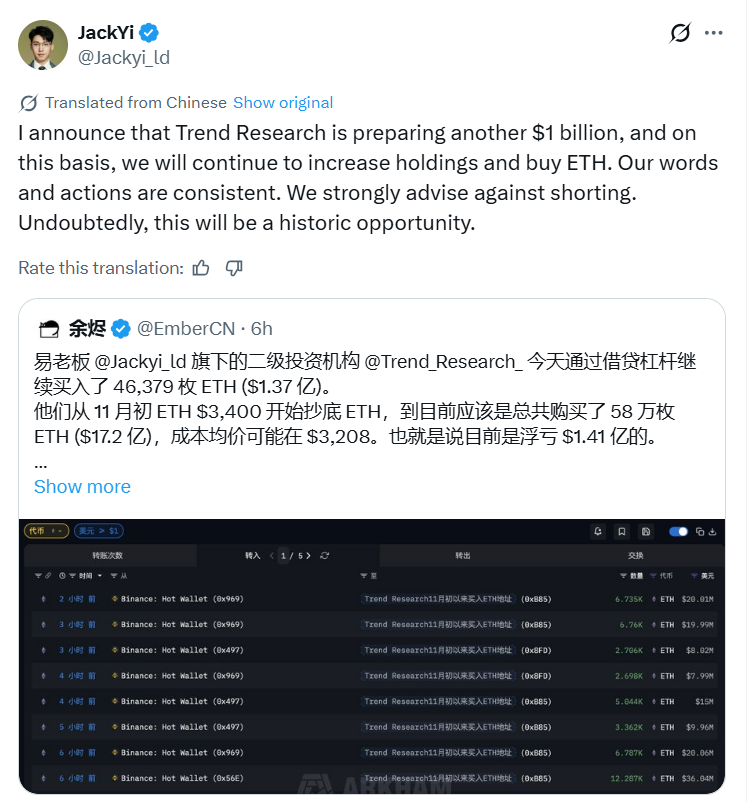
A machine translation of Yi’s Thursday X post states that his company is preparing another $1 billion to keep buying Ether as he urged traders not to short.

Trend Research is preparing another $1 billion to buy ETH | Source: Jack Yi

The rapid accumulation by a non‐listed player, alongside Bitmine and SharpLink’s public hoards, pushes Ether treasury concentration higher even as broader market sentiment remains fragile.

Lacie Zhang, research analyst at Bitget Wallet, told Cointelegraph that companies buy ETH during downturns to transform passive treasuries into “productive, yield-bearing infrastructure.” However, unlike retail "dip buying," corporate accumulation is “often a strategic play for network dominance.”

Related: BitMine, Strategy, SharpLink stocks outpace crypto market recovery

BitMine’s ‘alchemy of 5%’

The buying spree comes as BitMine announced a milestone of more than 4 million ETH on its balance sheet on Tuesday, or over 3.3% of the circulating supply, cementing its status as the largest known publicly listed ETH holder.

BitMine aims to keep increasing its Ether treasury well beyond the current 4 million ETH, with a target of 5% of the ETH supply.

It plans to stake a substantial portion of those holdings through its “Made in America Validator Network”, to generate yield on its long-term bet on Ethereum.

Zhang said that the staking engine was a “key motivator” for BitMine, and that, by reaching for a 5% supply target, it aimed to “dominate Ethereum’s proof-of-stake consensus,” earning consistent validation rewards and effectively “lowering their average cost basis regardless of price action.”

Related: Why BitMine is accumulating Ether despite broader market fear

ETHZilla, FG Nexus and the sellers

Not every balance sheet is leaning in. ETHZilla, one of the higher‐profile Ether treasury plays, disclosed that it sold 24,291 ETH for roughly $74.5 million to redeem senior secured convertible notes, trimming its stash to around 69,800 ETH.

FG Nexus, a US-listed holding company focused on specialty finance and insurance, has also been liquidating Ether to fund an aggressive share repurchase program.

Zhang called the sales a “balance sheet maneuver,” and said that ETHZilla and FG Nexus were liquidating ETH to redeem debt or to execute stock buybacks when their share price trades at a discount to their crypto holdings.

She added, “For aggressive buyers, these liquidations represent a ‘transfer of wealth’ from distressed entities to those positioned to own the network's future rails.”

Связанные с этим вопросы

QHow much ETH did Trend Research purchase on Wednesday, and what is their total holding after this purchase?

ATrend Research purchased 46,379 ETH on Wednesday, raising its total holdings to about 580,000 ETH.

QWhich two publicly listed companies have larger ETH balances than Trend Research, according to CoinGecko?

ASharpLink Gaming and BitMine Immersion Technologies have larger ETH balances, with 859,853 ETH and 4,066,062 ETH, respectively.

QWhat is the name of the founder associated with Trend Research, and what did he announce regarding future ETH purchases?

ATrend Research is associated with LD Capital founder Jack Yi, who announced that his company is preparing another $1 billion to keep buying Ether.

QWhat is BitMine's target for its Ether treasury supply, and how does it plan to generate yield on its holdings?

ABitMine aims to hold 5% of the ETH supply and plans to stake a substantial portion through its 'Made in America Validator Network' to generate yield.

QWhy did ETHZilla sell a portion of its ETH holdings, and what was the amount sold?

AETHZilla sold 24,291 ETH for roughly $74.5 million to redeem senior secured convertible notes, reducing its stash to around 69,800 ETH.

Похожее

The AI Investment Landscape Is Being Reshaped: Beyond the 'Magnificent Seven', What Opportunities Lie in the Semiconductor Supply Chain?

AI Investment Map is Reshaping: Opportunities Beyond the 'Magnificent Seven' Since ChatGPT ignited the AI wave, investment initially focused on the "Magnificent Seven" tech giants dominating cloud infrastructure. However, the rise of DeepSeek and debates on AI capital expenditure effectiveness are shifting this dynamic. Investors now recognize opportunities deeper in the supply chain—the companies providing the essential "picks and shovels." Early concerns about an AI investment "arms race" and potential low returns were partly alleviated by strong Q1 earnings from cloud providers, validating robust compute demand. This has highlighted a more certain investment thesis: regardless of which AI applications ultimately win, massive capital expenditure will first fuel demand for semiconductors and related components. This "pick-and-shovel" logic has driven semiconductor ETFs to record highs. Key beneficiaries include: * **Memory Chipmakers (e.g., SK Hynix, Samsung, Micron)**: High Bandwidth Memory (HBM) is a critical bottleneck for AI training. * **Photonics Companies**: Crucial for high-speed data transfer within AI data centers. * **The Broader "AI-11" Semiconductor Ecosystem**: This encompasses foundries & lithography (TSMC, ASML), logic & custom chips (AMD, Broadcom, Intel, Marvell), and enterprise storage (SanDisk, Western Digital). Every dollar of AI infrastructure spending flows through this chain. While the "Magnificent Seven" remain dominant in market size, their earnings growth premium over the rest of the S&P 500 ("S&P 493") is narrowing. Market attention and marginal investment are shifting towards the expanding semiconductor supply chain. The investment narrative is evolving from "betting on the ultimate AI winner" to "investing in the certainty of the infrastructure build-out." Understanding this shift from the demand side to the supply side is key to identifying future AI investment opportunities.

marsbit2 мин. назад

The AI Investment Landscape Is Being Reshaped: Beyond the 'Magnificent Seven', What Opportunities Lie in the Semiconductor Supply Chain?

marsbit2 мин. назад

600 People, $66 Billion: The First Major Cash-Out in the Era of Large Models

The first systematic "big cash-out" of the AI era occurred in October 2025, when over 600 current and former OpenAI employees sold a total of $6.6 billion in shares via a secondary market. Approximately 75 individuals maxed out a $30 million per-person sale limit, while around 525 others cashed out an average of $8.3 million each. This event, exceeding the scale of any 2024 US IPO, functioned as a "shadow IPO." It marked a radical departure from the traditional Silicon Valley path of waiting for a public listing, instead allowing employees to convert equity to cash after just two years of tenure—a direct retention tool in a fiercely competitive talent market where rivals like Meta have offered packages worth hundreds of millions. This massive liquidity event presents a dual-edged sword for OpenAI. While it helps retain talent, it also risks triggering a brain drain as newly wealthy employees may depart. Furthermore, it creates a dilemma for those who sold: they forfeited potential future gains as the company's valuation soared from $400 billion to $852 billion within months. In stark contrast, employees at rival Anthropic demonstrated greater reluctance to sell during their own secondary offering. The financial narratives of the two labs also diverge sharply. OpenAI, while achieving over $20 billion in annualized revenue by 2025, faces massive projected losses (up to $14 billion in 2026), a long path to cash flow positivity, and significant revenue-sharing payments to Microsoft. Anthropic reports rapid revenue growth, improving gross margins, and a faster path to profitability. OpenAI's trajectory is thus balanced precariously between skyrocketing valuation based on funding narratives and the pressures of sustained financial losses post-cash-out. The event underscores that the AI race has evolved into a capital and human experiment, where immense wealth crystallizes the complex calculations of greed, fear, and ambition within the industry.

marsbit22 мин. назад

600 People, $66 Billion: The First Major Cash-Out in the Era of Large Models

marsbit22 мин. назад

NVIDIA Begins Adding Soap to the Bubble

NVIDIA is taking on a dual role: not just as a leading chip supplier, but as a massive capital allocator across the entire AI supply chain. In 2026, the company has committed over $40 billion in investments within five months, targeting everything from optical fiber manufacturing and data center operations to foundational AI model development. This investment spree, described as a systematic "sprinkler" approach, primarily funds companies that are major buyers of NVIDIA's own GPUs. Critics, including analysts from Goldman Sachs, label this a "circular revenue" loop—comparable to a supplier financing a customer to buy more of its products. A prominent example is NVIDIA's investment in OpenAI, which is expected to generate around $13 billion in revenue for NVIDIA, much of which may be reinvested back into OpenAI. While CEO Jensen Huang dismisses the "circular financing" critique as "absurd," arguing the investments are confidence votes in long-term generational shifts, some analysts express discomfort. They note that while investments in critical supply chain components like optics are strategically sound, funding new cloud providers like CoreWeave feels like "pre-paying for your own GPUs." The strategy carries significant risks. If the AI investment cycle turns, the market may question how much demand is genuine versus artificially sustained by NVIDIA's own balance sheet. Despite posting record-breaking earnings—$215.9 billion in annual revenue and $120 billion in net profit for FY2026—NVIDIA's stock fell after its report, signaling that "beating expectations" may no longer be enough to assure investors about the duration of the AI spending boom. The article concludes that while a bubble isn't necessarily a fraud, NVIDIA's actions resemble adding soap to a bubble—making it appear more robust and durable. This creates a complex scenario requiring extreme冷静 from investors to distinguish between real structural growth and financial engineering.

marsbit39 мин. назад

NVIDIA Begins Adding Soap to the Bubble

marsbit39 мин. назад

Short Positions Have Been Squeezed Out: Will the Next Leg of the U.S. Stock AI Rally Continue in Seoul?

"Short Squeeze Exhausted: Will the Next Leg of the AI Rally Continue in Seoul?" A Nomura report suggests the US AI stock rally, which saw the S&P 500 rise ~16.6% in 28 days largely driven by 10 key stocks, may be pausing. The fuel from short covering, CTA fund positioning, and volatility-control strategies is nearing its limit. For the rally to continue, new momentum from retail and sentiment-driven FOMO (Fear Of Missing Out) is needed. South Korea's market provided a potential answer on the very day the report was published. The KOSPI index surged 4.32%, triggering a buy-side circuit breaker, led by massive gains in chip giants SK Hynix (+11.98%) and Samsung. This surge is characterized by retail "hynix FOMO" and overseas funds precisely buying into AI themes via chip-focused ETFs, shifting from broad Korean market ETFs. The Korean rally is a high-beta extension of the US AI capital expenditure story, as major cloud providers plan massive infrastructure spending, directly benefiting memory chip leaders. However, this linkage also implies vulnerability. The sustainability of this next leg depends on whether US tech stocks correct, the trajectory of US inflation (with upcoming CPI data key), and geopolitical tensions around the Strait of Hormuz. Seoul has emerged as the new epicenter of the AI trade, but its fate remains tied to these broader macro and market dynamics.

marsbit44 мин. назад

Short Positions Have Been Squeezed Out: Will the Next Leg of the U.S. Stock AI Rally Continue in Seoul?

marsbit44 мин. назад

Торговля

Спот
Фьючерсы

Популярные статьи

Как купить S

Добро пожаловать на HTX.com! Мы сделали приобретение Sonic (S) простым и удобным. Следуйте нашему пошаговому руководству и отправляйтесь в свое крипто-путешествие.Шаг 1: Создайте аккаунт на HTXИспользуйте свой адрес электронной почты или номер телефона, чтобы зарегистрироваться и бесплатно создать аккаунт на HTX. Пройдите удобную регистрацию и откройте для себя весь функционал.Создать аккаунтШаг 2: Перейдите в Купить криптовалюту и выберите свой способ оплатыКредитная/Дебетовая Карта: Используйте свою карту Visa или Mastercard для мгновенной покупки Sonic (S).Баланс: Используйте средства с баланса вашего аккаунта HTX для простой торговли.Третьи Лица: Мы добавили популярные способы оплаты, такие как Google Pay и Apple Pay, для повышения удобства.P2P: Торгуйте напрямую с другими пользователями на HTX.Внебиржевая Торговля (OTC): Мы предлагаем индивидуальные услуги и конкурентоспособные обменные курсы для трейдеров.Шаг 3: Хранение Sonic (S)После приобретения вами Sonic (S) храните их в своем аккаунте на HTX. В качестве альтернативы вы можете отправить их куда-либо с помощью перевода в блокчейне или использовать для торговли с другими криптовалютами.Шаг 4: Торговля Sonic (S)С легкостью торгуйте Sonic (S) на спотовом рынке HTX. Просто зайдите в свой аккаунт, выберите торговую пару, совершайте сделки и следите за ними в режиме реального времени. Мы предлагаем удобный интерфейс как для начинающих, так и для опытных трейдеров.

1.3k просмотров всегоОпубликовано 2025.01.15Обновлено 2025.03.21

Как купить S

Sonic: Обновления под руководством Андре Кронье – новая звезда Layer-1 на фоне спада рынка

Он решает проблемы масштабируемости, совместимости между блокчейнами и стимулов для разработчиков с помощью технологических инноваций.

2.2k просмотров всегоОпубликовано 2025.04.09Обновлено 2025.04.09

Sonic: Обновления под руководством Андре Кронье – новая звезда Layer-1 на фоне спада рынка

HTX Learn: Пройдите обучение по "Sonic" и разделите 1000 USDT

HTX Learn — ваш проводник в мир перспективных проектов, и мы запускаем специальное мероприятие "Учитесь и Зарабатывайте", посвящённое этим проектам. Наше новое направление .

1.8k просмотров всегоОпубликовано 2025.04.10Обновлено 2025.04.10

HTX Learn: Пройдите обучение по "Sonic" и разделите 1000 USDT

Обсуждения

Добро пожаловать в Сообщество HTX. Здесь вы сможете быть в курсе последних новостей о развитии платформы и получить доступ к профессиональной аналитической информации о рынке. Мнения пользователей о цене на S (S) представлены ниже.

活动图片